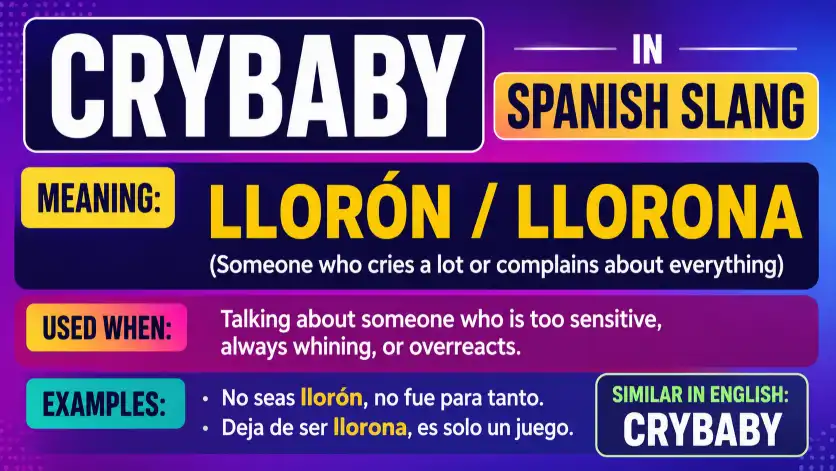
Crybaby in Spanish slang is usually translated as “llorón” (for a male) or “llorona” (for a female). These words describe someone who cries too much or complains over small problems.
In some Spanish speaking countries, people also use other informal words depending on the region and the tone of the conversation.
If you searched for crybaby in Spanish slang, you may want the correct word for texting, social media, or everyday conversations.
The meaning can change slightly from one country to another. In this guide, you will learn the most common Spanish slang words for crybaby, where they are used, If they are rude, and how to use them correctly.
Quick Answer: Crybaby in Spanish Slang
Crybaby in Spanish slang is most commonly llorón (male) or llorona (female). These words describe someone who cries easily or complains too much. They are informal and are widely understood across many Spanish speaking countries.
What Does Crybaby Mean in Spanish Slang?
A crybaby is someone who cries very easily or complains about small problems.
In Spanish, the most common slang like words are:
- Llorón = Male crybaby
- Llorona = Female crybaby
These words are informal. Friends and family often use them jokingly, but they can also sound insulting if used to criticize someone.
Male Form: Llorón
Llorón refers to a boy or man who cries easily or complains too much.
Example:
Carlos: You lost one game.
Miguel: Don’t be such a llorón.
Meaning: Miguel is telling Carlos not to complain so much.
Female Form: Llorona
Llorona refers to a girl or woman who cries or complains too often.
Example:
Ana: She cried because her team lost.
Sofia: She’s being a llorona today.
Meaning: Sofia thinks Ana is overreacting.
Other Spanish Words Similar to Crybaby
Spanish has several words that can describe someone who cries a lot. Some are more common in certain countries.
| Spanish Word | English Meaning | Tone |
| Llorón | Crybaby (male) | Informal |
| Llorona | Crybaby (female) | Informal |
| Quejica | Someone who complains a lot | Informal |
| Quejón | Complainer (male) | Informal |
| Quejona | Complainer (female) | Informal |
These words are similar, but they are not always exact synonyms.
- Llorón/Llorona focus on crying.
- Quejica focuses on complaining.
- Quejón/Quejona describe someone who complains frequently.
Does Crybaby Have One Spanish Slang Translation?
No. Crybaby in Spanish slang does not have one universal translation.
The best word depends on:
- The country
- The speaker
- The situation
- If the person is male or female
However, llorón and llorona are the most widely understood choices across the Spanish speaking world.
Is “Llorón” Always an Insult?
Not always.
The tone depends on the conversation.
Friendly Use
Friends sometimes say it jokingly.
Example:
Friend: You lost again?
Friend: Don’t be a llorón!
Everyone understands it as playful teasing.
Negative Use
The word can sound rude if it is used to embarrass or insult someone.
For example, calling a child or another person llorón during an argument may hurt their feelings.
Because of this, it is always best to consider the situation before using the word.
Different Meanings of Crybaby in Spanish Slang
The meaning of crybaby in Spanish slang depends on the situation. Sometimes it describes someone who cries easily. In other cases, it refers to a person who complains too much.
Someone Who Cries Easily
This is the most common meaning.
A person may be called llorón or llorona if they cry over small problems.
Example:
Luis: He started crying after losing the game.
Marco: He’s such a llorón.
Meaning: Marco thinks Luis is crying too easily.
Someone Who Complains Too Much
In some conversations, crybaby describes a person who complains all the time instead of solving the problem.
Words like quejica, quejón, or quejona may fit this meaning better.
Example:
Sara: You complain about everything.
Eva: Stop being so quejica.
Meaning: Eva thinks Sara complains too often.
Playful Teasing Between Friends
Friends sometimes use these words as jokes.
No one is trying to be rude.
Example:
Friend 1: My phone battery is only at 20%.
Friend 2: Don’t be a llorón!
Meaning: The second friend is joking.
Regional Differences
Spanish slang changes from country to country.
Although llorón and llorona are understood in many places, some countries may prefer different informal expressions.
| Country or Region | Common Word |
| Spain | Llorón / Llorona |
| Mexico | Llorón / Llorona |
| Argentina | Llorón is common |
| Colombia | Llorón is common |
| Chile | Llorón is widely understood |
The exact slang may change, but llorón remains one of the most recognized words.
Where Is Crybaby in Spanish Slang Commonly Used?
People usually use these words in casual conversations.
They are common in:
- Family conversations
- Friend groups
- School playgrounds
- Social media comments
- Text messages
- Funny memes
These words are much less common in professional settings.
On TikTok
TikTok creators sometimes use llorón or llorona in funny videos.
They often describe someone who overreacts to a small problem.
Example:
Caption: When your friend loses one game and starts complaining.
Comment: Qué llorón.
Meaning: “What a crybaby.”
On Instagram
Instagram users may use these words in comments or captions.
Sometimes they are playful.
Sometimes they criticize dramatic behavior.
The tone depends on the conversation.
In Text Messages
Friends often use llorón while joking.
Example:
Friend: My favorite team lost again.
Reply: No seas llorón.
Meaning: “Don’t be a crybaby.”
Is Crybaby in Spanish Slang Rude, Offensive, or Harmless?
The answer depends on the situation.
Most of the time, these words are informal, not offensive.
However, they can become rude if they are meant to insult someone.
Harmless Use
The words are usually harmless when friends tease each other.
Example:
Friend: You dropped your ice cream.
Friend: Don’t be a llorón.
Everyone understands it is a joke.
Rude Use
Calling someone llorón during an argument may sound insulting.
It suggests the person is weak or complains too much.
Because of this, it is better to avoid using the word with:
- Teachers
- Coworkers
- Strangers
- People you do not know well
Can You Use These Words at Work or School?
Usually, no.
Words like llorón and llorona are informal.
They are not suitable for:
- Business emails
- Job interviews
- School reports
- Professional presentations
If you need a neutral expression, choose a more respectful phrase.
For example:
- Sensitive person
- Easily upset
- Complains often
These alternatives sound more polite and professional.
Quick Comparison Table
| Word | Meaning | Formal? | Can Sound Rude? |
| Llorón | Crybaby (male) | No | Sometimes |
| Llorona | Crybaby (female) | No | Sometimes |
| Quejica | Complainer | No | Sometimes |
| Quejón | Complains a lot (male) | No | Sometimes |
| Quejona | Complains a lot (female) | No | Sometimes |
Real Life Examples of Crybaby in Spanish Slang
The easiest way to understand crybaby in Spanish slang is to see how native speakers use these words in everyday conversations.
Example 1: Losing a Game
David: We lost the match.
Carlos: Don’t be a llorón. We’ll win next time.
Meaning: Carlos is telling David not to complain or cry over the loss.
Example 2: School Conversation
Emma: He cried because he got one answer wrong.
Sofia: He’s such a llorón.
Meaning: Sofia thinks he is overreacting.
Example 3: Family Conversation
Mom: Your little brother is crying again.
Dad: He’s being a llorón today.
Meaning: Dad is joking that the child is crying too much.
Example 4: Text Message
Friend: My phone battery is only 10%.
Reply: No seas llorón. Charge it later.
Meaning: “Don’t be a crybaby.”
Example 5: TikTok Comment
Video: Someone gets upset after losing one game.
Comment: Qué llorón.
Meaning: “What a crybaby.”
Example 6: Complaining Too Much
Lucas: The weather is too hot.
Mateo: Stop being so quejica.
Meaning: Mateo thinks Lucas complains too much.
Origin and History of Crybaby in Spanish Slang
The words llorón and llorona come from the Spanish verb llorar, which means “to cry.”
The ending ón or ona makes the word describe someone who does something often or to a greater degree.
Over time, Spanish speakers began using llorón and llorona to describe people who cry easily or react emotionally to small problems.
Unlike many internet slang terms, these words did not begin on social media. They have been part of everyday spoken Spanish for many years.
Today, they are still common in:
- Family conversations
- Schools
- Sports
- Social media
- Everyday speech
Similar Spanish Slang Words
Spanish has several informal words that describe someone who complains, overreacts, or becomes upset easily.
| Spanish Word | English Meaning | Common Use |
| Llorón | Crybaby (male) | Everyday conversation |
| Llorona | Crybaby (female) | Everyday conversation |
| Quejica | Complainer | Casual speech |
| Quejón | Complains a lot (male) | Informal |
| Quejona | Complains a lot (female) | Informal |
| Dramático | Dramatic person | Casual conversation |
These words are related, but they are not always interchangeable.
For example, dramático describes someone who makes situations seem bigger than they really are, while llorón focuses on crying.
Llorón vs Quejica
People often confuse these two words.
Here is the difference.
| Llorón | Quejica |
| Cries easily | Complains often |
| Focuses on emotions | Focuses on complaints |
| Usually about crying | Usually about constant complaining |
| Informal | Informal |
Example:
Llorón: He cried after losing the game.
Quejica: He complains about everything.
When Should You Avoid Using Crybaby in Spanish Slang?
Although these words are common, they are not suitable in every situation.
Avoid using them in:
- Business meetings
- Professional emails
- Job interviews
- School essays
- Formal presentations
You should also avoid calling someone llorón or llorona if they are genuinely upset. It may sound insensitive or disrespectful.
Polite Alternatives
If you want to sound more respectful, try these alternatives.
| Instead of | Better Alternative |
| Llorón | Sensitive person |
| Llorona | Easily upset |
| Quejica | Complains often |
| Quejón | Expresses frustration frequently |
| Crybaby | Emotional person |
These phrases work better in professional, educational, or respectful conversations.
Is Crybaby in Spanish Slang Still Common?
Yes. Llorón and llorona are still widely used in many Spanish speaking countries.
However, younger people may also use newer internet slang depending on the platform and region.
Even so, these classic words remain easy to understand and are commonly heard in everyday conversations.
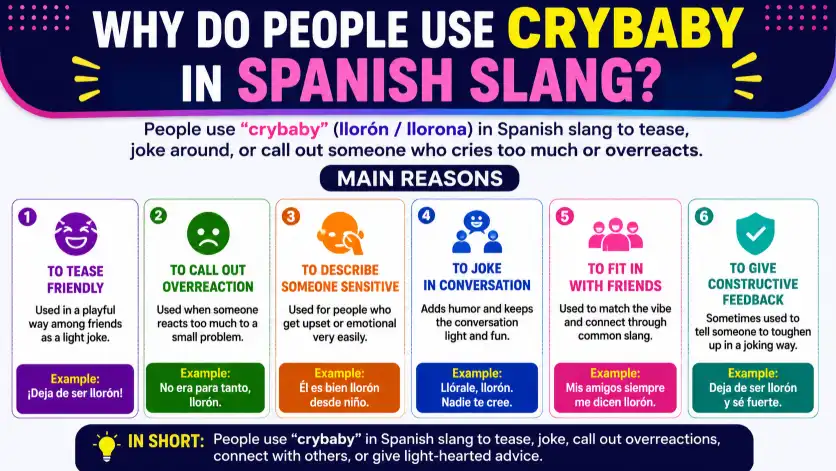
Why Do People Use Crybaby in Spanish Slang?
People use crybaby in Spanish slang because it is a quick way to describe someone who cries easily or complains too much.
Common reasons include:
- Teasing a friend in a playful way
- Describing someone who overreacts
- Joking during games or competitions
- Reacting to dramatic behavior
- Talking about everyday situations
Most of the time, the words are used in informal conversations with people who know each other well.
Common Misunderstandings
Some people misunderstand the meaning of crybaby in Spanish slang. Here are the most common mistakes.
It Does Not Always Mean Someone Is Crying
Not always.
Sometimes llorón or llorona describes a person who complains too much, even if they are not crying.
The meaning depends on the conversation.
It Is Not the Same in Every Country
Spanish is spoken in many countries.
While llorón and llorona are widely understood, some regions may prefer different informal words.
That is why context and location matter.
It Is Not Always an Insult
Friends often use these words while joking.
For example:
Friend: You lost one round and already want to quit?
Friend: No seas llorón.
In this case, the speaker is teasing, not trying to offend.
It Is Not Suitable for Formal Situations
These words belong to casual speech.
Avoid using them in:
- Business communication
- School reports
- Professional presentations
- Formal emails
Choose more neutral language when speaking in professional or academic settings.
Frequently Asked Questions
Q1. What is the most common Spanish slang for crybaby?
Answer: The most common words are llorón for a male and llorona for a female. They are widely understood across many Spanish speaking countries.
Q2. What does llorón mean?
Answer: Llorón describes a boy or man who cries easily or complains too much. It is an informal Spanish word.
Q3. What does llorona mean?
Answer: Llorona is the feminine form of llorón. It refers to a girl or woman who cries easily or overreacts to small problems.
Q4. Is llorón rude?
Answer: It depends on the context. Friends may use it jokingly, but it can sound insulting if it is used to criticize or embarrass someone.
Q5. Can I use llorón at work?
Answer: No. Llorón is informal slang. It is better to use respectful and neutral language in professional settings.
Q6. Is there one Spanish word for crybaby?
Answer: No. Llorón and llorona are the most common choices, but other words such as quejica may fit better when the person complains more than they cry.
Q7. Is crybaby in Spanish slang still common?
Answer: Yes. Llorón and llorona are still common in everyday conversations, social media posts, text messages, and family discussions.
Q8. Can these words be used on social media?
Answer: Yes. People often use llorón and llorona on TikTok, Instagram, X, Facebook, and in text messages. However, the tone should stay respectful to avoid offending others.
Conclusion
Crybaby in Spanish slang is most commonly translated as llorón for a male and llorona for a female.
These words describe someone who cries easily or reacts strongly to small problems. In some situations, words like quejica may be a better choice when the person complains more than they cry.
Although these terms are common across many Spanish speaking countries, they are informal.
Friends often use them as playful teasing, but they can sound rude if used to insult someone. Always think about your audience and the situation before using them.
Learning these expressions will help you understand Spanish conversations, social media posts, and everyday slang more naturally.
Discover More Articles:

Hi, I’m Anna Whitmore. I have 7+ years of experience writing about English slang and vocabulary. At SlangShine, I create simple, easy-to-understand content for English learners.