What does DDD mean in text? DDD can have different meanings depending on the conversation. One possible meaning is “Don’t Do Drugs,” while other uses may refer to a phrase, group, trend, or community specific term.
Because DDD does not have one fixed meaning, the words around it are important. The same three letters can mean something completely different in another conversation.
What Does DDD Mean in Text?
DDD is a three letter abbreviation that can represent different words or phrases in digital communication. Unlike common abbreviations such as LOL or IDK, its meaning is not always obvious.
One possible texting meaning is “Don’t Do Drugs.” In this context, DDD works as a short warning or reminder to avoid drugs.
For example:
“Stay away from that stuff. DDD.”
Here, the sender is using DDD as a warning.
However, you should not assume that every DDD you see means “Don’t Do Drugs.” The abbreviation can have other meanings depending on the topic, platform, or online community.
For instance, a gaming group might use DDD as the short name for something completely unrelated. A private friend group might even create its own meaning.
That is why context is especially important when interpreting DDD.
DDD Meaning in Different Texting Contexts
The meaning of DDD can change depending on what people are discussing. Looking at the entire conversation is often more useful than focusing on the abbreviation alone.
DDD as “Don’t Do Drugs”
One possible interpretation of DDD is “Don’t Do Drugs.”
This meaning fits conversations about substance use, risky behavior, health, or personal choices.
For example:
“Seriously, take care of yourself. DDD.”
The sender is giving a strong warning.
Another example is:
“You don’t need that stuff. DDD.”
Here, the abbreviation carries a serious tone.
DDD as a Community Term
Online communities often create their own shorthand. A group of friends, gamers, fans, or creators may use DDD to represent a phrase that makes sense only within that community.
Someone outside the group may not understand it immediately.
For example:
“Are you joining DDD tonight?”
Without knowing what DDD represents, the message is difficult to interpret.
DDD as a Name or Title
DDD can also be used as an abbreviation for a project, event, organization, group, or other name.
In this case, it may not be slang at all.
For example:
“The DDD meeting starts at 7.”
Here, the meaning depends entirely on what DDD represents in that particular setting.
DDD as an Inside Joke
Friends sometimes turn ordinary letters into private shorthand.
If a group has already explained what DDD means, they may continue using it without repeating the full phrase.
That can make the abbreviation confusing to someone seeing the conversation for the first time.
Where Is DDD Used?
DDD can appear across several forms of digital communication. The meaning may change from one platform or community to another.
DDD in Text Messages
In SMS or private messages, DDD may be used as a quick abbreviation.
For example:
“You know what I think. DDD.”
The exact interpretation depends on the messages that came before it.
If the conversation is about drugs, “Don’t Do Drugs” becomes more likely. If the topic is something else, another meaning may fit better.
DDD on Snapchat
Snapchat users often communicate through short messages, captions, and quick replies.
DDD may appear in a conversation when friends already understand the intended meaning.
For example:
“DDD 😂”
Without context, the message may be confusing. The surrounding chat provides the missing information.
DDD on TikTok
TikTok has many trends, communities, and recurring abbreviations. Users may introduce shorthand that becomes popular within a particular group.
A DDD comment might therefore have a meaning connected to the video rather than general texting slang.
Before interpreting it, check the caption, comments, hashtags, and topic.
DDD on Instagram
Instagram users can use DDD in DMs, comments, captions, or private group conversations.
The meaning may be obvious to the people involved but unclear to other viewers.
DDD on WhatsApp
WhatsApp chats often contain abbreviations, especially between friends and family members.
DDD can appear as part of casual conversations, jokes, or group-specific language.
What Does DDD Mean in Text: Real Chat Examples
Realistic examples make it easier to see why context matters.
Example 1
Alex: “You should seriously stay away from that stuff.”
Sam: “Yeah, DDD.”
Here, DDD can reasonably be understood as “Don’t Do Drugs.”
Example 2
Mia: “Everyone in our group keeps saying DDD.”
Emma: “What does it mean?”
The abbreviation is not clear because the conversation does not explain it.
Example 3
Jake: “Are you joining the DDD event tonight?”
Ryan: “Of course.”
Here, DDD appears to be the name or abbreviation of an event.
Example 4
Liam: “He told me DDD again.”
Noah: “What was he talking about?”
The topic is needed to understand the intended meaning.
Example 5
Sara: “Please think carefully before doing that.”
Nina: “DDD. Seriously.”
The context suggests that DDD may be functioning as a warning.
Example 6
Chris: “Our new project is called DDD.”
Daniel: “That’s actually a cool name.”
In this conversation, DDD is a project name rather than ordinary slang.
Example 7
Ella: “Why does everyone comment DDD under these videos?”
Olivia: “It’s part of the trend.”
This shows how social media can create community-specific meanings.
Example 8
Ben: “DDD 😂”
Tom: “Wait, what does that mean?”
A short abbreviation without context can easily confuse the reader.
Example 9
Sophie: “You know what I told you yesterday.”
Grace: “DDD?”
The sender is asking for clarification rather than using DDD as a definite phrase.
Example 10
Jack: “What does DDD mean here?”
Leo: “It depends on the context.”
This is an appropriate response when the abbreviation has several possible interpretations.
How to Reply When Someone Says DDD
Your response should depend on if you understand the abbreviation.
When the Meaning Is Clear
If the conversation is clearly about avoiding drugs and DDD means “Don’t Do Drugs,” you can respond naturally:
“I agree. Staying away from that is important.”
There is no need to overthink the abbreviation when the context is obvious.
When You Are Unsure
The easiest solution is to ask:
“What does DDD mean here?”
This avoids misunderstanding.
Casual Reply
If you’re talking to a friend, you could say:
“Wait, what does DDD stand for? 😂”
This keeps the conversation relaxed.
Neutral Reply
For a more serious conversation:
“Can you clarify what you mean by DDD?”
This sounds clear and respectful.
When It Is an Inside Joke
If you suspect your friends are using DDD as an inside joke, you could say:
“Okay, I clearly missed something 😂”
That lets them explain without making the conversation awkward.
Is DDD Rude or Offensive?
DDD itself is not automatically rude or offensive. The tone depends on what it means and how someone uses it.
If DDD means “Don’t Do Drugs,” the expression may sound serious or judgmental in certain situations.
For example:
“DDD. You know better.”
That message could feel like a strong warning or criticism.
However, the same abbreviation may have no negative meaning at all when it is used as a project name, event name, or community expression.
The relationship between the people also matters.
A close friend might use DDD casually, while the same message from a stranger could feel confusing or abrupt.
Who Uses DDD in Texting?
There is no specific age group or community that exclusively owns the abbreviation DDD.
You may encounter it among:
- Friends
- Teenagers
- Young adults
- Social media users
- Online communities
- Gamers
- Fandom groups
- Private group chats
- People who frequently use internet shorthand
The important point is that DDD is context dependent.
Someone who rarely uses texting abbreviations may not recognize it at all. Another person may immediately understand it because they are familiar with the particular community using it.
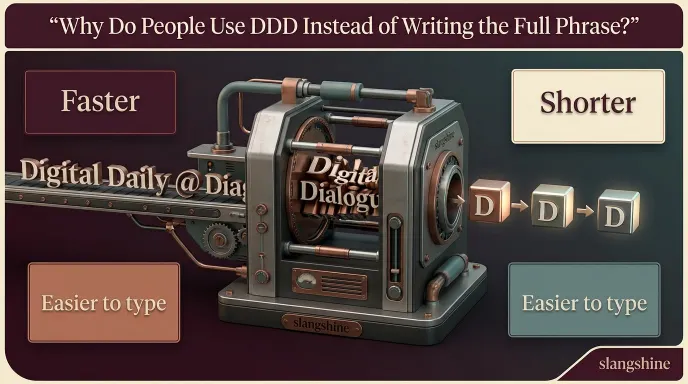
Why Do People Use DDD Instead of Writing the Full Phrase?
People commonly use abbreviations because digital conversations move quickly.
Typing three letters can be easier than writing an entire phrase, especially when the people involved already understand the shorthand.
It Saves Time
Abbreviations make quick conversations easier.
Instead of typing a longer phrase, someone can use DDD when everyone already knows what it means.
It Keeps Messages Short
Short replies are common in texting, especially when people are having a fast back and forth conversation.
It Matches Online Language
Internet conversations often contain abbreviations, emojis, slang, and shortened words.
DDD can fit naturally into that communication style.
It Creates Group Identity
Private communities sometimes develop their own language.
Using an abbreviation that only members understand can make the group feel more connected.
It Can Make a Message Feel Casual
Writing a complete phrase can sometimes feel more formal. An abbreviation may make the conversation feel relaxed.
DDD vs. Other Common Text Abbreviations
DDD can be confused with other short abbreviations, especially when someone sees it without context.
| Abbreviation | Common Meaning | Typical Use |
| DDD | Don’t Do Drugs / context-dependent | Warning or community-specific use |
| DND | Do Not Disturb | Showing unavailability |
| IDK | I Don’t Know | Expressing uncertainty |
| IDC | I Don’t Care | Showing lack of concern |
| BTW | By the Way | Adding information |
| FYI | For Your Information | Giving information |
| LOL | Laughing Out Loud | Showing amusement |
| BRB | Be Right Back | Temporarily leaving a chat |
The major difference is that DDD does not have one universally recognized texting definition.
DDD vs. DND
DDD and DND look similar because both are three letter abbreviations.
However, their common meanings are different.
DDD can mean “Don’t Do Drugs” in some contexts.
DND commonly means “Do Not Disturb.”
For example:
“I’m studying. DND.”
Here, DND means the person does not want to be disturbed.
Seeing the exact letters is important because one letter can completely change the meaning.
DDD vs. IDK
These abbreviations serve very different purposes.
DDD may represent a warning or another context specific phrase.
IDK means “I Don’t Know.”
For example:
“What time is the meeting?”
“IDK.”
The second person is saying they do not know the answer.
DDD vs. IDC
IDC means “I Don’t Care.”
DDD may have several meanings, including “Don’t Do Drugs” in certain conversations.
Compare:
“Should we go tonight?”
“IDC.”
The sender is saying the choice does not matter to them.
By contrast:
“Stay away from that stuff. DDD.”
The second message has a completely different purpose.
How to Know What DDD Means in a Conversation
When an abbreviation has several possible meanings, context is your best tool.
Read the Previous Messages
Look at what the people were discussing before DDD appeared.
If the conversation is about substance use, a warning-related meaning becomes more plausible.
If they are discussing a game, event, or project, DDD may refer to something connected to that subject.
Look at the Platform
The platform can provide clues, although it does not guarantee the meaning.
TikTok communities may develop trend specific shorthand. Gaming groups can use abbreviations related to games or events.
Check the Tone
Emojis and punctuation can provide additional clues.
For example:
“DDD 😭”
May have a playful or exaggerated tone.
Meanwhile:
“DDD. Seriously.”
Sounds more serious.
Ask for Clarification
When there is still doubt, asking is the safest option.
“What does DDD mean in this context?”
A direct question is better than confidently choosing the wrong meaning.
Can DDD Mean Something Other Than “Don’t Do Drugs”?
Yes. This is one of the most important things to remember.
DDD can represent different phrases, names, organizations, projects, events, or technical terms.
It may also be used as an abbreviation that is meaningful only within a particular online community.
For example, imagine a group chat where DDD is the name of a weekly gaming event.
A new member might see:
“Are you playing DDD tonight?”
And incorrectly assume it means “Don’t Do Drugs.”
The surrounding conversation would quickly show that this interpretation does not make sense.
That is why it is better to treat DDD as context dependent rather than giving it one permanent definition.
Is DDD a Common Texting Abbreviation?
DDD is not as universally recognized as some popular texting abbreviations.
Most people are familiar with terms such as:
- LOL
- IDK
- BRB
- BTW
- OMG
- FYI
- TTYL
DDD is more dependent on context and community.
Some people may recognize “Don’t Do Drugs” immediately, while others may have no idea what the sender means.
If your audience may not know the abbreviation, spelling out the phrase is usually a better choice.
Common Mistakes People Make When Looking Up “What Does DDD Mean in Text”
Assuming DDD Always Means One Thing
This is the biggest mistake.
DDD can represent different expressions, so the context should always be considered.
Sending Only “DDD”
A message such as:
“DDD.”
may leave the recipient confused.
If the other person does not know your abbreviation, add enough information to make the meaning clear.
Using an Unfamiliar Abbreviation With Strangers
Friends may understand your shorthand, but strangers may not.
Clear communication is usually more important than saving a few characters.
Using DDD in Formal Communication
Abbreviations like DDD are generally better suited to casual conversations.
In a professional email, academic message, or formal notice, write the full phrase instead.
Assuming Social Media Gives One Fixed Meaning
Social platforms contain many different communities.
A meaning used in one group may not apply to another.
Can DDD Be Used in a Professional Message?
It is generally better to avoid DDD in professional communication unless the organization or subject specifically uses DDD as an established abbreviation.
For example, if DDD is the official abbreviation of a project, using it may be perfectly appropriate.
But if you are simply using DDD as casual slang, a professional message should use the full phrase instead.
This makes your communication clearer and reduces the chance of misunderstanding.
Can DDD Be Used in a Funny Conversation?
Yes. Any abbreviation can become part of a joke or playful conversation when the people involved understand the context.
For example:
Friend: “Should we order another pizza?”
You: “DDD 😂”
If the group has already established a funny meaning for DDD, everyone may understand the joke.
Without that shared context, however, the other person may simply ask what you mean.
Does Capitalization Change the Meaning of DDD?
Usually, capitalization does not determine the meaning in casual texting.
You may see:
- DDD
- ddd
- Ddd
The surrounding conversation is more important than capitalization.
For example:
“ddd 😂”
can still refer to the same abbreviation as:
“DDD 😂”
when the context is clear.
Frequently Asked Questions About What Does DDD Mean in Text
Q1. What does DDD mean in text?
Answer: DDD can have different meanings in texting. One possible meaning is “Don’t Do Drugs,” but the intended meaning depends on the conversation and context.
Q2. Is DDD a texting abbreviation?
Answer: Yes. DDD can be used as a texting abbreviation, although it does not have one universally accepted meaning.
Q3. What does DDD mean on Snapchat?
Answer: DDD can have different meanings on Snapchat. The conversation, caption, trend, or community usually helps explain what the sender intends.
Q4. Is DDD slang?
Answer: DDD can function as informal slang when it represents a casual phrase used online. In other situations, it may simply be an abbreviation or name.
Q5. Can DDD mean “Don’t Do Drugs”?
Answer: Yes. In conversations about drugs, risky behavior, or substance use, DDD can be used as a short form of “Don’t Do Drugs.”
Q6. Is DDD rude?
Answer: DDD is not automatically rude. Its tone depends on what it represents and how the sender uses it. A warning-related use may sound serious or judgmental.
Q7. How should I reply to DDD?
Answer: If you understand the meaning, respond according to the conversation. If you are unsure, ask, “What does DDD mean here?”
Q8. Does DDD have other meanings?
Answer: Yes. DDD can represent different phrases, names, projects, organizations, technical terms, or community-specific expressions. Context is important.
Key Takeaways: What Does DDD Mean in Text
- What does DDD mean in text? It can have several meanings depending on the context.
- One possible meaning is “Don’t Do Drugs.”
- DDD does not have one universal texting definition.
- The conversation around the abbreviation usually provides the best clue.
- DDD can appear in texts, DMs, Snapchat, TikTok, Instagram, and WhatsApp.
- Some communities may use DDD for their own phrases, events, projects, or inside jokes.
- The abbreviation is informal unless it represents an established name or term.
- When the meaning is unclear, asking the sender is the safest approach.
Conclusion
What does DDD mean in text? There is no single answer for every conversation. DDD can mean “Don’t Do Drugs” in some informal contexts, but it may represent something completely different in another message or online community.
The surrounding conversation is the best way to understand it. If the meaning still is not clear, asking the sender for clarification is better than making an assumption.
DDD is useful when both people understand the shorthand, but writing the complete phrase is often the clearer option when talking to someone unfamiliar with the abbreviation.
Learn More About Slang:
- What Does DDA Mean in Text? Meaning, Uses & Examples
- HN Mean in Text: Is It Slang, an Abbreviation, or Something Else?
- HRU Mean in Text: What It Means & How to Reply

Hi, I’m Anna Whitmore. I have 7+ years of experience writing about English slang and vocabulary. At SlangShine, I create simple, easy-to-understand content for English learners.