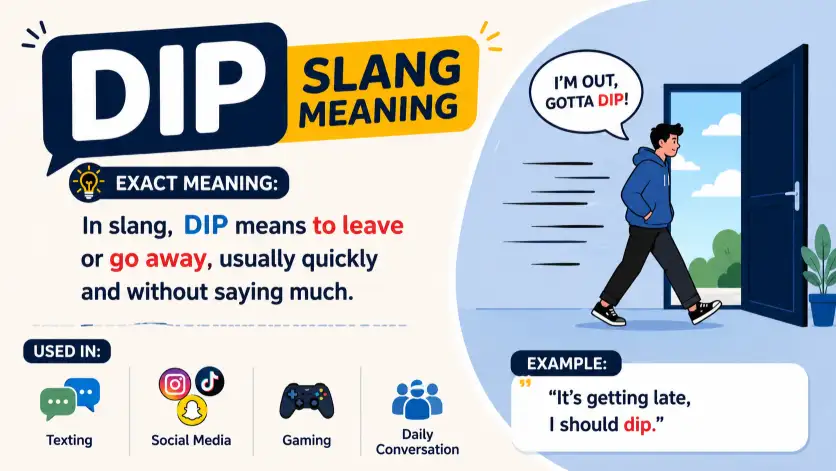
Dip slang meaning refers to the term “dip,” commonly used to say someone is leaving or exiting a place quickly.
The dip slang meaning is often used in casual conversations, like “let’s dip” or “I gotta dip,” signaling it’s time to go.
People searching for dip slang meaning may also come across “oh dip,” an exclamation of surprise similar to “oh snap” or “oh damn.”
Understanding dip slang meaning helps clarify captions, comments, and conversations where someone mentions leaving suddenly or reacting to something unexpected.
Today, dip slang meaning remains popular in everyday texting and casual conversations across all age groups.
Words at a Glance:
| Feature | Details |
| Word | Dip |
| Primary Slang Meaning | To leave quickly or suddenly |
| Part of Speech | Verb |
| Tone | Casual, informal |
| Common Users | Teenagers, young adults, friends, online communities |
| Common Platforms | TikTok, Instagram, Snapchat, Reddit, Discord, Text Messages |
| Positive or Negative? | Usually neutral |
| Offensive? | No |
| Best Used In | Casual conversations |
Quick Answer:Dip slang meaning
In slang, dip means to leave a place quickly, often without staying long. For example, if someone says, “I’m going to dip,” they simply mean “I’m going to leave.” It is an informal expression commonly used in texting, social media, and everyday conversations.
What Does Dip Slang Mean?
The most common slang meaning of dip is to leave quickly.
People often use the word when they are ready to go home, leave a party, or exit a conversation. Instead of saying “I’m leaving,” they simply say “I’m going to dip.”
The word makes the conversation sound casual and natural.
Examples
- “It’s getting late. I’m going to dip.”
- “Let’s dip before the traffic gets worse.”
- “We should dip now if we want to catch the last train.”
In all of these examples, dip simply means leave.
Different Meanings of Dip in Slang
Like many slang words, dip can have more than one meaning. Understanding the context helps you know which meaning is correct.
Dip Meaning “Leave Quickly”
This is the most common slang meaning.
People say dip when they want to leave without making a big announcement.
Examples
- “Let’s dip before it starts raining.”
- “I’m tired, so I’m going to dip.”
- “They dipped right after dinner.”
In these examples, dip means to leave.
Dip Meaning “Leave Suddenly”
Sometimes dip suggests leaving without warning.
The person may leave unexpectedly or without saying goodbye.
Examples
- “He dipped before anyone noticed.”
- “She dipped as soon as the meeting ended.”
- “They dipped without saying goodbye.”
Here, the word suggests a quick or unexpected exit.
Dip Meaning “Briefly Go Somewhere”
Sometimes people use dip to mean going somewhere for a short time before returning.
This meaning is less common than leave quickly, but you may still hear it in casual conversations.
Examples
- “I’m going to dip into the store for a minute.”
- “She dipped out to answer a phone call.”
- “I’ll dip over to my neighbor’s house and be right back.”
In these examples, the speaker plans to return after a short time.
Dip Meaning “Steal” (Less Common)
In some slang, dip can mean to steal something. However, this meaning is much less common than leave quickly.
Examples
- “Someone dipped my jacket.”
- “Be careful. Don’t let anyone dip your phone.”
If you hear dip in this context, it refers to taking something without permission.
Which Meaning Is Most Common?
The meaning “to leave quickly” is by far the most common use of dip in modern slang.
If someone says:
“Let’s dip.”
They almost always mean:
“Let’s leave.”
Unless the conversation clearly suggests another meaning, you can safely assume dip means to leave.
Where Is Dip Commonly Used?
Dip is mostly used in casual conversations. You will often hear it among friends or see it in text messages and on social media. It is rarely used in formal situations.
Here are the most common places where people use dip.
In Text Messages
People often use dip when they want to say they are leaving.
It is shorter and more casual than saying, “I’m leaving.”
Examples
- “I’m going to dip now.”
- “Let’s dip before it gets crowded.”
- “I’ll dip after dinner.”
On Social Media
You may see dip on TikTok, Instagram, Snapchat, Reddit, and Discord.
People use it in captions, comments, memes, and short videos.
Examples
- “Time to dip!”
- “We dipped before the party got boring.”
- “Nobody noticed when we dipped.”
On social media, the word usually means leaving quickly.
In Everyday Conversations
Friends often use dip when making casual plans.
Instead of saying leave, they choose dip because it sounds more relaxed.
Examples
- “Let’s dip and grab some food.”
- “I have an early class tomorrow, so I’m going to dip.”
- “We should dip before the rain starts.”
In Online Gaming
Gamers sometimes say dip when they are leaving a game, ending a voice chat, or logging off.
Examples
- “I’m going to dip after this match.”
- “He dipped before the next round started.”
- “Let’s dip and play again tomorrow.”
Here, dip simply means leaving the game or ending the session.
Is Dip Rude, Offensive, or Harmless?
Dip is generally a harmless slang word. It is informal but not offensive.
Most people use it in friendly conversations without causing any problems.
When It Is Fine to Use
Using dip feels natural when you are:
- Talking with friends.
- Sending text messages.
- Chatting on social media.
- Speaking with classmates.
- Playing online games.
In these situations, the word sounds casual and easygoing.
When You Should Avoid It
Although dip is not rude, it is usually too informal for professional situations.
Avoid using it:
- During job interviews.
- In business meetings.
- In professional emails.
- When speaking with clients.
- In school assignments or formal writing.
Instead of saying:
“I’m going to dip.”
You can say:
“I’m going to leave now.”
This sounds more professional.
Real Life Examples of Dip in Slang
These examples show how dip is used in everyday conversations.
Example 1: Friends at a Party
Jake: It’s getting late.
Liam: Yeah, let’s dip.
Here, dip means leave.
Example 2: Text Message
Emma: Are you still at the mall?
Sophia: No, we dipped about an hour ago.
The word means they already left.
Example 3: School Conversation
Noah: Are you staying after class?
Ethan: No, I’m going to dip as soon as the bell rings.
Here, dip means leaving immediately.
Example 4: Online Gaming
Player 1: One more game?
Player 2: Sorry, I have to dip.
The player is leaving the game.
Example 5: Social Media Caption
Caption:
“We dipped before the traffic got bad.”
The caption means they left early.
Example 6: Short Trip
Olivia: Where’s Mia?
Grace: She dipped into the store for a few minutes.
In this example, dip means going somewhere briefly before returning.
Origin and History of Dip as Slang
The word dip has been part of the English language for hundreds of years.
Its original meaning was to move something into or under a liquid.The slang meaning developed later.
By the late 20th century, dip was being used in informal American English to mean leave quickly or head out.
Over time, the expression became popular among younger speakers and spread through movies, music, and everyday conversations.
Today, social media platforms like TikTok, Instagram, Snapchat, Reddit, and Discord have helped keep the slang popular.
Although new slang words appear every year, dip continues to be widely used because it is short, simple, and easy to understand.
Similar Slang or Related Terms
If you hear dip, you may also hear other slang words that mean to leave or go away. While they have a similar meaning, each one has a slightly different tone.
| Slang Term | Meaning | Common Use |
| Bounce | Leave quickly | Friends, texting |
| Head out | Leave a place | Casual conversations |
| Take off | Leave or depart | Everyday speech |
| Roll out | Leave together | Friends |
| Jet | Leave quickly | Informal conversations |
| Split | Leave immediately | Casual speech |
| Peace out | Say goodbye and leave | Friends |
| Hit the road | Start a journey | Travel |
| Make a move | Get ready to leave | Casual conversations |
| Skedaddle | Leave quickly | Playful conversations |
Although these expressions have similar meanings, dip is one of the most common choices in modern texting and social media.
When Should You Avoid Using Dip?
Dip is an informal slang word, so it is not suitable for every situation.
In Professional Settings
Avoid using dip in business meetings, professional emails, or workplace conversations.
Instead of saying:
“I’m going to dip.”
Say:
“I’m going to leave now.”
This sounds more professional and respectful.
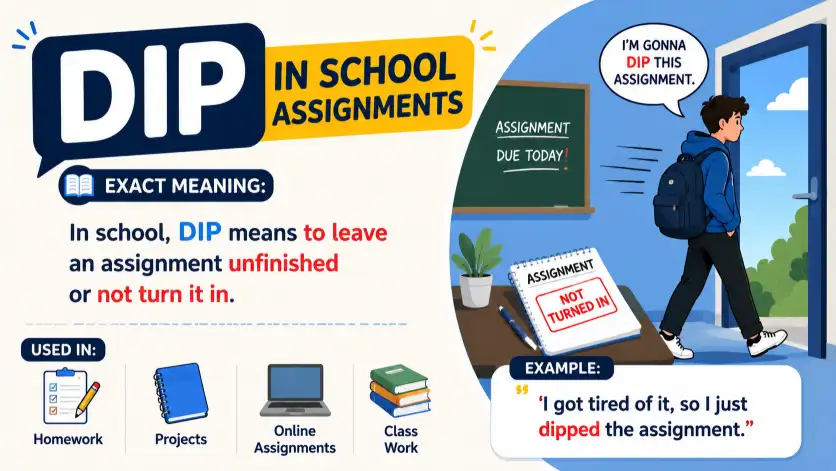
Dip In School Assignments
Teachers usually expect standard English in essays and assignments.
Words like leave, depart, or exit are better choices than slang.
When Speaking With Someone Who May Not Know Slang
Not everyone understands modern slang.
If you are talking to someone who is unfamiliar with internet expressions, using leave instead of dip makes your meaning much clearer.
During Serious Conversations
If you are discussing an important topic, formal language is usually a better choice than slang.
Polite Alternatives to Dip
If dip feels too casual, try one of these alternatives.
| Alternative | Best Used In |
| Leave | Everyday and professional conversations |
| Depart | Formal writing |
| Head home | Casual conversations |
| Excuse me, I have to go | Polite situations |
| I’ll be leaving now | Workplace conversations |
| See you later | Friendly goodbyes |
Why Do People Use Dip?
People like using dip because it is short, simple, and easy to say.
Instead of saying “I’m going to leave now,” they can simply say “I’m going to dip.”
People commonly use it because it:
- Sounds casual.
- Saves time.
- Feels natural among friends.
- Is popular in texting and social media.
- Makes conversations sound relaxed.
For example:
Standard English
“I’m going to leave now.”
Slang
“I’m going to dip.”
Both sentences mean the same thing, but the second sounds more informal.
Quick Tips:Dip Slang Meaning
- Use dip in casual conversations.
- It usually means to leave quickly.
- Avoid using it in formal writing or business communication.
- Always pay attention to the context because dip has more than one meaning.
- If you are unsure, use leave instead.
- Remember that “leave quickly” is the most common slang meaning today.
Common Misunderstandings
Dip Always Means Leaving Forever
No. In most conversations, dip simply means leaving a place. It does not mean the person will never return.
Dip Is Always Negative
No. The word is usually neutral. It simply tells someone that a person is leaving.
Dip Only Has One Meaning
No. While leave quickly is the most common meaning, dip can also mean going somewhere briefly or, less commonly, stealing something. The context tells you which meaning is correct.
Dip Is Only Used Online
No. People use dip in everyday conversations, text messages, online games, and social media.
Everyone Uses Dip
No. Some people prefer saying leave, head out, or take off instead.
Frequently Asked Questions
Q1. What does dip mean in slang?
Answer: In slang, dip usually means to leave quickly or head out. If someone says, “I have to dip,” they simply mean “I have to leave.”
Q2. What does dip mean in Gen Z slang?
Answer: In Gen Z slang, dip has the same meaning as in everyday slang. Young people use it to say they are leaving a place, ending a conversation, or logging off a game. For example, “Let’s dip” means “Let’s go.”
Q3. What does “let’s dip” mean?
Answer: “Let’s dip” is a casual way of saying “Let’s leave.” Friends often use this phrase when they are ready to leave a party, restaurant, school, or any other place.
Q4. What does dip mean in a text message?
Answer: In a text message, dip usually means leave or go. If someone texts, “I gotta dip,” they mean they have to leave the conversation or go somewhere else.
Q5. What does “dip me” mean in slang?
Answer: “Dip me” is not a common standalone slang phrase. In most cases, it is a variation of dip or part of a longer sentence. Its meaning depends on the context, but it is often related to leaving or moving away.
Q6. What does “oh dip” mean in slang?
Answer: “Oh dip!” is an expression of surprise. People use it when something unexpected happens. It has a similar meaning to “Oh snap!” or “Oh no!” and is usually said in a lighthearted way.
Q7. Is dip a rude slang word?
Answer: No. Dip is an informal slang word, but it is not rude or offensive. It is commonly used in friendly conversations.
Q8. Can I use dip at work?
Answer: It is better to avoid dip in professional settings. Instead of saying “I’m going to dip,” say “I’m going to leave now” to sound more professional.
Q9. Is dip still popular?
Answer: Yes. Dip is still widely used in text messages, social media, and everyday conversations because it is short, simple, and easy to understand.
Q10. Can dip mean something other than leaving?
Answer: Yes. Although “leave quickly” is the most common slang meaning, dip can also mean going somewhere briefly or, in less common slang, stealing something. The context tells you which meaning is correct.
Conclusion
Dip slang meaning most commonly refers to leaving a place quickly or suddenly. If someone says, “Let’s dip,” they simply mean “Let’s leave.”
It is a casual expression that is widely used in text messages, social media, online gaming, and everyday conversations.
Although dip can have a few other slang meanings, such as going somewhere for a short time or, less commonly, stealing something, the context usually makes the intended meaning clear.
In most modern conversations, people use dip to talk about leaving.
If you plan to use dip, remember that it is best suited for informal conversations with friends or family.
In professional or formal situations, words like leave, depart, or head out are usually better choices. Understanding the context will help you use dip naturally and avoid confusion.
Related Slang Terms:

Hi, I’m Anna Whitmore. I have 7+ years of experience writing about English slang and vocabulary. At SlangShine, I create simple, easy-to-understand content for English learners.