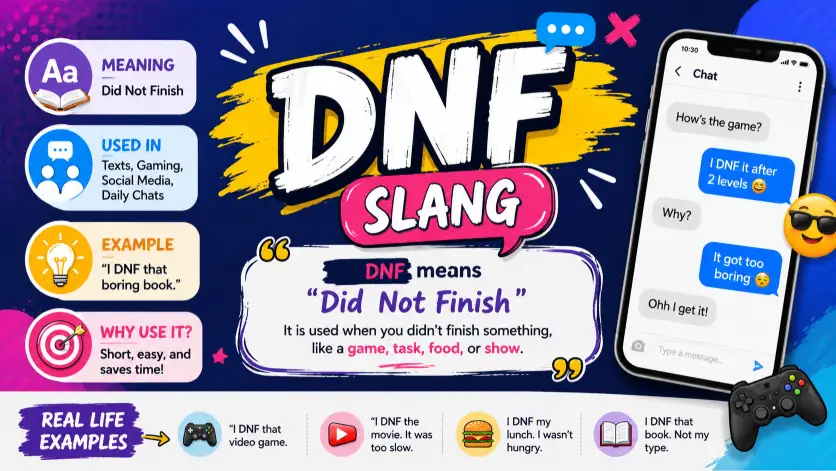
DNF Slang stands for “Did Not Finish,” which is a slang term used when someone starts a task, race, book, or game but abandons it before reaching the end.
In sports and racing, it formally indicates that an athlete or vehicle could not complete the event due to an injury or mechanical failure.
In the gaming world, it refers to a player who rage-quits or disconnects from a match before it officially concludes.
Recently, the book community has heavily adopted the term to describe a novel that was too boring or poorly written to read until the final page.
On social media, people casually use it as everyday slang for anything they start but decide not to complete.
Quick Answer:
DNF slang most commonly stands for “Did Not Finish.” It describes a situation where someone begins an activity but does not complete it. The term is neutral and is widely used in gaming, sports, reading communities, and casual online conversations.
What Does DNF Slang Mean?
The most common meaning of DNF slang is “Did Not Finish.” It tells others that a person started something but stopped before reaching the end.
The exact meaning depends on the situation.
DNF in Gaming
In gaming, DNF means a player did not finish a match, race, mission, or event. This may happen because they quit, disconnected from the internet, or were unable to continue.
Examples:
- “I got a DNF because my internet disconnected.”
- “Half the players ended with a DNF after the server crashed.”
DNF in Sports
In sports, DNF is officially used to show that an athlete started a race or competition but did not complete it.
Common reasons include:
- Injury
- Equipment failure
- Illness
- Voluntarily stopping
Examples:
- “The runner recorded a DNF after twisting her ankle.”
- “Three cyclists received a DNF due to mechanical problems.”
DNF in Book Communities
Book lovers on platforms like BookTok, Goodreads, and reading forums also use DNF.
Here, it means the reader stopped reading a book before finishing it because they lost interest or did not enjoy it.
Examples:
- “I DNF’d the novel after chapter five.”
- “This book wasn’t for me, so it’s officially a DNF.”
DNF in Everyday Texting
People sometimes use DNF in casual messages to describe any unfinished task.
Examples:
- “I had to DNF my homework because I wasn’t feeling well.”
- “We DNF’d the puzzle and finished it the next day.”
Full Form of DNF Slang
The most common full form of DNF is:
DNF = Did Not Finish
This meaning is recognized across:
- Gaming
- Sports
- Reading communities
- Social media
- Online chats
- Text messages
Although other meanings exist in specific industries or technical fields, “Did Not Finish” is the meaning most people intend when using DNF as internet slang.
Different Meanings of DNF Slang
While Did Not Finish is the primary meaning, DNF can have different interpretations depending on the context.
1. Did Not Finish (Most Common)
Used for games, races, books, or tasks that were started but left incomplete.
Tone: Neutral
2. Did Not Finish a Book
Popular among readers and book reviewers.
Example:
“That thriller became a DNF after 80 pages.”
3. Did Not Finish a Game
Frequently seen in multiplayer games and racing games.
Example:
“Our whole squad got a DNF because the server disconnected.”
4. Technical or Industry Meanings
Outside internet slang, DNF may represent different technical phrases in computing or business. These meanings are uncommon in everyday conversations, so readers should rely on the surrounding context to understand which definition applies.
Where Is DNF Slang Commonly Used?
The meaning of DNF slang stays largely the same across different platforms, but the context changes depending on where it appears.
Gaming
DNF is one of the most common abbreviations in gaming. Players use it when someone leaves or fails to complete a match, race, mission, or event.
Examples:
- “I got a DNF after my game crashed.”
- “Two players ended with a DNF.”
Sports
Race results often use DNF to show that an athlete started but did not finish.
Common reasons include:
- Injury
- Equipment failure
- Illness
- Bad weather
- Choosing to stop
Book Communities
Readers on BookTok, Goodreads, Reddit, and book clubs use DNF when they stop reading a book before finishing it.
Example:
“This novel became a DNF after chapter four.”
Social Media and Texting
People also use DNF jokingly when talking about unfinished tasks.
Examples:
- “I totally DNF’d my workout today.”
- “We DNF’d the movie because it was too boring.”

Is DNF Slang Rude, Offensive, or Harmless?
DNF slang is generally harmless and neutral.
It simply describes something that was not completed. There is no offensive meaning attached to the abbreviation itself.
When It Is Appropriate
DNF is perfectly acceptable in:
- Gaming chats
- Sports discussions
- Reading communities
- Text messages
- Social media posts
- Casual conversations
When to Avoid It
Although DNF is harmless, it may confuse people who are unfamiliar with internet slang.
Avoid using it in:
- Business emails
- Academic papers
- Formal reports
- Professional presentations
In formal writing, it’s usually clearer to write “did not finish” instead of using the abbreviation.
Real Life Examples of DNF Slang
Friendly Conversation
Friend: “Did you finish that game?”
You: “No, I got a DNF because my internet went out.”
Casual Text Message
Alex: “Did you finish the movie?”
Sam: “Nope. Total DNF. I fell asleep.”
Gaming Chat
Player 1: “Where did everyone go?”
Player 2: “Three teammates got a DNF after the server disconnected.”
Book Review
“I wanted to enjoy this novel, but it became a DNF after 100 pages.”
Sports Discussion
“The marathon report listed five runners as DNF because of the extreme heat.”
Origin and History of DNF Slang
The abbreviation DNF has been used in competitive sports for many years. Race organizers recorded DNF (Did Not Finish) next to the names of athletes who started an event but could not complete it.
As online gaming became more popular in the late 1990s and early 2000s, players adopted the same abbreviation to describe unfinished matches or races.
Later, reading communities on websites like Goodreads and BookTok began using DNF for books they stopped reading before the final page.
Today, DNF has become a widely recognized internet abbreviation used in gaming, sports, reading communities, texting, and social media.
Similar Slang and Related Terms
| Slang | Meaning | Common Use |
| DNF | Did Not Finish | Gaming, books, sports |
| AFK | Away From Keyboard | Gaming |
| GG | Good Game | Gaming |
| Rage Quit | Leaving because of frustration | Gaming |
| Quit | Stop before finishing | General |
| DC | Disconnected | Gaming |
When Should You Avoid Using DNF?
Avoid using DNF when your audience may not understand internet abbreviations.
Examples include:
- Job applications
- Workplace emails
- School assignments
- Professional reports
- Conversations with people unfamiliar with online slang
Instead, write:
- Did not finish
- Could not complete
- Left unfinished
These phrases are clearer in formal communication.
Why Do People Use DNF Slang?
People like using DNF because it is:
- Short
- Easy to type
- Easy to understand in online communities
- Common across gaming, sports, and book discussions
It quickly explains that something was started but not completed without needing a long explanation.
Common Misunderstandings About DNF
Does DNF Always Mean Someone Quit?
No.
Sometimes a DNF happens because of:
- Internet problems
- Injuries
- Technical issues
- Emergencies
- Equipment failures
It does not always mean someone gave up voluntarily.
Is DNF Only Used in Gaming?
No.
It is also widely used in:
- Sports
- Reading communities
- Social media
- Text messages
- Everyday conversations
Frequently Asked Questions
Q1. What does DNF slang mean?
Answer: DNF most commonly means “Did Not Finish.” It refers to starting something but not completing it.
Q2. What is the full form of DNF?
Answer: The full form of DNF is Did Not Finish.
Q3. Is DNF only used in gaming?
Answer: No. DNF is also common in sports, book communities, texting, and social media.
Q4. Is DNF slang rude?
Answer: No. DNF is a neutral abbreviation and is not considered offensive.
Q5. Why do readers say DNF?
Answer: Readers use DNF when they stop reading a book before finishing it because they lose interest or do not enjoy it.
Q6. Can I use DNF in professional writing?
Answer: It is better to write “did not finish” instead of using DNF in formal or professional documents.
Conclusion
DNF slang most commonly stands for “Did Not Finish.” If someone is talking about a video game, a marathon, a book, or another activity, the abbreviation simply means the person started something but did not complete it.
The term is widely used across gaming, sports, reading communities, texting, and social media. It is neutral, easy to understand in casual conversations, and useful for quickly describing an unfinished task.
However, in formal or professional settings, writing out “did not finish” is usually the clearer choice.
Discover More Articles:

Hi, I’m Emma Carter, an English language writer with over 8 years of experience in vocabulary and language learning. At SlangShine, I write simple, accurate, and easy-to-understand articles about slang, synonyms, idioms, and everyday English to help learners build confidence and improve their communication skills.