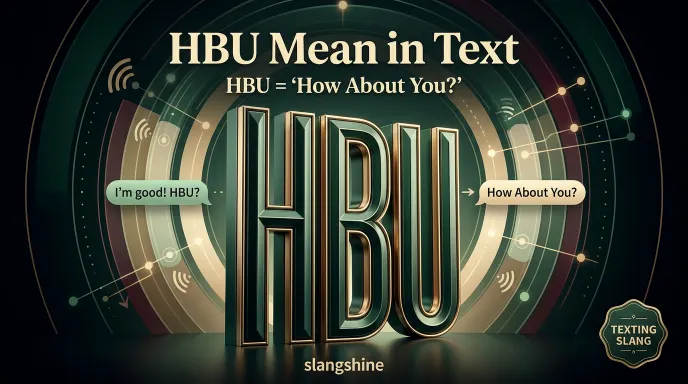
If you are wondering what does HBU mean in text, it usually means “How About You?” People use HBU when they want to ask the same question back to someone in a quick and casual way.
For example, if someone asks, “How are you?”, you might reply, “I’m good, HBU?” Here, HBU means “How about you?” and keeps the conversation short and casual.
People commonly use HBU in text messages, WhatsApp, Snapchat, Instagram DMs, TikTok, and other online chats. It is especially useful when talking casually with friends or online contacts.
What Does HBU Mean in Text?
HBU means “How About You?” in most texting and social media conversations.
People use it when they want the other person to answer the same question they just answered.
For example:
“I’m doing great. HBU?”
This means:
“I’m doing great. How about you?”
Another example is:
“I like this movie. HBU?”
That means:
“I like this movie. How about you?”
HBU can be used after talking about almost anything. You might use it to ask about someone’s mood, plans, preferences, location, or opinion.
It is usually friendly and conversational.
HBU Meaning in Different Texting Situations
The exact use of HBU depends on what the conversation is about.
HBU After “How Are You?”
This is one of the most common uses.
Person A: “I’m feeling much better today.”
Person B: “That’s good! HBU?”
Person B is asking how Person A feels in return.
HBU After Sharing Plans
HBU can also ask about someone’s plans.
“I’m going to the gym after work. HBU?”
This means:
“I’m going to the gym after work. How about you?”
HBU When Discussing Preferences
Someone can use HBU to ask for another person’s opinion.
“I prefer coffee over tea. HBU?”
The person wants to know the other person’s preference.
HBU in Casual Questions
Sometimes HBU replaces a longer question.
“I’m staying home tonight. HBU?”
Instead of writing:
“I’m staying home tonight. What are you doing?”
The person simply uses HBU.
HBU on Different Social Media Platforms
People commonly use HBU across casual online platforms.
HBU in Text Messages
SMS conversations often use short abbreviations because they make typing faster.
For example:
“I’m good, HBU?”
This is a natural casual text.
HBU on WhatsApp
WhatsApp users frequently use HBU when chatting with friends, family, classmates, or online contacts.
Example:
“I’m free this weekend. HBU?”
The person is asking about the other person’s availability.
HBU on Snapchat
Snapchat conversations tend to be quick and informal, so HBU fits naturally.
Example:
“I’m bored lol, HBU?”
This means:
“I’m bored. How about you?”
HBU on Instagram
HBU may appear in DMs when two people are getting to know each other.
For example:
“I’m from Lahore, HBU?”
The person is asking where the other person is from.
HBU on TikTok
TikTok users may use HBU in comments or private messages.
For example:
“I’m obsessed with this song, HBU?”
The person wants to know if the other person likes it too.
HBU on Discord
Gaming and online communities also use HBU in casual conversations.
Example:
“I’m playing tonight, HBU?”
The question is asking if the other person is also playing.
10 Real Text Examples of HBU
Here are some realistic examples to make the meaning clearer.
Example 1: Asking About Feelings
A: “I’m doing pretty good today. HBU?”
B: “I’m good too!”
Here, HBU means How about you?
Example 2: Asking About Plans
A: “I’m going out tonight. HBU?”
B: “Probably staying home.”
The person is asking about the other person’s plans.
Example 3: Asking About Food
A: “I already ate pizza. HBU?”
B: “Not yet.”
HBU asks what the other person has eaten.
Example 4: Asking About Preferences
A: “I love horror movies. HBU?”
B: “I prefer comedies.”
The abbreviation keeps the conversation moving.
Example 5: Asking About School
A: “I have two exams next week. HBU?”
B: “Same 😭”
Here, HBU means “How about you?” regarding exams.
Example 6: Asking About Work
A: “I’m working late today. HBU?”
B: “I get off at five.”
The person is asking about the other person’s work schedule.
Example 7: Asking About Location
A: “I’m from Karachi. HBU?”
B: “I’m from Islamabad.”
Here, HBU means “How about you?” in terms of location.
Example 8: Asking About Music
A: “I’ve been listening to this song all day. HBU?”
B: “Same! It’s so good.”
The question asks if the other person feels the same way.
Example 9: Asking About Weekend Plans
A: “I’m visiting my cousins this weekend. HBU?”
B: “I haven’t made any plans yet.”
HBU asks what the other person plans to do.
Example 10: Casual Conversation
A: “I’m kinda tired lol. HBU?”
B: “Same here 😂”
The abbreviation creates a relaxed, conversational tone.
How to Reply When Someone Says “HBU?”
There is no special response required when someone asks HBU?
Simply answer the question they are asking.
For example:
“I’m good, thanks!”
Or:
“I’m staying home tonight.”
Casual Replies
You can keep your response short:
- “I’m good!”
- “Pretty good.”
- “Same here.”
- “Not bad.”
- “Doing great.”
- “I’m tired lol.”
Friendly Replies
If you want to keep the conversation going:
- “I’m doing great! How’s your day going?”
- “Pretty good! What are you up to?”
- “I’m good! Got any plans tonight?”
- “Doing fine. What about your weekend?”
Funny Replies
With a close friend, you can make the response playful.
For example:
“Surviving 😂”
Or:
“Running on coffee 😂”
Or:
“Better now that you asked 😭”
The best reply depends on your relationship and the subject of the conversation.
Is HBU Rude or Offensive?
No, HBU is generally not rude or offensive.
It is simply a casual abbreviation for “How About You?”
For example:
“I’m good, HBU?”
sounds completely normal in an informal conversation.
The tone can change depending on the message around it, though.
For instance:
“Fine. HBU?”
may sound a little dry or uninterested.
But that does not mean HBU itself is rude. The short tone comes from the overall message.
In professional communication, you may want to write the full phrase instead. However, using HBU with friends or in casual chats is normal.
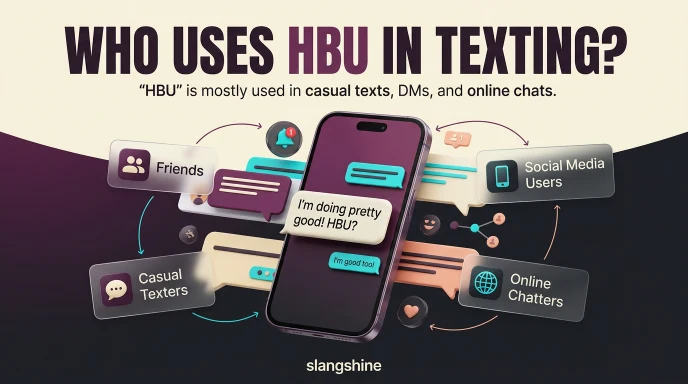
Who Uses HBU in Texting?
HBU is widely associated with informal digital communication.
You may see it used by:
- Teenagers
- Young adults
- Friends
- Classmates
- Online friends
- Social media users
- Gaming communities
- People chatting through messaging apps
It is especially useful when a conversation involves back-and-forth questions.
For example:
“I’m from Texas, HBU?”
The person answers the original question and immediately returns it to the other person.
Why Do People Use HBU?
The main reason is convenience.
Typing:
“How about you?”
Takes more time than typing:
“HBU?”
In a fast-moving conversation, abbreviations can make communication easier.
People also use HBU because it:
- Saves typing time
- Keeps messages short
- Feels casual
- Works well in quick conversations
- Makes it easy to return a question
- Fits naturally with other texting abbreviations
HBU is not usually used to make a message confusing. In most cases, both people already understand the abbreviation.
HBU vs. How About You
There is no major difference in meaning.
HBU is simply the abbreviated version of “How About You?”
| Form | Meaning | Tone |
| HBU? | How about you? | Very casual |
| How about you? | How about you? | Neutral |
| And you? | Asking the same question back | Casual to neutral |
| What about you? | Asking for the other person’s answer | Casual to neutral |
For example:
“I’m tired. HBU?”
means essentially the same thing as:
“I’m tired. How about you?”
The difference is mainly the level of informality.
HBU vs. WBU: What’s the Difference?
HBU and WBU are very similar.
- HBU = How About You?
- WBU = What About You?
Both are commonly used to return a question to another person.
For example:
“I’m staying home tonight. HBU?”
and:
“I’m staying home tonight. WBU?”
Both ask what the other person is doing.
The choice usually comes down to personal texting style.
HBU vs. WYD
Both HBU and WYD are common in casual conversations, but they have different meanings and uses.
HBU = How About You?
WYD = What You Doing? / What Are You Doing?
For example:
“I’m watching a movie. HBU?”
Asks what the other person is doing or feeling in the same general context.
But:
“WYD?”
Directly asks what the other person is doing.
They are related in casual conversation, but they are not interchangeable in every sentence.
Can HBU Mean Something Else?
HBU has meanings outside casual texting, but “How About You?” is the standard interpretation in everyday text conversations.
Context is still important.
If you see:
“I’m good, HBU?”
There is almost no confusion. It clearly means How About You?
However, abbreviations can have specialized meanings in areas such as organizations, businesses, education, technology, or other fields.
If the conversation is not casual, check the surrounding words before deciding what HBU means.
How to Know What HBU Means
When you see HBU in a message, look at the sentence before it.
For example:
“I love this restaurant. HBU?”
The person is asking if you like the restaurant too.
Another example:
“I’m going home after class. HBU?”
The person is asking about your plans.
A simple rule works in most casual conversations:
If someone answers a question and then says “HBU?”, they are asking you the same question back.
Common Mistakes With HBU
HBU is easy to understand, but beginners can sometimes misunderstand how it works.
Mistake 1: Thinking HBU Is a Greeting
HBU is not usually a greeting by itself.
It means “How about you?”, so it normally follows some information or a question.
For example:
“I’m good, HBU?”
sounds natural.
Mistake 2: Replying With “HBU?” Again
If someone says:
“I’m tired. HBU?”
They are asking about you.
Reply with your own answer instead of repeating HBU.
Mistake 3: Using HBU in Formal Writing
HBU is informal.
For a formal email or professional message, writing “How about you?” or another complete sentence is clearer.
Mistake 4: Assuming HBU Always Refers to Feelings
HBU can refer to many things.
It can ask about:
- Feelings
- Plans
- Opinions
- Preferences
- Locations
- Experiences
- Activities
The context tells you what the question refers to.
HBU in a Longer Conversation
Consider this example:
Mia: “How was your weekend?”
Noah: “Pretty good! I went to the beach. HBU?”
Mia: “Mine was quiet. I mostly stayed home.”
Noah: “Honestly, that sounds relaxing 😂”
Here, HBU asks about Mia’s weekend.
Another example:
A: “I’m thinking about getting pizza.”
B: “Same. HBU?”
A: “I’ll probably order pepperoni.”
B: “Good choice 😂”
The meaning is still “How about you?”, but the subject changes with the conversation.
Is HBU Only Used With Friends?
No.
HBU is most natural in casual conversations, but it can be used with many people when the communication is informal.
For example, two people who have recently met online might use:
“I’m from Canada, HBU?”
It can also appear between coworkers who are chatting casually.
However, the level of formality matters. In an official email, HBU would usually be too informal.
HBU Meaning in Online Conversations
HBU works particularly well online because digital conversations often move quickly.
Instead of repeating an entire question, people use the abbreviation to keep the discussion flowing.
For example:
“I’m watching a new series. HBU?”
The person does not need to write:
“I’m watching a new series. What are you watching?”
The context does the work.
This is one reason abbreviations like HBU are so common in everyday texting.
Frequently Asked Questions About HBU Mean in Text
Q1. What does HBU mean in text?
Answer: HBU usually means “How About You?” It is a casual abbreviation used to ask another person the same question or ask for their response.
Q2. What does HBU mean on Snapchat?
Answer: On Snapchat, HBU usually means “How About You?” It is often used in quick, informal conversations between friends or other users.
Q3. Is HBU rude?
Answer: No. HBU is generally a friendly and casual abbreviation. The overall tone depends on the rest of the message and the relationship between the people chatting.
Q4. What is the difference between HBU and WBU?
Answer: HBU means “How About You?”, while WBU means “What About You?” Both are commonly used to return a question to someone.
Q5. What is the difference between HBU and WYD?
Answer: HBU means “How About You?”, while WYD usually means “What You Doing?” or “What Are You Doing?” They can appear in similar conversations but have different meanings.
Q6. How do you respond to HBU?
Answer: Answer the question being returned to you. For example, if someone says, “I’m good, HBU?” you can reply, “I’m good too!” or share how you are feeling.
Q7. Can HBU mean something other than How About You?
Answer: Yes, HBU can have specialized meanings in other contexts. However, in ordinary texting and social media conversations, “How About You?” is the most common interpretation.
Q8. Is HBU formal or informal?
Answer: HBU is informal. It works well in texts, DMs, social media, and casual chats, but writing “How about you?” is generally better for formal communication.
Key Takeaways
- HBU usually means “How About You?”
- It is a common texting and social media abbreviation.
- People use it to return a question to someone.
- HBU can refer to feelings, plans, opinions, preferences, or other topics.
- HBU and WBU have very similar meanings.
- HBU and WYD are different abbreviations with different uses.
- HBU is casual rather than formal.
- The surrounding conversation helps determine exactly what HBU refers to.
Conclusion
So, what does HBU mean in text? In most casual conversations, HBU means “How About You?” It is a quick way to return a question to another person without repeating the full sentence.
You might see HBU after someone shares how they feel, what they are doing, where they are from, or what they like. For example, “I’m good, HBU?” simply means “I’m good, how about you?”
HBU is friendly, informal, and widely useful in texting and online conversations. If you are writing a formal message, spelling out “How about you?” is usually a better choice.
Learn More About Slang:
- What Does GTS Mean in Text? GTS Slang Explained (2026)
- What Does HB Mean in Text? HB Slang Explained
- What Does GTG Mean in Text? Real Meaning, & Social Media Use

Hi, I’m Emma Carter, an English language writer with over 8 years of experience in vocabulary and language learning. At SlangShine, I write simple, accurate, and easy-to-understand articles about slang, synonyms, idioms, and everyday English to help learners build confidence and improve their communication skills.