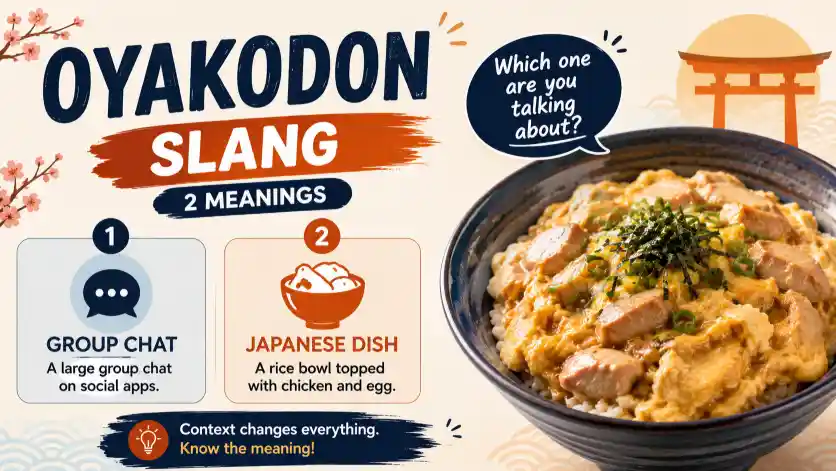
Oyakodon Slang is a Japanese word with two very different meanings. In its normal use, oyakodon is a Japanese rice bowl made with chicken and egg. The name comes from the Japanese words for “parent” and “child,” referring to the chicken and egg.
However, oyakodon also has a vulgar slang meaning. In this context, it refers to a sexual situation involving a parent and child, most commonly a mother and daughter.
This meaning is not related to the food itself, but it comes from the same “parent and child” wordplay. Japanese dictionaries list this usage as vulgar slang.
Because the two meanings are very different, context is extremely important. A restaurant menu and an adult online discussion can use the same word while referring to completely different things.
Quick Answer: Oyakodon Slang
Oyakodon normally means a Japanese chicken and egg rice bowl. As vulgar slang, however, it can refer to a sexual situation involving a parent and child, usually a mother and daughter.
What Does Oyakodon Mean?
Oyakodon (親子丼) is a Japanese food name that literally carries the idea of a “parent and child bowl.”
The word can be broken down into two main parts:
- Oyako (親子) = parent and child
- Don (丼) = rice bowl or bowl style dish
In the food meaning, the “parent” is the chicken, while the “child” is the egg. Both are served together over rice.
So, if you see oyakodon on a Japanese restaurant menu, it normally has nothing to do with slang.
What Is Oyakodon as a Food?
Oyakodon is a popular Japanese donburi dish made with chicken, egg, and rice.
The chicken and egg are usually cooked together with a savory sweet sauce before being placed over rice.
The name is also a simple food related wordplay. The chicken represents the parent, while the egg represents the child.
For example:
“I ordered oyakodon for lunch.”
This simply means that the person ordered the Japanese chicken and egg rice bowl.
Therefore, you should not assume that every use of the word is slang.
Why Does Oyakodon Have a Slang Meaning?
The slang meaning comes from the parent and child idea contained in the Japanese name.
The same word that describes the relationship between chicken and egg was later used as vulgar wordplay for a sexual situation involving a parent and child.
This creates two very different meanings:
| Meaning | Context | Tone |
| Chicken and egg rice bowl | Food | Neutral |
| Parent child sexual situation | Vulgar slang | Explicit |
As a result, context is essential whenever you see the word online.
What Does Oyakodon Mean in Slang?
In vulgar slang, oyakodon refers to a sexual encounter involving a parent and child, commonly described as a mother and daughter. Japanese dictionary sources classify this meaning as vulgar slang.
This is an adult term and can be disturbing because it involves a family relationship.
It is also important to understand that this is not the everyday meaning of oyakodon in Japanese. The ordinary meaning remains the food dish.
So, seeing the word by itself does not automatically mean that someone is using the slang definition.
Is Oyakodon Always a Slang Word?
No.
This is one of the most important points for English learners.
If you see:
“Oyakodon is my favorite Japanese dish.”
the word refers to food.
If you see it in an adult or explicit online discussion, the slang meaning may be intended.
Therefore, never label every use of oyakodon as vulgar. The context determines which meaning is relevant.
Oyakodon in Restaurants
In a food setting, oyakodon is completely normal vocabulary.
You may see it on:
- Japanese restaurant menus
- Food blogs
- Cooking websites
- Japanese food videos
- Travel guides
- Conversations about Japanese cuisine
For example:
“This restaurant has great oyakodon.”
Here, the speaker is talking about food.
In this context, there is no reason to interpret the word as slang.
Oyakodon in Online Conversations
Online, the word can be more confusing because people may use it outside its food meaning.
You might encounter the slang meaning in adult discussions, fandom spaces, or posts where people intentionally use Japanese terms as euphemisms.
However, online usage is not always consistent. Some people may simply be discussing the dish, while others may be using the word because they know its secondary meaning.
That is why reading the surrounding text is important.
How Can You Tell Which Meaning Is Intended?
Look at the topic before translating the word.
If the conversation mentions:
- Rice
- Chicken
- Eggs
- Japanese food
- Restaurants
- Cooking
then oyakodon almost certainly refers to the dish.
On the other hand, if the conversation contains explicit adult language or references to sexual relationships, the vulgar meaning may be intended.
This simple context check can prevent a major misunderstanding.
Is Oyakodon Offensive?
The normal food meaning is not offensive.
The slang meaning, however, is vulgar and involves an incest related sexual concept. Because of that, it is not suitable for polite or professional conversation.
If you are talking about the food, simply use oyakodon normally.
If you are unsure about an online use, avoid repeating the slang interpretation until you understand the context.
Common Example: Food Meaning
“I tried oyakodon at a Japanese restaurant.”
Meaning: The speaker ate a chicken and egg rice bowl.
This is a normal and harmless use of the word.
Another Example
“Oyakodon is easy to make at home.”
Here, the person is clearly discussing cooking.
Therefore, there is no slang meaning in either example.
Is Oyakodon Commonly Used as Slang?
The slang meaning of oyakodon is much more specific than its normal food meaning. The word is widely known as the name of a Japanese dish, while the vulgar meaning is a separate slang use. Japanese dictionary sources list both meanings under the same word.
Because the food meaning is completely ordinary, seeing oyakodon does not mean that someone is using sexual slang.
For example, a person talking about Japanese restaurants will almost certainly mean the dish. In contrast, an adult conversation may use the word differently.
Oyakodon vs. Other Japanese Food Names
Oyakodon belongs to the donburi category of Japanese rice bowl dishes.
| Japanese Word | Meaning |
| Oyakodon | Chicken and egg over rice |
| Katsudon | Breaded pork cutlet over rice |
| Gyudon | Beef over rice |
| Tendon | Tempura over rice |
| Donburi | General term for rice bowl dishes |
Therefore, the ordinary meaning of oyakodon fits naturally into Japanese food vocabulary.
Why Can the Same Word Have Two Meanings?
The two meanings are connected by the word “oyako,” which means parent and child.
In the food name, the parent and child idea is a playful reference to the relationship between chicken and egg.
The slang meaning uses that same relationship as wordplay for an adult sexual concept. Japanese dictionaries record this secondary use as vulgar slang.
So, the slang meaning is not the basic definition of the dish. It is a separate use built around the same word.
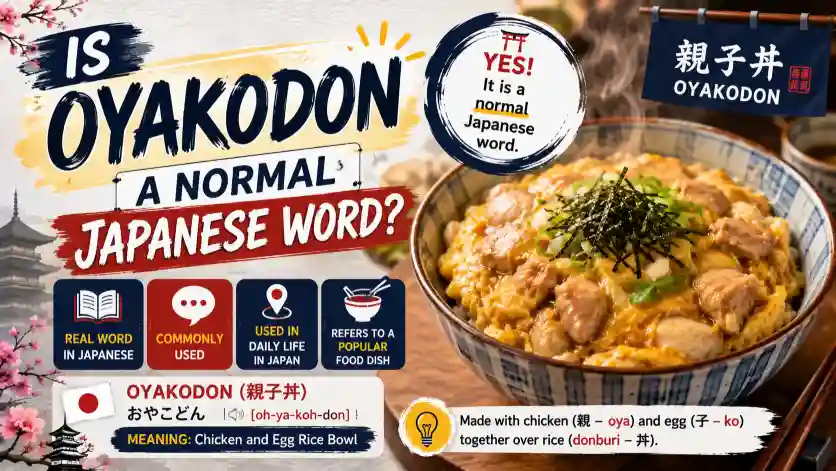
Is Oyakodon a Normal Japanese Word?
Yes.
This is important for anyone learning Japanese.
If someone says:
“今日は親子丼を食べました。”
they are talking about eating oyakodon.
There is nothing unusual or vulgar about the word in a food context.
In fact, the ordinary food meaning is the one learners are most likely to encounter in restaurants, recipes, and conversations about Japanese cuisine.
Can Oyakodon Be Misunderstood Online?
Yes, especially when the surrounding context is missing.
Online posts sometimes use Japanese words because of their secondary or adult meanings. As a result, someone who only knows the food meaning may misunderstand what another person intends.
However, the opposite can also happen. Someone who knows only the slang meaning may incorrectly assume that a normal food discussion is sexual.
That is why context matters in both directions.
How Should English Learners Understand Oyakodon?
If you are learning Japanese, it is best to remember the two meanings separately.
Food Meaning
Oyakodon = chicken and egg rice bowl
This is the normal culinary meaning.
Slang Meaning
Oyakodon = a vulgar sexual term involving a parent and child
This is an adult slang meaning listed by Japanese dictionaries.
Keeping these meanings separate will help you avoid confusion when reading Japanese content online.
Is Oyakodon Appropriate in Conversation?
Yes, when you are talking about food.
You can use the word when discussing:
- Japanese restaurants
- Cooking
- Recipes
- Japanese cuisine
- Food preferences
- Travel and dining
There is no need to avoid the word simply because it has a secondary slang meaning.
However, you should understand the slang definition so that you can recognize it when you encounter it in an adult context.
When Should You Avoid the Slang Meaning?
The slang meaning should generally be avoided in polite, professional, or family friendly communication.
It refers to an explicit and taboo sexual concept. Therefore, using it casually can easily make a conversation uncomfortable or offensive.
If your topic is food, simply use oyakodon in its normal culinary sense.
In other words, there is no problem with saying the name of the dish. The concern is specifically about intentionally using its vulgar secondary meaning.
Common Mistakes About Oyakodon
Mistake 1: Thinking Oyakodon Is Only Slang
It is not. Oyakodon is primarily a Japanese food term, and dictionaries list the chicken and egg rice bowl as its culinary meaning.
Mistake 2: Thinking the Food Name Is Offensive
The normal food meaning is not offensive.
A restaurant menu can use oyakodon without any vulgar intention.
Mistake 3: Assuming Every Online Use Is Sexual
Online context can be misleading. A food blogger, restaurant, or traveler may simply be talking about the dish.
Mistake 4: Ignoring the Secondary Meaning
At the same time, learners should know that the word has a vulgar slang definition.
Therefore, understanding both meanings is better than assuming only one.
Is Oyakodon Safe to Use on Social Media?
Yes, when you are clearly referring to the food.
For example:
“I finally tried oyakodon today. It was delicious.”
This clearly refers to the dish.
However, using the word in an adult context can give your post a very different meaning.
If your audience may not understand Japanese context, adding “Japanese chicken and egg rice bowl” can make your meaning even clearer.
Frequently Asked Questions
Q1. What does oyakodon mean in slang?
Answer: In vulgar Japanese slang, oyakodon refers to a sexual encounter involving a parent and child. Japanese dictionaries list this as a slang meaning.
Q2. Does oyakodon normally mean something sexual?
Answer: No. Its normal meaning is a Japanese chicken and egg rice bowl. The sexual meaning is a separate vulgar slang use.
Q3. Is oyakodon a real Japanese food?
Answer: Yes. Oyakodon is a Japanese rice bowl topped with chicken and egg. It is a normal food term.
Q4. Why does oyakodon have a slang meaning?
Answer: The slang meaning uses the “parent and child” idea in the Japanese name as sexual wordplay. The culinary meaning itself is not vulgar.
Q5. Is oyakodon offensive?
Answer: The food meaning is not offensive. The secondary slang meaning is vulgar and can be offensive or inappropriate in many situations.
Q6. Should English learners use the word oyakodon?
Answer: Yes, when talking about the Japanese dish. However, learners should understand its secondary slang meaning so they can recognize it when reading adult or online content.
Conclusion
Oyakodon has two very different meanings in Japanese. Its normal meaning is a chicken and egg rice bowl, while its secondary meaning is a vulgar slang term involving a parent and child. Japanese dictionary sources clearly distinguish these uses.
For everyday Japanese, oyakodon is simply the name of a popular food. Therefore, seeing the word on a menu, recipe, or food post should not be treated as slang.
The key is context. If the conversation is about food, think of the dish. If it appears in an adult context, the slang meaning may be intended. Understanding both meanings helps English learners avoid unnecessary confusion.
Discover More:
- Banger Slang Meaning: What “Banger” Really Means
- What Does OMM Mean in Slang? Texting and Social Media Guide
- WYS Meaning Slang: The Meaning You Might See in Online Chats

Hi, I’m Anna Whitmore. I have 7+ years of experience writing about English slang and vocabulary. At SlangShine, I create simple, easy-to-understand content for English learners.