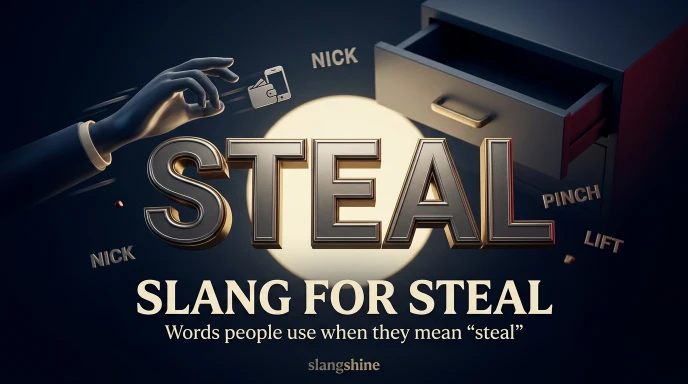
Slang for steal includes informal words such as jack, boost, swipe, nick, lift, pinch, and five-finger discount.
These terms can describe taking something without permission, but their meanings and usage can vary by country and situation.
For example, “Someone swiped my phone” means someone took the phone without permission.
Some of these expressions are common in everyday informal English, while others are strongly connected with British slang, American slang, or humorous online language. Understanding the context helps you choose the right meaning.
Quick Answer: Slang for Steal
Common slang for steal includes:
- Jack : to steal something
- Boost : to steal, especially from a store
- Swipe : to take something without permission
- Nick : British slang for steal
- Lift : to steal something
- Pinch : to steal or take something
- Five-finger discount : a humorous way to refer to shoplifting
- Rip off : to cheat or overcharge someone, and sometimes to describe taking something unfairly
Not every word has exactly the same meaning. Some focus on secretly taking an item, while others describe dishonest treatment more generally.
Slang for Steal: Quick Comparison
| Term | Meaning | Regional or usage note |
| Jack | Steal | Common in American slang |
| Boost | Steal, especially merchandise | Often linked with shoplifting |
| Swipe | Take without permission | Widely understood |
| Nick | Steal | Strong British association |
| Lift | Steal or take | Common in British/informal use |
| Pinch | Steal or take | Often informal or playful |
| Five-finger discount | Shoplift | Humorous expression |
| Borrow permanently | Keep something taken from someone | Joking expression |
What Does “Jack” Mean in Slang?
Jack can mean to steal something in informal English.
For example:
“Someone jacked my bike.”
This means:
“Someone stole my bike.”
The word can also appear in phrases such as “jack something” or “jack someone’s stuff.”
The exact tone depends on the situation. In casual speech, it can sound direct and informal.
What Does “Boost” Mean in Slang?
Boost is a slang term for stealing, especially stealing merchandise from a store.
For example:
“He got caught trying to boost some clothes.”
Here, boost means steal.
You may also hear booster in discussions about someone who steals goods, particularly in the context of shoplifting.
This term is especially associated with American informal language.
What Does “Swipe” Mean in Slang?
Swipe can mean to take or steal something quickly, often without permission.
For example:
“Someone swiped my headphones.”
The meaning is clear from the context: the headphones were taken without permission.
However, swipe has several other common meanings. You can swipe a screen on a phone, swipe a card, or move something across a surface.
That is why the surrounding sentence matters.
What Does “Nick” Mean in British Slang?
Nick is a well-known British slang term meaning to steal.
For example:
“Someone nicked my wallet.”
This means:
“Someone stole my wallet.”
In British English, nick has other meanings too. It can also refer to being arrested or taken to a police station.
For example:
“He got nicked.”
In that context, it does not mean “he got stolen.” It means he was arrested.
This makes context especially important when reading British slang.
What Does “Lift” Mean in Slang?
Lift can mean to steal something, particularly when someone takes an item quietly.
For example:
“Someone lifted my phone from the table.”
The sentence means that someone stole the phone.
The word lift also has a completely different everyday meaning. It can refer to getting a ride from another person.
For example:
“Can you give me a lift home?”
That has nothing to do with stealing.
What Does “Pinch” Mean in Slang?
Pinch can be used informally to mean steal or take something without permission.
For example:
“Someone pinched my pen.”
This means:
“Someone took my pen.”
The word can sometimes sound less serious than words such as steal or rob, especially when someone takes a small or inexpensive item.
However, the context determines if the speaker is being serious or playful.
What Does “Five-Finger Discount” Mean?
Five-finger discount is a humorous expression for shoplifting.
The phrase jokingly compares stealing an item to receiving a discount, even though the person did not actually pay for it.
For example:
“He tried to get a five-finger discount.”
The speaker means that the person tried to take something from a store without paying.
This expression is usually humorous or sarcastic. It does not mean that a real discount was available.
What Does “Rip Off” Mean?
Rip off usually means to cheat someone, overcharge them, or give them something that is not worth what they paid.
For example:
“That shop ripped me off.”
The speaker means they believe the shop charged them unfairly.
This is different from simply stealing an object.
So, although rip off sometimes appears in lists of slang related to stealing, it should not automatically be treated as a direct synonym for steal.
Slang for Steal in American English
Several terms are especially common in American informal English.
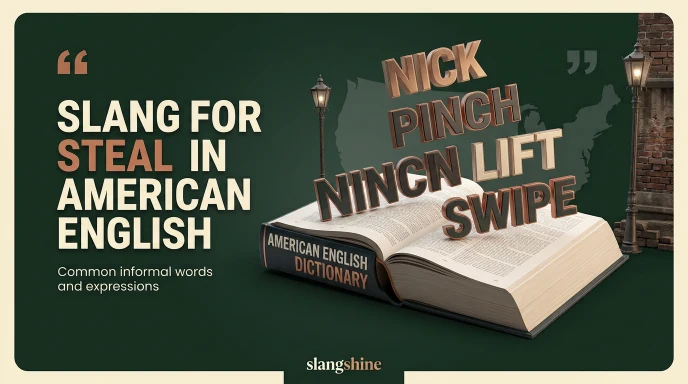
Jack
Jack can mean steal.
“Someone jacked his car.”
Boost
Boost often refers to stealing merchandise, especially from stores.
“They were caught trying to boost electronics.”
Swipe
Swipe can describe taking an item without permission.
“Someone swiped my bag.”
Five Finger Discount
This humorous phrase refers to shoplifting.
“He thought he could get a five-finger discount.”
These expressions are informal and should not replace steal in formal writing.
Slang for Steal in British English
British English has its own familiar terms for stealing.
Nick
Nick means steal.
“Someone nicked my phone.”
Pinch
Pinch can also mean steal.
“Someone pinched my umbrella.”
Lift
Lift can describe stealing something.
“Someone lifted the watch.”
British slang changes between regions and generations, so not every expression has the same level of popularity throughout the UK.
Slang for Steal in a Sentence
Here are some natural examples:
“Someone swiped my charger.”
Meaning: Someone stole my charger.
“He jacked my bike.”
Meaning: He stole my bike.
“Someone nicked my wallet.”
Meaning: Someone stole my wallet.
“They tried to boost some clothes.”
Meaning: They tried to steal clothes from a store.
“Someone pinched my headphones.”
Meaning: Someone took my headphones without permission.
These examples show why the word steal can have many informal alternatives.
Steal vs. Rob vs. Take
These words are related, but they are not interchangeable.
Steal means taking something that belongs to another person without permission.
Rob usually means taking money or property from a person or place through theft. It can also involve force or threats.
Take is much broader. It does not automatically mean stealing.
For example:
“I took my jacket.”
This simply means you picked up or carried your own jacket.
But:
“Someone stole my jacket.”
means another person took it without permission.
The difference becomes important when using slang.
Is “Steal” Itself Slang?
No. Steal is standard English, not slang.
It is the normal word used in everyday speech, formal writing, news reports, legal contexts, and academic discussions.
Slang terms such as jack, boost, nick, and swipe are more informal.
If you are unsure which word to use, steal is usually the clearest choice.
Why Are There So Many Slang Words for Steal?
English develops different words for the same action through regional speech, popular culture, humor, and social groups.
Some expressions become popular because they are short and easy to use. Others spread through music, movies, television, books, and online conversations.
Regional differences also play a role. Nick is strongly associated with British English, while boost is commonly associated with American slang.
Internet culture adds another layer. A humorous phrase such as five-finger discount can spread quickly because it is easy to understand and memorable.
Are These Terms Still Used in 2026?
Yes. Several of these expressions remain recognizable in 2026, although their popularity differs by region and age group.
Jack, boost, swipe, nick, lift, and pinch can still appear in informal conversations. Humorous expressions such as five-finger discount also remain understandable to many English speakers.
However, slang is constantly changing. A term can remain recognizable without being equally common among every group.
When Should You Use Slang for Steal?
These expressions work best in casual conversations, dialogue, social media, entertainment, and informal storytelling.
For example, slang can make fictional dialogue sound natural:
“Someone nicked my bike!”
A casual message might also say:
“Who swiped my charger?”
Formal situations are different.
In a report, professional email, academic assignment, or official document, steal is usually clearer than slang.
Using a regional term without understanding its meaning can also cause confusion.
Key Difference Between Common Terms
| Slang term | General meaning | Common association |
| Jack | Steal | American informal English |
| Boost | Steal, often from a store | American slang |
| Swipe | Take without permission | General informal English |
| Nick | Steal | British slang |
| Lift | Steal or take | British/informal English |
| Pinch | Steal or take | British/informal English |
| Five-finger discount | Shoplifting | Humorous informal English |
The meanings can overlap, but they are not perfect substitutes in every sentence.
Origin and History of Slang for Steal
The English language has used informal words for stealing for centuries. Many of these terms developed through regional speech, everyday conversation, and changing social attitudes.
The history of individual slang words is not always easy to trace to one person or one exact date. Words often spread gradually through communities before appearing in dictionaries or written records.
Nick, for example, has a long history in British informal English. Pinch has also been used for taking something that belongs to someone else.
American English later developed and popularized expressions such as jack and boost in different informal contexts.
Modern media has helped these words travel between regions. Movies, television, music, and social media can introduce a local expression to a much wider audience.
Slang for Stealing Money
Some informal expressions can describe taking money, although the exact word depends on the situation.
Jack can be used when someone steals money:
“Someone jacked his cash.”
Swipe can also work when someone takes money without permission:
“Someone swiped the money from my bag.”
However, rob is often more precise when someone takes money or property directly from a person or place.
For example:
“The store was robbed.”
That sentence describes a robbery rather than simply using a casual synonym for steal.
Slang for Stealing Food
Informal English also has expressions for taking food without permission.
Swipe works naturally:
“Someone swiped my lunch.”
Pinch can also be used:
“He pinched my fries.”
The second example can sound playful, especially when someone takes a small amount of food from a friend.
Context matters because pinch does not always suggest serious theft.
Slang for Stealing Clothes
When talking about stolen clothing, jack, swipe, lift, or boost may appear depending on the context.
For example:
“Someone jacked my jacket.”
“She swiped my hoodie.”
“They tried to boost some clothes.”
The words do not all carry the same regional association. Boost is especially connected with stealing merchandise, while jack is broader.
Slang for Stealing a Car
In informal American English, jack can describe stealing a vehicle.
For example:
“Someone jacked his car.”
This means:
“Someone stole his car.”
You may also hear boost in discussions about vehicle theft, but its use depends on the speaker and context.
Because car theft is a serious crime, formal descriptions normally use words such as steal, stealing, or vehicle theft.
Slang for Stealing Something Small
When someone takes a small item, informal speakers may use words such as swipe, pinch, or lift.
For example:
“Someone swiped my pen.”
“My brother pinched my headphones.”
“Someone lifted my umbrella.”
These expressions can sometimes make the action sound less serious than the word stole.
That does not mean the action is harmless. The tone simply reflects the speaker’s choice of vocabulary.
Common Mistakes With Slang for Steal
Mistake 1: Treating Every Term as a Perfect Synonym
Words such as jack, boost, nick, swipe, and pinch all relate to stealing, but their usage differs.
Nick has a strong British association.
Boost is often linked with shoplifting.
Swipe can describe taking something quickly.
Understanding these differences makes your writing more natural.
Mistake 2: Confusing Steal With Rob
Steal and rob are related but have different grammatical patterns.
You normally say:
“Someone stole my phone.”
You would not normally say:
“Someone robbed my phone.”
Instead, you could say:
“Someone robbed me.”
or:
“The store was robbed.”
The distinction is important even when using informal language.
Mistake 3: Thinking “Swipe” Always Means Steal
Swipe has several meanings.
You can swipe a screen, swipe a card, or swipe left or right on an app.
Only the context tells you if it means stealing.
Mistake 4: Assuming “Nick” Is American Slang
Nick is strongly associated with British informal English.
American speakers may understand it because of British media, but it is not the typical American equivalent of steal.
Mistake 5: Using Slang in Formal Writing
Words such as jack and boost can sound too informal in an academic or professional document.
Use steal, stolen, or theft when you need clear and formal language.
Is “Jack” the Same as “Steal”?
In slang, jack can mean steal.
For example:
“Someone jacked my phone.”
means:
“Someone stole my phone.”
However, jack has several other meanings in English. It can refer to a mechanical lifting device, a playing card, or appear in other expressions.
The surrounding words therefore determine the intended meaning.
Is “Boost” the Same as “Shoplift”?
They are closely related, but they are not always identical.
Shoplift specifically means stealing merchandise from a store.
Boost can be used for shoplifting, especially in American informal English, but it may also appear in broader discussions of stealing goods.
For example:
“He was caught shoplifting.”
Is more precise than:
“He was caught boosting.”
The second sentence is more informal.
Is “Five-Finger Discount” Actually a Discount?
No. Five-finger discount is a humorous expression for stealing something from a store.
It does not describe a legitimate price reduction.
For example:
“He tried to get a five-finger discount.”
Means that he tried to leave with merchandise without paying.
The phrase is usually used jokingly, but the underlying action is still theft.
Which Slang for Steal Is British?
Several terms have strong British associations.
Nick is one of the clearest examples.
Pinch and lift can also be heard in British informal English.
For example:
“My phone got nicked.”
“Someone pinched my bag.”
“The wallet was lifted from my pocket.”
These expressions can also be understood outside Britain because of international media and online communication.
Which Slang for Steal Is American?
Jack and boost are strongly associated with American informal English.
Swipe is more widely understood across English-speaking communities.
For example:
“Someone jacked my bike.”
or:
“They were caught trying to boost merchandise.”
The regional background can help you choose the expression that sounds most natural.
Can Slang for Steal Be Funny?
Yes. Some expressions are deliberately humorous.
Five-finger discount is the clearest example.
People may also use borrow permanently as a joke when someone takes something and does not plan to return it.
For example:
“I guess my brother decided to borrow my hoodie permanently.”
This does not literally mean the person has committed a formal act of theft. The phrase is a humorous way to describe keeping someone else’s property.
When Should You Avoid Slang for Steal?
Avoid slang when precision is important.
Formal alternatives include:
- Steal
- Stolen
- Theft
- Shoplifting
- Robbery
- Take without permission
The correct term depends on what actually happened.
For example, shoplifting specifically concerns stealing goods from a store, while robbery involves taking property through force or the threat of force.
Using the precise term prevents confusion.
Frequently Asked Questions About Slang for Steal
Q1. What are some slang words for steal?
Answer: Common slang terms include jack, boost, swipe, nick, lift, and pinch. “Five-finger discount” is a humorous phrase for shoplifting.
Q2. What does “jack” mean in slang?
Answer: Jack can mean to steal something. For example, “Someone jacked my bike” means “Someone stole my bike.”
Q3. What does “nick” mean in British slang?
Answer: Nick means to steal in British informal English. “Someone nicked my phone” means “Someone stole my phone.”
Q4. What does “boost” mean in slang?
Answer: Boost can mean to steal, particularly merchandise from a store. It is strongly associated with American informal language.
Q5. What is slang for shoplifting?
Answer: Boost can be used as slang for shoplifting, while five-finger discount is a humorous expression for stealing merchandise from a store.
Q6. What is a casual way to say someone stole something?
Answer: Depending on the region and context, you can say someone swiped, jacked, nicked, lifted, or pinched something. These are informal alternatives to “stole.”
Key Takeaways
- Slang for steal includes jack, boost, swipe, nick, lift, and pinch.
- Jack is commonly associated with American informal English.
- Boost often refers to stealing merchandise, especially through shoplifting.
- Nick is strongly associated with British slang.
- Swipe can mean stealing, but it also has several unrelated meanings.
- Five-finger discount is a humorous phrase for shoplifting.
- Steal is standard English and works in both casual and formal contexts.
- Rob is not simply another word for steal; the grammar and meaning differ.
- Regional slang can vary between speakers, age groups, and communities.
- Always consider the audience before using informal or humorous theft-related expressions.
Conclusion
There are many forms of slang for steal, and each one carries its own tone or regional flavor.
Words such as jack, boost, swipe, nick, lift, and pinch can all describe taking something without permission, but they do not work in exactly the same situations.
American informal English commonly uses jack and boost, while nick has a strong British connection.
Swipe is more widely understood, and five finger discount adds a humorous tone to the idea of shoplifting.
The safest choice in formal communication is still steal. Slang works best when the setting is casual and the audience understands the expression.
Knowing these differences helps you understand conversations, social media posts, movies, and regional English without assuming that every slang term has the same meaning.
Learn More About Slang:
- CTFU Meaning: The Slang Word for Laughing TOO Hard (2026)
- Bombaclat Slang Meaning: What Does Bombaclat Mean?
- Scouser Slang: Meaning, Origin, Examples & Usage in 2026

Hi, I’m Anna Whitmore. I have 7+ years of experience writing about English slang and vocabulary. At SlangShine, I create simple, easy-to-understand content for English learners.