Snowbelt region slang refers to the regional words, phrases, and local expressions heard in the snowy parts of the northern United States, especially around the Great Lakes and parts of the Northeast. The Snow Belt itself is not a single slang dialect. It is a geographic term for areas that receive heavy or frequent snowfall.
If you search for Snowbelt region slang, you may expect one fixed list of words used everywhere in the region. That is not quite how American regional speech works.
The Snowbelt covers different states and communities. People in Buffalo may use words that are less common in Cleveland or Wisconsin.
Some expressions are shared across the wider Midwest, while others are strongly tied to one city or state.
This guide explains the most useful terms, what they mean, where they are heard, and why the Snowbelt has such distinctive regional language.
Quick Answer: What Is Snowbelt Region Slang?
| Question | Answer |
| What is the Snowbelt? | A region known for heavy or frequent snowfall |
| Where is it? | Mainly parts of the northern U.S., especially the Great Lakes and Northeast |
| Is Snowbelt a slang word? | No. It is a regional geographic term |
| What is Snowbelt slang? | Local words and expressions used in Snowbelt communities |
| Common example | “Pop” for a soft drink in parts of the Inland North |
| Is there one Snowbelt dialect? | No. Different areas have different speech patterns |
The term snowbelt has been used for a region with substantial snowfall since at least the 19th century. Merriam-Webster gives 1874 as its first known use.
What Does Snowbelt Region Mean?
The Snowbelt is an informal name for parts of the United States that regularly receive significant snowfall.
It is especially associated with areas near the Great Lakes, where lake-effect snow can produce very heavy snowfall.
The term can also refer more broadly to snowy parts of the Northeast and northern United States.
For example, parts of:
- New York
- Pennsylvania
- Ohio
- Michigan
- Wisconsin
- Indiana
- Illinois
can be associated with Snowbelt conditions, although the exact boundaries are not fixed.
Why Is It Called the Snow Belt?
The name is simple.
Snow + belt = Snow Belt.
A “belt” in American geography often means a broad region where a particular feature is common. Other examples include the Rust Belt, Sun Belt, and Bible Belt.
The Snow Belt is therefore a geographic label, not the name of one specific culture or language group.
Is Snowbelt Region Slang a Real Thing?
Yes, but with an important distinction.
Snowbelt region slang is not one official set of slang words.
Instead, the phrase can be used to describe the regional vocabulary and informal expressions found in Snowbelt communities.
This matters because the Snowbelt stretches across several speech regions.
For example, people in Western New York may say pop, while communities farther east in New York are more likely to use soda.
Linguistic sources describe this as part of a larger regional vocabulary pattern rather than a single Snowbelt rule.
So, it is more accurate to say:
“Snowbelt areas have several overlapping regional slang traditions.”
That is better than saying:
“Everyone in the Snowbelt uses the same slang.”
Common Snowbelt Region Slang and Regional Words
Some words are especially useful when discussing speech in the Great Lakes and northern parts of the United States.
1. Ope
Ope is a short informal reaction often associated with Midwestern speech.
People may say it after making a small mistake, bumping into someone, or suddenly noticing something.
For example:
“Ope, sorry! I didn’t see you there.”
The expression is strongly associated with the Midwest, although people outside the region also use it.
It should not be treated as a word used by every Snowbelt resident. The Snowbelt and the Midwest overlap, but they are not identical regions.
2. Pop
In many parts of the Inland North and Midwest, pop means a carbonated soft drink.
For example:
“Do you want a pop?”
This differs from soda, which is more common in many parts of the Northeast and other regions.
Western New York provides a useful example of how the boundary can shift. Buffalo and areas farther west commonly use pop, while Syracuse and areas farther east tend to use soda. Rochester can show variation.
So pop is a good example of regional vocabulary connected with parts of the Snowbelt, but it is not exclusive to the Snowbelt.
3. Up North
Up North is a familiar regional phrase in parts of the Midwest, especially Michigan and Wisconsin.
It often refers to traveling toward a more northern, rural, wooded, or recreational area.
For example:
“We’re going Up North this weekend.”
The exact meaning depends on where the speaker lives.
For one person, “Up North” may mean northern Michigan. For another, it may mean northern Wisconsin.
This is a good example of how local geography can shape everyday speech.
4. Lake Effect
Lake effect refers to weather caused when cold air moves across relatively warmer lake water and picks up moisture.
In Snowbelt communities near the Great Lakes, lake-effect snow is an important part of winter vocabulary.
You might hear:
“We’re getting lake effect tonight.”
Or:
“The lake-effect snow is really heavy.”
This phrase is not slang in the strict sense. It is a normal weather term that has become especially familiar in communities affected by Great Lakes snow.
5. Snow Belt
Locals may simply use Snow Belt as a regional label.
For example:
“That town sits right in the Snow Belt.”
The phrase is common in weather, travel, news, and local discussions.
It can also be used casually when people compare winter conditions:
“We got six inches, but the Snow Belt got buried.”
Snowbelt Slang vs. Midwest Slang
These terms are related, but they should not be treated as identical.
The Snowbelt is based mainly on climate and geography.
The Midwest is a larger cultural and geographic region.
Because the Great Lakes overlap with the Midwest, many expressions can appear in both categories.
| Term | Meaning | Regional Note |
| Ope | Quick reaction to a surprise or small mistake | Strongly associated with Midwest speech |
| Pop | Carbonated soft drink | Common in much of the Inland North |
| Up North | A northern recreational area | Common in parts of the Upper Midwest |
| Lake effect | Weather caused by the Great Lakes | Common in Great Lakes communities |
| Snow Belt | Area with heavy snowfall | Used across several snowy regions |
This overlap explains why online lists sometimes mix Snowbelt slang, Midwest slang, Great Lakes slang, and Rust Belt slang.
They are related categories, but they are not interchangeable.
Where Is Snowbelt Region Slang Used?
There is no single boundary for Snowbelt slang.
The strongest overlap is found around the Great Lakes and snowy parts of the Northeast.
Some well-known Snowbelt areas include parts of:
- Western New York
- Northern Ohio
- Michigan
- Northern Indiana
- Wisconsin
- Pennsylvania
- Upstate New York
The exact list changes depending on if someone is talking about climate, geography, culture, or language.
For example, Buffalo and nearby Western New York are famous for heavy lake-effect snow and also have distinctive local vocabulary.
The Snow Belt in New York is particularly associated with the area around Buffalo and toward Oswego.
Buffalo and Western New York
Western New York has several expressions that can sound different to outsiders.
Pop is one clear example. Local speech also includes distinctive pronunciation patterns and regional names for places and roads.
For instance, some Buffalo speakers commonly put “the” before major highway numbers, such as “the 90.” Local sources also describe a recognizable Buffalo accent.
These features show why it is better to study local Snowbelt speech rather than search for one universal list of Snowbelt slang.
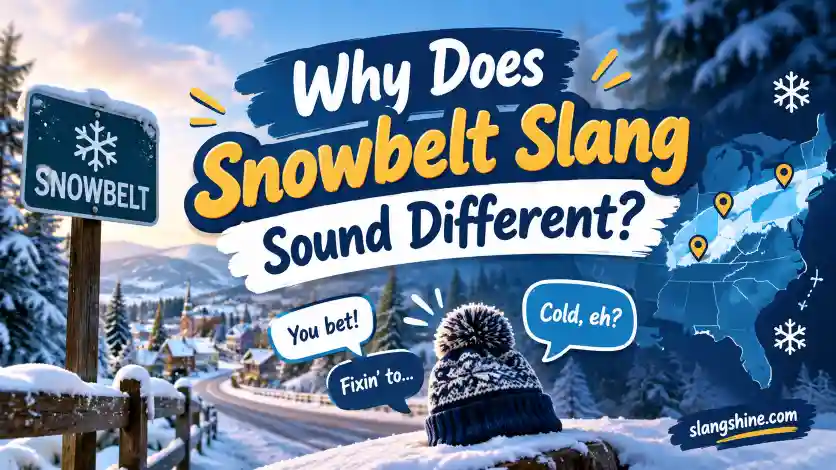
Why Does Snowbelt Slang Sound Different?
Regional language develops over time.
People who live in the same area often share:
- Local history
- Similar weather
- Food traditions
- Neighboring dialects
- Community habits
- Shared local places
- Common cultural references
Weather can also shape vocabulary.
Someone living with heavy lake-effect snow may regularly discuss snow bands, plowing, lake effect, snow days, and winter roads.
These terms may feel ordinary to locals but unfamiliar to someone from a warmer region.
Language can therefore reflect the environment without becoming “slang” in the strict dictionary sense.
Is Snowbelt Slang the Same Across All States?
No.
This is one of the most important points to remember.
A person from Buffalo may use an expression that is unfamiliar to someone from Cleveland. A person from Michigan may have different vocabulary from someone in upstate New York.
Even within one state, speech can change from city to city.
Western New York is a good example. Sources discussing the area point out that regional identity itself can vary between Buffalo, Rochester, Syracuse, and surrounding communities.
So the safest approach is to describe terms as regional, local, or associated with a particular area, rather than claiming that every Snowbelt speaker uses them.
Is Snowbelt Region Slang Still Used in 2026?
Yes, but it is better described as living regional vocabulary than as one modern slang system.
Words such as pop, ope, and local expressions remain familiar in parts of the Midwest and Great Lakes area. At the same time, social media has spread some regional expressions far beyond their original communities.
The word snowbelt itself is also still actively used in modern weather reporting. Merriam-Webster’s current examples include references to Snowbelt areas around the Great Lakes.
That means the term remains relevant in 2026, even though its meaning is geographic rather than internet-based.
More Regional Words You May Hear in Snowbelt Areas
Snowbelt communities do not share one fixed slang list. Instead, different areas have their own words and expressions. Some are linked to the Midwest, while others are tied to a specific state or city.
Here are a few regional terms that may appear in or near Snowbelt areas.
Drinking Fountain
In parts of the Inland North, drinking fountain is a common term for a public place where people get water.
Some other parts of the United States use water fountain instead.
This is a good example of regional vocabulary. The object is the same, but the preferred word can change by location.
Expressway
Expressway is another word strongly associated with parts of the Inland North.
It means a major road designed for fast traffic, usually with limited access.
Other Americans may say freeway, highway, or turnpike, depending on the region and road type.
Bubbler
Bubbler is a regional word for a drinking fountain. The term is especially associated with Wisconsin and some nearby areas.
Rather than being a universal Snowbelt expression, the word is better understood as a local regional term. Its use appears mainly in parts of the broader northern and Great Lakes area.
Yooper
A Yooper is a person from Michigan’s Upper Peninsula.
The word comes from the pronunciation of “U.P.”, meaning Upper Peninsula.
Yooper is regional identity language rather than general Snowbelt slang. It can be used proudly by people who identify with the area.
Up North
Up North is a familiar regional expression in places such as Michigan and Wisconsin.
It usually means heading toward a more northern, rural, wooded, or vacation-oriented part of the state.
The exact meaning changes by location. In Michigan, for example, “Up North” can refer to a large part of northern Michigan rather than one specific town.
Real-Life Snowbelt Region Slang Examples
The meaning of a regional word often becomes clearer when you see it in a sentence.
Example 1: “I’m going Up North this weekend.”
This usually means the speaker is traveling toward a northern part of their state.
Tone: Casual and regional.
It is not necessarily slang in the same way as internet slang. It is a local expression that can feel natural to people from the area.
Example 2: “Grab me a pop.”
Here, pop means a soft drink.
This usage is common in parts of the Midwest and Inland North, including areas that overlap with the Snowbelt.
Tone: Normal, casual, and regional.
A person from another part of the United States may use “soda” instead.
Example 3: “We got lake-effect snow again.”
This describes snow produced or increased by the effect of a large lake.
Tone: Everyday and weather-related.
“Lake effect” is not really slang. It is a standard weather term that is especially familiar in Great Lakes communities.
Example 4: “Ope, sorry!”
Ope is associated with Midwestern speech. People may use it when they bump into someone, notice something suddenly, or need to move around another person.
It can overlap with Snowbelt communities because parts of the Great Lakes region are also part of the Midwest.
However, ope is not exclusive to the Snowbelt.
Example 5: “The roads are bad because of the lake effect.”
This sentence sounds natural in many Great Lakes communities.
The phrase quickly communicates that the speaker is talking about weather influenced by a nearby lake.
Snowbelt Slang vs. Rust Belt Slang
The terms Snowbelt and Rust Belt can overlap geographically, but they do not mean the same thing.
The Snowbelt is mainly about snowfall and winter weather.
The Rust Belt is mainly connected with areas known historically for heavy industry and manufacturing.
Some cities can fit both descriptions.
For example, parts of the Great Lakes region can have:
- Heavy lake-effect snow
- Older manufacturing industries
- Midwest speech patterns
- Strong local vocabulary
- Distinct city accents
That does not mean there is one “Snowbelt dialect.”
The same person may use a word associated with the Midwest, another word associated with their city, and a weather term common across the Great Lakes.
Snowbelt Slang vs. Northeast Slang
The Snowbelt also overlaps with parts of the Northeast, but regional speech changes as you move east.
For example:
Western New York has connections to both the Great Lakes region and the Northeast.
This creates interesting language patterns.
A speaker in Buffalo may share some vocabulary with other Great Lakes communities while also having expressions that are strongly local.
This is why it is risky to label every word used in a snowy area as Snowbelt slang.
Snowfall does not create one language variety by itself.
Instead, geography, migration, history, local culture, and contact between communities all help shape regional speech.
Common Mistakes About Snowbelt Region Slang
Mistake 1: Thinking Snowbelt is a slang word
Snowbelt is primarily a geographic term.
It describes a region that receives substantial snowfall.
It does not name a special slang language.
Mistake 2: Assuming every Snowbelt state talks the same way
They do not.
Language can change between cities, states, and even neighboring communities.
Mistake 3: Calling every regional word “slang”
Some terms are better described as:
- Regional vocabulary
- Dialect features
- Informal expressions
- Local names
- Weather terms
Using the right label makes the explanation more accurate.
Mistake 4: Saying “ope” belongs only to the Snowbelt
Ope is associated with Midwestern speech more broadly.
Some Snowbelt communities use it, but it is not a Snowbelt-only word.
Mistake 5: Saying “pop” is used everywhere in the Snowbelt
“Pop” is common in parts of the Midwest and Inland North, but it is not universal.
Different communities prefer soda, pop, or other terms.
When Should You Use Snowbelt Regional Words?
If you live in or regularly communicate with people from a Snowbelt community, regional expressions can sound completely natural.
They are especially useful in:
- Casual conversations
- Text messages
- Social media posts
- Local discussions
- Friendly conversations
- Stories about regional life
You should be more careful in formal writing.
For example, if you are writing a school report, explain a regional term when your audience may not know it.
Instead of writing:
“We went Up North.”
You could write:
“We went Up North, a local expression for traveling toward northern Michigan.”
That makes the meaning clear to everyone.
People Also Ask About Snowbelt Region Slang
Q1. What does Snowbelt mean?
Answer. Snowbelt means a region that receives substantial or frequent snowfall. In the United States, the term is strongly associated with parts of the Great Lakes and northern states.
Q2. Is Snowbelt a slang word?
Answer. No. Snowbelt is mainly a geographic and weather-related term. It describes a snowy region rather than a type of slang.
Q3. What is an example of Snowbelt region slang?
Answer. “Pop” is one useful example because it is common in parts of the Midwest and Inland North, areas that overlap with sections of the Snowbelt.
Q4. Do people in the Snowbelt say “ope”?
Answer. Yes, some do. “Ope” is associated with Midwestern speech and can be heard in parts of the Great Lakes region. It is not exclusive to the Snowbelt.
Q5. What does “Up North” mean?
Answer. “Up North” is a regional expression that usually means a northern part of the state or region. Its exact meaning depends on where the speaker lives.
Q6. Is “lake effect” Snowbelt slang?
Answer. Not exactly. “Lake effect” is a standard weather term. It is especially familiar in Great Lakes communities because nearby lakes can produce heavy local snowfall.
Q7. Is Snowbelt slang the same in every state?
Answer. No. Snowbelt communities have different speech patterns. Local vocabulary can vary between Michigan, Wisconsin, Ohio, New York, Pennsylvania, and other northern areas.
Key Takeaways
- Snowbelt region slang is not one official slang system.
- Snowbelt mainly describes areas with significant snowfall.
- Many Snowbelt communities overlap with the Midwest, Inland North, and Northeast.
- Pop is a common regional word in parts of the Midwest and Inland North.
- Ope is associated with Midwestern speech but is not Snowbelt-specific.
- Up North has strong regional use in places such as Michigan and Wisconsin.
- Yooper identifies someone from Michigan’s Upper Peninsula.
- Lake effect is a weather term, not strict slang.
- Regional speech can change from one city or state to another.
- In 2026, these regional expressions remain part of local speech and culture.
Conclusion
Snowbelt region slang is best understood as a collection of local words, expressions, and speech habits found in snowy northern areas, rather than as one official dialect. The Snowbelt covers communities with different histories and language patterns.
Words such as pop, ope, and Up North can help show how regional speech works. But they should not all be labeled Snowbelt slang. Some are Midwestern expressions, some are local terms, and some are ordinary weather vocabulary.
The most important point is simple: the Snowbelt is a geographic region, not a single slang language. Its language is shaped by the many communities that live there.
Read More Spanish & Regional Slang:
- Pickoola Slang Meaning: The Sweet, Sour Southern Secret (2026)
- What Does Chughole Mean in Slang in 2026?
- Upscuddle Slang: An Old-School Word for a Quarrel (2026 Guide)

Hi, I’m Anna Whitmore. I have 7+ years of experience writing about English slang and vocabulary. At SlangShine, I create simple, easy-to-understand content for English learners.