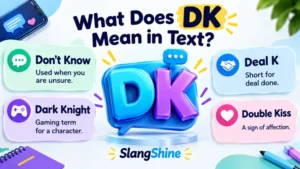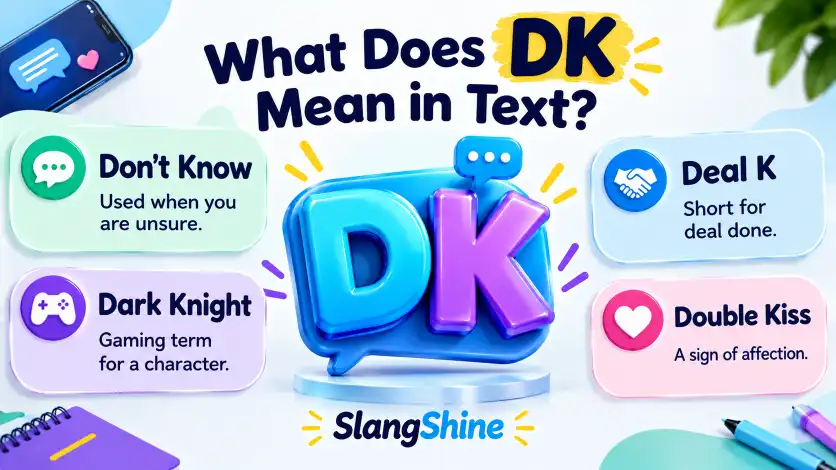
If you are wondering what does DK mean in text, it usually stands for “don’t know” in text messages and online chats. People use it as a short way to say they do not know the answer to a question. It saves time when chatting with friends, family, or other people online on platforms like WhatsApp, Snapchat, and Instagram.
For example, someone might text, “DK what time the party starts.” This means they do not know when the party begins. You may see DK on Snapchat, TikTok, Instagram, WhatsApp, and in regular text messages.
However, the meaning can change depending on the conversation. In some cases, DK may be a person’s initials, a username, or an abbreviation used in a specific community. The surrounding words usually help you understand what the sender means.
What Does DK Mean in Text Messages?
In casual texting, DK often stands for “don’t know.” People use it when they are unsure about something or cannot answer a question.
Instead of typing a full sentence, someone may write DK to keep the conversation short. It is an informal abbreviation, so it fits best in casual chats rather than formal emails or professional documents.
Here are a few examples:
- “DK where she went.”
- “DK what to say.”
- “Sorry, DK the answer.”
- “DK if I’m going tonight.”
Each message shows that the sender does not know something. DK can sound direct because it leaves out extra words. Still, it is not automatically rude. The tone depends on the conversation and the relationship between the people chatting.
What Does DK Stand for?
DK commonly stands for “don’t know” in informal messages. It expresses uncertainty without explaining why the person does not know the answer.
For example, imagine your friend asks, “Is the store open today?” You might reply, “DK, you should check online.” This response means you are unsure if the store is open. People may also use DK when they need more information before making a decision.
For example, “DK which movie to watch” means the sender has not decided which movie to choose. Keep in mind that DK does not have one fixed meaning in every situation. If someone uses it as a name, username, or initials, the intended meaning may be different.
How Is DK Used on TikTok, Snapchat, Instagram, and WhatsApp?
DK can appear on several social media platforms. Its basic meaning usually stays the same, although the conversation may change how it sounds.
DK Meaning on TikTok
On TikTok, people may use DK in comments, captions, or direct messages. It often appears when someone is unsure about a trend, video, or question.
For example:
“DK why this video is so funny.”
This means the person does not know why the video makes them laugh.
DK Meaning on Snapchat
On Snapchat, DK may appear in quick messages between friends. Since Snapchat conversations are often casual, people may use short forms instead of complete sentences.
For example:
“DK what time we’re meeting.”
The sender does not know the meeting time.
DK Meaning on Instagram
On Instagram, people may use DK in direct messages, comments, or replies to Stories.
For example:
“DK who posted this first.”
This means the person does not know who shared the content first.
DK Meaning on WhatsApp
On WhatsApp, DK can be used in personal chats or group conversations. It often helps people answer quickly when they do not have the information someone needs.
For example:
“DK if everyone is coming.”
The sender is unsure if everyone will attend.
DK Meaning in Regular Text Messages
In SMS messages, DK works the same way. It is a quick response when someone asks a question.
For example:
“DK when Dad will be home.”
This means the sender does not know when Dad will return.
10 Real Text Message Examples Using DK
These examples show how DK may appear in everyday conversations. Each one includes a short explanation to make the meaning clear.
Example 1: Asking About Plans
Person A: Are we meeting at 6 or 7?
Person B: DK, I haven’t checked the message.
Meaning: Person B does not know the meeting time yet.
Example 2: Talking About a Friend
Person A: Why is Mia upset?
Person B: DK, she hasn’t told me.
Meaning: Person B does not know why Mia is upset.
Example 3: Choosing a Movie
Person A: What movie should we watch tonight?
Person B: DK, you pick one.
Meaning: Person B is unsure which movie to choose and lets the other person decide.
Example 4: Discussing Homework
Person A: Do we have homework for tomorrow?
Person B: DK, check the class group.
Meaning: Person B does not know if homework was assigned.
Example 5: Asking About an Event
Person A: Who’s coming to the party?
Person B: DK yet. I’ll ask everyone.
Meaning: Person B does not know who will attend but plans to find out.
Example 6: Talking About a Social Media Post
Person A: Who made this meme?
Person B: DK, but it’s hilarious.
Meaning: Person B does not know who created the meme.
Example 7: Making Weekend Plans
Person A: Are you free on Saturday?
Person B: DK yet. I need to check with my family.
Meaning: Person B has not confirmed their plans.
Example 8: Asking for Directions
Person A: Is the café near the station?
Person B: DK, I’ve never been there.
Meaning: Person B cannot confirm the café’s location.
Example 9: Discussing a Surprise
Person A: What did they buy for Alex?
Person B: DK, it’s supposed to be a surprise.
Meaning: Person B does not know what the gift is, or is keeping the surprise secret. The context determines which meaning fits.
Example 10: Talking About the Weather
Person A: Will it rain tomorrow?
Person B: DK, check the forecast.
Meaning: Person B does not know if it will rain.
How to Reply When Someone Says DK
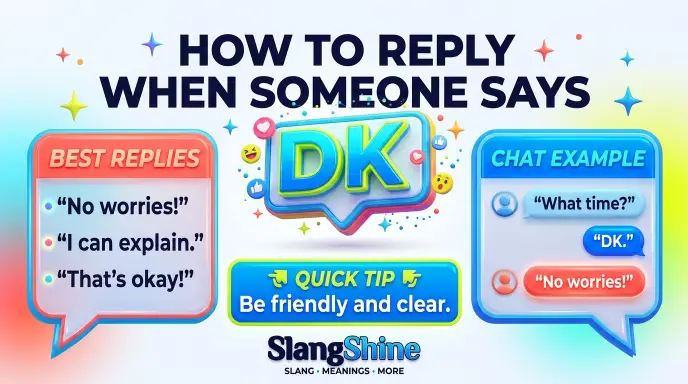
Your reply depends on what the person does not know. In many cases, you can provide the missing information or ask a follow up question.
Casual Replies
Use these responses when chatting with friends:
- “No worries.”
- “That’s okay.”
- “Let’s find out.”
- “I’ll check.”
- “Same here.”
Funny Replies
If the conversation is playful, you could say:
- “Welcome to the club!”
- “Guess we’ll find out.”
- “Mystery remains unsolved.”
- “Time to investigate!”
- “Let’s ask someone who knows.”
Use funny replies when you know the other person will understand your tone.
Friendly Replies
These work well when you want to keep the conversation going:
- “That’s fine. I’ll let you know.”
- “No problem, I’ll check for us.”
- “Let’s ask someone else.”
- “I’ll send you the details when I find out.”
Replies When You Need an Answer
If the information is important, ask a clear follow up question.
For example:
Friend: “DK what time the event starts.”
You: “Can you check with the organizer?”
This keeps the conversation helpful without making the other person feel bad for not knowing.
Is DK Rude or Offensive?
DK is not usually rude or offensive. It is a casual abbreviation that expresses a lack of knowledge. For example, “DK where it is” simply means the sender does not know the location. There is no insult in the phrase itself.
However, a short reply can sometimes sound dismissive. If someone asks an important question and receives only “DK,” they may feel that the sender is not interested in helping. The tone also depends on punctuation and the surrounding conversation.
A friendly message may make the abbreviation feel natural, while an argument can make almost any brief response seem cold. If you want to sound more polite, write “I don’t know, but I’ll check” or “I’m not sure. Let me find out.” These replies communicate uncertainty while showing that you are willing to help.
Who Uses DK in Text Messages?
People use DK in casual digital conversations when they want to say they do not know something. It is not limited to one age group or social media platform.
Common users include:
- Friends: When asking about plans, events, or other people.
- Students: When discussing homework, classes, or school activities.
- Family members: When sharing information or arranging plans.
- Social media users: When replying to comments, messages, or questions.
- Online communities: When answering questions about games, videos, or shared interests.
Although DK is easy to understand in many casual conversations, it may confuse someone who has not seen the abbreviation before. When clarity matters, writing the full phrase is a better choice.
Where Did DK Come From?
DK developed as a short form of “don’t know” in informal communication. Like many text abbreviations, it reduces the number of letters people need to type. Short forms became especially useful as texting and online messaging grew.
People wanted to send quick replies, particularly when using older mobile phones with limited keyboards. Today, abbreviations remain common in chats, even though most phones have full keyboards and autocorrect. People may choose DK because it is quick, familiar, and easy to type.
There is not one confirmed origin that explains every use of DK. Its meaning can also vary across communities, so the context remains important.
DK vs. IDK, IDC, IMO, and BRB
DK is similar to some common texting abbreviations, but each term serves a different purpose.
| Term | Full Form | Meaning in Text |
| DK | Don’t know | Expresses uncertainty |
| IDK | I don’t know | Says the sender does not know |
| IDC | I don’t care | Shows a lack of concern or interest |
| IMO | In my opinion | Introduces a personal view |
| BRB | Be right back | Says the sender will return soon |
The main difference between DK and IDK is that IDK includes the word “I.” Both can communicate the same general idea in casual messages.
For example:
- “DK what happened.” The sender does not know what happened.
- “IDK what happened.” The sender also does not know what happened.
- “IDC what happened.” The sender is saying they do not care what happened.
That last example has a different tone. It may sound dismissive, depending on the situation.
A Real Life Example of DK in Text
Imagine your friend asks you about a school event.
Friend: “Do we have to arrive early tomorrow?”
You: “DK. I haven’t checked the school group yet.”
Friend: “Can you check and tell me?”
You: “Sure, I’ll look now.”
In this conversation, DK means “don’t know.” You are being honest about not having the information yet, and the rest of the message explains what you plan to do.
Now imagine someone sends, “DK who that is.” If the conversation is about a person in a photo, the sender simply means they do not recognize the person. In both cases, the surrounding words make the meaning easier to understand.
Frequently Asked Questions About DK in Text
Q1. What Does DK Mean in Text Messages?
Answer: DK usually means “don’t know.” People use it in casual messages when they are unsure about something or cannot answer a question.
Q2. What Does DK Stand for in Chat?
Answer: In many casual chats, DK stands for “don’t know.” However, it may have another meaning if it is used as someone’s initials, nickname, or username.
Q3. Is DK the Same as IDK?
Answer: They have almost the same meaning. DK means “don’t know,” while IDK means “I don’t know.” Both can express uncertainty in a conversation.
Q4. What Does DK Mean on Snapchat?
Answer: On Snapchat, DK usually means “don’t know.” Friends may use it in quick messages when they do not have an answer or are unsure about plans.
Q5. Is DK Rude in Texting?
Answer: No, DK is not usually rude. However, a very short reply may sound dismissive in some situations. A longer response can sound more helpful and polite.
Q6. What Does DK Mean on TikTok?
Answer: On TikTok, DK may mean “don’t know” in comments, captions, or direct messages. The exact meaning depends on the content and the conversation.
Q7. Can DK Have More Than One Meaning?
Answer: Yes. Although it often means “don’t know” in casual texting, DK can also refer to initials, a nickname, or a username. Context helps you identify the intended meaning.
Q8. How Should I Reply to DK?
Answer: You can say “No worries,” “Let’s find out,” or “I’ll check.” If you need a specific answer, ask the person to look it up or contact someone who knows.
Conclusion
DK usually means “don’t know” in text messages and online chats. People use it to answer questions quickly when they are unsure or do not have enough information. You may see it on TikTok, Snapchat, Instagram, WhatsApp, and in regular SMS conversations.
DK is generally informal and not offensive. Still, a longer reply may be more helpful when the topic is important. If the abbreviation appears in an unusual context, check the surrounding words before deciding what it means.
Learn More About Slang:
- What Does “DJ” Really Mean in Text? (It’s Not Just Disc Jockey)
- What Does DIY Mean in Text? The Meaning Might Surprise You
- DJing Meaning Slang:More Than Just Pressing Play

Hi, I’m Anna Whitmore. I have 7+ years of experience writing about English slang and vocabulary. At SlangShine, I create simple, easy-to-understand content for English learners.