What Does DMI Mean in Text? DMI usually means “Don’t Mention It” in casual text messages. People use this abbreviation when someone thanks them for helping, doing a favor, or sharing something useful. It is a friendly way of saying “You’re welcome” or “No problem.”
However, DMI does not have only one meaning. In finance and technical trading, it can stand for Directional Movement Index or Dynamic Momentum Index. In economics, it can mean Direct Material Input, while some businesses may use it as shorthand for Direct Materials Inventory in internal records.
If you’re searching for What Does DMI Mean in Text, the correct meaning depends on the conversation. When someone sends DMI after you say thank you, they probably mean “Don’t Mention It.” However, if you see it in a trading chart, financial report, or business document, it may have a completely different definition.
What Does DMI Mean in Text?
What Does DMI Mean in Text? In everyday texting, DMI stands for “Don’t Mention It.” It is an informal abbreviation used to respond when someone expresses gratitude. Instead of typing the complete phrase, a person can simply write DMI to show that helping was no trouble.
For example, imagine your friend helps you prepare for an exam. After you thank them for sharing their notes, they reply, “DMI bro, anytime!” They are telling you that you do not need to thank them again because they were happy to help.
The expression is similar to several familiar responses:
- You’re welcome: A polite way to accept someone’s thanks.
- No problem: Shows that helping was not difficult.
- It’s nothing: Suggests that the favor was not a big deal.
- Happy to help: Communicates that the person was glad to assist.
- Anytime: Shows that the person would be willing to help again.
Is DMI Slang, an Acronym, or an Abbreviation?
DMI is an informal texting abbreviation formed from the first letters of “Don’t Mention It.” It is also an initialism because people generally read the letters separately rather than pronounce them as one word.
Unlike common internet expressions such as LOL, BRB, and IDK, DMI is less widely recognized. Some people may understand it immediately, while others may need the surrounding conversation to work out its meaning.
It is mainly suitable for informal digital communication. In a formal email or professional message, writing the complete phrase is usually clearer.
What Does DMI Express in a Conversation?
When someone uses DMI after receiving thanks, they are usually trying to make the other person feel comfortable. They want to communicate that the favor was not an inconvenience.
Depending on the situation, it can express:
- Kindness: The person was happy to help.
- Reassurance: You do not need to feel bad about asking.
- Friendliness: They want to keep the conversation relaxed.
- Appreciation: They value the friendly interaction.
- Willingness to help again: They may be happy to do another favor in the future.
Example:
Person A: Thanks for helping me finish the project!
Person B: DMI! It was fun working with you.
Here, Person B uses DMI to accept the appreciation and show that helping was enjoyable.
Does DMI Have Other Meanings?
Yes. DMI has several meanings outside casual texting. It appears in finance, technical trading, economics, and some business related documents. These definitions are not interchangeable, so the subject of the conversation matters.
Here are some important meanings to recognize:
| Context | Full Form | Real Meaning |
| Casual Texting | Don’t Mention It | A friendly response to thanks |
| Finance / Technical Trading | Directional Movement Index | An indicator used to analyze market trends |
| Technical Trading | Dynamic Momentum Index | An indicator used to assess price momentum |
| Economics / Environmental Studies | Direct Material Input | Materials entering an economy for production and consumption |
| Business / Accounting | Direct Materials Inventory | A possible company specific term for records of direct materials |
1. DMI Meaning in Finance: Directional Movement Index
In technical trading, DMI can stand for Directional Movement Index. It is a technical indicator used to examine the direction and strength of a market trend.
Traders may use it when studying stock prices, currencies, commodities, or other financial markets. It helps them assess if a market is moving upward, moving downward, or showing a weak trend.
Example:
“Check the four hour chart. DMI is showing a bullish crossover.”
In this sentence, DMI does not mean “Don’t Mention It.” The speaker is discussing a trading indicator and possible market movement.
2. DMI Meaning in Technical Analysis: Dynamic Momentum Index
DMI can also stand for Dynamic Momentum Index in technical analysis. This indicator is related to the Relative Strength Index (RSI) and uses a variable calculation period to respond to changes in price movement. Traders may use it to study momentum and identify possible changes in market conditions.
Example:
“The Dynamic Momentum Index is reacting quickly to the recent price movement.”
This meaning belongs to financial chart analysis, not everyday texting.
3. DMI Meaning in Economics: Direct Material Input
In economics and environmental studies, DMI can mean Direct Material Input. It measures the materials entering an economy for production and consumption.
The measurement includes materials extracted domestically for economic use and materials brought in through imports. It helps researchers understand how an economy uses natural resources.
Example:
“The report compares the country’s Direct Material Input with its material consumption.”
Here, DMI refers to an economic measurement rather than a texting expression.
4. DMI Meaning in Business: Direct Materials Inventory
Some businesses may use Direct Materials Inventory as an internal abbreviation when discussing materials needed for production. Direct materials are the raw materials or components that become part of a finished product.
For example, a furniture manufacturer may track wood, metal parts, and other materials used to make its products.
Example:
“We need to update the DMI sheet before the quarterly audit.”
In this example, the writer may be referring to a company specific Direct Materials Inventory sheet. However, this is not a universally established meaning of DMI, so the company’s terminology should be checked.
How Can You Identify the Correct Meaning?
The surrounding words usually provide the best clue.
- If someone thanks you and replies with DMI, it likely means Don’t Mention It.
- If a message discusses a stock chart or market trend, it may mean Directional Movement Index.
- If the conversation discusses momentum indicators, it may mean Dynamic Momentum Index.
- If a report discusses natural resources or imports, it may mean Direct Material Input.
- If a company document discusses production materials or inventory records, it may refer to Direct Materials Inventory.
Remember: The texting meaning is appropriate for casual conversations, but technical and business meanings require their own context.
Where Do People Use DMI in Text Messages?
DMI can appear in different types of digital conversations. It is not exclusive to one social media platform, and its casual meaning generally stays the same across messaging apps. People may use it when responding to thanks, accepting appreciation, or reassuring someone that a favor was not a problem.
DMI on TikTok
On TikTok, DMI may appear in comments or private messages when someone thanks another user for helpful information, advice, or content. For example, a creator might explain how to edit a video. A viewer could thank them for the tutorial, and the creator might respond with DMI.
Example:
Person A: Thanks for explaining how you made this transition!
Person B: DMI! Glad it helped.
The abbreviation is not a TikTok specific feature or a major platform trend. It simply carries its usual texting meaning.
DMI on Snapchat
Snapchat is known for quick conversations between friends. DMI may fit naturally when someone thanks another person for sending pictures, sharing information, or helping with something.
Example:
Person A: Thanks for sending me those pictures.
Person B: DMI, they’re yours!
Here, the sender is saying that sharing the pictures was no trouble.
DMI on Instagram
On Instagram, people may use DMI in direct messages or comment replies. It can appear after someone appreciates a recommendation, helpful response, or small favor.
Example:
Person A: Thanks for helping me choose an outfit!
Person B: DMI! You look great.
It works as a casual response between friends, followers, and people who communicate regularly.
DMI on WhatsApp
WhatsApp conversations often include short forms and informal expressions. DMI can be used in personal chats, family groups, and conversations with classmates or colleagues.
Example:
Person A: Thanks for booking the tickets for everyone.
Person B: DMI, it was easy!
The abbreviation keeps the response short while maintaining a friendly tone.
DMI in SMS Text Messages
DMI can also appear in regular SMS conversations. It does not require an internet based messaging app.
Example:
Person A: Thanks for picking up my package.
Person B: DMI. Happy to help.
In this situation, the abbreviation has the same meaning as it does on social media.
The key point: DMI is not tied to a particular platform. The conversation determines if it means “Don’t Mention It” or something else.
10 Real Chat Examples of DMI in Text Messages
Seeing DMI in realistic conversations makes its meaning easier to understand. In most casual examples, it appears after someone expresses gratitude.
Here are 10 situations showing how people may use it.
Example 1: Helping with Homework
Person A: Thanks for explaining that math question. I finally understand it.
Person B: DMI! Glad I could help.
Meaning: Person B is saying that explaining the question was no trouble.
Example 2: Sharing Important Information
Person A: Thank you for telling me about the meeting time.
Person B: DMI, I didn’t want you to miss it.
Meaning: The person is responding politely after sharing useful information.
Example 3: Helping a Friend
Person A: Thanks for helping me move those boxes yesterday.
Person B: DMI! Anytime you need help.
Meaning: Person B is happy to help and does not consider the favor a burden.
Example 4: Sending Pictures
Person A: These pictures are amazing. Thanks for sending them!
Person B: DMI, I knew you’d like them.
Meaning: The sender is casually accepting the appreciation.
Example 5: Giving Advice
Person A: Thanks for your advice. It really helped me make a decision.
Person B: DMI. I’m glad it worked out.
Meaning: The person is saying that giving advice was no problem.
Example 6: Covering a Work Shift
Person A: Thanks for covering my shift today. I really appreciate it.
Person B: DMI, happy to help when I can.
Meaning: Person B is responding kindly after doing a favor.
Example 7: Sharing Study Notes
Person A: Thanks for sharing your notes before the exam!
Person B: DMI. Good luck with your test!
Meaning: The person does not mind sharing their notes and wishes their friend well.
Example 8: Apologizing for a Small Inconvenience
Person A: Sorry for making you wait while I finished getting ready.
Person B: DMI, I wasn’t in a hurry.
Meaning: Person B is reassuring the other person that the delay was not a problem.
Example 9: Fixing a Technical Problem
Person A: Thank you for fixing my laptop settings.
Person B: DMI! It only took a minute.
Meaning: The person is explaining that helping required very little effort.
Example 10: Supporting Someone
Person A: I really appreciate you listening to me yesterday. Thank you.
Person B: DMI. I’m always here for you.
Meaning: Person B is showing that supporting a friend is something they are happy to do.
These examples show that DMI can fit many everyday situations. The common element is that one person expresses appreciation and the other responds by saying it was no trouble.
How to Reply When Someone Says DMI
If someone sends you DMI, you usually do not need a complicated response. They are simply telling you that helping was not a problem. Your reply can depend on your relationship with the person and the tone of the conversation.
Casual Replies
Casual responses work well when talking to friends, classmates, or people you know well.
- “I appreciate it!”
- “Thanks anyway!”
- “You’re the best!”
- “That’s really kind of you.”
- “Glad you could help!”
Example:
A: Thanks for sharing the link.
B: DMI!
A: Appreciate it!
Funny Replies
If you are talking to a close friend, a little humor can make the conversation more entertaining.
- “Too late, I already mentioned it!”
- “I’ll mention it again tomorrow!”
- “Haha, you’re a lifesaver.”
- “Okay, but I’m thanking you anyway!”
- “Fine, but you’re getting extra appreciation!”
Example:
A: Thanks for buying me lunch!
B: DMI!
A: Too late, you’re getting thanked twice!
Friendly Replies
Friendly responses are useful when you want to show genuine appreciation without making the conversation too serious.
- “That means a lot!”
- “You’re so thoughtful!”
- “I really appreciate your help.”
- “Thanks for always being there.”
- “I’ll return the favor sometime!”
Example:
A: Thanks for helping me prepare for the interview.
B: DMI, you’ve got this!
A: You’re so kind. I appreciate it!
Neutral Replies
Sometimes, a simple acknowledgment is enough. These responses work in everyday conversations where you do not want to sound overly casual or emotional.
- “Okay, thanks!”
- “I appreciate your help.”
- “That’s good to know.”
- “Thanks for understanding.”
- “Much appreciated.”
Example:
A: Thanks for sending the information.
B: DMI.
A: Much appreciated.
Choose a reply that matches the situation. A short response is usually enough with friends, while a more complete sentence may be better when communicating with someone you do not know very well.
Is DMI Rude or Offensive?
No. When DMI means “Don’t Mention It,” it is generally a polite and friendly expression, not an insult or offensive term. People use it to make someone feel comfortable after receiving help or appreciation.
However, the way someone uses an abbreviation can affect how the message feels. A very short response may seem less personal in a serious conversation.
Is DMI Safe to Use with Friends?
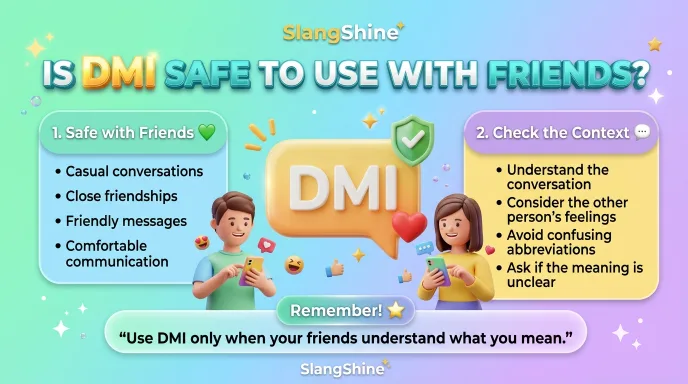
Yes. DMI is suitable for casual conversations with friends, relatives, and people you know well. For example, if a friend thanks you for sharing notes, you can reply, “DMI” It shows that you were happy to help and that they do not need to feel obligated.
Is DMI Appropriate at School?
DMI is generally fine in informal school conversations, especially when messaging classmates or friends. However, when writing to a teacher or communicating in an official school email, it is better to use the complete phrase “Don’t mention it” or a more professional response such as “You’re welcome.”
Can You Use DMI at Work?
You can use DMI in casual workplace chats if your colleagues regularly communicate through abbreviations. For example, a coworker might thank you for sharing a document or helping with a task. A short DMI can be appropriate in a relaxed conversation. For formal emails, client messages, and official communication, use clearer expressions such as:
- “You’re welcome.”
- “Happy to help.”
- “My pleasure.”
- “No problem at all.”
Can DMI Sound Dismissive?
Although DMI is not offensive, it can sometimes sound too brief if someone sends a heartfelt thank you message. For example, if a friend expresses deep appreciation after receiving significant support, replying with only three letters might feel less personal. A warmer response such as “DMI, I’m always here for you” can communicate more care.
Who Uses DMI in Text Messages?
DMI is an informal abbreviation that can be used by different age groups. It is not limited to teenagers or one particular online community. Anyone familiar with texting shorthand may understand or use it when responding to appreciation.
Do Teenagers and Gen Z Use DMI?
Teenagers and Gen Z users are familiar with many short forms because they regularly communicate through messaging apps and social platforms. However, DMI is not as widely recognized as LOL, IDK, BRB, or IMO. Some younger users may understand it, while others may prefer writing “No problem” or “You’re welcome.”
Do Adults Use DMI?
Adults can use DMI in personal conversations, especially when messaging friends, relatives, and colleagues. For example, an adult might use it after helping a family member, sharing information, or completing a small favor.
Which Online Platforms Are Associated with DMI?
DMI is not exclusive to any social media platform. It may appear in different types of digital communication, including:
- WhatsApp: Personal messages and group conversations.
- Instagram: Direct messages and comment replies.
- Snapchat: Casual conversations between friends.
- TikTok: Comments and private messages.
- SMS: Regular text messages between mobile users.
These are possible places to encounter the abbreviation, not evidence that it is trending or frequently used on every platform.
How Popular Is DMI Online?
DMI is a relatively uncommon texting abbreviation compared with widely recognized expressions such as IDK, BRB, and IMO.
People may understand its meaning when the conversation provides enough context, but not everyone will immediately recognize the three letters.
If someone uses DMI, the surrounding message is usually the best way to understand what they intend to say.
What Is the Origin of DMI?
DMI comes from the phrase “Don’t Mention It,” a traditional English expression used when responding to someone’s thanks. It communicates that a favor or helpful action was not a burden. The complete phrase existed in everyday conversation long before people started shortening expressions in digital messages.
How Did DMI Become a Texting Abbreviation?
As text messaging and online chat became popular, people started using shorter forms of everyday expressions. Typing on early mobile phones could take time, so abbreviations offered a convenient way to communicate quickly.
Examples include:
- LOL = Laugh Out Loud
- BRB = Be Right Back
- IDK = I Don’t Know
- TTYL = Talk To You Later
- DMI = Don’t Mention It
These abbreviations helped people communicate without typing complete sentences every time.
Did DMI Originate on Social Media?
There is no clear evidence that DMI originated on TikTok, Instagram, Snapchat, or another specific social media platform. Its texting meaning comes from the everyday phrase “Don’t Mention It” and follows the general pattern of shortening expressions for digital communication.
Is the Original Meaning Still Used Today?
Yes. In casual texting, DMI can still mean “Don’t Mention It.” However, the same letters may have different meanings in specialized fields. If you encounter DMI in a technical report, trading discussion, or business document, do not automatically assume it refers to the texting expression.
DMI vs. IDK, IDC, IMO, and BRB: What’s the Difference?
DMI, IDK, IDC, IMO, and BRB are short forms used in digital communication. However, each one expresses a different message. Some communicate appreciation, while others express uncertainty, personal opinions, or the need to leave a conversation temporarily.
| Abbreviation | Meaning | Type | Usage | Popularity |
| DMI | Don’t Mention It | Abbreviation | Responding to thanks | Less common |
| IDK | I Don’t Know | Initialism | Expressing uncertainty | Very common |
| IDC | I Don’t Care | Initialism | Expressing indifference | Common |
| IMO | In My Opinion | Initialism | Sharing an opinion | Common |
| BRB | Be Right Back | Initialism | Temporarily leaving a chat | Very common |
DMI vs. IDK
DMI means “Don’t Mention It,” while IDK means “I Don’t Know.” People use DMI when responding to someone’s appreciation. In contrast, IDK is used when someone does not have an answer or is unsure about something.
Example:
Person A: Thanks for helping me with my assignment.
Person B: DMI!
Different conversation:
Person A: Do you know when the class starts?
Person B: IDK, maybe at 9.
DMI vs. IDC
DMI is a friendly response to gratitude, whereas IDC means “I Don’t Care.” IDC can communicate indifference, although its tone depends on the situation. DMI usually communicates politeness and reassurance.
Example:
Person A: Thanks for sharing your notes.
Person B: DMI!
Different conversation:
Person A: Which movie should we watch?
Person B: IDC, you can choose.
DMI vs. IMO
DMI means “Don’t Mention It,” while IMO means “In My Opinion.” IMO introduces someone’s personal viewpoint. DMI, on the other hand, acknowledges another person’s thanks.
Example:
Person A: Thanks for recommending that restaurant.
Person B: DMI!
Different conversation:
Person A: Which restaurant has the best food?
Person B: IMO, the Italian one is better.
DMI vs. BRB
DMI is used to respond to appreciation, while BRB means “Be Right Back.” BRB tells someone that the sender is temporarily leaving the conversation but expects to return.
Example:
Person A: Thanks for answering my question.
Person B: DMI!
Different conversation:
Person A: Are you still there?
Person B: BRB, I need to answer the door.
Understanding these differences helps prevent confusion when reading short messages. Although the abbreviations look similar in length, their purposes are completely different.
What Does DMI Mean in Text? Real World Usage Example
Imagine that your friend is preparing for an important school presentation. They are having trouble organizing their slides, so you spend some time helping them arrange the information and correct a few mistakes.
After finishing the work, your friend sends you a message:
Friend: Thank you so much for helping me with my presentation. I couldn’t have finished it without you!
You: DMI! I’m glad I could help.
Friend: Seriously, I appreciate it.
You: No problem. Good luck with your presentation tomorrow!
In this situation, DMI communicates that helping your friend was not an inconvenience. You are also showing that you were happy to support them.
The same expression could work when someone thanks you for giving directions, sharing a useful link, helping with a computer problem, or completing a small favor.
However, if someone sends you a formal thank you email or expresses appreciation for something significant, a more personal response may be more appropriate.
Frequently Asked Questions About What Does DMI Mean in Text
Q1. What does DMI mean in text messages?
Answer: DMI usually means “Don’t Mention It” in casual text messages. It is a friendly abbreviation used when someone thanks you for helping them or doing something for them. It is similar to saying “You’re welcome” or “No problem.”
Q2. What does DMI mean on TikTok?
Answer: On TikTok, DMI generally means “Don’t Mention It.” Someone may use it in comments or direct messages when responding to another person’s appreciation. It is not a TikTok specific abbreviation.
Q3. Is DMI slang?
Answer: Yes. DMI can be considered an informal texting abbreviation because it shortens the phrase “Don’t Mention It.” People may use it in online conversations instead of typing the complete expression.
Q4. Is DMI rude or offensive?
Answer: No. When it means “Don’t Mention It,” DMI is generally polite and friendly. However, it may sound too casual in professional emails or formal conversations, where writing “You’re welcome” is more appropriate.
Q5. How should you reply to DMI?
Answer: You can respond with simple phrases such as “I appreciate it,” “Thanks again,” “You’re so kind,” or “Glad you could help.” Choose a reply that matches your relationship with the person and the conversation.
Q6. What does DMI mean in trading?
Answer: In technical trading, DMI commonly stands for Directional Movement Index. It is an indicator used to study market trends and assess their direction and strength. In some technical analysis sources, DMI can also refer to Dynamic Momentum Index.
Q7. What does DMI mean in economics?
Answer: In economics and environmental studies, DMI can stand for Direct Material Input. It measures the materials entering an economy for production and consumption, including domestic extraction used and imports.
Q8. Does DMI have the same meaning everywhere?
Answer: No. DMI can have different meanings depending on the subject. In casual texting, it can mean “Don’t Mention It,” while in trading it can mean “Directional Movement Index.” Always consider the surrounding conversation before deciding what it means.
Conclusion
What Does DMI Mean in Text? DMI usually means “Don’t Mention It” in casual text messages and online conversations. People use it to respond when someone thanks them for helping, sharing information, or doing a favor. It communicates that their kindness was not a problem.
However, DMI has other meanings in specialized contexts. It can refer to Directional Movement Index or Dynamic Momentum Index in technical trading and Direct Material Input in economics. Some businesses may also use it as an internal abbreviation for Direct Materials Inventory.
You may encounter these meanings in different conversations, reports, and documents. The surrounding context is the best way to identify the correct definition. If someone sends DMI after you thank them, the likely meaning is “Don’t Mention It.”
Learn More About Slang:
- What Does DMD Mean in Text? (“Don’t Mind Do” Slang Explained)
- What Does DMA Mean in Text? Text Slang vs. Digital Marketing
- What Does DMDP Mean in Text? (“Don’t Mind Picture” Slang)

Hi, I’m Anna Whitmore. I have 7+ years of experience writing about English slang and vocabulary. At SlangShine, I create simple, easy-to-understand content for English learners.