
DOMO in text usually means “thank you” or “thanks” in Japanese. It comes from the Japanese word どうも (dōmo), which people can use as a short, casual way to show appreciation. If you’re wondering what does DOMO mean in text, it can also mean “hi,” “hey,” or express a light apology, depending on the situation.
You may see DOMO in text messages, online chats, gaming conversations, social media comments, or messages from people who enjoy Japanese language and culture. It is especially useful when someone wants to give a quick, friendly response without writing a longer thank you message. Knowing what DOMO means in text messages can help you understand the friendly tone behind the expression.
However, DOMO is not a standard English texting acronym like LOL, BRB, or IDK. Its meaning comes from Japanese, and the surrounding conversation helps explain the intended message. Understanding what does DOMO mean in text can help you avoid confusing a casual Japanese expression with an internet abbreviation.
Quick Answer: What Does DOMO Mean in Text?
DOMO usually means “thanks” or “thank you” in Japanese. It is a short, informal expression that people can use to show appreciation for a small favor, helpful action, or kind gesture.
For example:
Person A: I sent you the photos from yesterday.
Person B: Domo!
Here, Person B is saying thanks.
DOMO can also have other meanings in Japanese conversation:
- Thanks: A quick way to show appreciation.
- Hi or hey: A casual greeting when meeting someone.
- Sorry: A light expression of apology in certain phrases.
- Very or greatly: An adverb that adds emphasis to another expression.
- Somehow: A meaning that depends on the sentence and context.
The most important point: DOMO is a flexible Japanese expression, not an abbreviation with one fixed English expansion. In casual messages, it most often communicates a quick thank-you or friendly greeting.
What Does DOMO Stand For in Texting?
Unlike many English texting abbreviations, DOMO does not have a standard full form made from four English words. It is the romanized spelling of the Japanese expression どうも, pronounced dōmo.
People sometimes type DOMO instead of using Japanese characters, especially when communicating with someone who understands Japanese or enjoys Japanese expressions. The word has several uses, but its meaning changes with the situation.
1. DOMO Means Thank You
This is one of the most recognizable uses of DOMO. Someone may send it after receiving help, a gift, information, or a small favor.
Example:
Person A: I saved you a seat.
Person B: Domo!
Meaning: Thanks for saving me a seat.
It is a quick and casual way to express appreciation.
2. DOMO Means Hi or Hey
Japanese speakers may also use DOMO as a casual greeting. It can work when meeting someone familiar or starting a relaxed conversation.
Example:
Person A: Hey, good to see you!
Person B: Domo, how are you?
Meaning: Person B is using DOMO as a friendly greeting.
3. DOMO Can Add Emphasis
In Japanese, DOMO can work as an adverb that adds emphasis to another expression. For example, it appears in phrases that communicate stronger gratitude or apology.
Example:
Person A: Thank you so much for helping me.
Person B: Domo arigato!
Meaning: Thank you very much.
These uses explain why the same word can communicate different feelings in different conversations.
How Is DOMO Used in Text Messages?
People may use DOMO as a short response when they want to thank someone or greet them casually. It can also appear in conversations about Japanese culture, anime, games, and language learning. Here are some realistic examples to make the meaning easier to understand.
Example 1: Thanking Someone for Help
Person A: I fixed the problem with your laptop.
Person B: Domo!
Meaning: Person B is thanking the other person for fixing the laptop.
Example 2: Receiving a Picture
Person A: Here is the picture you asked me to send.
Person B: Domo, it looks great!
Meaning: Person B is saying thanks and showing appreciation for the picture.
Example 3: Starting a Friendly Conversation
Person A: Domo! Long time no see.
Person B: Hey! How have you been?
Meaning: DOMO is being used as a casual greeting.
Example 4: Thanking a Gaming Friend
Person A: I dropped some extra supplies for you.
Person B: Domo! That really helps.
Meaning: The person is thanking their teammate for sharing useful items.
Example 5: Responding to a Small Favor
Person A: I held the door open for you.
Person B: Domo, appreciate it!
Meaning: Person B is expressing quick gratitude.
Example 6: Talking About Japanese Culture
Person A: I learned a new Japanese word today.
Person B: Nice! What word?
Person A: Domo.
Person B: That’s a useful one!
Meaning: The conversation is about the Japanese expression itself, not a special texting abbreviation.
Example 7: Thanking Someone for a Gift
Person A: I bought you a small birthday gift.
Person B: Domo! You didn’t have to do that.
Meaning: Person B is showing appreciation for the gift.
Example 8: A Quick Reply After Receiving Information
Person A: The meeting starts at 10 tomorrow.
Person B: Domo!
Meaning: Person B is acknowledging the information and thanking the sender.
These examples show that DOMO can make a conversation feel short and friendly. However, it is useful to remember that not every English-speaking person will recognize the expression immediately.
What Does DOMO Mean on Snapchat, TikTok, and Instagram?
DOMO does not have a separate official meaning on Snapchat, TikTok, or Instagram. Its Japanese meaning generally stays the same across these platforms. The difference comes from the type of conversation and the people using it.
DOMO on Snapchat
On Snapchat, DOMO may appear in private messages, snaps, or conversations between friends. Someone might use it to thank a friend for sending a picture, sharing information, or helping with something.
Example:
Friend: I sent you the video from the party.
You: Domo! I’ll watch it now.
Here, DOMO means thanks.
It can also work as a casual greeting when someone starts a conversation. However, if your friend does not know Japanese expressions, they might ask what you mean.
DOMO on TikTok
On TikTok, people may use DOMO in comments, replies, or conversations about Japanese language and entertainment. It may appear under videos about anime, Japanese culture, travel, or language learning.
Example:
Creator: Thanks for supporting my videos!
Comment: Domo!
In this example, the commenter is expressing appreciation. The expression may also appear in discussions about Japanese phrases. It should not be confused with a special TikTok feature or an official platform abbreviation.
DOMO on Instagram
On Instagram, DOMO may appear in direct messages, comments, or replies. People can use it to thank someone for sharing a post, sending a photo, or giving them a compliment.
Example:
Person A: I shared your artwork on my story.
Person B: Domo! Thanks for the support.
Here, DOMO communicates appreciation.
Remember: On all three platforms, DOMO usually carries its Japanese meaning. It does not automatically become a different slang term just because someone uses it on social media.
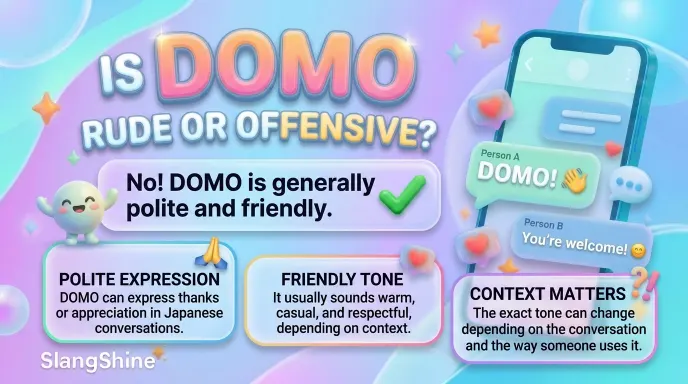
Is DOMO Rude or Offensive?
DOMO is not generally a rude or offensive expression. It is often friendly and polite enough for small, casual interactions. However, its level of politeness depends on the situation and the way someone uses it.
For example, using DOMO to thank a friend for sharing a picture is usually harmless. Using only DOMO in a serious apology or a formal business conversation may sound too casual.
When DOMO Sounds Friendly
People can use DOMO to express simple gratitude or greet someone they know.
Example:
Person A: I brought you your favorite snack.
Person B: Domo! That’s so kind of you.
This sounds warm and appreciative.
When DOMO May Sound Too Casual
In Japanese communication, the relationship between speakers matters. A short DOMO may not be respectful enough for a formal situation, a senior colleague, or someone who deserves a more complete expression of gratitude.
Example:
Person A: Thank you for attending the official meeting.
Person B: Domo.
The reply may sound too brief for a formal setting. A fuller and more polite expression would be better.
When DOMO Is Used as an Apology
DOMO can appear in Japanese apology phrases, such as dōmo sumimasen. However, using DOMO alone to apologize may not communicate enough seriousness.
For example:
Person A: You accidentally damaged my notebook.
Person B: Domo.
This may not sound like a complete or sincere apology.
A more appropriate Japanese expression would be dōmo sumimasen, which communicates an apology more clearly.
The takeaway: DOMO is generally friendly, but it is best suited to casual situations. Use a fuller expression when you need to show formal respect or offer a serious apology.
What Is the Difference Between DOMO, ARIGATO, and DOMO ARIGATO?
DOMO and ARIGATO are both Japanese expressions connected with gratitude, but they are not identical. Understanding their differences makes it easier to use them correctly.
DOMO
DOMO is a short and casual expression that can mean thanks. It may also be used as a greeting or as an intensifier in a longer phrase.
Example:
Person A: I brought your notebook.
Person B: Domo!
This is a quick thank-you.
ARIGATO
ARIGATO means thank you in Japanese. It is a more direct expression of gratitude than DOMO alone.
Example:
Person A: I helped you with your homework.
Person B: Arigato!
Here, the person is directly thanking their friend.
DOMO ARIGATO
In Japanese, this phrase expresses deep gratitude, meaning thank you very much or thanks a lot. The word domo adds extra emphasis to arigato.
Example:
Person A: I stayed late to help you finish the project.
Person B: Domo arigato!
The reply expresses stronger appreciation.
Quick Comparison
| Japanese expression | English meaning | General tone |
| DOMO | Thanks / Hi | Casual |
| ARIGATO | Thank you | Friendly |
| DOMO ARIGATO | Thank you very much | More emphatic |
| ARIGATO GOZAIMASU | Thank you | Polite |
| DOMO ARIGATO GOZAIMASU | Thank you very much | More polite and emphatic |
Important: These expressions are not always interchangeable. If you are thanking someone in a formal situation, ARIGATO GOZAIMASU or DOMO ARIGATO GOZAIMASU is generally a safer choice than DOMO alone.
How to Reply When Someone Says DOMO
Your response depends on the meaning of DOMO in the conversation. If someone uses it to thank you, you can acknowledge their gratitude. If they use it as a greeting, you can simply greet them back.
Here are some natural responses.
1. “You’re Welcome!”
Use this when someone sends DOMO to thank you.
Example:
A: I sent you the notes.
B: Domo!
A: You’re welcome!
2. “No Problem!”
This is a friendly response after doing someone a small favor.
Example:
Person A: Thanks for helping me today.
Person B: No problem!
3. “Anytime!”
Use this when you are happy to help again.
Example:
Person A: Domo for explaining the lesson.
Person B: Anytime! Glad I could help.
4. “Hi! How Are You?”
If someone uses DOMO as a greeting, respond with a friendly hello.
Example:
Person A: Domo!
Person B: Hi! How are you doing?
5. “You’re Very Welcome!”
This works when someone is expressing strong appreciation.
Example:
Person A: Domo arigato!
Person B: You’re very welcome!
6. “Dou Itashimashite!”
This is a Japanese expression that means you’re welcome.
Example:
Person A: Domo arigato!
Person B: Dou itashimashite!
This response is useful if both people are comfortable using Japanese.
7. “Glad I Could Help!”
Use this when someone thanks you for providing assistance.
Example:
Person A: Domo! I really needed that information.
Person B: Glad I could help!
You do not need to reply in Japanese every time someone says DOMO. A simple English response is perfectly fine if that feels more natural.
Why Do People Use DOMO in Online Conversations?
People may use DOMO because it is short, friendly, and connected with Japanese language and culture. It can also make a casual conversation feel more personal.
Here are some common reasons behind its use.
1. To Say Thanks Quickly
A person may type DOMO instead of writing a longer thank you message. It works well after receiving a small favor or helpful information.
2. To Use Japanese Expressions
People who study Japanese or enjoy Japanese entertainment may naturally include words such as DOMO and ARIGATO in their conversations.
3. To Sound Friendly
DOMO can make a short response feel warm and relaxed, especially when the people involved already understand the expression.
4. To Show Interest in Japanese Culture
Someone may use DOMO because they enjoy Japanese language, travel, anime, music, or other cultural content. The expression can become part of their everyday online vocabulary.
5. To Keep Messages Short
A single word can communicate appreciation without requiring a long reply. This can be useful in quick chats and gaming conversations. However, DOMO is not a universal texting abbreviation. Its use is more connected with Japanese vocabulary than with general English internet slang.
Other Meanings of DOMO You Should Know
Although DOMO is commonly understood as a Japanese expression, the same letters can appear in other contexts. It is important to look at the subject of the conversation before deciding what someone means.
1. DOMO as a Japanese Expression
This is the main meaning discussed in this article. It can communicate thanks, a greeting, an apology in a longer phrase, or emphasis.
2. DOMO as a Business Name
DOMO is also the name of a business intelligence and data analytics software company. In a conversation about dashboards, business reporting, or workplace technology, DOMO may refer to that company or its platform.
Example:
Person A: Our team uses DOMO to view business reports.
Person B: Does it show sales performance too?
Here, DOMO refers to the software platform, not the Japanese expression.
3. DOMO in Online Communities
Some people may use DOMO as a username, character name, brand name, or part of a community specific phrase. These uses do not necessarily have the same meaning as the Japanese word.
Example:
Person A: I saw someone named DOMO in the game lobby.
Person B: That might be their username.
In this case, DOMO is simply a name. The easiest way to understand it: If the conversation involves gratitude or Japanese language, DOMO probably refers to the Japanese expression. If it involves software, business reports, or an online identity, it may refer to something else.
Common Mistakes People Make About What DOMO Means in Text
People sometimes misunderstand DOMO because it can be used in several ways. These are some common mistakes worth avoiding.
Mistake 1: Thinking DOMO Is an English Acronym
DOMO is not normally an English abbreviation made from four separate words. It is a romanized Japanese expression.
Mistake 2: Assuming DOMO Only Means Thank You
Although DOMO can mean thanks, it can also work as a greeting or add emphasis to another Japanese expression.
Mistake 3: Confusing DOMO With ARIGATO
Both expressions can communicate gratitude, but they are different Japanese words. DOMO alone is generally more casual and flexible.
Mistake 4: Using DOMO in Every Formal Situation
DOMO alone may sound too casual when speaking to a supervisor, teacher, client, or someone you need to address respectfully.
Mistake 5: Assuming Everyone Understands It
Many English speakers may not know what DOMO means. If you are unsure, using “thanks” or “thank you” will make your message clearer.
FAQs About What Does Domo Mean in Text
Q1. What does DOMO mean in a text message?
Answer: DOMO usually means “thanks” or “thank you” in Japanese. It can also be used as a casual greeting meaning “hi” or “hey,” depending on the conversation.
Q2. Is DOMO a Japanese word?
Answer: Yes. DOMO is the romanized form of the Japanese word どうも (dōmo). It has several uses, including expressing gratitude, greeting someone, and adding emphasis to another expression.
Q3. Does DOMO mean thank you very much?
Answer: DOMO alone can mean a casual “thanks.” The phrase DOMO ARIGATO means “thank you very much” or “thanks a lot” because DOMO adds emphasis to ARIGATO.
Q4. What does DOMO mean on Snapchat?
Answer: On Snapchat, DOMO generally carries its Japanese meaning. Someone may use it to say thanks after receiving a picture, message, or favor. It can also work as a casual greeting.
Q5. What does DOMO mean on TikTok?
Answer: On TikTok, DOMO may appear in comments or replies as a way to express thanks. It can also appear in videos and discussions about Japanese language, anime, or culture.
Q6. Is DOMO rude in Japanese?
Answer: DOMO is not automatically rude, but it is casual. It may sound too brief or informal in serious situations. A fuller expression, such as ARIGATO GOZAIMASU, is more suitable when you want to show politeness.
Q7. What is the difference between DOMO and ARIGATO?
Answer: DOMO is a flexible Japanese expression that can mean thanks or serve as a greeting. ARIGATO directly means thank you. DOMO ARIGATO combines the two to express stronger gratitude.
Q8. How should I reply when someone says DOMO?
Answer: If someone uses DOMO to thank you, you can reply with “You’re welcome,” “No problem,” or “Anytime.” If they use it as a greeting, respond with “Hi” or “Hey.”
Conclusion:
DOMO in text usually means “thanks” or “thank you” in Japanese. It is a short, casual expression that can also mean “hi,” “hey,” or add emphasis to another phrase, depending on the situation. If you’re searching for what does DOMO mean in text, its intended meaning depends on how someone uses it.
You may encounter it in private messages, gaming chats, Snapchat conversations, TikTok comments, Instagram DMs, and discussions about Japanese culture. Although it is friendly and easy to use in casual situations, DOMO alone may not be the best choice for formal conversations.
Remember the difference between DOMO, ARIGATO, and DOMO ARIGATO: DOMO is a flexible casual expression, ARIGATO means thank you, and DOMO ARIGATO means thank you very much.
Explore More Texting Slang:
- What DOM Means in Text? The Meaning Behind This Short Form
- What Does DOI Mean in Text? Real Meaning & Uses [Quick Guide]
- What Does DOH Mean in Text? The Meaning Behind It (2026 Guide)

Hi, I’m Anna Whitmore. I have 7+ years of experience writing about English slang and vocabulary. At SlangShine, I create simple, easy-to-understand content for English learners.