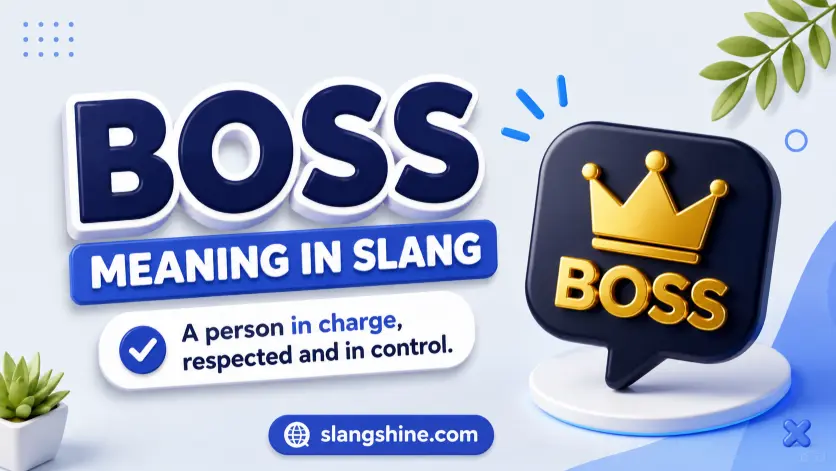
When you search for boss meaning slang, it usually means excellent, impressive, confident, or highly capable. In casual speech, “boss” can also be a friendly way to address someone, while its standard meaning is a manager or person in charge.
For example, if someone says, “That was a boss move,” they are praising the action. If they text “Thanks, boss,” they may simply be using “boss” like “mate” or “man.”
In gaming, however, a boss usually means a powerful enemy that players must defeat.The meaning can change depending on the sentence and tone.
This guide explains boss meaning slang in UK English, texting, chat, social media, and everyday conversation.
You will also learn what it means when someone calls you “boss,” if it is a compliment, and how the word differs from “bossy.”
Quick Answer: Boss Meaning Slang
In slang, “boss” usually means very good, impressive, confident, or skilled. It can also be a friendly form of address, as in “Thanks, boss.” The standard meaning is still a manager or person in charge, so context and tone tell you which meaning is intended.
What Does Boss Mean in Slang?
The slang meaning of boss is usually someone or something that is impressive, excellent, confident, or highly capable.
For example:
“That new car is boss.”
This means the car is really good, cool, or impressive.
You can also use it for a person:
“She handled that situation like a boss.”
This suggests that she handled it confidently and successfully.
The slang use is normally positive. It shows approval or admiration rather than simply describing someone’s job or position.
Boss Can Have Several Meanings
| Example | Meaning |
| “My boss called me.” | My manager called me. |
| “That car is boss.” | That car is excellent or cool. |
| “You’re a boss.” | You are impressive or capable. |
| “Thanks, boss.” | Friendly way to address someone. |
| “Beat the boss.” | Defeat the major enemy in a game. |
Context matters more than the word by itself.
What Does Boss Mean in UK Slang?
In UK slang, “boss” can mean very good, excellent, or impressive.
For example:
“That was a boss night.”
Means:
“That was a really good night.”
The slang adjective is especially associated with Liverpool and Scouse speech, where “boss” is commonly used to mean something like brilliant or excellent.
However, this use is not limited to Liverpool and can be understood more broadly in UK English.
So if someone in Britain says:
“That’s boss!”
They may simply mean:
“That’s brilliant!”
The popularity of the expression can vary by region, age, and social group.
What Does It Mean When Someone Calls You “Boss”?
When someone calls you “boss” in slang, they may be showing friendliness, respect, or approval. It does not automatically mean you are their actual manager.
For example:
“Thanks, boss.”
This can simply mean:
“Thanks, mate.”
Another example is:
“Nice one, boss.”
This can be a friendly way to thank or praise someone.
There is a difference between:
“Thanks, boss.”
And:
“You’re a boss.”
The first usually addresses the person casually. The second normally praises the person’s ability, confidence, or success.
Tone matters too. Someone saying:
“Okay, boss.”
might be genuinely respectful, playful, or sarcastic. If the person clearly disagrees with you, “Okay, boss” can mean something closer to “Sure, you’re in charge” rather than a real compliment.
What Does Boss Mean in Chat?
In chat, boss can mean excellent, impressive, or capable, but it can also simply be a casual form of address.
Here are some common examples:
“That’s boss!”
Meaning: That’s excellent!
“You’re a boss.”
Meaning: You’re impressive or capable.
“Thanks, boss!”
Meaning: Thanks, mate or friend.
“Boss move.”
Meaning: An impressive or confident action.
“Okay, boss.”
Meaning: This can be friendly or sarcastic depending on the conversation.
This is why reading only the word boss is not enough. Look at the words around it and consider the relationship between the people chatting.
Is Boss a Compliment?
Yes, slang “boss” is usually a compliment.
When someone calls a person a boss or says something is boss, they are generally expressing approval.
For example:
“You fixed the problem in five minutes. You’re a boss.”
The speaker is praising the person’s skill.
Similarly:
“That was a boss move.”
means the action was smart, confident, or impressive.
However, “Okay, boss” can be different. It may be friendly, but it can also be sarcastic. The words alone do not determine the tone.
What Does “You’re a Boss” Mean?
“You’re a boss” usually means you are confident, capable, successful, or impressive.
For example:
“You got the whole project finished early. You’re a boss!”
This is a clear compliment.
It does not mean:
“You are my manager.”
Instead, the speaker is praising what you did.
The expression can be used when someone:
- Does a difficult task well
- Stays calm under pressure
- Solves a problem
- Wins a competition
- Makes a smart decision
- Handles an awkward situation confidently
It is informal, so it works better in casual conversations than formal writing.
Boss vs. Bossy: What’s the Difference?
“Boss” and “bossy” have very different meanings.
Boss can be positive when it describes someone as capable, impressive, or confident.
Bossy is usually negative. It describes someone who keeps telling other people what to do or acts as though they are in charge.
For example:
“She’s a boss.”
This can mean she is strong, capable, or impressive.
But:
“She’s bossy.”
means she tries to control other people or gives too many orders.
So calling someone a boss is often praise, while calling them bossy can be criticism.
What Is a Slang Word for “Boss”?
If you mean “boss” as a manager or person in charge, some informal alternatives include:
- Chief
- Big boss
- Head honcho
- Top dog
- The man
These are not perfect synonyms in every situation.
For example, “chief” can be a casual form of address, while “top dog” usually emphasizes being the person with the most power or influence.
If you mean boss as “excellent,” the alternatives are different. Depending on the context, people might say:
- Awesome
- Cool
- Amazing
- Ace
- Legendary
The best alternative depends on if you are describing a person in charge, an impressive person, or something excellent.
Where Is Boss Slang Commonly Used?
The slang use of boss appears mainly in informal communication.
You may encounter it in:
- Text messages
- Social media comments
- Online chats
- Gaming communities
- Friendly conversations
- British English
- Casual workplace conversations
On social media, someone might comment:
“Boss outfit!”
meaning the outfit looks excellent or impressive.
In a chat, someone might write:
“Thanks, boss.”
As a friendly way to address another person.
The word is not restricted to one platform. The context and relationship between speakers matter more than if the message appears on TikTok, Instagram, Discord, or in a normal text.
Is Boss Used in Gen Z Slang?
Boss is not a uniquely Gen Z slang word.
The informal meaning of boss = excellent is older than Gen Z. Modern users may still use it in texts, social media, memes, and online conversations, but that does not make it a new Gen Z invention.
Some current users may use it in a playful or ironic way, especially in casual chats.
For example:
“Okay, boss 😭”
could be playful or sarcastic.
Meanwhile:
“That’s boss!”
is simply an informal compliment.
So boss is better described as older slang that remains usable today, rather than as a Gen Z-only expression.
What Does Boss Mean in Gaming?
In gaming, boss usually means a powerful enemy that players must defeat.
For example:
“The final boss was so difficult.”
Here, boss does not mean “excellent.” It refers to a major opponent, often one that is harder to defeat than ordinary enemies.
However, gamers can use both meanings in the same conversation:
“That boss was hard, but your strategy was boss.”
The first boss means a powerful enemy.
The second boss means excellent or impressive.
This distinction is useful because gaming communities commonly use the standard gaming meaning alongside informal slang.
Is Boss Rude or Offensive?
No, slang “boss” is generally harmless and positive.
Calling someone “boss” is usually friendly, respectful, or complimentary. Saying something is “boss” normally means you think it is excellent.
The main exception is tone.
For example:
“Thanks, boss!”
is usually friendly.
But:
“Okay, boss.”
could be sarcastic if the speaker is annoyed or does not agree with you.
So the word itself is not normally offensive. The attitude behind the phrase determines if it sounds sincere, playful, or sarcastic.
Why Do People Use “Boss” as Slang?
People use boss as slang because it is a quick, friendly way to show approval, confidence, or respect.
Instead of saying:
“That was an excellent decision.”
someone might casually say:
“Boss move.”
Likewise, instead of:
“You handled that very well.”
A friend might say:
“You bossed it.”
When boss is used to address someone, it can also make a conversation feel relaxed and friendly:
“Thanks, boss. I appreciate it.”
The exact feeling depends on the relationship and tone. Among friends, it may sound warm and playful. Between strangers, it can simply be a casual form of respect.
Common Boss Slang Phrases
Several expressions use boss in slightly different ways. Understanding these phrases makes the slang easier to recognize in texts and conversations.
“Boss Move”
A “boss move” means an impressive, confident, or smart action.
“Booking the tickets early was a boss move.”
The speaker is praising the decision.
It does not mean that the person is literally someone’s boss.
“Like a Boss”
“Like a boss” means doing something confidently, successfully, or skillfully.
“She walked into the meeting like a boss.”
This suggests that she appeared confident and in control.
The phrase became especially common through internet culture and memes, but people also use it in everyday informal speech.
“Bossing It”
“Bossing it” means doing something very well or handling a situation successfully.
“You’re bossing it at your new job.”
This means:
“You’re doing really well.”
It is informal and works better in casual conversation than in formal writing.
“Thanks, Boss” vs. “You’re a Boss” vs. “That’s Boss”
These expressions look similar, but they do not mean exactly the same thing.
| Expression | Meaning |
| “Thanks, boss.” | A friendly way to address someone |
| “You’re a boss.” | You are impressive, capable, or confident |
| “That’s boss.” | That is excellent or cool |
| “Boss move.” | An impressive or confident action |
| “Okay, boss.” | Can be friendly, playful, or sarcastic |
This distinction is especially useful in texting and chat, where you cannot always hear the speaker’s tone.
Is “Boss” Appropriate at Work?
The normal word boss is completely appropriate at work when you mean your manager or supervisor.
For example:
“I need to ask my boss about the schedule.”
That is standard English.
The slang uses are different. Calling a coworker:
“You’re a boss!”
may be perfectly fine in a relaxed workplace, but it can sound too casual in a formal setting.
Similarly:
“That was a boss move.”
is suitable for an informal conversation but would usually sound out of place in a formal report.
Better choices for formal situations
Instead of slang, you can use:
- Excellent
- Impressive
- Well handled
- Effective
- A smart decision
The slang is not offensive, but formal communication usually benefits from clearer and more professional wording.
When Should You Avoid Using “Boss” as Slang?
You should avoid slang boss when the situation requires formal or neutral language.
This includes:
- Formal business emails
- Academic writing
- Job applications
- Official documents
- Legal writing
- Professional reports
- Formal presentations
You should also be careful with “Okay, boss” when speaking to someone you do not know well. Without the right tone, it can sound sarcastic or disrespectful.
In a formal situation, instead of:
“Okay, boss.”
You could say:
“Understood.”
That communicates the same basic response without the risk of sounding sarcastic.
What Is the Origin of Boss Slang?
The history of boss is older and more interesting than simply saying that it became slang in the 1950s.
The English word boss comes from Dutch baas, meaning a master or person in charge. The standard meaning connected with a person who directs or manages others developed in American English.
Historical sources also record an informal adjective use of boss meaning excellent or first-rate much earlier than modern Gen Z slang.
The slang adjective later saw periods of renewed popularity, including during the 1950s and 1970s.
This is why it is better to describe “boss = excellent” as an older slang sense that became popular again at different times, rather than calling it a newly invented modern expression.
The exact history of slang can vary depending on if a source is discussing the word’s first appearance, its first recorded slang use, or a period when it became widely popular.
Keeping those points separate avoids the common mistake of assigning the entire slang meaning to one decade.
Is “The Boss” a Slang Expression?
“The Boss” can be a nickname or informal expression, but it is not the same as the general slang meaning of boss.
For example, Bruce Springsteen is famously known as “The Boss.” The nickname is connected with his career and public identity, rather than being the origin of the general slang meaning of “boss.”
In everyday speech, “the boss” can also simply mean the person who is in charge:
“Ask the boss first.”
That is the standard meaning, not necessarily slang.
Is Boss Slang Still Used in 2026?
Yes, but its popularity depends on the speaker, region, and context.
“Boss” is not as clearly tied to one generation as newer internet slang. Some people use it naturally, while others may find it old-school, regional, or playful.
In modern online conversations, you may also see it used ironically:
“Okay, boss 😂”
Or:
“Look at you, boss!”
The expression can therefore feel different from the straightforward compliment:
“That’s boss!”
There is no need to label the word as outdated simply because newer slang exists. It remains understandable and usable, especially in informal speech.
Real-Life Examples of Boss Slang
Friendly Conversation
A: “I got the last table at the restaurant.”
B: “Boss! Nice one.”
Here, “boss” expresses approval.
Text Message
A: “I sent you the files.”
B: “Thanks, boss.”
Here, it is a casual form of address.
Social Media
“That jacket is boss 🔥”
Here, the speaker means the jacket looks excellent or impressive.
Gaming
“We finally beat the final boss.”
Here, boss means a powerful game enemy.
Praising a Decision
“You saved money by booking early. Boss move.”
Here, boss move means a smart or impressive decision.
Sarcastic Use
A: “Do exactly what I said.”
B: “Okay, boss.”
Depending on the tone, this can be playful or sarcastic rather than respectful.
Common Misunderstandings About Boss
“Boss” always means a manager.
No. In standard English, boss can mean a manager, but in slang it can mean excellent or impressive. It can also be a casual way to address someone.
“You’re a boss” means you own a company.
No. In slang, “you’re a boss” usually praises someone’s confidence, ability, or success.
“Boss” is Gen Z slang.
No. The slang sense is much older than Gen Z. Modern users may still use it, but it is not a Gen Z invention.
“Boss” is always positive.
Usually, slang boss is positive. However, expressions such as “Okay, boss” can become sarcastic depending on tone and context.
“Boss” and “bossy” mean the same thing.
No. Boss can be a compliment, while bossy usually describes someone who is overly controlling or constantly tells others what to do.
“Boss” means the same thing in gaming and slang.
No. A gaming boss is a major enemy. Slang boss can mean excellent, impressive, or capable.
Frequently Asked Questions
Q1. What does boss mean in slang?
Answer: Boss usually means excellent, impressive, confident, or highly capable when used as slang. It can also be a friendly way to address someone, depending on the context.
Q2. What does “boss” mean in UK slang?
Answer: In UK slang, boss can mean very good, excellent, or brilliant. The expression is especially associated with Liverpool and Scouse speech, although the meaning is understood beyond Liverpool too.
Q3. What does it mean when someone calls you boss?
Answer: When someone calls you “boss,” they may be showing friendliness, respect, or approval. “Thanks, boss” usually works as a casual form of address, while “You’re a boss” is more clearly a compliment.
Q4. What does boss mean in chat?
Answer: In chat, boss can mean excellent or impressive, as in “That’s boss!” It can also simply address someone casually, as in “Thanks, boss.” “Okay, boss” may be friendly or sarcastic depending on the conversation.
Q5. What is a slang word for boss?
Answer: Informal alternatives for boss as a person in charge include chief, head honcho, top dog, and big boss. If you mean boss as “excellent,” words such as awesome, cool, ace, or amazing may fit better.
Q6. Is boss Gen Z slang?
Answer: No, boss is not uniquely Gen Z slang. The slang meaning of “boss” as excellent or impressive is much older, although younger users may still use it in casual chats and online conversations.
Conclusion
The main boss meaning slang is excellent, impressive, capable, or confident. It is generally a positive expression, but the tone can change when someone uses it as a form of address.
For example, “That’s boss” means something is excellent, while “Thanks, boss” is usually a friendly way to address someone.
“You’re a boss” praises someone’s ability or confidence, and “boss move” describes an impressive action.
In UK slang, particularly in Liverpool and Scouse speech, boss can mean brilliant or very good. The word is also common in gaming, where it has a completely different meaning: a powerful enemy.
The easiest rule is to look at the surrounding words and the situation. If “boss” is praising a person or thing, it probably means impressive or excellent.
If someone says “Thanks, boss,” it is probably a friendly form of address. And if a gamer says “final boss,” they mean an enemy, not a compliment.
More Slang Meanings:
- Slang for 1000 Dollars: Common Terms & Meanings in 2026
- Grass Meaning Slang: What It Really Means in 2k26
- Slang for Cars in 2026: What Gen Z Calls Cars,Explained

Hi, I’m Anna Whitmore. I have 7+ years of experience writing about English slang and vocabulary. At SlangShine, I create simple, easy-to-understand content for English learners.