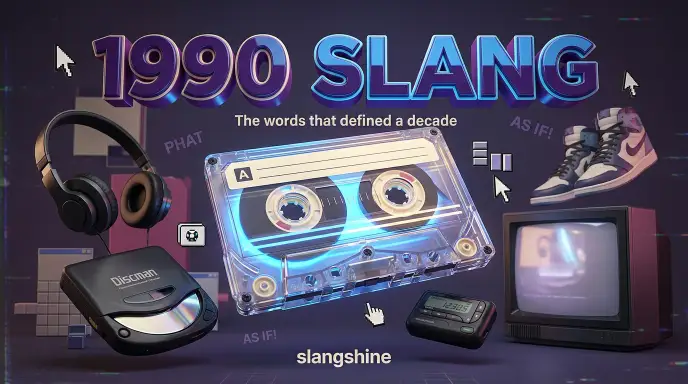
1990 slang refers to the informal words, phrases, and expressions that became popular during the 1990s. Some came from youth culture, music, television, movies, and street language, while others had been around earlier but became widely used during the decade.
Common examples include “all that,” “as if!,” “da bomb,” “phat,” “talk to the hand,” “whatever,” and “my bad.”
The 1990s had a distinct style of communication. People used short, playful, and expressive phrases to show excitement, disagreement, approval, or attitude.
Many of these expressions still appear online today, especially in nostalgic posts and discussions about 1990s culture.
Quick Answer: What Is 1990 Slang?
1990 slang refers to informal words and phrases popular in the 1990s, such as “da bomb,” “as if!,” “my bad,” “phat,” and “whatever.” Some are still used today, while others are mainly linked to 1990s nostalgia.
What Does 1990 Slang Mean?
1990 slang means informal language associated with the 1990s. It was not one single form of slang.
Different groups used different expressions depending on age, location, music taste, and social background.
For example, a teenager might call something “da bomb” to say it was excellent. Someone who wanted to reject an idea might simply say “whatever.”
The phrase “my bad” could be used to admit a small mistake.
Some expressions were strongly connected with American pop culture. Others were popular in particular communities or regions.
It is also important to remember that not every slang word used in the 1990s was created during that decade.
Some expressions existed earlier but became more noticeable or mainstream during the 1990s.
Popular 1990 Slang Words and Phrases
The 1990s produced many expressions that are now strongly associated with the decade. Here are some of the most recognizable examples.
1. All That
“All that” could describe someone or something considered impressive, attractive, or important.
Example:
“Everyone thinks she’s all that.”
The phrase could also appear as “all that and a bag of chips,” a humorous way to say someone thought they were especially impressive.
2. As If!
“As if!” was a sarcastic way to reject something or show disbelief.
The expression became especially recognizable through 1990s teen culture and the movie Clueless.
Example:
“You think I would go there with you? As if!”
Today, people may use it jokingly when imitating 1990s speech.
3. Da Bomb
“Da bomb” meant something was excellent, exciting, or highly impressive.
It was an informal variation of “the bomb.”
Example:
“That new song is da bomb.”
The expression was especially common in casual speech and youth culture.
4. Phat
“Phat” was a slang spelling used to describe something excellent, stylish, or impressive.
Example:
“Those shoes are phat.”
The word is often associated with 1990s hip-hop and youth culture. Its spelling made it visually distinctive, but the meaning depended on context.
5. Talk to the Hand
“Talk to the hand” was a dismissive phrase used when someone did not want to listen.
The expression was often accompanied by holding up an open hand toward another person.
Example:
“You keep complaining, but talk to the hand.”
It became a memorable catchphrase of 1990s pop culture.
6. Whatever
“Whatever” was not new in the 1990s, but its sarcastic use became strongly associated with teenage speech and popular culture during the decade.
It could show disagreement, boredom, or a lack of interest.
Example:
“You can believe that if you want. Whatever.”
The tone mattered. A friendly “whatever” could sound casual, while a sharp version could sound dismissive.
7. My Bad
“My bad” means “my mistake” or “I’m sorry about that.”
It was widely used in casual American English during the 1990s and remains familiar today.
Example:
“I forgot to send the message. My bad.”
Unlike some 1990s expressions, this one has remained useful in modern informal communication.
8. Wassup?
“Wassup?” was a casual greeting meaning “What’s up?”
The spelling was used to create a more relaxed, spoken feel.
Example:
“Hey, wassup?”
The greeting became highly recognizable through 1990s advertising and pop culture.
9. Fly
“Fly” could mean cool, stylish, attractive, or fashionable.
Example:
“That jacket is really fly.”
The word had a long history before the 1990s, but it remained an important part of casual language during the decade.
10. Homie
“Homie” referred to a close friend or someone from the same neighborhood or social circle.
Example:
“I’m going to hang out with my homie tonight.”
The term has roots that go back before the 1990s and became especially visible through hip-hop and popular culture.
1990s Slang Used in Sentences
Seeing these expressions in context makes their meanings easier to understand.
- “That movie was da bomb.” The movie was excellent.
- “As if I’m going to wear that!” Definitely not; that idea is ridiculous.
- “My bad. I forgot your book.” I made a mistake.
- “Those sneakers are fly.” Those sneakers look stylish.
- “Talk to the hand.” I do not want to listen.
- “Wassup, homie?” What’s up, friend?
- “She thinks she’s all that.” She thinks she is very impressive.
- “Whatever, I don’t care.” I am dismissing the issue.
These examples also show why tone is important. The same word can sound funny, friendly, sarcastic, or rude depending on how it is used.
Why Was 1990s Slang So Distinctive?
Several parts of 1990s culture helped slang spread quickly.
Music
Hip-hop, R&B, pop, and alternative music introduced many expressions to wider audiences. Artists and fans often developed language that reflected their communities and styles.
Television and Movies
Popular shows and films helped turn certain phrases into recognizable catchphrases. A line used by a memorable character could quickly become part of everyday conversation.
Youth Culture
Teenagers often created or adopted slang to express identity and group belonging. Some phrases stayed within particular groups, while others crossed into mainstream speech.
Advertising
Companies also used casual language to connect with younger audiences. Memorable commercials helped some expressions reach people who did not normally use that type of slang.
The spread was slower than it is today because social media did not exist in its modern form. Television, radio, music, magazines, schools, and local communities played a much larger role.
Was 1990 Slang Only Used by Teenagers?
No. 1990 slang was not limited to teenagers.
Teenagers and young adults often used the most noticeable expressions, but adults also used many casual terms.
The level of use depended on the person, region, workplace, and social setting.
Some phrases became mainstream enough that people outside their original communities recognized them.
Others remained connected to specific music scenes, neighborhoods, or youth groups.
This distinction matters because there was never one universal list of slang that every person in the 1990s used.
American vs. British 1990s Slang
1990s slang varied significantly between countries.
American expressions such as “da bomb,” “my bad,” and “talk to the hand” became strongly associated with U.S. popular culture.
British speakers had their own informal vocabulary. Words such as “mate,” “sorted,” “wicked,” and “naff” had different meanings and histories within British English.
Some expressions crossed national boundaries through music, television, and movies. However, assuming that all 1990s slang was American can give a misleading picture of the decade.
Regional differences existed within countries too. A phrase that sounded natural in one city or social group might not be common somewhere else.
Did All 1990s Slang Come From the 1990s?
No. This is one of the most common misunderstandings about 1990 slang.
A word can be strongly associated with the 1990s without having originated during that decade.
For example, “fly” and “homie” had histories that extended beyond the 1990s. Their visibility and popularity during that period helped connect them with the decade.
The same applies to several other expressions. A better way to describe them is “slang popular in the 1990s” rather than claiming that every word was invented in the 1990s.
How 1990 Slang Sounds Different Today
Some 1990s expressions still sound natural in casual conversation. Others now feel strongly dated.
For example, “my bad” remains familiar. People can still use it without sounding like they are deliberately copying the 1990s.
On the other hand, phrases such as “talk to the hand” often sound humorous or nostalgic today. Someone might use them to recreate a 1990s character or joke about the decade.
That difference is important. A slang term can survive even when its original cultural moment has passed.
Is 1990 Slang Still Used in 2026?
Yes, but usually in a different way.
Some expressions remain part of everyday informal English. Others appear mainly in nostalgia, memes, retro content, movies, television discussions, and social media posts.
People may also use 1990s slang ironically. For example, someone might write “As if!” or “talk to the hand” because the phrase instantly creates a 1990s vibe.
Modern users can also mix older slang with current internet language. This creates a playful blend of different generations of informal English.
Common 1990 Slang Examples at a Glance
| Slang | Meaning |
| All that | Impressive or important |
| As if! | No way; disbelief or rejection |
| Da bomb | Excellent or exciting |
| Phat | Cool, stylish, or impressive |
| Talk to the hand | I do not want to listen |
| Whatever | Dismissal or lack of concern |
| My bad | My mistake |
| Wassup? | What’s up? |
| Fly | Cool or stylish |
| Homie | Close friend |
Why People Still Search for 1990 Slang
Interest in 1990s slang continues because the decade has a strong nostalgic identity.
People may search for these expressions when writing about 1990s fashion, music, television, movies, school life, video games, or childhood memories. Writers and creators may also use them when trying to give dialogue an authentic period feel.
However, using a 1990s phrase does not automatically make writing historically accurate. Slang differed by location, age, community, and year.
For that reason, it is better to choose expressions that fit the specific setting and character rather than filling every sentence with old slang.
1990 Slang vs. Modern Internet Slang
The biggest difference is how slang spreads.
In the 1990s, expressions often spread through television, music, radio, magazines, movies, schools, and local communities.
Today, slang can spread globally within hours through TikTok, Instagram, Reddit, Discord, gaming communities, and messaging apps.
This does not mean modern slang is always more creative. It simply means the speed and reach of slang have changed.
A phrase from the 1990s could take time to become popular across regions. A modern internet expression can reach millions of users almost instantly.
Origin and History of 1990 Slang
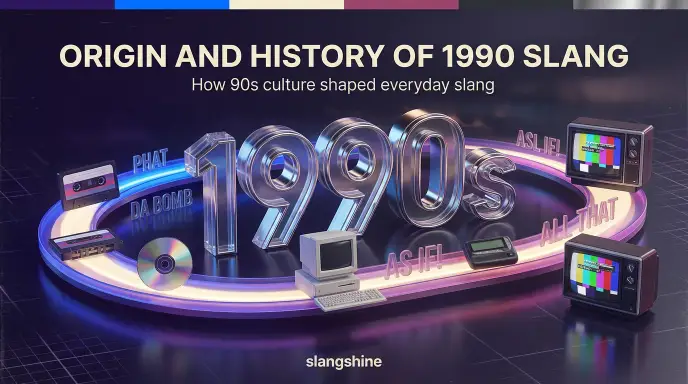
The history of 1990 slang is closely connected to the culture of the decade. Music, television, movies, advertising, and youth communities all helped informal expressions reach wider audiences.
Hip-hop had a major influence on American popular language during this period. R&B and pop culture also introduced words and phrases to people outside their original communities.
At the same time, movies and television turned certain expressions into familiar catchphrases.
However, there was no single source for 1990s slang. Some words came from African American English, regional speech, school culture, music scenes, and earlier generations.
Others were simply older expressions that became especially visible during the decade.The internet was also beginning to change communication.
Online communities existed in the 1990s, but they were much smaller than today’s social media platforms.
As a result, slang usually spread through offline culture before reaching a large audience online.
1990s Slang From Music and Pop Culture
Music played an important role in making informal language recognizable across the United States and beyond.
Hip-hop artists used distinctive vocabulary in songs, interviews, and everyday speech. Fans then repeated some of those expressions.
Television hosts, actors, and advertisers could take the same words into mainstream entertainment.
This process sometimes changed the meaning or audience of a term. A phrase that began in one community could become widely recognized without being used in exactly the same way everywhere.
That is why the history of a slang term can be more complicated than simply saying “it started in the 1990s.”
1990 Slang for Friends
Several casual words could describe friends or people in someone’s social circle.
Homie was used for a close friend or someone from the same neighborhood or community.
Boo could refer to a romantic partner or someone a person cared about.
Dude was also common casual language for a person or friend. The word existed long before the 1990s, but it remained extremely common during the decade.
Examples
- “What’s up, homie?”
- “My boo is coming over later.”
- “Dude, you have to see this movie.”
The exact tone depended on the speaker and relationship.
1990 Slang for Something Cool
People in the 1990s had several ways to describe something impressive or fashionable.
Fly could mean stylish or attractive.
Phat could describe something considered excellent or impressive.
Da bomb was another way to praise something strongly.
All that could describe a person or thing viewed as especially impressive.
Examples
- “That jacket is fly.”
- “Those shoes are phat.”
- “This game is da bomb.”
- “That new car is all that.”
Some of these expressions now sound strongly tied to the decade, while others remain understandable today.
1990 Slang for Disagreement or Dismissal
The decade also produced memorable ways to show disagreement or dismiss someone’s comment.
“As if!” could reject an idea with sarcasm.
“Whatever” could show that someone did not care about an argument.
“Talk to the hand” was a much stronger and more theatrical way to dismiss someone.
Examples
“You think I’m going to apologize? As if!”
“Whatever. Believe what you want.”
“You keep talking, but talk to the hand.”
These phrases often worked because of tone and body language. Saying them seriously could sound rude, while using them today can create a deliberately retro or humorous effect.
1990 Slang and Teen Culture
Teen culture had a strong influence on the language associated with the decade.
School life, music, fashion, movies, television, and friendship groups all helped young people develop their own ways of speaking.
Some expressions were temporary trends, while others survived for decades.
Teen slang also helped people signal that they belonged to a particular group. Using the same expressions could create a sense of shared identity.
Still, it is inaccurate to imagine every teenager using the same vocabulary. Slang differed between regions and social groups.
A teenager interested in hip-hop might use different expressions from someone involved in alternative music or another subculture.
1990 Slang and the Rise of the Internet
The 1990s were an important transition period for online communication.
People were beginning to use email, chat rooms, message boards, and early online communities. These spaces created new forms of informal communication.
However, modern social media did not yet dominate everyday communication. Slang still spread mainly through real-life conversations and mass media.
This makes 1990s slang interesting when compared with today’s internet language. Modern terms can become popular at a much faster rate.
A phrase can now move from one online community to millions of users almost immediately.
Common Mistakes When Using 1990s Slang
Using old slang can be fun, but there are a few mistakes to avoid.
Mistake 1: Treating Every Old Word as 1990s Slang
A word being common in the 1990s does not mean it originated during that decade.
Many expressions had much older histories.
Mistake 2: Assuming Everyone Used the Same Slang
Slang varied by region, age, community, and culture.
American teenagers in one area could use different expressions from British teenagers or adults in another region.
Mistake 3: Using Too Much Slang
Putting several outdated expressions into every sentence can make dialogue sound unnatural.
If you are writing a 1990s character, use a few appropriate expressions rather than turning every line into a collection of catchphrases.
Mistake 4: Ignoring Tone
Some expressions were playful, while others could sound dismissive or insulting.
For example, “whatever” can sound harmless between friends but rude during an argument.
Does 1990 Slang Sound Old Fashioned Today?
Some expressions definitely can.
Words such as “my bad” remain familiar, while phrases such as “talk to the hand” often create an obvious 1990s feeling.
The difference depends on how often the expression is used today.
A term can remain understandable without remaining fashionable. People may recognize a phrase immediately but use it only as a joke or reference to the past.
That is why 1990s slang often works well in nostalgic content. It instantly gives readers a sense of the decade.
How to Use 1990 Slang in Modern Writing
If you want your writing to sound inspired by the 1990s, choose expressions that fit the setting.
For a casual conversation, something like “my bad” can work naturally.
For a deliberately nostalgic character, expressions such as “as if!” or “da bomb” can create a stronger period feel.
For modern social media content, older slang can be used humorously:
“This playlist is da bomb. Total 1990s energy.”
The key is context. Slang should support the voice of the character or post rather than distract from it.
Is 1990 Slang Still Popular in 2026?
Some 1990s expressions are still part of informal English, but their popularity varies.
“My bad” remains widely recognizable. Other expressions are more likely to appear in nostalgic or humorous contexts.
In 2026, people may use 1990s slang when discussing retro culture, recreating old school dialogue, making memes, or talking about childhood memories.
Social media has also helped older slang return to public attention. A phrase from decades ago can suddenly become recognizable to younger users through clips, memes, movies, or nostalgia content.
That does not mean every 1990s expression has become popular again. Many remain strongly associated with their original era.
1990 Slang vs. 2000s Slang
The two decades overlap in some ways, but they have different cultural associations.
1990s slang is often connected with hip-hop, grunge, teen movies, sitcoms, early pop culture, and pre social media communication.
2000s slang developed alongside faster internet access, texting, reality television, blogs, and early social networking.
Some expressions continued across both decades. Others became dated as new vocabulary appeared.
So, if you are writing dialogue set in a specific year, it is better to consider the exact period rather than treating all slang from 1990 through 2009 as one category.
6 Popular 1990 Slang Examples
Here is a quick review of some well known expressions associated with the decade:
| Expression | Meaning | Typical tone |
| All that | Impressive or important | Casual |
| As if! | Strong disbelief or rejection | Sarcastic |
| Da bomb | Excellent | Enthusiastic |
| Phat | Cool or impressive | Casual |
| My bad | My mistake | Casual |
| Talk to the hand | Stop talking to me | Dismissive |
| Whatever | I don’t care / dismissal | Casual or sarcastic |
| Wassup? | What’s up? | Friendly |
| Fly | Stylish or cool | Positive |
| Homie | Close friend | Friendly |
Frequently Asked Questions About 1990 Slang
Q1. What is the most famous 1990s slang?
Answer: There is no single slang word that everyone used in the 1990s. Expressions such as “as if!,” “my bad,” “da bomb,” “whatever,” and “talk to the hand” are strongly associated with 1990s popular culture.
Q2. What did “da bomb” mean in the 1990s?
Answer: “Da bomb” was an informal way to say something was excellent, exciting, or impressive. It was a variation of “the bomb.”
Q3. What did “phat” mean in 1990s slang?
Answer: “Phat” was a slang spelling used to describe something cool, stylish, or excellent. It became particularly associated with 1990s youth and music culture.
Q4. What did “my bad” mean in the 1990s?
Answer: “My bad” meant “my mistake.” People used it as a casual way to admit an error or apologize for something minor.
Q5. Was “as if” 1990s slang?
Answer: “As if!” became strongly associated with 1990s teen culture and popular media. It was commonly used sarcastically to reject an idea or show disbelief.
Q6. Is 1990s slang still used in 2026?
Answer: Yes. Some expressions remain part of casual English, while others are mainly used for nostalgia, humor, memes, retro content, or references to 1990s culture.
Key Takeaways
- 1990 slang includes informal words and phrases associated with the 1990s.
- Popular examples include “as if!,” “da bomb,” “phat,” “my bad,” “whatever,” and “talk to the hand.”
- Not every slang term associated with the decade was actually invented during the 1990s.
- Music, television, movies, advertising, and youth culture helped slang spread.
- Usage varied by region, age, community, and subculture.
- Some expressions remain natural today, while others mainly create a nostalgic 1990s feel.
- In 2026, older slang can still appear in memes, social media, entertainment, and retro conversations.
Conclusion
1990 slang reflects a decade shaped by music, television, movies, youth culture, and changing communication habits.
Expressions such as “da bomb,” “as if!,” “my bad,” and “talk to the hand” became recognizable parts of the era, although their popularity varied across different groups and regions.
Some of these phrases remain useful in casual English. Others now sound deliberately retro. That difference is what makes 1990s slang interesting today.
If you are researching the decade, writing a period character, or simply enjoying 1990s nostalgia, these expressions offer a quick look at how informal language changes over time.
Learn More Slang Terms:
- Snatch Slang Meaning: What Does Snatch Mean in Slang?
- Splintereens Slang Meaning: A Playful Word for Tiny Pieces (2026)
- What Does TM Mean in Slang? Every Meaning Explained (2026)

Hi, I’m Emma Carter, an English language writer with over 8 years of experience in vocabulary and language learning. At SlangShine, I write simple, accurate, and easy-to-understand articles about slang, synonyms, idioms, and everyday English to help learners build confidence and improve their communication skills.