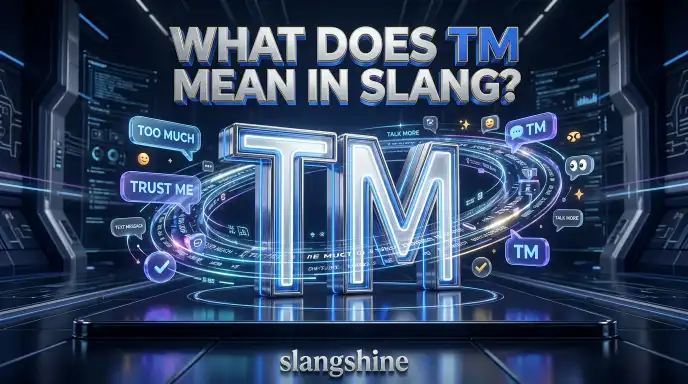
What does TM mean in slang? TM most commonly means “tomorrow” in casual texting, especially when someone’s talking about plans or scheduling. However, this tiny two-letter abbreviation carries several other meanings depending on where it appears and who’s using it.
Depending on the context, TM can also mean “too much” (when reacting to something overwhelming or dramatic), “trust me” (used for reassurance), “text me” (asking someone to send a message), or even “trademark” in business and branding conversations.
On social media, in group chats, and across platforms like Snapchat, Discord, and Instagram, the right meaning almost always depends on what’s being discussed around it.
In this guide, you’ll learn every common meaning of TM, how to tell them apart using context, and real examples of each one in action.
Quick Answer: What Does TM Mean in Slang?
TM commonly means “tomorrow” in texting and casual online conversations.
For example:
“I’ll call you tm.”
This means:
“I’ll call you tomorrow.”
You may see TM in text messages, group chats, social media conversations, and other informal communication. Some people write it as tm, while others use TM.
However, TM does not have just one meaning. If someone writes:
“TM, you’ll understand.”
they may mean “trust me” rather than “tomorrow.”
That is why context matters when interpreting this abbreviation.
What Does TM Mean in Texting?
In texting, TM often means “tomorrow.” It gives people a quick way to refer to the following day without typing the entire word.
For example:
- “See you tm.”
- “I’ll finish it tm.”
- “Are you free tm?”
- “Let’s talk tm.”
- “I have class tm.”
In each sentence, TM means “tomorrow.”
This usage is especially easy to recognize when TM appears next to words about plans or future activities.
For example:
“Are we meeting tm?”
The natural interpretation is:
“Are we meeting tomorrow?”
Origin and History of TM
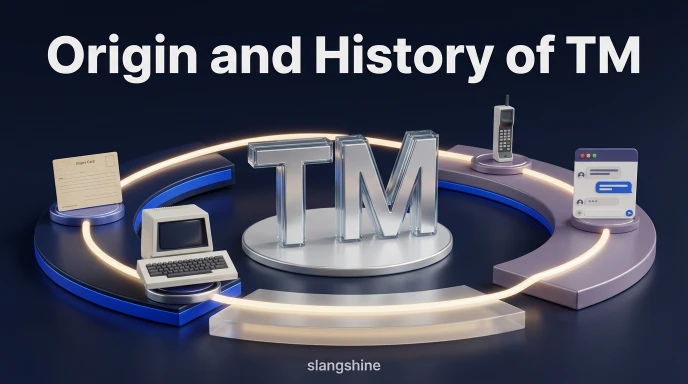
TM does not have one single slang origin. Its use comes from the broader development of texting abbreviations and internet shorthand.
Early text messaging encouraged people to shorten common words. Mobile phones made typing slower than writing by hand, especially on older keypads. Short forms helped users communicate more quickly.
As online messaging developed, these abbreviations moved into chat rooms, instant messaging, forums, and social media.
Common time-related words were natural candidates for shortening because people often discuss plans in casual conversations.
TM became one of several short forms that people may use for “tomorrow.”
The abbreviation also gained other meanings over time. In different settings, TM can represent phrases such as “trust me” or the legal term “trademark.”
Because of this, modern readers should not assume that every TM has the same meaning.
TM Meaning in Different Contexts
The meaning of TM depends heavily on where and how someone uses it.
TM = Tomorrow
This is a common texting interpretation.
“I’ll send it tm.”
Meaning:
“I’ll send it tomorrow.”
TM = Trust Me
In some casual conversations, TM can stand for “trust me.”
For example:
“TM, this movie is amazing.”
Here, “tomorrow” would not make sense.
The intended meaning is:
“Trust me, this movie is amazing.”
This use is more dependent on context than the “tomorrow” meaning.
TM = Text Me
Some people may also use TM to mean “text me.”
For example:
“TM when you get home.”
This can mean:
“Text me when you get home.”
Again, the sentence itself helps reveal the intended meaning.
TM = Trademark
Outside slang and texting, TM commonly refers to a trademark.
You may see the symbol ™ next to a brand name, slogan, or product name.
For example:
“Example Brand™”
This is different from the casual texting meanings of TM.
How Is TM Used in a Sentence?
When TM means “tomorrow,” it usually appears in sentences about future plans or activities.
Here are some natural examples:
“I’ll see you tm.”
Meaning:
“I’ll see you tomorrow.”
“Can you send the file tm?”
Meaning:
“Can you send the file tomorrow?”
“Are you working tm?”
Meaning:
“Are you working tomorrow?”
“I’ll explain everything tm.”
Meaning:
“I’ll explain everything tomorrow.”
“Let’s finish this tm.”
Meaning:
“Let’s finish this tomorrow.”
These examples show how easily the abbreviation can replace the full word.
What Does TM Mean on Social Media?
On social media, TM can have several meanings, depending on the conversation.
A person discussing plans might write:
“I’ll post it tm.”
Here, TM most likely means “tomorrow.”
Someone giving strong advice might write:
“TM, you need to try this.”
In that context, TM could mean “trust me.”
A message such as:
“TM when you’re free.”
could mean “text me when you’re free.”
Because social media conversations are informal and often very short, abbreviations can sometimes create ambiguity.
Reading the entire sentence is the easiest way to determine what TM means.
Is TM a Slang Word or an Abbreviation?
TM is better described as an abbreviation or texting shorthand than a traditional slang word.
Traditional slang usually involves informal words or expressions that have developed a particular social meaning.
TM works differently. It shortens words or phrases to make casual communication faster.
For example:
Tomorrow → TM
This is a shortening rather than a new slang definition.
The same letters can also represent different phrases, which makes TM a context-dependent abbreviation.
TM vs. “Tomorrow”
When TM means “tomorrow,” there is no major difference in meaning between the two.
The difference is mainly formality and style.
| Form | Meaning | Typical Use |
| TM | Tomorrow | Casual texting |
| tomorrow | Tomorrow | Standard writing |
For example:
“I’ll do it tm.”
And:
“I’ll do it tomorrow.”
Both communicate the same idea.
The first sounds more like quick texting, while the second works in both casual and formal writing.
Is TM Always a Slang Term?
No. TM is not always slang.
Its meaning changes according to the setting.
In a text message about weekend plans, TM may mean “tomorrow.” In a business or branding context, TM may refer to “trademark.”
In a casual conversation, it could potentially mean “trust me” or “text me.”
This makes context especially important.
If you see TM next to a brand name or logo, it probably relates to trademark rather than texting slang.
If you see it in a sentence about plans, the intended meaning may be “tomorrow.”
How Can You Tell What TM Means?
Look at the words surrounding TM and ask what meaning makes the sentence logical.
For example:
“Are you free tm?”
The word “tomorrow” fits naturally, so TM almost certainly refers to tomorrow.
Now consider:
“TM, I’m serious.”
“Tomorrow” does not fit. In this case, “trust me” makes much more sense.
Another example is:
“TM when you arrive.”
Here, “text me” is a possible interpretation because the sentence describes contacting someone.
Context turns an otherwise confusing abbreviation into a much clearer one.
Common Examples of TM in Texting
Here are some short examples you may encounter:
- “See you tm.” See you tomorrow.
- “Free tm?” Are you free tomorrow?
- “I’ll do it tm.” I’ll do it tomorrow.
- “TM, it’s worth it.” Trust me, it’s worth it.
- “TM when you’re home.” Text me when you’re home.
The first three strongly suggest “tomorrow.” The last two demonstrate why context matters.
Should You Use TM in Formal Writing?
It is usually better to avoid TM in formal writing.
If you are writing a school assignment, professional email, report, application, or official message, write “tomorrow” instead.
For example:
Casual:
“I’ll send the document tm.”
More appropriate for professional writing:
“I’ll send the document tomorrow.”
The full word is clearer and follows standard written English.
TM works best in quick, informal conversations where the reader already understands the shorthand.
TM in Casual Online Conversations
The meaning of TM becomes easier to understand when you look at the type of conversation.
If friends are discussing plans, TM will often refer to “tomorrow.”
“We can meet tm.”
If someone is encouraging you or making a strong statement, TM may instead mean “trust me.”
“TM, you’ll love this place.”
In a conversation about messages, it can also mean “text me.”
“TM when you get there.”
These meanings are not interchangeable. The words around TM usually provide the clue.
TM Meaning on Snapchat, Instagram, and Other Apps
TM can appear in casual messages across social platforms and messaging apps. There is no single platform-specific meaning that always applies.
For example, a person discussing plans on Snapchat might write:
“See you tm!”
Here, TM means “tomorrow.”
Someone commenting on a recommendation might write:
“TM, this one is better.”
In that sentence, “trust me” could make more sense.
The same abbreviation can therefore have different meanings even within the same app. Context remains the best way to understand it.
TM vs. Other Texting Abbreviations
TM is part of a larger group of shortcuts people use in digital conversations.
For example:
- TM = tomorrow, trust me, or text me, depending on context
- TMR = tomorrow
- IDK = I don’t know
- TBH = to be honest
- BTW = by the way
- LMK = let me know
Unlike some common internet abbreviations, TM can be particularly confusing because several meanings are possible.
That makes the sentence around it more important than the abbreviation itself.
How Do You Reply to TM?
Your response depends on what the person means.
If TM means “tomorrow,” you can respond naturally:
“Yeah, tomorrow works for me.”
If TM means “text me,” you might answer:
“Sure, I’ll text you when I get there.”
If TM means “trust me,” you can simply respond to the statement:
“Okay, I trust you.”
You do not need to use another abbreviation just because the other person used TM. Clear communication matters more than matching their texting style.
Is TM Appropriate for Everyone?
Not necessarily.
People who regularly use texting shorthand may understand TM immediately. Someone who rarely uses abbreviations may need more context.
If you are unsure if the other person knows the abbreviation, writing the complete word or phrase is safer.
For example, instead of:
“I’ll see you tm.”
You can write:
“I’ll see you tomorrow.”
The second version works for almost any audience.
Common Mistakes With TM
A common mistake is assuming that TM always means “tomorrow.”
Although that is a common interpretation in texting, the abbreviation has other uses.
Another mistake is using TM in a formal message without considering the audience.
For example:
“I will contact you tm.”
May look too casual in a professional email.
A better choice would be:
“I will contact you tomorrow.”
You should also avoid relying on TM when the meaning could confuse the reader. Clear language is more useful than a shorter message when the context is unclear.
Is TM Popular in 2026?
TM remains recognizable as informal digital shorthand in 2026, but its use varies from person to person.
Modern messaging apps make it easy to type complete words, so there is less practical need to shorten every word.
Even so, people continue to use abbreviations because casual online communication often favors speed and convenience.
Some users may prefer tm, while others write tomorrow or another abbreviation such as tmr.
There is no requirement to use TM. It is simply one possible shortcut in informal communication.
When Should You Use TM?
TM can work well when the conversation is casual and the meaning is obvious.
It may be appropriate in:
- Text messages
- Private chats
- Group conversations
- Casual social media messages
- Informal online discussions
Use the full word or phrase in:
- Professional emails
- Academic writing
- School assignments
- Job applications
- Official documents
- Important business communication
When clarity matters more than speed, writing the complete word is usually the better option.
Final Meaning of TM in Slang
So, what does TM mean in slang? The answer depends on context.
In casual texting, TM commonly means “tomorrow.” It can also mean “trust me” or “text me” in some conversations. Outside texting, TM may refer to “trademark,” which is a completely different use.
The best way to understand TM is to read the entire sentence instead of interpreting the abbreviation on its own.
If someone says, “See you tm,” they almost certainly mean “See you tomorrow.” If they write, “TM, you’ll love it,” the meaning may be “Trust me.” Context makes the difference.
FAQs About TM Meaning in Slang
Q1. What does TM mean in slang?
Answer: TM can have several meanings in casual communication. It commonly means “tomorrow” in texting, but it may also mean “trust me” or “text me” depending on context.
Q2. What does TM mean in a text message?
Answer: In a text message about plans or future events, TM commonly means “tomorrow.” For example, “Are you free tm?” means “Are you free tomorrow?”
Q3. Does TM mean “trust me”?
Answer: Yes. TM can mean “trust me” in some casual conversations. For example, “TM, this movie is great” can mean “Trust me, this movie is great.”
Q4. Can TM mean “text me”?
Answer: Yes. In some messages, TM can be understood as “text me.” For example, “TM when you get home” can mean “Text me when you get home.”
Q5. What does TM mean on social media?
Answer: TM can mean different things on social media. In posts about plans, it may mean “tomorrow,” while another conversation may use it for “trust me” or “text me.”
Q6. Is TM slang or an abbreviation?
Answer: TM is generally better described as an abbreviation or texting shorthand. Its meaning changes according to the context in which someone uses it.
Key Takeaways
- TM commonly means “tomorrow” in casual texting.
- TM can also mean “trust me” or “text me” in some conversations.
- The surrounding sentence usually reveals the intended meaning.
- TM is better described as texting shorthand than traditional slang.
- TM can also mean “trademark” outside casual texting.
- It works best in informal conversations.
- Use complete words in professional, academic, and formal writing.
- TM remains a recognizable form of casual digital shorthand in 2026.
Conclusion
TM usually means “tomorrow” in casual texting, but it can have several meanings depending on context.
People may also use it for “trust me” or “text me,” while the symbol ™ commonly refers to a trademark.
If you see TM in a message about plans, the safest interpretation is often “tomorrow.” If the sentence does not make sense with that meaning, consider other possibilities.
The key is simple: look at the context before deciding what TM means. That small step can help you understand texting shorthand without confusing one abbreviation for another.
Learn More Slang Terms:
- What Does SMT Mean in Slang? Explained Simply (2026)
- Smoke Slang Meaning: From Fights to Flattery (2026)
- Scadoodles Slang Meaning: What It Means to Have “A Lot” (2026)

Hi, I’m Emma Carter, an English language writer with over 8 years of experience in vocabulary and language learning. At SlangShine, I write simple, accurate, and easy-to-understand articles about slang, synonyms, idioms, and everyday English to help learners build confidence and improve their communication skills.