Smoke slang can have several meanings depending on the context. In casual English, “smoke” can mean conflict, a challenge, a fight, or a confrontation. For example, when someone says, “You want smoke?” they are usually asking if the other person wants to fight or deal with a challenge.
However, “smoke” can also refer to cigarettes, cannabis, or literal smoke, so context is essential.
The slang meaning became especially common in music, sports talk, gaming, and social media.
Expressions such as “want smoke,” “bring the smoke,” and “no smoke” can all carry slightly different meanings.
Quick Answer: What Does “Smoke” Mean in Slang?
In slang, “smoke” often means a fight, conflict, confrontation, or serious challenge.
For example:
“If you want smoke, come see me.”
Here, the speaker is not talking about actual smoke. They are challenging someone to a confrontation.
Another common example is:
“I don’t want any smoke with him.”
This usually means:
“I don’t want any trouble or conflict with him.”
The exact meaning can change with the situation. In some conversations, smoke may refer to a dispute or competition rather than a physical fight.
What Does “Want Smoke” Mean?
“Want smoke” usually means wanting a confrontation, challenge, or conflict.
A person might say:
“You want smoke?”
This can sound like a direct challenge. Depending on the situation, it may mean:
- Do you want to fight?
- Do you want to argue?
- Do you want to compete?
- Are you ready for a confrontation?
The phrase often appears in competitive situations. Someone may use it seriously, jokingly, or as playful trash talk.
For example:
“You think you can beat me at this game? You want smoke?”
Here, smoke means a competitive challenge rather than necessarily a physical fight.
What Does “No Smoke” Mean in Slang?
“No smoke” usually means no conflict, no trouble, or no serious disagreement.
For example:
“I have no smoke with her.”
This means the speaker has no problem or conflict with her.
You may also see:
“There’s no smoke between them.”
That can mean the two people are not currently involved in a dispute.
The phrase can also appear in competitive talk:
“He can talk all he wants, but he doesn’t want smoke with our team.”
In that sentence, the speaker is suggesting that the other person is not ready for the competition or confrontation.
What Does “Bring the Smoke” Mean?
“Bring the smoke” means to bring serious competition, pressure, conflict, or a strong response.
For example:
“If they want a rematch, we’ll bring the smoke.”
The speaker is saying that they are ready to compete seriously.
In another situation:
“He brought the smoke in the final round.”
This could mean that the person performed aggressively or intensely.
The phrase does not always describe violence. Sports fans, gamers, and online communities often use it as competitive slang.
What Does “Smoke Someone” Mean in Slang?
“Smoke someone” can mean defeating someone badly, overwhelming them, or sometimes physically attacking them.
The intended meaning depends heavily on context.
For example:
“Our team smoked them 5–0.”
Here, smoked means defeated them easily or badly.
In gaming:
“I smoked that player in the final round.”
This usually means the speaker beat the other player decisively.
In a more aggressive context, however, “smoke someone” can refer to attacking or killing someone. Because of that, you should not assume the phrase always means simply “win.”
What Does “Smoke” Mean in Sports Slang?
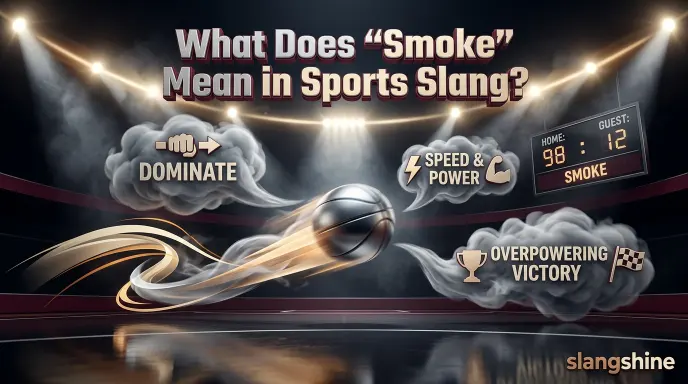
Sports fans often use smoke to describe competition, pressure, or a difficult matchup.
For example:
“They don’t want smoke with our team.”
The meaning is roughly:
“They don’t want to face our team.”
Another example:
“Bring the smoke next Sunday.”
Here, the speaker is encouraging their team to compete aggressively and confidently.
Sports slang often uses exaggerated language. Therefore, smoke does not automatically imply a real physical fight.
What Does “Smoke” Mean in Gaming?
Gaming communities use smoke in a similar way. It can describe a challenge, intense competition, or a decisive victory.
Examples include:
“You want smoke in the next match?”
“He smoked everyone in the lobby.”
“That squad brought the smoke.”
In these examples, the word usually relates to competition or performance.
Gaming context makes the meaning easier to identify because words such as match, lobby, team, round, or player usually appear nearby.
Is “Smoke” the Same as “Beef”?
Smoke and beef can overlap, but they are not exactly the same.
Beef usually means an ongoing disagreement, rivalry, or personal conflict.
Smoke often focuses more on the confrontation or challenge itself.
For example:
“They have beef.”
This suggests an existing dispute.
Meanwhile:
“He wants smoke.”
This sounds more like a willingness to confront or challenge someone.
A person can have beef with someone without wanting a fight. Someone asking for smoke is usually presenting a more direct challenge.
Does “Smoke” Mean a Fight?
Yes, smoke can mean a fight or confrontation in slang, especially in phrases such as “want smoke” or “looking for smoke.”
For example:
“He was looking for smoke outside the club.”
Depending on the context, this could mean he was looking for trouble or a fight.
However, not every slang use of smoke refers to physical violence. In sports and gaming, it can simply mean competition or a serious challenge.
That distinction is important when interpreting messages, lyrics, comments, or conversations.
What Does “Looking for Smoke” Mean?
“Looking for smoke” means looking for trouble, conflict, or a confrontation.
For example:
“Why is he acting like that? Is he looking for smoke?”
The speaker is suggesting that the person seems to be trying to start a conflict.
The phrase can also appear as playful exaggeration online. A gamer might say someone is “looking for smoke” because they keep challenging stronger players.
So, the surrounding situation determines if the phrase sounds serious or humorous.
Where Is “Smoke” Slang Commonly Used?
The slang meaning of smoke appears across several informal settings.
Music and Lyrics
Hip-hop and rap frequently use smoke in discussions of rivalry, toughness, conflict, or competition. The meaning can vary considerably from one lyric to another.
Social Media
On TikTok, Instagram, X, Reddit, and other platforms, users may say someone wants smoke when that person appears ready for an argument or online confrontation.
Gaming
Gamers use smoke to describe competitive challenges and strong victories.
Sports
Fans and athletes may use the term when talking about difficult opponents or intense competition.
Everyday Conversation
Friends may use expressions such as “no smoke” or “want smoke?” during playful arguments or competitive situations.
Because the term has several meanings, context should always come before interpretation.
Origin and History of “Smoke” in Slang
The slang use of smoke developed through informal speech and different cultural communities rather than from one clearly documented starting point.
Over time, the word gained figurative meanings connected with conflict, confrontation, pressure, and competition.
The expression “want smoke” became especially recognizable through hip-hop, rap, sports culture, and other forms of competitive language.
Music and popular culture helped carry the expression into wider everyday speech.
Online communities then gave the slang new space to spread. Social media users, gamers, and sports fans began using smoke for arguments, challenges, rivalries, and strong competition.
Because slang changes over time, the exact history of every expression is difficult to trace.
What remains clear is that the modern slang sense is strongly associated with being ready for conflict or a serious challenge.
Smoke Slang vs. Literal “Smoke”
The word smoke has a completely normal literal meaning.
For example:
“Smoke filled the room.”
Here, smoke means the visible mixture produced by burning something.
Slang uses are different:
“He wants smoke.”
This usually means he wants conflict, competition, or a confrontation.
Another meaning appears when people talk about smoking cigarettes or cannabis:
“He went outside for a smoke.”
In that sentence, a smoke can refer to a cigarette or a smoking break.
Therefore, never assume that every appearance of “smoke” is slang. The surrounding words and situation determine the meaning.
Common Expressions With “Smoke”
Several expressions use smoke in informal English.
“Want Smoke”
This means someone is willing to face a confrontation, challenge, or competition.
“You want smoke? Let’s play.”
“No Smoke”
This can mean someone does not want trouble or has no conflict with another person.
“I have no smoke with them.”
“Bring the Smoke”
This means to bring strong competition, pressure, or a powerful response.
“They better bring it because we’re bringing the smoke.”
“Smoke Someone”
This can mean defeating someone badly, overwhelming them, or, in a more serious context, physically attacking them.
“Our team smoked them in the final.”
“Looking for Smoke”
This usually means looking for trouble or a confrontation.
“He keeps starting arguments like he’s looking for smoke.”
These expressions overlap, but their meanings can change according to context.
Common Mistakes When Understanding “Smoke” Slang
Mistake 1: Assuming It Always Means a Fight
Smoke can mean conflict, but it can also describe competition, an argument, or a decisive victory.
A gamer saying “I want smoke” may simply want a challenging match.
Mistake 2: Ignoring the Context
The sentence “I need a smoke” usually has nothing to do with conflict. It may refer to a cigarette or smoking break.
Meanwhile, “You want smoke?” normally carries a completely different meaning.
Mistake 3: Thinking “Smoke Someone” Always Means Defeat
“Smoke someone” can mean beat them badly, but the phrase can carry a more violent meaning in certain contexts.
Look at the surrounding conversation before deciding what the speaker means.
Mistake 4: Treating Slang as Formal English
Expressions such as “want smoke” and “bring the smoke” belong mainly to informal communication.
They may work in casual conversation but can sound inappropriate or unclear in professional writing.
Mistake 5: Assuming Every Speaker Uses It the Same Way
Slang varies by community, age, region, and online culture. A phrase that sounds normal to one group may sound aggressive or unfamiliar to another.
Is “Smoke” Appropriate to Use?
The answer depends on the meaning.
The ordinary noun smoke is completely appropriate in formal and informal English. The slang expressions are more casual.
For example:
“Smoke from the fire damaged the building.”
This is standard English.
However:
“You want smoke?”
sounds informal and potentially confrontational.
If you are speaking professionally, clearer alternatives may be better:
- conflict
- disagreement
- challenge
- competition
- confrontation
When the slang could be interpreted as a threat, choosing neutral wording is especially important.
Is “Smoke” Still Used as Slang in 2026?
Yes. Smoke remains recognizable slang in 2026, particularly in music, sports, gaming, social media, and casual conversations.
Expressions such as “want smoke,” “no smoke,” “bring the smoke,” and “smoke someone” continue to appear in informal communication.
Still, usage is not identical across every group. Some people use these phrases naturally, while others may understand them mainly because they have encountered them online or in music and entertainment.
The safest approach is to read the context before interpreting the word.
FAQs About Smoke Slang
Q1. What does “smoke” mean in slang?
Answer: Smoke in slang can mean conflict, confrontation, trouble, or a serious challenge. In competitive settings, it may simply refer to competition.
Q2. What does “you want smoke?” mean?
Answer: “You want smoke?” usually means “Do you want a confrontation or challenge?” It can refer to a fight, argument, or competitive situation depending on the context.
Q3. What does “no smoke” mean in slang?
Answer: “No smoke” can mean no conflict, no trouble, or no disagreement. For example, “I have no smoke with him” means the speaker has no problem or conflict with him.
Q4. What does “smoke someone” mean?
Answer: “Smoke someone” can mean defeating or overwhelming them, especially in sports or gaming. In more serious contexts, it can have a violent meaning, so context matters.
Q5. Is “smoke” a bad word?
Answer: Smoke is not a swear word. Its slang meaning can sound aggressive or confrontational, especially when someone says “you want smoke?” The ordinary meaning of smoke is completely neutral.
Q6. Is “smoke” still slang in 2026?
Answer: Yes, “smoke” is still used as slang in 2026. It remains common in informal speech, music, sports, gaming, and online conversations, although familiarity varies between different groups.
Key Takeaways
- Smoke slang can mean conflict, confrontation, trouble, or a serious challenge.
- “Want smoke?” usually asks if someone wants a confrontation or challenge.
- “No smoke” can mean no conflict or trouble.
- “Bring the smoke” suggests bringing serious competition or pressure.
- “Smoke someone” can mean defeating them badly, although it may have a more serious meaning in some contexts.
- The word smoke also has ordinary meanings, including visible material produced by burning and a smoking break.
- Music, sports, gaming, and social media have helped spread the slang.
- The meaning can change depending on the speaker, setting, and tone.
- In professional situations, neutral wording is usually safer.
- The slang remains recognizable and widely used in informal communication in 2026.
Conclusion
The smoke slang meaning usually involves conflict, confrontation, competition, or a serious challenge.
Expressions such as “you want smoke?” and “bring the smoke” often signal that someone is ready to face another person or group.
At the same time, smoke does not always have a slang meaning. It can refer to literal smoke or, in another informal use, a cigarette or smoking break. That is why context is the key to understanding this word correctly.
In 2026, smoke remains a familiar part of informal language, especially in music, sports, gaming, and social media.
However, because some uses can sound aggressive, it is best to consider the situation before using the term.
Learn More Slang Terms:
- 1980 Slang: Rad Words and Phrases from the Decade (2026)
- Shade Meaning Slang: A Subtle Way to Insult (2026 Guide)
- What Does TM Mean in Slang? Every Meaning Explained (2026)

Hi, I’m Anna Whitmore. I have 7+ years of experience writing about English slang and vocabulary. At SlangShine, I create simple, easy-to-understand content for English learners.