Flabagate slang means “to confuse” or “to bewilder” someone. It is a rare historical American regional word documented in the Dictionary of American Regional English (DARE).
The term appears in 19th-century American material and is now considered unusual and old-fashioned rather than common modern slang.
Words like this were once part of everyday regional speech before more common terms like “confuse,” “baffle,” or “bewilder” became standard across American English.
Today, Flabagate survives mainly in linguistic archives and historical records rather than in daily conversation it’s the kind of word language enthusiasts and dialect researchers rediscover rather than one people casually use.
Quick Answer: Flabagate Slang
| Question | Answer |
| What does flabagate mean? | To confuse or bewilder someone |
| Is flabagate slang? | Yes, it is documented as a historical American regional/slang word |
| Is flabagate common today? | No, it is extremely rare |
| Where is it found? | In historical American English sources |
| Is flabagate offensive? | No, the word itself is not offensive |
| Can you use it today? | Yes, but mainly for humor, historical writing, or playful language |
What Does Flabagate Mean in Slang?
Flabagate means to confuse, bewilder, or leave someone unsure about what is happening.
If something flabgates you, it makes the situation harder to understand. The word can describe a person becoming confused because of complicated information, strange behavior, or an unexpected situation.
For example:
“The complicated instructions completely flabagated him.”
In modern English, most people would simply say:
“The complicated instructions completely confused him.”
That difference is important. Flabagate has a real historical meaning, but it is not a normal word in everyday modern English.
The Dictionary of American Regional English includes flabagate among unusual words found in historical American sources and gives its meaning as “to confuse.”
Is Flabagate Really Slang?
Yes, but flabagate is best described as historical or regional American slang rather than current internet slang.
The word appears in material examined by the Dictionary of American Regional English, a major project documenting regional words and expressions from across the United States.
DARE specifically highlights flabagate as one of the unusual terms found in an 1834 biography of Andrew Jackson.
That gives the word a genuine historical basis.
However, this does not mean Americans commonly use flabagate today.
Modern speakers are much more likely to say:
- confuse
- bewilder
- puzzle
- baffle
- throw someone off
- leave someone confused
So, when writing about flabagate slang, it is more accurate to present it as a rare historical American slang or regional expression.
What Does Flabagate Mean in a Sentence?
The simplest way to understand flabagate is to replace it with confuse.
For example:
“The strange explanation flabagated the entire group.”
This means:
“The strange explanation confused the entire group.”
Another example:
“His unusual answer flabagated me.”
This means that his answer left the speaker confused.
You could also use the word in a playful sentence:
“That math problem completely flabagated me.”
A modern reader may not recognize the word immediately, but the sentence gives enough context to understand the intended meaning.
More Example Sentences
Here are a few additional examples:
- “The complicated directions flabagated the travelers.”
- “Her sudden change of plans flabagated everyone.”
- “The strange question flabagated the young student.”
- “That old-fashioned explanation would flabagate a modern reader.”
- “The confusing message nearly flabagated me.”
These are modern-style examples created to explain the historical meaning. They should not be treated as evidence that people commonly use flabagate in 2026.
What Is the Origin and History of Flabagate?
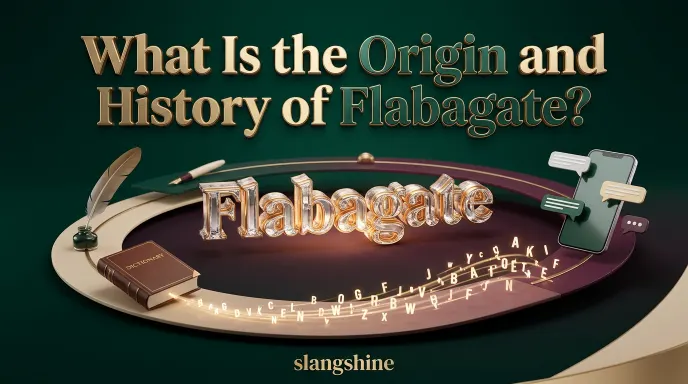
Flabagate has a documented history in 19th-century American English.
One important source is The Life of Andrew Jackson, an 1834 biography. The Dictionary of American Regional English points to this historical work as a source containing the word flabagate.
It appears alongside several other unusual American expressions collected from historical texts.
This is useful because it shows that flabagate is not simply a recent internet invention.
The word belongs to an older layer of American vocabulary that included many colorful regional and informal expressions.
Some of those words survived into later American speech, while others became rare or disappeared from everyday use.
Flabagate appears to have followed the second path.
Today, the word is mainly interesting to people studying:
- American regional English
- historical slang
- unusual vocabulary
- dialect words
- older American writing
- language history
Where Was Flabagate Used?
The available historical evidence connects flabagate with American English, particularly the kind of regional and historical vocabulary documented by DARE.
However, it would be too strong to claim that the word belonged exclusively to one modern U.S. state unless a reliable source clearly establishes that geographic restriction.
DARE was created to document regional language across the United States. Its research combined historical written sources with fieldwork involving speakers from geographically distinct communities.
Therefore, the safest description is:
Flabagate is a rare historical American regional word meaning “to confuse.”
This wording gives the term its proper context without inventing a specific location.
Is Flabagate Still Used Today?
Flabagate is extremely uncommon in modern English.
You are unlikely to hear it in an ordinary conversation, text message, workplace discussion, or social media post.
Instead, modern speakers normally use words such as confuse, baffle, or puzzle.
For example:
Modern:
“This question is confusing me.”
Historical/playful:
“This question is flabagating me.”
The second sentence sounds unusual because most modern readers do not have flabagate in their everyday vocabulary.
That rarity can actually make the word interesting. Writers sometimes use obscure historical words to give a sentence an old-fashioned, humorous, or quirky tone.
What Is the Pronunciation of Flabagate?
A simple pronunciation guide for flabagate is:
FLAB-uh-gate
You can break the word into three easy parts:
flab – uh – gate
The final part sounds like “gate.”
Because flabagate is a very rare historical word, you should not expect one universally familiar modern pronunciation.
Many people encountering it today would probably pronounce it by looking at its spelling.
If you are writing an article about the word, giving a simple pronunciation guide is useful because readers are unlikely to have heard it spoken.
Is Flabagate a Positive or Negative Word?
Flabagate is generally neutral.
The word describes the act of confusing someone. It does not automatically express praise, anger, or insult.
The emotional tone depends on the sentence.
For example:
“The difficult puzzle flabagated the students.”
This is neutral. It simply says the puzzle confused them.
But:
“His ridiculous explanation flabagated everyone.”
This sounds more critical because the surrounding language is negative.
So, the word itself is not strongly positive or negative. It simply describes confusion or bewilderment.
Is Flabagate Offensive?
No. Flabagate is not generally offensive, vulgar, or a slur.
Its meaning is connected to confusion rather than a person’s identity or social group.
You can therefore discuss the term safely in educational, linguistic, or historical contexts.
The bigger problem is understanding, not offensiveness.
Because the word is so rare, some readers may assume that it is a spelling mistake or a newly invented expression. If you use it today, providing enough context can prevent confusion.
For example:
“The complicated instructions flabagated me in other words, they completely confused me.”
That makes the intended meaning immediately clear.
Flabagate vs. Confuse
The closest modern equivalent to flabagate is simply confuse.
The two words can describe a similar situation, but their style is very different.
| Word | Meaning | Modern Use |
| Flabagate | To confuse or bewilder | Very rare |
| Confuse | To make someone unsure or unable to understand | Very common |
| Baffle | To confuse or puzzle someone | Common |
| Bewilder | To confuse someone deeply | Less common but standard |
| Puzzle | To make someone unsure or curious | Common |
For everyday communication, confuse is clearly the better choice.
Flabagate is mainly useful when discussing historical vocabulary or when you intentionally want an unusual word.
Flabagate vs. Baffle
Baffle is another useful modern comparison.
If something baffles you, you cannot understand it easily.
For example:
“The strange result baffled me.”
The same idea could be expressed historically with flabagate:
“The strange result flabagated me.”
The difference is that baffle remains a normal English word, while flabagate has become highly unusual.
This comparison also shows why knowing the historical meaning matters. A reader who sees flabagate for the first time can understand it by connecting it with familiar words such as baffle and confuse.
Why Does Flabagate Sound So Unusual?
The word flabagate has a distinctive sound that makes it stand out from ordinary modern English.
Part of that unusual feeling comes from its age. English vocabulary changes over time. Words that once appeared in regional or informal speech can eventually disappear from everyday conversation.
Flabagate is a good example of that process.
Modern readers are familiar with words such as:
- confuse
- baffle
- puzzle
- bewilder
- perplex
They are much less likely to recognize flabagate.
That does not mean the word is meaningless. It means that its historical usage has become much less visible.
Can Flabagate Mean “Confused”?
Not exactly in the same grammatical form.
Flabagate functions as a verb, meaning to confuse.
So you could think of it like this:
Flabagate someone = confuse someone.
For example:
“The complicated question flabagated him.”
This means:
“The complicated question confused him.”
If you want to describe the person rather than the action, modern English would normally use confused:
“He was confused by the complicated question.”
It is better not to create modern forms such as flabagated or flabagating and assume they were historically standard unless a historical source supports that exact form.
Can You Use Flabagate in Texting?
Technically, yes, but it would be very unusual in normal texting.
If you send:
“That explanation flabagated me.”
The other person may ask what flabagate means.
That can make the word useful as a joke.
For example:
“You just flabagated my brain 😂”
Here, the unusual word creates a playful effect.
Still, if your goal is clear everyday communication, use:
- “You confused me.”
- “That threw me off.”
- “I have no idea what that means.”
- “You lost me.”
These expressions sound much more natural in modern texting.
Can Flabagate Be Used on Social Media?
It can, but it should be treated as rare historical vocabulary rather than trending internet slang.
A social-media user might deliberately use flabagate because it sounds strange or humorous.
For example:
“This new update completely flabagated me.”
The sentence uses an old word in a modern setting. That contrast can make the post funny or attention-grabbing.
However, there is no reason to present flabagate as a current viral slang term. Its documented importance comes from its historical American usage, not from modern social-media popularity.
Is Flabagate a Good Slang Word to Use in 2026?
Flabagate can be fun to use in 2026, but it is not a practical everyday slang word.
Use it when you want:
- A humorous tone
- An old-fashioned feel
- An unusual vocabulary choice
- A playful way to say “confuse”
- A historical-language reference
Avoid relying on it when you need immediate clarity.
For example, in a casual conversation:
“That explanation confused me.”
Is much clearer than:
“That explanation flabagated me.”
The second sentence may sound clever, but it also requires the listener to know an obscure word.
So, flabagate is interesting to know, but not necessary to use.
How Is Flabagate Different From “Confuse”?
The main difference is age and familiarity.
Confuse is a standard modern English verb. People use it in conversations, emails, schoolwork, and online communication.
Flabagate, on the other hand, is rare and historical.
| Word | Meaning | Style |
| Flabagate | To confuse or bewilder | Historical/regional |
| Confuse | To make someone unable to understand | Modern/common |
| Baffle | To confuse or puzzle | Modern/common |
| Bewilder | To confuse deeply | Standard, somewhat formal |
| Perplex | To make something difficult to understand | Standard/formal |
So, if you want clear modern English, confuse is the safest choice.
Common Mistakes With Flabagate
Because flabagate is unfamiliar to most modern readers, it is easy to misuse.
Mistake 1: Treating It as Popular Modern Slang
Flabagate has historical documentation, but that does not make it current mainstream slang.
Avoid writing:
“Everyone uses flabagate in 2026.”
There is no good basis for that claim.
A better description is:
“Flabagate is a rare historical American slang or regional word meaning ‘to confuse.’”
Mistake 2: Assuming It Means “Confused”
Flabagate is primarily a verb meaning to confuse.
Do not automatically treat it as an adjective meaning “confused.”
For modern writing, use:
“I am confused.”
rather than inventing unusual forms without historical evidence.
Mistake 3: Calling It Internet Slang
Flabagate did not originate as TikTok, texting, gaming, or social-media slang.
Its documented history goes back to much older American English.
Mistake 4: Giving It a Fixed State Origin
The available evidence supports its connection with American regional English, but that does not justify claiming that it was exclusively created or used in one particular state.
When Should You Use Flabagate?
You can use flabagate when the unusual nature of the word is part of the point.
It may work well in:
- Historical writing
- Linguistic discussions
- Creative writing
- Word-history articles
- Humorous posts
- Old-fashioned dialogue
- Educational content about American English
For example:
“The bizarre instructions flabagated everyone in the room.”
This sentence deliberately uses an obscure word to create a playful effect.
For normal communication, however, confuse is better.
When Should You Avoid Flabagate?
Avoid it when your audience needs immediate and universal understanding.
For example, a teacher writing instructions would normally say:
“The confusing question caused several students to make mistakes.”
Using flabagate would make the sentence unnecessarily difficult.
The same applies to business writing, customer support, medical information, technical instructions, and other situations where clarity matters more than style.
A rare word can be interesting, but it should never make an important message harder to understand.
Is Flabagate an Old-Fashioned Word?
Yes. Flabagate has a distinctly old-fashioned feel today.
Its historical documentation comes from 19th-century American English, while modern dictionaries and ordinary conversation rarely use it.
This gives the word a different character from newer slang.
Modern slang often spreads through music, social media, gaming, and online communities. Flabagate belongs to an older tradition of regional American vocabulary.
That distinction is important for anyone researching flabagate slang.
It is better described as historical American regional slang than as a modern trendy expression.
Is Flabagate a Dialect Word or Slang?
It can be discussed as both regional/dialect vocabulary and slang, depending on the classification being used.
DARE was specifically designed to document regional American words, expressions, and pronunciations.
Its material includes unusual informal terms that may not appear in standard modern dictionaries.
Flabagate fits that broader historical vocabulary category.
Flabagate is a rare historical American slang/regional word meaning “to confuse.”
This wording avoids making it sound more common than it really is.
Does Flabagate Have Different Meanings?
The documented sense relevant to this article is “to confuse.”
Because the word is obscure, you may encounter websites or user-generated pages that attach different meanings to unusual words.
Those claims should not automatically be treated as established definitions.
For a reliable slang explanation, the documented historical sense should remain the focus.
Therefore:
Flabagate = to confuse or bewilder.
It should not be presented as having several unrelated meanings unless strong historical sources support those meanings.
Is Flabagate Used in American English Today?
Not commonly.
Modern American English has largely replaced this type of rare regional vocabulary with widely understood words such as:
- confuse
- baffle
- puzzle
- bewilder
- perplex
- throw off
A person could still use flabagate intentionally, but most Americans would probably recognize confuse much faster.
This makes flabagate more useful as a language-history word than as an everyday slang term.
Flabagate vs. Perplex
Perplex is another useful comparison because both words can describe a situation that leaves someone unsure.
For example:
“The strange instructions perplexed me.”
This means the instructions made the speaker uncertain or confused.
You could use flabagate in a similar historical sense:
“The strange instructions flabagated me.”
The difference is register.
Perplex remains part of standard English, while flabagate is rare and regional.
That makes perplex suitable for formal writing, while flabagate is better reserved for historical, humorous, or deliberately unusual language.
What Are Better Modern Alternatives to Flabagate?
If you want natural 2026 English, choose a familiar alternative.
For Everyday Conversation
Use:
Confuse
“You completely confused me.”
For Strong Confusion
Use:
Baffle
“That result really baffled me.”
For Deep Confusion
Use:
Bewilder
“The sudden change bewildered everyone.”
For Casual Texting
Use:
Throw me off
“That message really threw me off.”
For a Rare or Playful Style
Use:
Flabagate
“That explanation completely flabagated me.”
The last option is intentionally unusual.
Can Flabagate Be Used as a Joke?
Yes. Its rarity makes it suitable for playful language.
Imagine someone explaining something in an unnecessarily complicated way. You could jokingly say:
“Congratulations. You have successfully flabagated me.”
The humor comes from using an obscure historical word where everyone expects confused me.
This type of usage works especially well when the audience enjoys unusual vocabulary.
However, the joke may fail if readers do not understand the word. Adding context can solve that problem.
Is Flabagate Good for Creative Writing?
Yes, particularly when you want an unusual or old-fashioned voice.
A historical character, fictional storyteller, or humorous narrator could use flabagate to make dialogue sound distinctive.
For example:
“Your complicated scheme has completely flabagated me.”
The word gives the sentence an unusual flavor.
Still, writers should avoid inserting obscure vocabulary simply to make prose sound sophisticated.
If the word does not add character, humor, or historical accuracy, confuse will usually be stronger.
FAQs About Flabagate Slang
Q1. What does flabagate mean in slang?
Answer. Flabagate means to confuse or bewilder someone. It is a rare historical American regional expression rather than common modern slang.
Q2. Is flabagate a real word?
Answer. Yes. Historical American sources document flabagate, and the Dictionary of American Regional English records it with the meaning “to confuse.”
Q3. Is flabagate still used in 2026?
Answer. Flabagate is extremely rare in modern English. You may encounter it in historical discussions, unusual vocabulary lists, or playful writing, but it is not common everyday slang.
Q4. Is flabagate an American slang word?
Answer. Yes. Flabagate is associated with historical American regional English and is documented in American language sources.
Q5. What is a modern synonym for flabagate?
Answer. The simplest modern synonym is confuse. Other alternatives include baffle, bewilder, puzzle, and perplex.
Q6. Is flabagate offensive?
Answer. No. Flabagate is not generally offensive, vulgar, or a slur. It simply describes confusing or bewildering someone.
Q7. Can I use flabagate in texting?
Answer. Yes, but it will sound unusual. You can use it jokingly when you want to replace the ordinary phrase “you confused me” with an obscure word.
Q8. Is flabagate popular slang on social media?
Answer. No. Flabagate is not widely recognized as current social-media slang. Its main interest comes from its historical and regional American usage.
Key Takeaways
- Flabagate means “to confuse” or “to bewilder.”
- It has documented roots in historical American English.
- The word is associated with regional and slang vocabulary.
- It is not common modern slang in 2026.
- Confuse is the clearest modern alternative.
- Flabagate is not generally offensive.
- Its unusual sound can make it useful in humorous or creative writing.
- Historical context is important when describing the word.
- Do not present flabagate as a trending TikTok or internet expression.
- Its value today is mainly linguistic, historical, and playful.
Conclusion
Flabagate slang means “to confuse” or “to bewilder.” Although the word is now extremely rare, its historical American usage makes it an interesting example of regional slang and older English vocabulary.
Modern speakers would normally choose words such as confuse, baffle, puzzle, or bewilder. Still, flabagate can add a quirky or old-fashioned touch to creative writing and humorous conversation.
If you come across this unusual word, remember its simple meaning: to flabagate someone is to confuse them.
Learn More Slang Terms:
- Pre-Funk Slang: The Pacific Northwest’s Pre-Party Word (2026)
- What Does TM Mean in Slang? Every Meaning Explained (2026)
- Smoke Slang Meaning: From Fights to Flattery (2026)

Hi, I’m Anna Whitmore. I have 7+ years of experience writing about English slang and vocabulary. At SlangShine, I create simple, easy-to-understand content for English learners.