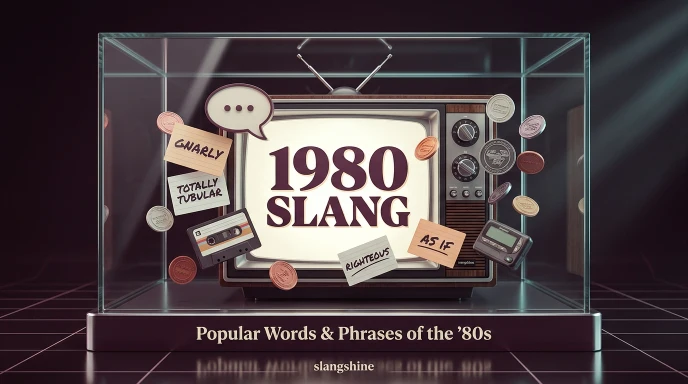
1980 slang refers to the informal words, phrases, and expressions that became popular during the 1980s. Terms such as “rad,” “totally,” “gnarly,” “wicked,” and “gag me with a spoon” captured the decade’s bold, playful style.
Some expressions stayed strongly connected to the 1980s, while others continued into later decades.
The 1980s brought a unique mix of music, movies, television, youth culture, and changing technology.
All of these influences shaped the way people talked. Today, many 1980s slang terms still appear in nostalgic conversations, retro-themed content, movies, and social media.
Quick Answer: What Does 1980 Slang Mean?
1980 slang means informal words and expressions that people commonly used during the 1980s, especially in American youth and pop culture. Popular examples include rad for something excellent, gnarly for something extreme or impressive, and totally as an emphatic way to agree or react.
What Is 1980 Slang?
1980 slang is not one specific type of language. Instead, the term covers a wide range of informal expressions that became recognizable during the decade.
Some words came from earlier slang but became especially popular in the 1980s. Others developed through youth culture, music scenes, movies, television, and regional speech.
For example, someone might have described an exciting experience as “rad.” A difficult or extreme situation could be “gnarly.” Meanwhile, “totally” often added extra emphasis to a statement.
The meaning of these expressions also depended on tone. A speaker could use them seriously, jokingly, or simply to sound more casual.
Origin and History of 1980 Slang
The slang associated with the 1980s developed from several cultural sources rather than from one single movement.
Youth Culture
Young people played a major role in spreading new expressions. High schools, colleges, skateboarding communities, music scenes, and local social groups all helped slang move from one group to another.
A phrase that started in one community could become much more recognizable once popular media picked it up.
Movies and Television
Entertainment had an especially strong influence on 1980s vocabulary. Teen movies, sitcoms, music programs, and other popular shows introduced expressions to large audiences.
Because television reached millions of homes, phrases could spread much faster than they had in earlier decades.
Music and Subcultures
Different music communities also contributed their own vocabulary. Rock, punk, hip-hop, new wave, and other scenes developed distinct styles of communication.
Skateboarding and surfing culture also helped popularize words such as rad and gnarly, particularly among younger speakers.
Why Some 1980s Slang Survived
Not every slang term from the decade disappeared. Expressions that were easy to understand, fun to say, or strongly connected to popular culture had a better chance of lasting.
Some words eventually became ordinary informal English. Others remained recognizable mainly because they remind people of the 1980s.
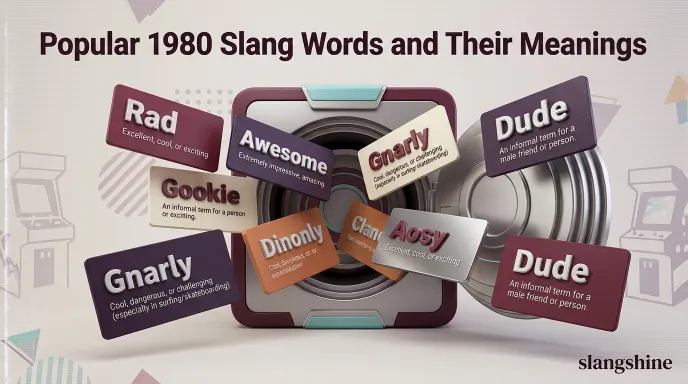
Popular 1980 Slang Words and Their Meanings
Here are some of the best-known examples of 1980s slang.
1. Rad
Rad meant excellent, exciting, impressive, or really cool.
The word became strongly associated with youth culture, especially skateboarding and surfing.
Example:
“That new skateboard is rad.”
Today, rad can still appear in casual speech, although it often has a nostalgic or retro feel.
2. Gnarly
Gnarly could describe something extreme, difficult, dangerous, or impressive.
Its meaning could change depending on the situation. A person might call a challenging experience “gnarly,” but the word could also express admiration.
Example:
“That was a gnarly wave.”
Context matters because the speaker could mean either “intense” or “awesome.”
3. Totally
Totally was used as an emphatic way to say completely, definitely, or absolutely.
Although the word existed long before the 1980s, its strong association with teenage speech and pop culture made it a recognizable part of the decade’s style.
Example:
“I totally agree with you.”
4. Wicked
In some informal varieties of English, especially regional American speech, wicked could mean very, extremely, or really.
For example:
“That concert was wicked good.”
This usage was not exclusive to the 1980s, but it fits the casual vocabulary associated with the period.
5. Gag Me With a Spoon
“Gag me with a spoon” was a humorous way to show disgust, annoyance, or strong dislike.
The expression became closely associated with the stereotypical language of 1980s teenage culture.
Example:
“You actually like that outfit? Gag me with a spoon!”
The phrase is now mostly used for humor or to create a deliberately retro tone.
6. Awesome
Awesome became a major casual expression for something excellent, exciting, or impressive.
The word itself is much older than the 1980s, but its everyday informal use became increasingly common during this period.
Example:
“Your new car is awesome.”
Unlike many decade-specific expressions, awesome remained highly common in modern English.
1980s Slang for Something Cool
Several expressions could communicate that something was impressive or enjoyable.
Rad was one of the clearest examples. Awesome also worked naturally in casual conversations, while gnarly could express admiration when something seemed extreme or impressive.
The exact choice depended on the speaker and the social setting.
For example:
- “That movie was rad.”
- “Your new jacket is awesome.”
- “That trick was gnarly.”
These examples show why slang cannot always be translated into one fixed synonym. Tone and context can change the meaning.
1980s Slang for Friends and People
The 1980s also had informal ways to address friends and other people.
Dude
Dude was widely used as a casual term for a person, especially a friend or acquaintance.
Example:
“Dude, you have to see this!”
Although dude existed long before the 1980s, the decade helped strengthen its connection with casual youth speech and popular culture.
Guys
Guys was also common as an informal way to address a group of people.
Example:
“Are you guys ready to go?”
This expression was not unique to the 1980s, but it remained a familiar part of everyday speech during the decade.
1980 Slang in Movies and Pop Culture
Popular culture helped make certain expressions recognizable far beyond their original communities.
Teen movies often portrayed characters using exaggerated casual language. Television created memorable catchphrases, while music videos gave young audiences new cultural references.
This connection between slang and entertainment explains why many people can recognize an expression from the 1980s even if they never personally used it.
Some phrases now function almost like linguistic time capsules. When someone uses them today, the goal may be less about everyday communication and more about creating a deliberately retro mood.
Did Everyone Use 1980s Slang?
No. Slang never represents the speech of an entire generation.
Different people used different expressions depending on their age, location, social group, interests, and cultural background.
A teenager involved in skateboarding might use different slang from someone in a formal school environment.
Regional differences mattered too. Some expressions were strongly associated with particular parts of the United States, while others spread nationwide through television and music.
That is why it is better to describe these terms as popular 1980s slang rather than claiming that everyone in the decade used them.
1980 Slang vs. Modern Slang
One major difference is how quickly slang spreads.
During the 1980s, television, radio, movies, magazines, schools, and local communities played major roles in spreading informal language.
Today, social media can push a new expression across countries within a very short time.
Still, the basic purpose remains similar. Slang helps people express identity, humor, emotion, group membership, and informality.
Some 1980s terms have also returned because modern audiences enjoy retro culture. A word such as rad may sound old-fashioned in one conversation but intentionally cool in another.
How Is 1980 Slang Used Today?
Most 1980s slang is no longer used with the same frequency it had during its peak. However, many expressions remain understandable.
People may use these words when discussing the 1980s, writing fictional dialogue, making jokes, creating retro content, or talking about old movies and music.
For example:
“That arcade game is totally rad.”
A modern speaker might use this sentence seriously, but they could also be deliberately copying the style associated with the decade.
The surrounding context usually makes the intention clear.
Why Is 1980 Slang Still Popular?
Nostalgia plays a major role. The 1980s have a strong visual and cultural identity, so their language often appears alongside retro fashion, arcade games, cassette tapes, classic movies, music, and vintage technology.
Social media has also made older slang easier to rediscover. Younger users can encounter these expressions through clips, memes, movies, and discussions about earlier decades.
As a result, 1980s slang can serve two purposes today: it can communicate an actual idea, or it can deliberately create an old-school atmosphere.
More Popular 1980s Slang Words
The 1980s produced many expressions that still feel familiar today. Some became everyday informal English, while others now sound distinctly retro.
1. Bodacious
Bodacious meant something like excellent, impressive, or remarkable. It had strong connections with surfing culture and became widely recognizable through popular entertainment.
Example:
“That was a bodacious performance.”
2. Hella
Hella was used as an intensifier meaning very or a lot. Its use was strongly associated with Northern California speech and later spread more widely.
Example:
“That concert was hella good.”
The term did not originate in the 1980s, but it became increasingly recognizable in informal American speech during and after that period.
3. Valley Girl
Valley Girl originally referred to a young woman associated with California’s San Fernando Valley. The term later became connected with a recognizable style of teenage speech.
Expressions such as “like,” “totally,” and “gag me with a spoon” became part of the exaggerated Valley Girl stereotype.
Example:
“She used that exaggerated Valley Girl style as a joke.”
4. No Duh
No duh was a sarcastic way to say “obviously” or “of course.”
Example:
“You forgot your keys again.”
“No duh, I know.”
The expression usually carried a playful or mildly sarcastic tone.
5. Fer Sure
Fer sure was a casual pronunciation and spelling of “for sure.” It was used to show agreement or confidence.
Example:
“Are you coming tonight?”
“Fer sure!”
Today, the spelling is more likely to appear when someone wants to imitate a casual or retro speaking style.
What Did People Say Instead of “Cool” in the 1980s?
People had several alternatives to cool, depending on their social group and the situation.
Rad could mean excellent or exciting. Awesome worked for something impressive, while bodacious gave a more exaggerated, playful reaction.
Gnarly could also express admiration when something seemed extreme or difficult.
For example:
- “That jacket is rad.”
- “That concert was awesome.”
- “That trick was gnarly.”
- “That was a bodacious move.”
Not every expression was equally popular everywhere. Slang changed across regions and communities.
1980s Slang in Everyday Conversation
Many expressions worked because they added emotion rather than completely changing the meaning of a sentence.
Consider the difference between:
“That movie was good.”
and:
“That movie was totally awesome.”
The second sentence feels more energetic and informal. Words such as totally, awesome, rad, and wicked helped speakers show enthusiasm.
Some expressions also communicated sarcasm. No duh is a good example because its meaning depends heavily on tone.
1980s Slang and Teen Culture
Teenagers were especially important in shaping the decade’s informal language. Schools, malls, music venues, parties, arcades, skate parks, and friendship groups created spaces where new expressions could spread.
The language of teenagers also attracted attention from television and movies. Once an expression appeared repeatedly in popular entertainment, people outside the original group could recognize it.
That process sometimes created a stereotype. Not every teenager actually spoke like characters in an 1980s movie, even when those characters used the same slang.
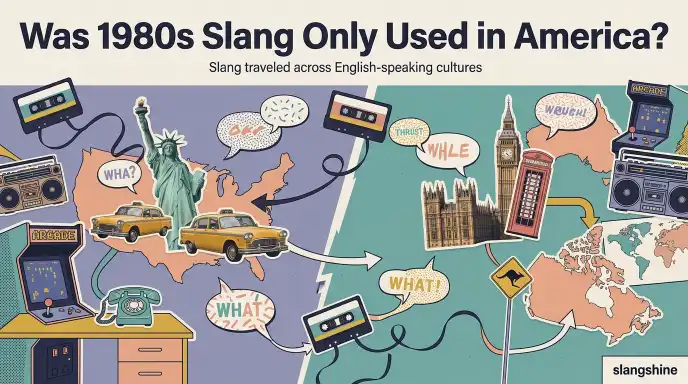
Was 1980s Slang Only Used in America?
No. However, many of the expressions commonly labeled 1980s slang come from American popular culture.
British, Australian, Canadian, and other English-speaking communities had their own slang during the same period.
Some expressions crossed national boundaries through music, television, movies, and other forms of entertainment.
For that reason, the phrase “1980 slang” can cover different regional traditions. When a specific term has a clear regional background, it is better to mention that rather than treating it as universal.
Is 1980s Slang Still Used in 2026?
Some expressions are still used, but usually not with exactly the same frequency or social meaning.
Words such as awesome, dude, and totally remain understandable and can still appear in casual English.
Other expressions, including gag me with a spoon and fer sure, are more likely to appear for humor, nostalgia, or deliberate retro styling.
Modern speakers may also reuse older slang ironically. A person might say “That is so rad” because they genuinely like something, or because they want to create an unmistakably 1980s vibe.
How Do You Use 1980s Slang Today?
The safest approach is to consider the setting.
For casual conversation, a familiar word such as awesome or dude usually sounds natural. More strongly dated expressions work better when the speaker intentionally wants a humorous or nostalgic effect.
Here are a few examples:
- “That arcade is totally rad.”
- “Dude, that was gnarly.”
- “No duh! I already knew that.”
- “That movie was awesome.”
- “Gag me with a spoon that outfit is awful.”
These examples show how tone can make older slang sound either natural or deliberately retro.
Why Do People Still Search for 1980 Slang?
Interest in 1980s slang often comes from nostalgia and pop culture. People may want to understand an old movie, write realistic dialogue, research the decade, or recreate its style for a party or social media post.
Older expressions also help explain how informal English changes over time. A word that once sounded fresh can eventually become ordinary, outdated, or humorous.
Studying 1980s slang therefore gives us more than a list of funny words. It shows how language, entertainment, technology, and youth culture influence one another.
1980s Slang vs. Modern Slang
Modern slang can spread much faster because social media allows expressions to travel across countries almost instantly.
In the 1980s, people depended more heavily on television, radio, music, magazines, schools, and local communities.
That made popular culture extremely important for spreading new expressions.
The purpose of slang, however, remains similar. People still use informal language to sound relaxed, show emotion, identify with a group, and make communication more expressive.
Common Questions About 1980 Slang
Q1. What is the most popular 1980s slang word?
Answer: There is no single most popular 1980s slang word. Terms such as rad, awesome, gnarly, dude, and totally are among the most recognizable examples.
Q2. What did “rad” mean in the 1980s?
Answer: Rad meant excellent, exciting, impressive, or cool. It became strongly associated with youth, skateboarding, surfing, and casual American speech.
Q3. What did “gnarly” mean in 1980s slang?
Answer: Gnarly could mean extreme, difficult, dangerous, or impressive. The intended meaning depended on the situation and the speaker’s tone.
Q4. Did people really say “gag me with a spoon”?
Answer: Yes, the phrase became a recognizable part of the exaggerated Valley Girl style associated with 1980s American pop culture. It expressed disgust or strong dislike.
Q5. Is 1980s slang still used today?
Answer: Yes. Some terms, such as awesome, dude, and totally, remain common. Other expressions are mainly used for humor, nostalgia, or a deliberate retro effect.
Q6. Why was 1980s slang so distinctive?
Answer: Movies, television, music, youth culture, regional speech, and emerging technology all influenced the decade’s vocabulary. Popular media helped many expressions reach a much wider audience.
Key Takeaways
- 1980 slang refers to informal words and expressions associated with the 1980s.
- Popular examples include rad, gnarly, awesome, totally, dude, and gag me with a spoon.
- Youth culture, music, movies, television, and regional communities helped spread these expressions.
- Not every person in the 1980s used the same slang.
- Some terms remain common, while others now sound deliberately retro.
- Context and tone are important when understanding older slang.
Conclusion
1980s slang reflects a decade shaped by strong youth culture and rapidly changing popular media.
Words such as rad, gnarly, awesome, and totally gave casual speech an energetic style, while expressions such as gag me with a spoon became memorable parts of 1980s pop culture.
Although some terms have faded, many remain recognizable today. When people use them in 2026, they may be communicating normally, making a joke, or deliberately bringing back the unmistakable feel of the 1980s.
Learn More Slang Terms:
- What Does BBG Mean in Slang? Full Meaning Explained (2026)
- BP Slang Meaning: One Acronym, Six Different Meanings (2026)
- Trim Slang Meaning: One Word, Three Very Different Uses (2026)
- Scadoodles Slang Meaning: What It Means to Have “A Lot” (2026)

Hi, I’m Emma Carter, an English language writer with over 8 years of experience in vocabulary and language learning. At SlangShine, I write simple, accurate, and easy-to-understand articles about slang, synonyms, idioms, and everyday English to help learners build confidence and improve their communication skills.