Cattycorner slang means something is diagonally across from or diagonally opposite another place or thing. For example, if a store is across the street and slightly to the side, you can say it is catty-corner from your location.
The term is informal American English and has several forms, including catty-corner, cattycorner, kitty-corner, and cater-corner.
Quick Answer: CattyCorner Slang
Catty-corner means “diagonally opposite” or “at a diagonal angle.”
For example:
“The coffee shop is catty-corner from the bank.”
This means the coffee shop is across from the bank but not directly opposite it. Instead, the two places sit at opposite corners or at a diagonal position.
You may also hear kitty-corner, which has the same basic meaning. Both forms are common in informal North American English.
What Does Catty-Corner Mean in Slang?
In slang or casual speech, catty-corner describes the position of something that sits diagonally across from something else.
It can describe buildings, streets, rooms, furniture, people, or objects.
For example:
- “The pharmacy is catty-corner from the grocery store.”
- “She sat catty-corner from me.”
- “Our house is catty-corner to the school.”
- “The restaurant is catty-corner across the intersection.”
The word does not usually describe a person’s attitude or personality. Its main meaning is about location and direction.
Cambridge and Collins both define catty-corner as being in a diagonal position relative to something else.
Is Catty-Corner Actually Slang?
Catty-corner is better described as an informal regional term than modern internet slang.
This distinction is important.
People may search for “catty-corner slang” because the word sounds unusual or because they hear it in casual American speech.
However, dictionaries classify it as US informal or informal North American English rather than as trendy online slang.
So, you probably will not see catty-corner used like newer texting slang such as “LOL” or “FR.”
Instead, it is an everyday spoken expression that some Americans naturally use when describing locations.
What Is the Simple Meaning of Catty-Corner?
The easiest way to understand catty-corner is:
Catty-corner = diagonally across.
Imagine standing at one corner of a street intersection. A store sits across the intersection at the opposite corner.
That store is catty-corner from you.
It is not directly in front of you. It is across from you at an angle.
Simple Example
Imagine four corners:
A = B
C = D
If you are at A, the place at D is catty-corner from you.
This is why the term can be useful when giving directions. It describes a location more precisely than simply saying “across the street.”
Catty-Corner vs. Across the Street
These expressions are similar, but they are not always identical.
Across the street simply means something is on the other side of the street.
Catty-corner suggests that the place is diagonally opposite, usually near the opposite corner.
For example:
“The bank is across the street.”
This tells you the bank is on the other side.
But:
“The bank is catty-corner from the pharmacy.”
This gives you a more specific picture. The bank is positioned diagonally from the pharmacy.
That small difference makes catty-corner useful when people give directions in casual conversation.
Catty-Corner vs. Kitty-Corner
Catty-corner and kitty-corner mean essentially the same thing.
You may hear one form more often depending on where someone lives.
Other related forms include:
- catty-corner
- cattycorner
- catty-cornered
- kitty-corner
- kitty-cornered
- cater-corner
- cater-cornered
Oxford lists catty-corner(ed) and kitty-corner(ed) as informal forms meaning opposite and at a diagonal angle.
So if someone says:
“The store is kitty-corner from the library.”
They are describing the same basic position as:
“The store is catty-corner from the library.”
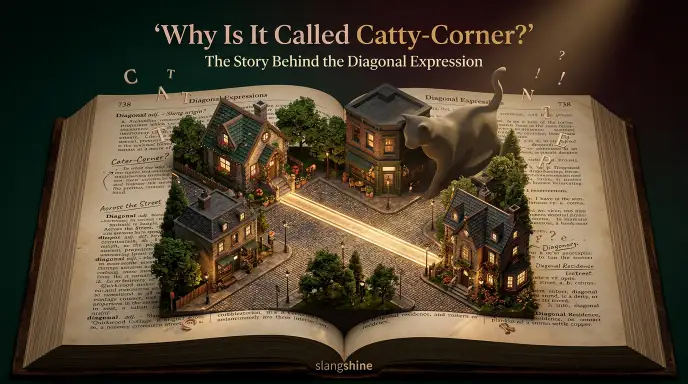
Why Is It Called Catty-Corner?
The name can be confusing because it looks like it has something to do with cats.
It does not.
The older form was cater-cornered. Historical sources connect cater with an old word related to four, ultimately linked to French quatre and Latin quattuor. The term developed the sense of something placed diagonally.
Over time, speakers changed the unfamiliar cater-corner into forms that sounded more familiar, including catty-corner and kitty-corner.
So the “catty” in catty-corner does not refer to a cat sitting in a corner.
Merriam-Webster explains that the modern forms developed from catercorner, which means being in a diagonal or oblique position.
When Did Catty-Corner Start Being Used?
Catty-corner is not a new internet expression.
The term dates back to the 19th century. Etymological sources record cater-cornered earlier and catty-cornered by the 1830s.
That long history explains why the term can sound old-fashioned or unusual to some speakers while sounding completely normal to others.
It has remained part of American informal vocabulary rather than becoming a short-lived slang trend.
Where Is Catty-Corner Used?
Catty-corner is mainly associated with American English, although related forms appear elsewhere in North American English.
Its exact popularity varies by region.
Collins identifies catty-cornered as a form used especially in the South Midland and Southern United States.
Other regional forms are also common. For example, kitty-corner has a strong presence in parts of the North, Midland, and West.
This means two Americans can describe the same location differently:
“The diner is catty-corner from the hotel.”
Or:
“The diner is kitty-corner from the hotel.”
Both can be perfectly natural.
How Do You Use Catty-Corner in a Sentence?
Catty-corner can work as an adverb or adjective, depending on the sentence.
Here are some natural examples:
“The bookstore is catty-corner from the café.”
“She lives catty-corner across from us.”
“There is a gas station catty-corner to the supermarket.”
“He sat catty-corner from me at the table.”
“The two buildings are catty-corner from each other.”
The most common idea stays the same: one thing is positioned diagonally from another.
Catty-Corner in Texting
People can use catty-corner in texting when they are giving directions or describing where something is.
For example:
“The pizza place is catty-corner from the bank.”
Or:
“I’m at the store catty-corner from your house.”
However, it is not a major texting abbreviation or internet slang term. Someone is using the word because it is part of their everyday vocabulary.
That makes catty-corner different from expressions created mainly for online communication.
Is CattyCorner Slang Still Used in 2026?
Yes. Catty-corner remains understandable and in use in 2026, especially in informal American English.
It is not a viral slang term, and its use varies by region. Some speakers prefer kitty-corner, while others say diagonally across, diagonally opposite, or simply across the street.
The word remains useful because it gives a quick description of a diagonal location without needing a long explanation.
CattyCorner Slang in Everyday American English
Catty-corner slang is most useful when someone wants to describe a diagonal location quickly.
Imagine two shops sitting on opposite corners of an intersection. Instead of explaining the exact position, a local speaker might say:
“The bakery is catty-corner from the bank.”
That one phrase tells you the bakery sits diagonally across from the bank.
The expression also works indoors. Someone could say:
“The TV is catty-corner from the sofa.”
In this case, the word does not describe a street or building. It simply explains the position of one object compared with another.
Regional Forms of CattyCorner Slang
One interesting thing about this expression is that different parts of North America may prefer different versions.
You might hear:
- Catty-corner
- Catty-corner
- Kitty-corner
- Cater-corner
- Catty-cornered
- Kitty-cornered
- Cater-cornered
These forms can sound different, but they usually communicate the same basic idea: something is positioned diagonally or at an angle.
This regional variation explains why one person may find “catty-corner” completely normal while another has never heard it before.
It is not necessarily a case of one person using the word incorrectly. Regional vocabulary often develops different forms for the same idea.
Is Catty-Corner More Common Than Kitty-Corner?
There is no single form that every American speaker prefers.
Kitty-corner is very familiar in many areas, while catty-corner appears in other regions. Cater-corner is another established form.
The choice can depend on family speech, local culture, and where a person grew up.
For a general audience, it helps to recognize all three forms rather than assuming that only one is correct.
For example:
“The gas station is kitty-corner from the supermarket.”
And
“The gas station is catty-corner from the supermarket.”
Both describe a diagonal relationship.
What Does Catty-Cornered Mean?
Catty-cornered is simply an adjective form of catty-corner.
It describes something that sits diagonally.
For example:
“The houses are catty-cornered from each other.”
You can also hear:
“The two buildings sit catty-cornered across the road.”
The meaning remains the same. The objects or places are not directly side by side or directly opposite; they sit at an angle.
Is Catty-Corner Used for People?
Yes. Catty-corner can describe where a person sits or stands.
For example:
“She sat catty-corner from me.”
This means she sat diagonally across from the speaker.
You could also say:
“He was sitting catty-corner to his brother.”
The expression still describes position, not a relationship between the people.
It does not mean that the people are arguing, avoiding each other, or behaving strangely.
Is Catty-Corner an Insult?
No. Catty-corner is not normally an insult.
The word simply describes location.
Some people may misunderstand it because catty has another meaning in English. “Catty” can describe someone who makes mean or spiteful comments.
But that meaning is separate from catty-corner.
For example:
“She made a catty comment.”
Here, catty describes someone’s behavior.
But:
“The pharmacy is catty-corner from the school.”
Here, catty-corner describes a location.
Context makes the difference clear.
Common Mistakes With CattyCorner Slang
A few misunderstandings are worth clearing up.
1. Thinking it means “directly opposite”
Catty-corner usually suggests a diagonal position.
If two buildings face each other directly across a narrow street, “opposite” may be more precise.
2. Thinking it refers to cats
The modern spelling can make the word look like it has something to do with cats. It does not.
The expression developed from older forms such as cater-corner.
3. Treating it as internet slang
Catty-corner is much older than modern social media. It is an informal regional expression, not a term created by TikTok or texting culture.
4. Assuming every American uses it
Regional vocabulary varies. Some speakers use catty-corner often, while others prefer kitty-corner, cater-corner, or “diagonally across.”
CattyCorner Slang Examples in Real Conversations
Here are some natural examples:
Giving directions:
“The hotel is catty-corner from the train station.”
Talking about a store:
“There’s a pharmacy catty-corner to the grocery store.”
Describing a seat:
“I sat catty-corner from my friend.”
Talking about houses:
“Their house is catty-corner from ours.”
Describing furniture:
“Put the chair catty-corner to the desk.”
These examples show that the expression can work in many everyday situations.
Catty-Corner vs. Diagonally
If you want a more standard phrase, diagonally across or diagonally opposite works well.
For example:
“The restaurant is diagonally opposite the hotel.”
This sounds more neutral and may be easier for international English learners to understand.
By contrast:
“The restaurant is catty-corner from the hotel.”
sounds more informal and distinctly American.
So the difference is mainly style and regional usage, not meaning.
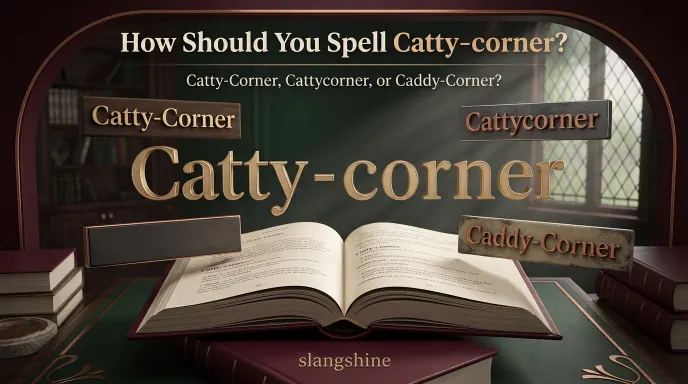
How Should You Spell Catty-Corner?
Catty-corner is a common spelling, but you may also see cattycorner written as one word.
Because the expression is informal and has several regional forms, spelling can vary between dictionaries, publications, and speakers.
If you are writing for a general audience, catty-corner is an easy form to recognize.
If you are discussing regional American English, it is useful to mention kitty-corner and cater-corner as related forms.
CattyCorner Slang Meaning in 2026
In 2026, catty-corner is still a recognizable expression in American English. It has not disappeared simply because newer slang has become popular.
However, it is better described as informal regional vocabulary than as trending slang.
That distinction matters for anyone learning English. You may encounter the word in conversation, local writing, books, or directions even though it does not appear frequently in online slang lists.
If you hear someone say:
“It’s catty-corner from here,”
they are simply telling you that the place is diagonally across from your current position.
FAQs About CattyCorner Slang
Q1. What does catty-corner mean in slang?
Answer: Catty-corner means diagonally across from or diagonally opposite something. It is an informal American expression used mainly to describe location.
Q2. Is catty-corner the same as kitty-corner?
Answer: Yes. Catty-corner and kitty-corner generally have the same meaning. Both describe something positioned diagonally from another object or place.
Q3. Is catty-corner American slang?
Answer: Catty-corner is informal American English with regional variation. It is better described as a regional or informal expression than modern internet slang.
Q4. Why do people say catty-corner?
Answer: Catty-corner developed from older forms such as cater-corner. The expression came to describe something positioned diagonally, and forms such as catty-corner and kitty-corner developed over time.
Q5. Does catty-corner mean directly across?
Answer: Not exactly. It usually means diagonally across or at an opposite corner. “Directly across” suggests a straight position, while catty-corner suggests an angle.
Q6. Is catty-corner offensive?
Answer: No. Catty-corner is not normally offensive. It simply describes the position of a person, place, or object.
Q7. What are other words for catty-corner?
Answer: Similar expressions include kitty-corner, cater-corner, diagonally across, and diagonally opposite. The best choice depends on region and context.
Conclusion: CattyCorner Slang
Catty-corner slang means diagonally across or diagonally opposite. It is an informal American expression used to describe where a person, building, object, or place sits in relation to something else.
The word has several forms, including kitty-corner and cater-corner. These variations can reflect regional speech rather than different meanings.
Although people often search for it as slang, catty-corner is not modern internet slang. It is an older regional expression that remains useful in everyday American English.
If someone tells you that a store is catty-corner from the bank, they simply mean the store is located diagonally across from the bank.
Learn More Slang Terms:
- IKYFL Meaning Slang: Five Letters, One Big Feeling
- What Does Cap Slang Mean? No Cap, Here’s the Real Answer
- Dalcop Slang Meaning: An Old Insult for a Dull-Headed Fool (2026)

Hi, I’m Anna Whitmore. I have 7+ years of experience writing about English slang and vocabulary. At SlangShine, I create simple, easy-to-understand content for English learners.