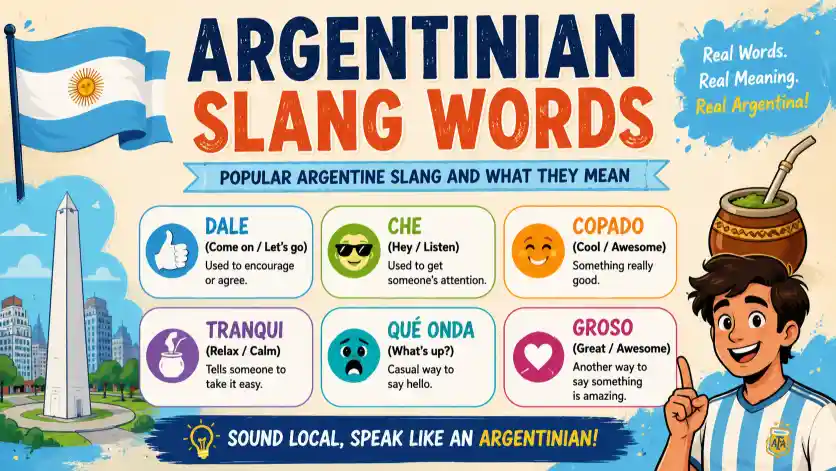
Argentinian slang words are informal expressions commonly used in Argentina. These words make everyday conversations sound more natural, friendly, and expressive.
You will hear them in daily life, social media, text messages, TV shows, football discussions, and Argentine movies.
Many of these slang terms come from Rioplatense Spanish, the variety of Spanish spoken in Argentina and Uruguay. Some words have unique meanings that may confuse Spanish learners from other countries.
Learning these expressions will help you understand native speakers and communicate more naturally.
Quick Answer: Argentinian Slang Words
Argentinian slang words are informal expressions used in Argentina to make conversations more natural. Popular examples include Che, Boludo, Pibe, Mina, Laburo, and Copado.
What Are Argentinian Slang Words?
They Make Conversations More Natural
People in Argentina use slang every day.
These expressions help speakers:
- Sound friendly.
- Express emotions.
- Speak more naturally.
- Build closer relationships.
Many slang words are common among friends and family.
Their Meaning Depends on Context
Some slang words have more than one meaning.
The speaker’s tone and the situation often decide how the word should be understood.
For example, a word that sounds friendly between friends may sound disrespectful when used with a stranger.
Common Argentinian Slang Words
Che
Meaning:
A casual word used to get someone’s attention. It is similar to saying “Hey,” “Mate,” or “Friend.”
Tone:
Friendly and informal.
Example:
“Che, how are you?”
Meaning:
“Hey, how are you?”
Boludo
Meaning:
A very common slang word. Among close friends, it can mean “buddy” or “mate.” During an argument, however, it can mean “idiot.”
Tone:
Friendly or offensive, depending on the situation.
Example:
“Boludo, that was funny.”
Meaning:
“Buddy, that was funny.”
Pibe
Meaning:
A boy or a young man.
Tone:
Friendly.
Example:
“That pibe plays football every afternoon.”
Meaning:
That young boy plays football every afternoon.
Mina
Meaning:
A woman or a girl.
Tone:
Informal.
Example:
“She’s a nice mina.”
Meaning:
She is a nice woman.
Laburo
Meaning:
Work or a job.
Tone:
Casual.
Example:
“I have a lot of laburo today.”
Meaning:
I have a lot of work today.
Copado
Meaning:
Cool, great, or awesome.
Tone:
Positive.
Example:
“That restaurant is really copado.”
Meaning:
That restaurant is really cool.
Are Argentinian Slang Words Offensive?
Most Are Friendly
Most Argentinian slang words are harmless when used correctly.
However, some expressions change meaning depending on the context.
For example, Boludo is often friendly between close friends. The same word can become an insult during an argument.
Learning the context is just as important as learning the word.
Where Are Argentinian Slang Words Commonly Used?
Everyday Conversations
People use slang in daily conversations with friends, family, and classmates.
These expressions are a normal part of life in Argentina.
Social Media
You will often see these slang words on:
- TikTok
- X (formerly Twitter)
- YouTube
They appear in captions, comments, and short videos.
Football Conversations
Football is a big part of Argentine culture.
Fans often use slang while talking about matches, players, and teams.
Movies and TV Shows
Many Argentine films and television programs include slang to make conversations sound authentic.
Watching local content is a great way to learn these expressions.
Text Messages
Friends also use slang while texting.
Example:
“Che, are you coming later?”
Meaning:
“Hey, are you coming later?”
Origin and Background of Argentinian Slang Words
How Did Argentinian Slang Develop?
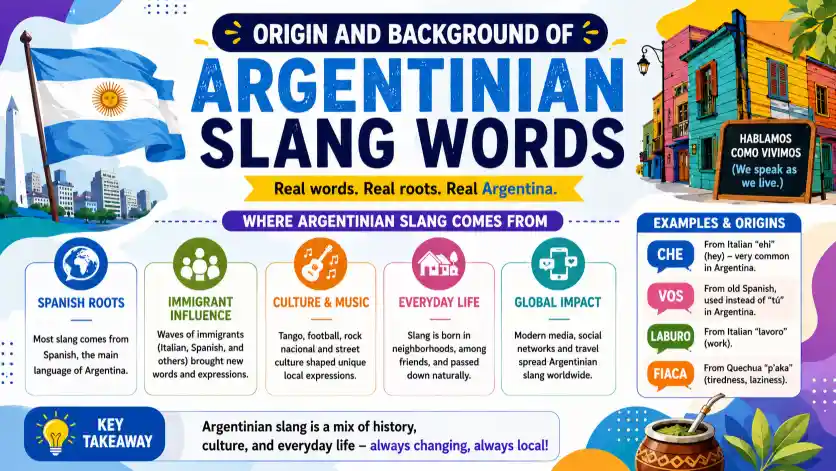
Many Argentinian slang words developed over hundreds of years. They come from Spanish, Italian, Indigenous languages, and the unique culture of Argentina.
Large waves of Italian immigration also influenced everyday speech. As a result, many expressions sound different from the Spanish spoken in other countries.
Today, these slang words are an important part of Argentine identity.
Why Do People Use Argentinian Slang Words?
To Sound Friendly
Most people use slang to make conversations feel relaxed.
Instead of speaking very formally, they choose casual expressions that feel more natural.
This is common among friends, classmates, and family members.
To Express Personality
Slang helps people show emotions more clearly.
It can express:
- Excitement
- Surprise
- Happiness
- Frustration
- Humor
These expressions often make conversations more lively.
To Connect With Others
Using familiar slang helps people feel closer to each other.
That is why many Argentinians use these words every day.
More Popular Argentinian Slang Words
Quilombo
Meaning:
A mess, a chaotic situation, or a big problem.
Tone:
Informal.
Example:
“This office is a quilombo.”
Meaning:
This office is very messy or chaotic.
Guita
Meaning:
Money.
Tone:
Casual.
Example:
“I don’t have enough guita.”
Meaning:
I don’t have enough money.
Bondi
Meaning:
Bus.
Tone:
Friendly.
Example:
“Let’s take the bondi.”
Meaning:
Let’s take the bus.
Chabón
Meaning:
A guy or a man.
Tone:
Informal.
Example:
“That chabón is really funny.”
Meaning:
That guy is really funny.
Macanudo
Meaning:
Great, nice, or pleasant.
Tone:
Positive.
Example:
“He’s a macanudo person.”
Meaning:
He is a very nice person.
Fiaca
Meaning:
Feeling lazy or not wanting to do anything.
Tone:
Casual.
Example:
“I have fiaca today.”
Meaning:
I feel lazy today.
Argentinian Slang Words vs Standard Spanish
Many slang words have standard Spanish alternatives.
| Argentinian Slang | Standard Spanish | English Meaning |
| Che | Oye | Hey |
| Boludo | Amigo (context matters) | Buddy |
| Pibe | Niño | Boy |
| Mina | Mujer | Woman |
| Laburo | Trabajo | Work |
| Guita | Dinero | Money |
| Bondi | Autobús | Bus |
| Copado | Genial | Cool |
These slang words are common in casual conversations but are rarely used in formal writing.
When Should You Avoid Argentinian Slang Words?
Some situations require formal language.
Avoid slang in:
- Business meetings
- Job interviews
- School essays
- Official emails
- Academic reports
- Professional presentations
Standard Spanish is more appropriate in these settings.
Polite Alternatives
If you are unsure about using slang, choose standard Spanish instead.
| Slang Word | Polite Alternative |
| Che | Hola |
| Boludo | Amigo |
| Mina | Mujer |
| Laburo | Trabajo |
| Guita | Dinero |
| Bondi | Autobús |
| Copado | Excelente |
These words are widely understood across Spanish speaking countries.
Why Learning Argentinian Slang Words Is Helpful
Learning Argentinian slang words offers many benefits.
It helps you:
- Understand native speakers.
- Enjoy Argentine movies and TV shows.
- Follow football discussions.
- Read social media posts.
- Improve your Spanish listening skills.
- Learn more about Argentine culture.
Even if you do not use every slang word, recognizing them will make conversations much easier to understand.
Impact of Using Argentinian Slang Words in Communication
Argentinian Slang Words Makes Conversations Feel More Natural
Using Argentinian slang words can make your Spanish sound more relaxed and friendly. Native speakers use these expressions every day, especially with friends and family.
For example:
“Che, let’s go.”
The sentence sounds much more natural in Argentina than a formal greeting.
Slang Helps You Understand Native Speakers
Learning slang is useful even if you do not plan to use it often.
It helps you understand:
- Everyday conversations
- Social media posts
- Movies
- TV shows
- Football discussions
- Podcasts
The more slang you know, the easier it becomes to follow real conversations.
Use Slang Carefully
Not every slang word fits every situation.
Some expressions:
- Are only for close friends.
- Sound too casual in formal settings.
- Can be misunderstood outside Argentina.
- May have different meanings in other countries.
When you are unsure, choose standard Spanish.
Is It Safe to Use Argentinian Slang Words on Social Media?
Yes, Most Are Safe
Most Argentinian slang words are safe for social media.
People often use them on:
- TikTok
- X (formerly Twitter)
- YouTube
They appear in comments, captions, memes, and short videos.
However, always use respectful language and avoid slang that could offend someone.
Real Life Examples Of Argentinian Slang Words
Friendly Examples
Example 1
“Che, how was your day?”
Meaning:
The speaker is greeting a friend in a casual way.
Example 2
“You’re a great pibe.”
Meaning:
The speaker is saying the young man is kind or friendly.
Example 3
“That place is really copado.”
Meaning:
The speaker thinks the place is cool and enjoyable.
Casual Examples
These expressions are common in everyday conversations.
- “I have a lot of laburo today.”
- “Let’s take the bondi.”
- “I don’t have enough guita.”
- “Today I have fiaca.”
- “That café is copado.”
Football Examples
Football fans often use slang while talking about matches.
Example 1
“That pibe played an amazing game.”
Meaning:
The young player performed very well.
Example 2
“The stadium was full of people, che.”
Meaning:
The speaker is talking casually with a friend.
Example 3
“That match was copado.”
Meaning:
The game was exciting and enjoyable.
Social Media Examples
“This trip was copado.”
Meaning:
The trip was fantastic.
TikTok
“Che, watch this video.”
Meaning:
The speaker is getting the viewer’s attention.
“No laburo today.”
Meaning:
The speaker does not have work today.
YouTube
“That chabón is hilarious.”
Meaning:
The speaker thinks the man is very funny.
Common Mistakes People Make
Thinking Every Slang Word Is Friendly
Not every slang word has the same tone.
For example, Boludo can be friendly between close friends. During an argument, it can become an insult.
Always consider the situation.
Using Slang in Formal Situations
Avoid slang in:
- Business emails
- School assignments
- Professional meetings
- Job interviews
Formal Spanish is the better choice.
Assuming the Meaning Is the Same Everywhere
Some Argentinian slang words are unique to Argentina.
People in other Spanish speaking countries may use different words for the same idea.
Learning regional differences will improve your communication.
Using Too Much Slang
Using several slang words in one sentence can confuse listeners.
Mix slang with standard Spanish to sound more natural.
Tips for Using Argentinian Slang Words Correctly
Follow these simple tips.
- Learn one expression at a time.
- Listen to native speakers.
- Practice in casual conversations.
- Avoid slang in formal settings.
- Pay attention to the context.
- Use respectful language with strangers.
These habits will help you speak more naturally while avoiding misunderstandings.
Frequently Asked Questions
Q1.What are Argentinian slang words?
Answer: Argentinian slang words are informal expressions used in Argentina. They help people communicate in a relaxed and natural way. Many are common in daily conversations, social media, and local entertainment.
Q2.What is the most common Argentinian slang word?
Answer: One of the most common Argentinian slang words is Che. People use it to get someone’s attention, similar to saying “Hey” or “Mate.”
Q3.Is “Boludo” an insult?
Answer: It depends on the context. Among close friends, Boludo can mean “buddy” or “mate.” During an argument, however, it often becomes an insult that means “idiot.”
Q4.Are Argentinian slang words used on social media?
Answer: Yes. You can find Argentinian slang words on TikTok, Instagram, Facebook, X (formerly Twitter), YouTube, and in text messages. They are common in comments, captions, and casual chats.
Q5.Can Spanish learners use Argentinian slang?
Answer: Yes, but they should learn the meaning and context first. Some expressions are only suitable for casual conversations and may sound inappropriate in formal situations.
Q6.Should I use Argentinian slang while traveling?
Answer: You can use simple and friendly expressions like Che once you understand how native speakers use them. If you are unsure, standard Spanish is always the safest option.
Key Takeaways
Here are the most important things to remember about Argentinian slang words:
- They are informal expressions used in everyday life.
- Many come from Rioplatense Spanish and local culture.
- Che is one of the most popular slang words in Argentina.
- Boludo can be friendly or offensive, depending on the situation.
- Words like Laburo, Guita, Pibe, and Copado are common in casual conversations.
- Most slang is suitable for friends but not for professional settings.
- Learning these expressions helps you understand native speakers, movies, football discussions, and social media.
Conclusion
Argentinian slang words are an important part of everyday communication in Argentina. They make conversations sound friendly, natural, and full of personality.
Popular expressions such as Che, Boludo, Pibe, Mina, Laburo, Guita, and Copado appear in daily conversations, social media, football discussions, movies, and music.
While many of these words are easy to learn, their meaning often depends on the speaker, the tone, and the situation. Understanding the context is just as important as learning the vocabulary itself.
If you are studying Spanish, planning a trip to Argentina, or simply interested in Argentine culture, learning these slang terms will help you understand native speakers more easily.
Use them respectfully, avoid slang in formal situations, and enjoy discovering the unique style of Argentine Spanish.
Discover More Articles:

Hi, I’m Emma Carter, an English language writer with over 8 years of experience in vocabulary and language learning. At SlangShine, I write simple, accurate, and easy-to-understand articles about slang, synonyms, idioms, and everyday English to help learners build confidence and improve their communication skills.