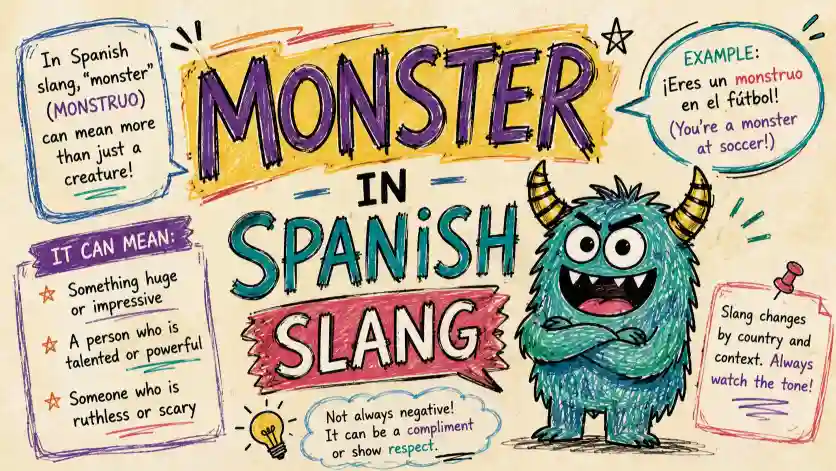
“Monster” in Spanish slang does not have one fixed meaning. The normal Spanish word for “monster” is monstruo, but in informal speech, monstruo can describe a person who is extremely good at something, very strong, impressive, or sometimes difficult to deal with.
The meaning depends on the situation and the speaker. For example, calling someone un monstruo can be a compliment when they are highly skilled. However, in another context, it can describe someone who behaves in a frightening or unpleasant way.
People searching for monster in Spanish slang may also come across different regional uses. Spanish slang changes between countries, so an expression that sounds natural in one place may not have the same meaning somewhere else.
Quick Answer: Monster in Spanish Slang
The Spanish word for “monster” is “monstruo.” In slang, monstruo can describe someone who is exceptionally talented, powerful, or impressive, depending on context.
What Does “Monster” Mean in Spanish?
The standard Spanish translation of monster is:
Monstruo = monster
It can describe a fictional creature, a frightening person, or something that looks unusually large or powerful.
For example:
“El monstruo vive en el bosque.”
Meaning:
“The monster lives in the forest.”
That is the normal, literal meaning. However, informal speech can give the word a completely different feel.
What Does “Monstruo” Mean in Spanish Slang?
In informal Spanish, monstruo can be used as a strong compliment for someone who is extremely good at something.
It can be similar to saying:
- Beast
- Monster
- Legend
- Superstar
- Expert
For example:
“Ese jugador es un monstruo.”
A natural English meaning could be:
“That player is a beast.”
The speaker is not saying the player is a scary creature. Instead, they are praising the person’s ability.
What Does “Monster” Mean in Text?
In text messages, “monster” can mean different things depending on the context. It may literally refer to a scary creature, but it can also describe someone who is extremely good, powerful, tough, or impressive at something.
For example, “You’re a monster!” can be a compliment meaning “You’re incredibly good at this.” In some chats, however, it may be used negatively to describe someone as cruel or frightening.
Is “Monstruo” a Compliment?
It can be, especially when talking about talent or performance.
The surrounding words usually make the meaning clear.
Sports
“Ese futbolista es un monstruo.”
Meaning:
“That soccer player is a beast.”
The speaker is praising the player’s skill.
Music
“Es un monstruo con la guitarra.”
Meaning:
“He’s a monster on the guitar.”
Here, monstruo means the person is extremely talented.
Gaming
“Mi amigo es un monstruo jugando.”
Meaning:
“My friend is a beast at gaming.”
Again, the word works as praise rather than an insult.
Why Does “Monster” Become a Compliment?
The idea comes from using “monster” to describe someone unusually powerful or skilled.
English does something similar with words such as beast or monster. A person can be called a “monster” because they perform at a very high level.
Spanish speakers can use monstruo in a similar informal way.
For example, if someone performs an extremely difficult task with ease, another person might call them un monstruo.
The important point is that the word describes exceptional ability, not an actual creature.
Monster in Spanish Slang for a Person
When monstruo describes a person, context is especially important.
It can suggest that someone is:
- Very talented
- Extremely skilled
- Strong
- Powerful
- Impressive
- Hard to beat
For example:
“Eres un monstruo.”
Depending on the situation, this can mean:
“You’re a beast.”
or:
“You’re incredibly good.”
However, the same phrase can sound negative if the conversation is about someone’s behavior.
Can “Monstruo” Be an Insult?
Yes. In some contexts, monstruo can have a negative meaning.
If someone calls another person a monster while discussing cruel or harmful behavior, the word is closer to its literal negative sense.
For example:
“Ese hombre es un monstruo.”
This could mean:
“That man is a monster.”
Here, the speaker is not praising him. Instead, they are criticizing his behavior.
So, the same Spanish word can work as either praise or criticism.
Positive vs. Negative Meaning
The easiest way to understand monstruo is to look at what comes after or around it.
| Context | Possible Meaning | Tone |
| Sports performance | Extremely skilled | Positive |
| Gaming | Very good player | Positive |
| Music | Highly talented | Positive |
| Physical strength | Very powerful | Positive |
| Cruel behavior | A terrible person | Negative |
| Fiction | Actual monster | Neutral / scary |
Therefore, never translate monstruo automatically without checking the full sentence.
Real Life Examples of “Monstruo”
Friendly
“¡Eres un monstruo! Ganaste otra vez.”
Meaning:
“You’re a beast! You won again.”
The speaker is praising a friend.
Casual
“Mi hermano es un monstruo para las matemáticas.”
Meaning:
“My brother is a beast at math.”
This describes exceptional skill.
Gaming
“Ese jugador es un monstruo.”
Meaning:
“That player is a beast.”
The speaker is impressed by the player’s ability.
Negative
“Después de lo que hizo, todos lo llamaban un monstruo.”
Meaning:
“After what he did, everyone called him a monster.”
Here, the word has a negative meaning.
Is “Monstruo” the Same as “Beast” in English Slang?
Sometimes, yes. When monstruo is used to praise someone’s ability, beast is often a natural English equivalent.
However, the two words are not identical in every situation.
| Spanish | English Idea | Context |
| Monstruo | Monster | Literal or negative |
| Monstruo | Beast | Skill or performance |
| Monstruo | Expert | Strong ability |
| Monstruo | Powerful person | Strength or dominance |
For example, “Es un monstruo jugando al fútbol” is better understood as “He’s a beast at soccer” than as “He’s a monster playing soccer.”
Where Can You See This Slang?
This informal use can appear in casual conversations about skills, sports, music, gaming, and other areas where people praise strong performance.
You may encounter it in:
- Text messages
- Social media posts
- Sports discussions
- Gaming chats
- Music conversations
- Friendly conversations
Still, regional usage can vary. Spanish slang is not identical across all Spanish-speaking countries.
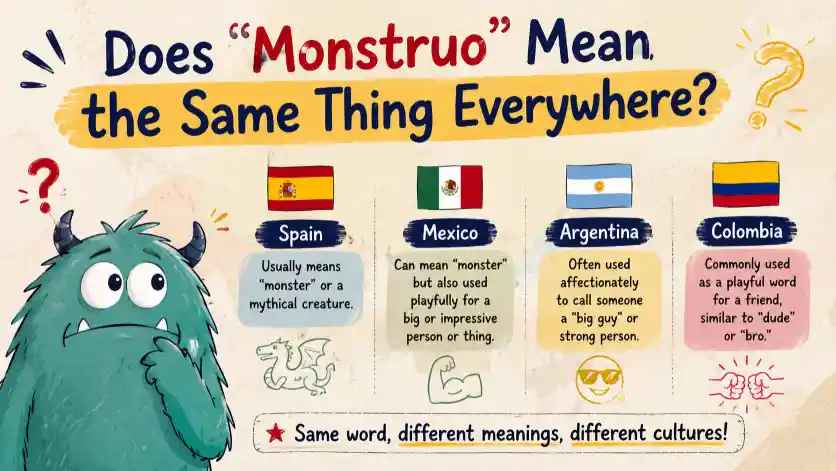
Does “Monstruo” Mean the Same Thing Everywhere?
Not always.
Spanish is spoken across many countries, and informal vocabulary can change from one region to another.
The positive slang use of monstruo may be easy to understand in context, but the exact frequency and naturalness can differ between speakers.
For that reason, it is safer to learn the expression through complete examples rather than assuming that every Spanish speaking community uses it in exactly the same way.
How Do You Know Which Meaning Is Intended?
The words around “monstruo” usually tell you whether it is positive, negative, or literal.
If the sentence talks about skill, winning, talent, or performance, the word is likely being used as praise.
For example:
“Es un monstruo con el balón.”
The sports context makes the intended meaning clear.
On the other hand, if the sentence describes cruel behavior, violence, or someone’s character, the word may be negative.
When the sentence describes a fictional creature, it simply has its normal meaning.
So, always look at the topic, tone, and surrounding words before choosing an English translation.
“Monstruo” in Different Situations
The same word can feel different depending on the conversation.
Sports
In sports, monstruo can show strong admiration for an athlete’s ability.
A fan might use it after an amazing performance.
Gaming
Among gamers, the word can praise someone who dominates a match or performs difficult moves.
However, gamers may also use many other slang terms, so the exact meaning depends on the community.
School or Work
Someone can use monstruo informally when talking about a person who is extremely good at a subject or skill.
For example:
“Ella es un monstruo programando.”
The speaker is praising her programming ability.
Everyday Conversation
In casual speech, it can be a playful compliment between friends.
Still, it may sound unusual if translated word for word into English. The natural translation depends on the situation.
“Monstruo” vs. Similar Spanish Expressions
Spanish has several informal ways to praise someone’s ability. They do not all carry exactly the same feeling.
| Expression | Simple Meaning | Typical Feeling |
| Monstruo | Extremely skilled person | Strong praise |
| Crack | Very talented person | Positive |
| Máquina | Someone highly capable | Positive |
| Fiera | Skilled or formidable person | Strong |
| Genio | Genius / very smart person | Positive |
For example, crack can sound like “star” or “pro,” while monstruo can give a stronger sense of exceptional ability.
These words can also vary by country, so they should not be treated as universal slang.
Is “Monstruo” Offensive?
Not automatically.
When used as praise, it can be positive. When used to criticize someone’s behavior, it can be harsh.
The literal meaning can also be unpleasant when it refers to a frightening creature.
Therefore, the word itself is not always offensive. The meaning comes from the context and intention.
If you are speaking with someone you do not know well, a clearer compliment such as “muy bueno” or “excelente” is safer.
When Should You Avoid Using “Monstruo” as Slang?
You do not necessarily need to avoid the word, but you should be careful when the meaning could be misunderstood.
Formal Communication
In a formal email, report, or academic paper, use a clear description instead.
For example:
“She is highly skilled at programming.”
This is clearer than using slang.
With People From Different Spanish Regions
Because informal language varies, someone from another Spanish-speaking region may understand the word differently.
In that case, standard vocabulary is less likely to cause confusion.
When Giving a Serious Compliment
If you want your praise to sound respectful and direct, use a standard compliment.
Words such as excelente, talentoso, or muy bueno make your meaning clear.
Why Do Spanish Speakers Use “Monstruo” as Praise?
The slang use makes praise sound stronger and more expressive.
Instead of simply saying someone is good, the speaker can suggest that the person’s ability is far above normal.
This can make casual speech more energetic.
For example, calling a skilled player un monstruo can show excitement about how impressive their performance was.
The expression also fits the playful style often found in conversations about sports, gaming, music, and other competitive activities.
Common Mistakes to Avoid
Mistake 1: Assuming It Always Means a Scary Creature
In casual speech, monstruo can describe exceptional talent.
Mistake 2: Translating It Word for Word
A literal translation may sound strange in English.
Instead, look at the situation and choose a natural English expression.
Mistake 3: Assuming It Is Always a Compliment
The word can also describe someone negatively.
Therefore, check whether the sentence discusses talent or harmful behavior.
Mistake 4: Treating It as Universal Slang
Spanish slang changes across countries and communities.
As a result, a phrase that sounds natural to one speaker may be less common to another.
Is “Monster” Safe to Use on Social Media?
The word “monstruo” itself is not automatically offensive on social media.
If someone uses it to praise a player’s skills or a friend’s talent, it can be completely harmless.
However, the meaning changes when the word is connected to cruelty, harmful actions, or insults.
Before posting or replying, check the surrounding conversation. That way, you can avoid making a compliment sound like an insult.
What Is a Polite Alternative to “Monstruo”?
If you are unsure whether slang will be understood, use a standard Spanish compliment.
Useful alternatives include:
- Muy bueno = very good
- Excelente = excellent
- Talentoso = talented
- Increíble = incredible
- Genial = great
These expressions are easier for most Spanish learners to use safely.
FAQs About Monster in Spanish Slang
Q1. What does monster mean in Spanish slang?
Answer: The Spanish word monstruo can describe someone who is extremely talented, powerful, or impressive. It can also have a negative meaning depending on context.
Q2. What is the Spanish slang word for monster?
Answer: Monstruo is the standard Spanish word for “monster.” In informal speech, it can also be used as praise for exceptional ability.
Q3. Does monstruo mean “beast” in Spanish slang?
Answer: Sometimes. When it describes someone with outstanding skill, monstruo can be translated naturally as “beast” in English.
Q4. Is monstruo a compliment?
Answer: It can be. When used to describe talent or performance, it is often a strong compliment. However, the same word can be negative in another context.
Q5. Can I use monstruo with Spanish speakers?
Answer: You can recognize and use it in informal situations, but regional differences matter. If you are unsure, a standard compliment such as excelente is safer.
Q6. What is a polite alternative to monstruo?
Answer: You can use muy bueno, excelente, talentoso, or increíble when you want a clear and polite compliment.
Conclusion
“Monster” in Spanish is “monstruo,” and its informal meaning depends on context. When used to describe talent, sports ability, gaming skills, music, or another strong performance, it can mean something close to “beast” or “someone extremely skilled.”
At the same time, monstruo can describe a cruel person or an actual frightening creature. Therefore, the surrounding sentence is important when deciding what the speaker means.
For Spanish learners, the safest approach is to understand the context first. If you want a simple and polite compliment, words such as excelente or talentoso are easier choices.
Discover More Articles:

Hi, I’m Anna Whitmore. I have 7+ years of experience writing about English slang and vocabulary. At SlangShine, I create simple, easy-to-understand content for English learners.