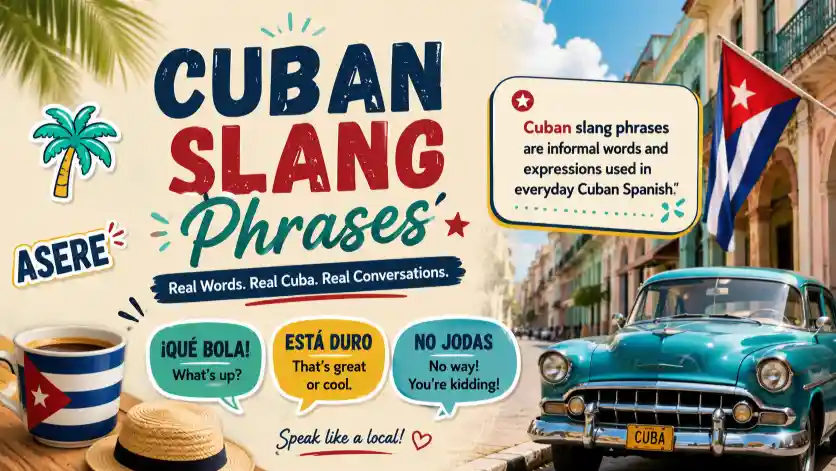
Cuban slang phrases are informal words and expressions used in everyday Cuban Spanish. They can make conversations sound more natural, friendly, funny, or local.
However, some phrases are strongly tied to Cuban culture, so their meaning may not be obvious from a direct English translation.
People often search for Cuban slang phrases when they hear Cuban Spanish in conversations, movies, music, travel content, or online posts.
Learning these expressions can help you understand the way people speak in relaxed settings.
In this guide, you will find common Cuban slang words and phrases with simple meanings and examples. You will also learn when they sound natural and which expressions need extra care.
Quick Answer: Cuban Slang Phrases
Common Cuban slang phrases include ¿Qué bola? for “What’s up?”, asere for “friend” or “buddy,” dale for “okay” or “let’s go,” and chama/chamaco for “girl/boy” or “young person.” Their meaning can change with context.
Quick Reference: Cuban Slang
| Cuban Slang | Simple English Meaning | Tone |
| ¿Qué bola? | What’s up? | Casual |
| Asere | Friend / buddy | Very casual |
| Dale | Okay / let’s go | Casual |
| Chama | Girl / young woman | Casual |
| Chamaco | Boy / young person | Casual |
| Pipo | Buddy / guy | Informal |
| Tener tremenda nota | To be in a great mood | Informal |
| Estar volao | To be excited or really into something | Informal |
| La lucha | The daily struggle | Informal |
| Resolver | To find a way to manage or get something | Informal |
What Are Cuban Slang Phrases?
Cuban slang phrases are informal expressions that are common in Cuban Spanish. They often reflect local culture, humor, and everyday life.
Unlike standard Spanish, slang may not follow the wording you expect from a textbook. For example, a phrase can have a simple literal meaning but carry a different idea in a real conversation.
That is why learning slang is useful for understanding natural speech.
However, not every expression is suitable for every situation. Some words are friendly among close friends but may sound too informal with strangers or in professional settings.
1. ¿Qué Bola?
¿Qué bola? is one of the best-known Cuban expressions for asking “What’s up?” or “How are you?”
It is a casual greeting between people who know each other.
Example:
“¡Asere! ¿Qué bola?”
Meaning:
“Hey, buddy! What’s up?”
The phrase is friendly and relaxed. Therefore, it fits casual conversations much better than formal introductions.
2. Asere
Asere is a familiar Cuban word used to address a friend, buddy, or person you know.
It is strongly associated with Cuban speech and is often heard in informal conversations.
Example:
“Asere, vamos a comer.”
Meaning:
“Buddy, let’s go eat.”
Because it is informal, it is best used with people who are comfortable with casual Cuban Spanish.
3. Dale
Dale is a very useful informal expression. Depending on the situation, it can mean “okay,” “go ahead,” “come on,” or “let’s go.”
Its meaning depends heavily on the conversation.
Example:
“¿Nos vemos a las ocho?”
“Dale.”
Meaning:
“See you at eight?”
“Okay.”
It can also encourage someone to continue.
“¡Dale, vamos!”
Here, it means something like:
“Come on, let’s go!”
4. Chama
Chama is an informal word for a girl or young woman.
It is commonly used in casual speech.
Example:
“Esa chama es muy amable.”
Meaning:
“That girl is very nice.”
The masculine form chamaco can refer to a boy or young person.
Example:
“Ese chamaco juega muy bien.”
Meaning:
“That boy plays very well.”
5. Pipo
Pipo is an informal way to address a guy, friend, or buddy.
It can sound warm and familiar when used between people who know each other.
Example:
“Pipo, ¿vas a venir?”
Meaning:
“Buddy, are you coming?”
Still, slang can vary between speakers and regions, so the exact feeling may depend on the relationship.
6. Tener Tremenda Nota
Tener tremenda nota is an informal Cuban expression connected with being in a very good mood or having a strong, lively feeling.
The phrase can also be used in contexts involving a high or altered state, depending on the speaker and situation. For that reason, context is important.
Example:
“Hoy tengo tremenda nota.”
A possible meaning is:
“I’m in a great mood today.”
The phrase should not always be translated word for word.
7. Estar Volao
Estar volao is an informal expression that can describe someone who is very excited, deeply interested, or highly energized.
Its meaning can change with context.
Example:
“Está volao con ese juego.”
Meaning:
“He’s really into that game.”
Therefore, it is better to look at the full sentence instead of translating volao alone.
8. La Lucha
La lucha literally means “the struggle.” In Cuban informal speech, it can refer to dealing with everyday difficulties and finding ways to get through them.
Example:
“Seguimos en la lucha.”
A natural English meaning is:
“We’re still getting through it.”
The expression can carry a sense of persistence. In other words, it can describe continuing to manage life despite problems.
9. Resolver
Resolver literally means “to solve,” but in Cuban everyday speech, it can have a broader informal sense.
It can describe finding a practical way to get something needed or deal with a problem.
Example:
“Tengo que resolver la comida.”
Depending on context, this can mean:
“I need to figure out the food.”
The important idea is not simply solving a question. Instead, it can mean finding a practical solution.
How Cuban Slang Differs From Standard Spanish
Cuban slang can sound very different from textbook Spanish.
Standard Spanish often uses words that are understood across many Spanish-speaking countries. Cuban slang, on the other hand, can include local expressions that carry a special cultural meaning.
For example:
| Standard Spanish | Cuban Informal Expression | English Idea |
| ¿Cómo estás? | ¿Qué bola? | What’s up? |
| Amigo | Asere | Buddy / friend |
| De acuerdo | Dale | Okay |
| Chica | Chama | Girl |
| Chico | Chamaco | Boy / young person |
However, this does not mean Cuban speakers use slang all the time. People naturally switch between formal, neutral, and informal language depending on the setting.
Why Do People Use Cuban Slang?
People use slang because it makes casual communication feel more natural and personal.
These expressions can:
- Show friendliness
- Create a relaxed tone
- Express emotion
- Reflect Cuban culture
- Make speech sound less formal
At the same time, slang can be difficult for learners because the literal translation may not explain the real meaning.
That is why context matters when learning Cuban expressions.
10. ¿Qué Es Eso?
¿Qué es eso? literally means “What is that?” However, in casual Cuban speech, the expression can also sound like a reaction to something strange, unexpected, or confusing.
Example:
“¿Qué es eso? Nunca había visto algo así.”
Meaning:
“What is that? I’ve never seen anything like that.”
The phrase itself is not exclusive to Cuba. Still, you may hear it in Cuban conversations with a local tone or accent.
11. Está de Madre
Está de madre is a Cuban expression used when something is difficult, annoying, intense, or frustrating.
The exact English meaning depends on the situation.
Example:
“El tráfico está de madre hoy.”
A natural translation could be:
“The traffic is terrible today.”
This is informal language. Therefore, it is better suited to relaxed conversations than formal situations.
12. Qué Clase de…
Qué clase de… can be used to emphasize a reaction to a person, thing, or situation.
For example:
“¡Qué clase de fiesta!”
Depending on the context, this can express strong admiration or surprise, such as:
“What an amazing party!”
The phrase is not always slang by itself. Instead, its informal feel often comes from how Cuban speakers use it in conversation.
13. Asere Qué Bola
Asere, ¿qué bola? combines two familiar Cuban expressions: asere and ¿qué bola?
It is a relaxed way to greet a friend.
Example:
“Asere, ¿qué bola? ¿Todo bien?”
Meaning:
“Hey, buddy, what’s up? Everything good?”
Because both parts are informal, the full greeting sounds especially casual.
14. No Hay Problema
No hay problema means “no problem.” While this phrase is common across the Spanish-speaking world, it can naturally appear in Cuban casual conversations too.
Example:
“¿Puedes ayudarme mañana?”
“Sí, no hay problema.”
Meaning:
“Can you help me tomorrow?”
“Yes, no problem.”
It is useful for learners because it is easy to understand and does not carry strong slang.
15. ¡Qué Bola Contigo!
¡Qué bola contigo! is another casual way to greet or address someone.
Depending on tone, it can mean something like “What’s up with you?” or simply work as a friendly greeting.
Example:
“¡Qué bola contigo! Hace tiempo no te veo.”
Meaning:
“What’s up with you? I haven’t seen you in a while.”
The relationship between the speakers helps determine how friendly or playful it sounds.
Cuban Slang Phrases in Real Conversations
Cuban slang becomes easier to understand when you see how several expressions work together.
Friendly Conversation
“Asere, ¿qué bola?”
“Todo bien, pipo. ¿Y tú?”
Meaning:
“Hey, buddy, what’s up?”
“All good, man. And you?”
This type of exchange is relaxed and familiar.
Making Plans
“¿Vamos a comer?”
“Dale.”
Meaning:
“Are we going to eat?”
“Sure.”
Here, dale gives a quick positive response.
Talking About Daily Problems
“¿Cómo va todo?”
“Aquí, en la lucha.”
Meaning:
“How’s everything going?”
“Just getting through it.”
The expression gives the conversation a more personal and informal feel.
Which Cuban Slang Phrases Should Learners Use Carefully?
Some expressions are easy to recognize but should not be used casually until you understand their tone.
This is especially true for phrases that can change meaning depending on the speaker or situation.
| Expression | Why Use Care |
| Asere | Very informal |
| Pipo | Depends on familiarity |
| Tremenda nota | Meaning changes with context |
| Está de madre | Can sound strong |
| Estar volao | Meaning depends on context |
As a learner, listening first is often the safest approach. Once you understand how native speakers use a phrase, it becomes easier to judge when it fits.
Cuban Slang vs. General Spanish Slang
Not every informal Spanish expression is uniquely Cuban.
Some words are used across many Spanish-speaking regions. Others have a stronger connection to Cuban speech.
For example, dale is widely understood outside Cuba. However, expressions such as ¿qué bola? and asere are much more strongly associated with Cuban Spanish.
This difference matters when learning slang. A word may be understood in several countries but still sound more natural in one particular variety of Spanish.
Is Cuban Slang Appropriate for Beginners?
Yes, but beginners should focus on understanding before trying to use every expression.
Start with phrases that have clear meanings and low risk, such as:
- ¿Qué bola?
- Dale
- No hay problema
Then, as your listening skills improve, you can learn expressions whose meanings depend more heavily on context.
This approach helps prevent awkward or incorrect use.
Common Mistakes When Learning Cuban Slang
Translating Every Word Literally
A direct translation does not always show the real meaning.
For example, resolver can mean more than simply “to solve.” Its informal use may involve finding a practical way to deal with something.
Using Slang in Formal Settings
Cuban slang belongs mainly in relaxed communication. Therefore, use standard Spanish for formal writing, schoolwork, and professional situations.
Assuming Every Cuban Uses the Same Words
Slang can differ by age, location, social group, and personal style. As a result, two Cuban speakers may not use exactly the same expressions.
Ignoring Tone
A phrase can sound friendly between close friends but strange with a stranger. For that reason, the relationship between speakers matters.
Frequently Asked Questions
Q1. What are some common Cuban slang phrases?
Answer: Common examples include ¿Qué bola?, asere, dale, chama, chamaco, and pipo. Their tone and meaning depend on context.
Q2. What does “¿Qué bola?” mean in Cuban Spanish?
Answer: It is a casual Cuban greeting that can mean “What’s up?” or “How are you?”
Q3. What does “asere” mean?
Answer: Asere is an informal Cuban word used when addressing a friend, buddy, or someone familiar.
Q4. Is Cuban slang different from standard Spanish?
Answer: Yes. Cuban Spanish includes local expressions that may not be common in other Spanish-speaking regions. However, many Cuban speakers also use standard Spanish.
Q5. Can Spanish learners use Cuban slang?
Answer: Yes. However, learners should understand the context and level of informality before using an expression, especially with strangers or in formal situations.
Q6. Is Cuban slang used outside Cuba?
Answer: Some Cuban expressions are recognized outside Cuba, especially through Cuban communities, music, media, and online content. Still, their frequency can vary by location.
Conclusion
Cuban slang phrases add a local and informal feel to everyday Spanish. Expressions such as ¿Qué bola?, asere, dale, chama, and pipo can help learners understand casual Cuban conversations more naturally.
At the same time, slang depends heavily on context. Some expressions are friendly, while others can sound very informal or have meanings that change with the situation.
Overall, the best way to learn Cuban slang is to pay attention to how native speakers use each phrase. Learn the basic meaning first, notice the tone, and then decide if the expression fits the conversation.
Discover More Articles:

Hi, I’m Emma Carter, an English language writer with over 8 years of experience in vocabulary and language learning. At SlangShine, I write simple, accurate, and easy-to-understand articles about slang, synonyms, idioms, and everyday English to help learners build confidence and improve their communication skills.