Brazilian Portuguese slang refers to informal words, phrases, and expressions commonly used by people in Brazil in everyday conversations, texting, social media, and casual settings. These terms can sound different from formal Portuguese and often reflect Brazilian culture, humor, and local speech.
If you are learning Brazilian Portuguese, you may understand every standard word in a sentence and still miss what the speaker means. That is because everyday speech often includes casual expressions that do not translate well word for word.
For example, “beleza?” can mean “okay?” or “all good?” in a casual conversation. “Valeu!” is commonly used to say “thanks!” in an informal setting.
This guide explains common Brazilian Portuguese slang in simple English. You will learn what these expressions mean, where they are used, how informal they are, and how to avoid using them in the wrong setting.
Quick Answer: What Is Brazilian Portuguese Slang?
Brazilian Portuguese slang is informal language used in Brazil in relaxed conversations, texting, social media, entertainment, gaming, and online communities. The Portuguese word gíria is commonly used for slang, although not every informal expression is necessarily slang.
What Does Brazilian Portuguese Slang Mean?
Brazilian Portuguese slang refers to informal words and expressions that people use in relaxed communication.
Some expressions are widely understood across Brazil. Others are linked to a particular region, age group, community, or social setting. Therefore, there is no single list that represents how every Brazilian speaks.
Slang can also change over time. An expression that sounds natural to one generation may sound old fashioned or unusual to another.
What Does “Gíria” Mean?
Gíria is the Portuguese term commonly used for slang.
It can describe informal vocabulary associated with particular groups, communities, or social situations. A slang word may spread through music, television, friendships, local culture, or online platforms.
For English speaking learners, the important point is that gíria is usually more casual than the language used in formal documents.
Is Slang the Same as Informal Portuguese?
Not exactly.
Informal Portuguese is a broad term for relaxed ways of speaking and writing.
Slang is narrower. It often includes expressions connected with a particular group, culture, trend, or social style.
For example, a shortened spoken form may simply be informal Portuguese. A special expression used by a certain community may be better described as slang.
This difference matters when deciding if a word is suitable for a formal situation.
Common Brazilian Portuguese Slang Words
The expressions below are common examples of informal Brazilian Portuguese. Their exact use can vary depending on the speaker, region, and situation.
1. Beleza
Meaning: Okay, all good, great, or how are you?
Tone: Casual and friendly.
Example:
“Beleza? Vamos?”
English meaning: “All good? Shall we go?”
The literal meaning of beleza is related to beauty, but in casual Brazilian speech it can have a completely different conversational meaning.
It can also work as a short reply:
“Beleza!”
Here, it can mean “Okay!”, “Sounds good!”, or “All right!”
2. Valeu
Meaning: Thanks or cheers.
Tone: Casual.
Example:
“Valeu pela ajuda!”
English meaning: “Thanks for the help!”
Valeu is an informal way to thank someone. It works naturally with friends and in relaxed conversations.
For formal communication, obrigado or obrigada is usually a safer choice.
3. Cara
Meaning: Dude, guy, or man.
Tone: Casual.
Example:
“Cara, você viu isso?”
English meaning: “Dude, did you see that?”
Cara can be used when speaking directly to someone or when referring to a man.
Between friends, it can sound very natural. In formal communication, however, it is usually better to use the person’s name or a more neutral form.
4. Mano
Meaning: Bro, dude, or man.
Tone: Very informal.
Example:
“Mano, olha isso!”
English meaning: “Bro, look at this!”
Mano is common in casual speech and online communication. It can be especially common among younger speakers, although usage varies by person and region.
It should not be treated as a formal way to address someone.
5. Tô
Meaning: An informal shortened form of estou, meaning “I am.”
Tone: Informal.
Example:
“Tô cansado.”
English meaning: “I’m tired.”
You may see tô in:
- Text messages
- Social media
- Casual conversations
- Informal comments
It is common in everyday communication but is not the best choice for formal writing.
6. Tá
Meaning: Okay, all right, or an informal shortened form related to está.
Tone: Casual.
Example:
“Tá bom.”
English meaning: “Okay.”
You may also see “tá?” at the end of a sentence. Depending on context, it can work like “okay?”, “right?”, or “all right?”
Because it is so common in informal communication, learners may encounter it often.
7. E aí?
Meaning: What’s up? or How’s it going?
Tone: Casual and friendly.
Example:
“E aí, cara?”
English meaning: “What’s up, dude?”
It is a common informal greeting. It is normally used with people in relaxed social situations rather than in formal introductions.
The best English translation depends on the context. A literal translation would not explain its real conversational purpose very well.
8. Rolê
Meaning: A casual outing, hangout, or social plan.
Tone: Informal.
Example:
“Vamos dar um rolê?”
English meaning: “Want to hang out?”
Rolê can refer to going somewhere, spending time with friends, or having a casual outing.
The exact English translation changes with the situation, which makes it a good example of why slang should be understood through context rather than translated word for word.
9. Perrengue
Meaning: A difficult, annoying, or troublesome situation.
Tone: Casual and often humorous.
Example:
“Passei um perrengue ontem.”
English meaning: “I went through a rough situation yesterday.”
Perrengue can describe travel problems, delays, uncomfortable situations, or unexpected trouble.
The word often has a light, conversational feel, especially when someone talks about a problem after it has already happened.
10. Treta
Meaning: Drama, conflict, argument, or trouble.
Tone: Informal.
Example:
“Deu treta na festa.”
English meaning: “There was drama at the party.”
Online, treta can describe an argument, disagreement, or public drama.
For example:
“Tem treta entre eles.”
English meaning: “There is some conflict between them.”
Because it refers to conflict, it is mainly suited to casual communication.
Brazilian Portuguese Slang in Texting
Brazilian slang is especially noticeable in informal digital communication.
People may shorten words, use expressive phrases, or choose vocabulary that sounds natural between friends.
| Expression | Simple English Meaning | Tone |
| Beleza? | All good? / Okay? | Casual |
| Valeu! | Thanks! | Casual |
| E aí? | What’s up? | Casual |
| Mano | Bro / dude | Very informal |
| Cara | Dude / guy | Casual |
| Tá | Okay / informal form of “is” | Casual |
| Tô | I’m | Informal |
| Rolê | Hangout / outing | Informal |
| Treta | Drama / conflict | Informal |
| Perrengue | Trouble / rough situation | Informal |
These examples help learners recognize casual Brazilian Portuguese in messages and online conversations. However, knowing a word does not always mean it is appropriate to use everywhere.
Is Brazilian Portuguese Slang the Same Everywhere in Brazil?
No. Brazilian Portuguese slang varies by region, age group, community, and situation.
Brazil is a large country with many regional speech patterns. A word that is very common in one area may be less familiar somewhere else.
Age also matters. Younger speakers may use expressions that older speakers rarely use. Online communities can also develop their own vocabulary.
Because of this, it is better to learn slang in context rather than assume that every expression is universal across Brazil.
Regional Variation
Some slang expressions are widely understood, while others have a stronger local identity.
This does not mean a word is automatically “wrong” outside its original region. It simply means that frequency and familiarity can change depending on where the speaker is from.
Learners should also avoid treating Brazilian Portuguese and European Portuguese as identical. They share the same language, but everyday vocabulary, pronunciation, and informal usage can differ.
Where Is Brazilian Portuguese Slang Used?
Brazilian slang appears in many casual settings.
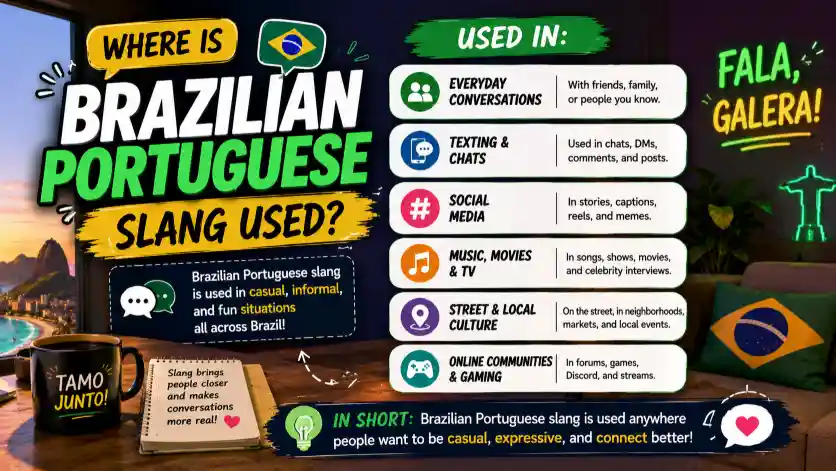
Everyday Conversation
Friends and family may use informal expressions naturally.
Text Messages
Short expressions such as “tá,” “tô,” “valeu,” and “e aí?” can appear in casual messages.
Social Media
Slang may appear in comments, captions, memes, short videos, and online discussions.
Gaming Communities
Brazilian gamers may combine everyday slang with gaming specific terms.
Music and Pop Culture
Music, television, comedy, and online creators can help spread informal expressions.
However, seeing a word on social media does not automatically mean that every Brazilian uses it. Some expressions remain tied to certain communities, regions, or age groups.
Is Brazilian Portuguese Slang Appropriate at Work?
Most slang should be avoided in formal workplace writing. Emails, reports, applications, presentations, and official documents are usually better written in standard Portuguese.
For example, “Valeu!” is natural in a casual conversation but “Obrigado” or “Obrigada” is generally more suitable for a formal message.
The same rule applies to very informal expressions such as mano, cara, and treta. They may be fine among friends but can sound too casual in a professional setting.
A relaxed workplace conversation is different. If coworkers already communicate informally, some expressions may be acceptable. The relationship and setting matter.
Real Life Examples of Brazilian Portuguese Slang
Brazilian slang becomes easier to understand when you see how it works in real conversations. The same expression can feel different depending on who is speaking and why.
Friendly Conversation
Friend: “E aí? Tudo bem?”
Meaning: “What’s up? Everything okay?”
Here, the expression works as a relaxed greeting between people who know each other.
Text Message
Friend 1: “Vamos sair hoje?”
Friend 2: “Beleza!”
Meaning: “Are we going out today?” “Sounds good!”
The short reply keeps the conversation casual and natural.
Saying Thanks
Friend: “I sent you the notes.”
Reply: “Valeu!”
Meaning: “Thanks!”
This is a simple example of informal language between friends.
Talking About Trouble
Friend: “How was your trip?”
Reply: “Passei um perrengue.”
Meaning: “I had a rough time.”
The speaker is describing a difficult situation in a casual way.
Online Argument
Comment: “Deu treta nos comentários.”
Meaning: “There was drama in the comments.”
Here, treta describes conflict rather than a friendly disagreement.
Gaming Context
Player: “Mano, olha esse play!”
Meaning: “Bro, look at that play!”
The expression helps show excitement and familiarity between players. It is informal and fits a relaxed gaming chat better than a professional setting.
Brazilian Slang vs. Similar Informal Expressions
Not every informal expression has the same purpose. Some are greetings, some show agreement, and others describe people or situations.
| Expression | Main Use | Simple English Meaning | Formal? |
| E aí? | Greeting | What’s up? | No |
| Beleza? | Greeting / agreement | All good? / Okay? | No |
| Valeu! | Thanks | Thanks! | No |
| Cara | Addressing someone | Dude / guy | No |
| Mano | Addressing someone | Bro / dude | Very informal |
| Rolê | Social activity | Hangout / outing | No |
| Treta | Conflict | Drama / trouble | No |
| Perrengue | Difficulty | Rough situation | No |
The main difference is function. For example, e aí? is mainly used as a greeting, while valeu is used to thank someone. Knowing the purpose of an expression makes it easier to use correctly.
Is Brazilian Portuguese Slang Rude, Offensive, or Harmless?
Most everyday Brazilian slang is not automatically rude or offensive. However, the tone can change depending on the expression, speaker, relationship, and situation.
Words such as valeu and beleza are generally harmless in casual settings.
More personal expressions can be different. Calling someone mano or cara may sound friendly between friends but too familiar when speaking to a stranger or someone in a formal role.
A good rule is to consider three things:
- Who are you talking to?
- Where are you talking?
- What tone does the conversation have?
Slang should not be judged by the word alone. Context often determines if it sounds friendly, playful, disrespectful, or simply too informal.
When Should You Avoid Brazilian Portuguese Slang?
Avoid slang when the situation clearly requires formal or respectful language.
This includes:
- Job applications
- Formal business emails
- Academic assignments
- Official documents
- Professional presentations
- Speaking to an authority figure for the first time
- Formal customer communication
You should also avoid using unfamiliar slang just because you saw it online. A phrase may have a regional or group specific meaning that you do not fully understand.
When in doubt, use standard Brazilian Portuguese first. You can become more informal once you understand the relationship and setting.
Why Do People Use Brazilian Portuguese Slang?
People use slang because it can make communication feel more natural and relaxed.
It can also help speakers show:
- Familiarity
- Humor
- Excitement
- Friendship
- Group identity
- A casual mood
Online, slang can make a short message feel warmer or more expressive.
For learners, this is why slang is worth understanding even if they do not use every expression themselves.
Recognizing informal language can make conversations, videos, comments, and messages much easier to follow.
Common Mistakes When Learning Brazilian Slang
One common mistake is translating every expression literally.
For example, beleza has a literal meaning connected with beauty, but “Beleza?” can function as “All good?” in casual conversation.
Another mistake is assuming that one slang word works in every situation. A phrase that sounds normal among friends may feel too casual with a teacher, employer, or stranger.
Learners should also avoid assuming that something popular online is used equally by all Brazilians. Region, age, and community can affect how familiar an expression is.
The safest approach is simple: learn the meaning, notice the context, and listen to how native speakers use it before copying it.
Impact of Slang in Communication
Slang can make a conversation sound more relaxed, personal, and natural. It can also make a speaker sound like they understand a particular social group or online community.
However, slang can create confusion when the listener does not know the expression.
For language learners, this is especially important. A direct translation may not show the real tone of a phrase.
That is why understanding context is often more useful than memorizing a long vocabulary list.
Frequently Asked Questions
Q1. What is Brazilian Portuguese slang?
Answer: Brazilian Portuguese slang is informal language used in casual speech, texting, social media, entertainment, gaming, and online communities. The Portuguese term gíria is commonly used for slang.
Q2. Is Brazilian Portuguese slang the same everywhere in Brazil?
Answer: No. Slang can vary by region, age group, social community, and situation. Some expressions are widely understood, while others are more local or group specific.
Q3. Is Brazilian slang different from standard Portuguese?
Answer: Yes. Slang is generally more informal and is often linked to casual speech or particular groups. Standard Portuguese is more suitable for formal writing and official communication.
Q4. Can Brazilian Portuguese slang sound rude?
Answer: Sometimes. Most everyday slang is not offensive by itself, but an expression can sound too familiar, disrespectful, or harsh depending on the speaker, listener, and tone.
Q5. Is Brazilian Portuguese slang used in movies and music?
Answer: Yes. Informal expressions can appear in Brazilian movies, television, music, comedy, and online content. However, a phrase used in entertainment may still be regional, trendy, or linked to a particular group.
Q6. Does Brazilian slang change over time?
Answer: Yes. Informal language changes as people adopt new expressions and older ones become less common. Social media, music, entertainment, and youth culture can help spread newer slang.
Q7. What are some common mistakes learners make with Brazilian slang?
Answer: Common mistakes include translating slang word for word, using a very informal expression in a formal situation, and copying a phrase without understanding its tone or context.
Q8. Can Brazilian Portuguese slang be used in formal situations?
Answer: Usually, it is better to avoid slang in formal situations. Standard Portuguese is safer for professional, academic, official, and business communication.
Q9. How can learners tell if Brazilian slang is friendly or rude?
Answer: Look at the speaker, listener, relationship, setting, and tone. The same informal word may sound friendly between close friends but too familiar in another situation.
Q10. How can I learn Brazilian Portuguese slang naturally?
Answer: Learn slang from real context instead of memorizing isolated words. Notice how native speakers use expressions in conversations, videos, messages, and other casual settings, then check their meaning before using them.
Conclusion
Brazilian Portuguese slang makes casual communication more expressive and natural. Expressions such as beleza, valeu, cara, mano, rolê, and treta can appear in everyday conversations and online communication, but their use depends on context.
The most important thing for learners is not to memorize every slang word. Instead, understand what an expression means, who normally uses it, and when it sounds appropriate.
If you are unsure, standard Portuguese is the safer choice. Once you become familiar with the social setting and tone, you can better recognize when informal Brazilian expressions fit naturally.
Discover More Articles:

Hi, I’m Anna Whitmore. I have 7+ years of experience writing about English slang and vocabulary. At SlangShine, I create simple, easy-to-understand content for English learners.