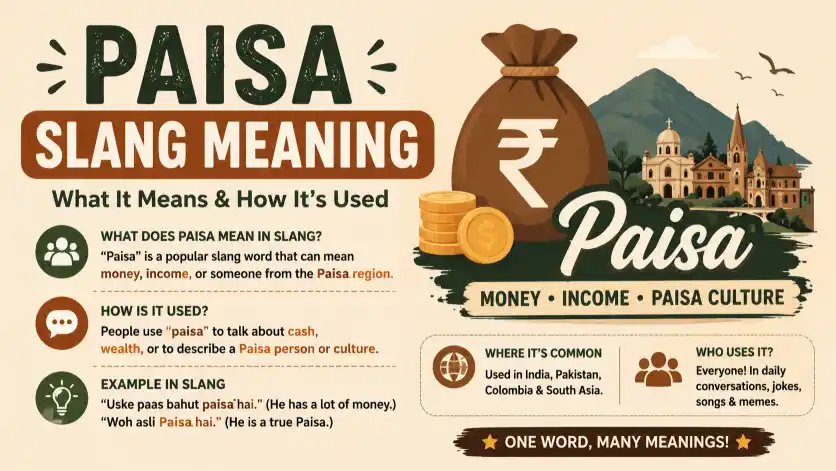
Paisa slang meaning refers to the word used for people from the Paisa region of Colombia, especially Antioquia and Medellín. It can also describe their unique accent, culture, food, and local expressions. In this context, paisa does not mean money.
The paisa slang meaning can be confusing because “paisa” also has a money related meaning in countries such as India and Pakistan.
The correct meaning depends on the context. This guide explains what paisa means in Colombian slang, where people use it, and how to understand it in everyday conversations.
Quick Answer: Paisa Slang Meaning
In Colombian slang, paisa refers to a person from the Paisa region, especially Antioquia and areas around Medellín. It can also describe something connected to Paisa culture, such as the accent, food, traditions, or local way of speaking.
What Does Paisa Mean in Slang?
The word paisa is a regional term used in Colombia. It usually describes a person who comes from the Paisa region or has a strong connection to its culture.
The term is closely linked with places such as:
- Antioquia
- Medellín
- The Colombian Coffee Region
- Other areas with strong Paisa culture
So, if someone says:
“He is paisa.”
They usually mean that he is from the Paisa region or identifies with its culture.
Paisa slang meaning as a Regional Identity
Paisa is more than a simple nickname. It can show a person’s regional identity.
Colombia has many different regions. Each region can have its own accent, food, customs, and expressions. Paisa is used for one of these regional identities.
For example:
“She is Colombian, but she is also paisa.”
This means the person is Colombian and has a connection to the Paisa region.
Paisa slang meaning as a Cultural Term
People can also use paisa for things linked to the region.
You may see phrases such as:
- Paisa culture
- Paisa food
- Paisa accent
- Paisa Spanish
- Paisa expressions
- Paisa traditions
In this way, the word can describe both people and culture.
Is Paisa a Slang Word?
Paisa is often called slang because it is common in informal speech. However, it is more accurate to call it a regional identity term.
It is not only used online or by young people. Colombians may use the word in normal conversations when talking about people, places, language, or culture from the Paisa region.
Is Paisa Informal?
Yes, the word is common in casual conversation.
You may hear it when people talk about:
- Where someone is from
- A person’s accent
- Colombian culture
- Local food
- Regional expressions
It can also appear in social media posts, videos, comments, and travel content.
Is Paisa slang meaning Positive or Negative?
The word is usually neutral or positive.
Many people use it to show regional pride or identity. However, the tone can change if someone uses the word to mock a person or make unfair stereotypes.
The word itself is not normally offensive.
Where Is Paisa Slang Meaning Commonly Used?
The Colombian meaning of paisa is strongly connected with Antioquia, Medellín, and the Coffee Region.
You may hear or see the word in:
- Everyday Colombian conversations
- Colombian movies and shows
- Social media
- Travel content
- Music
- Online communities
- Discussions about Colombian culture
Paisa on Social Media
People often use paisa online when talking about Colombian culture.
For example:
“I love the paisa accent.”
Here, the speaker is talking about the regional accent linked with the Paisa area.
Another example is:
“This restaurant serves paisa food.”
This means the restaurant serves food connected with Paisa culture.
Paisa in Text Messages
The word can also appear in casual texts.
For example:
“My cousin is paisa. He grew up in Medellín.”
This is a simple way to describe someone’s regional background.
Paisa on TikTok and Instagram
On platforms such as TikTok and Instagram, paisa may appear in videos about Colombian food, accents, travel, music, and local culture.
The word is not limited to one social media platform. Its meaning stays the same when the context is clearly Colombian.
Is Paisa Slang Meaning Rude or Offensive?
No, paisa is usually not rude or offensive.
It is normally a neutral term for a regional identity. Many people use it naturally when describing themselves or others from the Paisa region.
Still, context matters.
When Paisa Can Sound Disrespectful
The word itself is not normally offensive. However, it can sound disrespectful if someone uses it to:
- Mock a Colombian accent
- Make fun of regional speech
- Use negative stereotypes
- Insult someone because of their background
For respectful use, simply use paisa when you are talking about the person’s regional identity, culture, or language.
Paisa vs. the Money Meaning
One of the biggest reasons people search for paisa slang meaning is that the word has another common meaning.
In countries such as India and Pakistan, paisa refers to a small unit of money.
So, the context is very important.
| Context | Meaning |
| Colombian Spanish | A person or culture from the Paisa region |
| India | A small unit of currency |
| Pakistan | A small unit of currency |
| Nepal | A small unit of currency |
For example:
“He is paisa.”
In a Colombian context, this can describe a person’s regional identity.
But:
“I don’t have enough paisa.”
In a South Asian context, this can refer to money.
How Can You Tell the Difference?
Look at the words around paisa.
If the conversation mentions:
- Medellín
- Colombia
- Antioquia
- Colombian food
- Colombian accents
then paisa probably refers to the Colombian regional identity.
If the conversation mentions:
- Rupees
- Prices
- Buying something
- Money
- Currency
then paisa probably means a unit of money.
Context makes the meaning clear.
Real Life Examples of Paisa Slang Meaning
The best way to understand paisa is to see how people use it in real conversations. In Colombian Spanish, the word can describe a person, a regional style, or something connected with Paisa culture.
Example 1: Talking About a Person
“My friend is paisa.”
Meaning: My friend is from the Paisa region or has a strong connection to it.
Example 2: Talking About Medellín
“She is paisa and lives in Medellín.”
Meaning: She has a Paisa regional background and lives in Medellín.
Example 3: Talking About an Accent
“I really like his paisa accent.”
Meaning: The speaker likes the regional Spanish accent associated with the Paisa area.
Example 4: Talking About Food
“We had a traditional paisa meal.”
Meaning: The meal was connected with the food culture of the Paisa region.
Example 5: Talking About Culture
“I want to learn more about paisa culture.”
Meaning: The speaker wants to learn about the traditions and culture of the Paisa region.
Example 6: Talking About Language
“She taught me some paisa expressions.”
Meaning: She taught the speaker expressions commonly linked with Paisa speech.
What Is Paisa Culture?
Paisa culture refers to the traditions, food, speech, and regional identity connected with the Paisa area of Colombia.
The culture is especially associated with Antioquia and Medellín. It is also connected with parts of Colombia’s Coffee Region.
Paisa Food
Food is an important part of regional identity.
You may hear people use paisa when talking about traditional dishes from the region.
One well known example is bandeja paisa.
The dish is strongly associated with Antioquia and Paisa culture.
Paisa Accent
The Paisa accent is one of the most recognizable regional accents in Colombia.
It is especially linked with Medellín and Antioquia.
Someone may say:
“He has a strong paisa accent.”
This means the person’s Spanish pronunciation sounds like the regional speech associated with the Paisa area.
Paisa Expressions
Paisa speech also has local words and expressions.
Some Colombian expressions are strongly connected with the region. These words can help show the speaker’s local identity.
However, not every Colombian slang word is automatically Paisa.
Common Paisa Words and Expressions
Paisa Spanish has several words that visitors may hear in everyday conversations.
Parce
Parce is a casual word for a friend or close companion.
Example:
“Hey, parce, how are you?”
It is friendly and informal.
Parche
Parche can refer to a group of friends or a social plan.
Example:
“Are you coming to the parche?”
Here, the speaker is asking if someone is joining the group or social gathering.
Quiubo
Quiubo is a casual Colombian greeting.
It comes from ¿Qué hubo?
It can be similar to:
“What’s up?”
or
“How are you?”
Visaje
Visaje is another Colombian expression. Depending on context, it can refer to something strange, noticeable, suspicious, or unusual.
The exact meaning can change with the situation.
Berraco
Berraco is a Colombian word with several possible meanings.
It can describe someone who is strong, capable, brave, or very skilled.
The meaning depends heavily on the sentence and tone.
Paisa vs. Colombian
Paisa and Colombian are not the same thing.
Colombian refers to someone or something from Colombia as a whole.
Paisa refers to a more specific regional identity.
Simple Difference
| Word | Meaning |
| Colombian | From Colombia |
| Paisa | Connected with the Paisa region |
| Paisa culture | Culture linked with the Paisa region |
| Paisa accent | Regional Spanish accent |
For example:
“He is Colombian.”
This gives a broad national identity.
“He is paisa.”
This gives more specific regional information.
A person can be both Colombian and paisa.
Who Uses the Word Paisa?
People from Colombia may use paisa when talking about regional identity. People outside Colombia may also use it when discussing Colombian culture.
Colombians
A Colombian speaker may use the word to describe themselves or another person.
For example:
“I’m paisa.”
This can mean:
“I’m from the Paisa region.”
Travelers
Travelers may learn the word when visiting Medellín, Antioquia, or nearby areas.
They may hear it when talking with local people or learning about regional culture.
Language Learners
People learning Spanish may come across paisa while studying Colombian Spanish.
It is useful to know because regional Spanish can be different from the Spanish taught in basic language courses.
Can Paisa Be Used at Work?
Yes, but the context matters.
Using paisa in a normal conversation about someone’s regional background is generally fine.
For example:
“Our new colleague is paisa.”
This is a simple statement about regional identity.
However, professional writing should be clear and respectful. Do not use the word as a stereotype or joke about someone’s accent or background.
In a Workplace Chat
A casual workplace chat may include the word when discussing Colombian culture.
For example:
“Maria is paisa, so she knows a lot about Medellín.”
This is informal but easy to understand.
In Formal Writing
In formal writing, it may be better to explain the term if the audience may not know it.
For example:
“He comes from Colombia’s Paisa region.”
This is clearer for an international audience.
When Should You Avoid Using Paisa?
You do not normally need to avoid the word.
The main thing is to use it correctly and respectfully.
Avoid Stereotyping
Do not assume that every person from the region has the same personality, accent, or lifestyle.
A regional label does not tell you everything about a person.
Avoid Mocking the Accent
The Paisa accent is a real regional variety of Colombian Spanish.
It should not be used as a reason to make fun of someone.
Do Not Call Every Colombian Paisa
This is a common mistake.
Colombia has many regions and local identities. Not every Colombian person is Paisa.
Use the term when the person’s regional connection is actually relevant.
Check the Context
Remember that paisa can also mean money in South Asian contexts.
If the conversation is about prices, rupees, or spending, the meaning may be completely different.
Why Do People Use Paisa?
People use paisa because it is a simple way to describe a specific regional identity.
Instead of giving a long explanation, someone can use one word.
For example:
“She is from the Paisa region.”
can become:
“She is paisa.”
The word can also describe regional food, the local accent, or the culture of Antioquia.
This makes the term useful when discussing Colombian regional life.
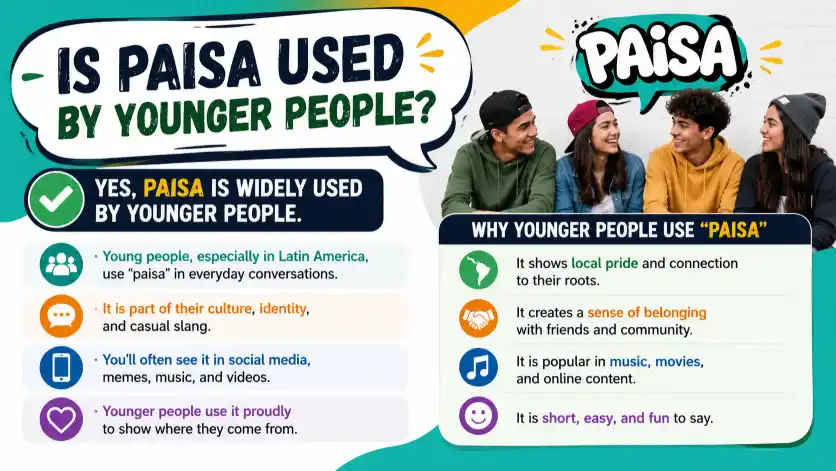
Is Paisa Used by Younger People?
Yes. The word can be used by people of different ages.
It is not limited to Gen Z or young internet users.
You may see it in:
- Casual conversations
- Social media
- Travel videos
- Colombian entertainment
- Online discussions
- Everyday speech
The meaning remains tied to regional identity rather than a specific age group.
Paisa in Different Online Spaces
The word can appear across many platforms, but the context is more important than the platform.
TikTok
On TikTok, paisa may appear in videos about Colombian accents, food, humor, travel, and culture.
Instagram posts may use the word when showing Paisa food, places, traditions, or local life.
On Reddit, people may use paisa while discussing Colombia, Spanish, travel, or regional culture.
Discord and Gaming
In a gaming or Discord chat, a Colombian user may use paisa when talking about their background.
The word does not become a different slang term just because it appears in a gaming chat.
Key Takeaway So Far
The Colombian paisa slang meaning is mainly about regional identity.
It can describe:
- A person from the Paisa region
- Paisa culture
- Paisa food
- The Paisa accent
- Regional expressions
- Things connected with the area
The most important point is context. Paisa can also refer to a unit of money in South Asian countries, so the surrounding words help you understand which meaning is intended.
Origin and History of Paisa Slang Meaning
The Colombian use of paisa is connected with the regional identity of western Colombia. The term is especially linked with Antioquia and the areas around Medellín, as well as parts of the Coffee Region.
It is not a new internet slang word. Its use is tied to the history and culture of the region.
The Paisa Region
The Paisa cultural area is mainly associated with:
- Antioquia
- Medellín
- Caldas
- Risaralda
- Quindío
- Nearby areas with strong Paisa influence
The exact boundaries of Paisa identity can vary. It is better to think of it as a cultural and regional identity rather than a strict political boundary.
Paisa Spanish
Paisa Spanish has its own accent and local vocabulary.
People who learn Spanish may notice differences in:
- Pronunciation
- Local expressions
- Word choice
- Rhythm of speech
- Informal greetings
As a result, you may hear someone describe a Colombian speaker as paisa, even when they are mainly talking about the person’s way of speaking.
What Makes Paisa Different?
Paisa identity is connected with more than language.
It can include a mix of:
- Regional history
- Food
- Music
- Traditions
- Local speech
- Family customs
- Regional pride
Regional Pride
For many people, paisa can be a positive identity label.
Someone may say:
“I am paisa.”
This can express pride in their regional background.
It does not automatically mean that the person is talking about slang.
Paisa as a Cultural Label
The word can also be used as an adjective.
For example:
“Paisa culture”
means the culture associated with the region.
Likewise:
“Paisa food”
refers to food connected with the regional tradition.
This makes the word useful in many different conversations.
Similar Colombian Slang and Regional Terms
Several Colombian words may appear in the same conversations as paisa.
They do not all mean the same thing.
Parce vs. Paisa
Parce is an informal word for a friend or close companion.
Paisa describes regional identity.
For example:
“That paisa is my parce.”
The sentence means the person is from the Paisa region and is also the speaker’s friend.
Parche vs. Paisa
Parche can refer to a group of friends or a social gathering.
Paisa refers to a regional identity or something connected with that culture.
These words can appear together, but they have different meanings.
Colombiano vs. Paisa
Colombiano means Colombian.
Paisa gives more specific regional information.
A Paisa person is Colombian, but not every Colombian person is Paisa.
Common Misunderstandings About Paisa
The word is easy to misunderstand because it has more than one use.
Mistake 1: Thinking Paisa Always Means Money
This is the most common confusion.
If you see paisa in a Colombian conversation, it may refer to regional identity.
If you see it in a conversation about rupees or prices, it may refer to money.
Always check the context.
Mistake 2: Thinking Paisa Means Every Colombian
Paisa is not a general word for all Colombians.
Colombia has many regional cultures.
Using paisa for every Colombian person can be inaccurate.
Mistake 3: Thinking Paisa Is Only Internet Slang
The word may appear on social media, but it did not start as an internet term.
Its Colombian use is connected with regional culture and identity.
Mistake 4: Thinking Paisa Is Offensive
The word itself is normally not offensive.
Problems usually come from the way someone uses it.
A respectful statement such as:
“She is paisa.”
is very different from using the word to mock someone’s accent or background.
Can You Call Someone Paisa?
Yes, if the person has a genuine connection to the Paisa region.
It is usually fine when used respectfully.
When It Is Natural
You can use paisa when discussing:
- Someone from Antioquia
- Someone from Medellín
- Paisa culture
- A Paisa accent
- Regional food
- Regional expressions
For example:
“My friend is from Medellín, so she is paisa.”
This is a natural use.
When It May Be Better to Explain
If your audience does not know the word, give a short explanation.
For example:
“He is paisa, meaning he is from Colombia’s Paisa region.”
This makes the meaning clear right away.
Can You Use Paisa With Teachers or Parents?
Yes, but explain the meaning if they may not know the term.
The word is not a bad word.
Still, formal communication may benefit from clearer wording.
Casual Conversation
“My teacher is paisa.”
This can be fine in casual speech if the regional background is relevant.
Formal Writing
A clearer option can be:
“My teacher is from Colombia’s Paisa region.”
This is easier for readers who have never heard the term.
Can You Use Paisa at Work?
Yes, when the context is respectful and relevant.
For example:
“Our colleague is from Medellín and identifies as paisa.”
This is clear and respectful.
However, avoid using regional identity as a shortcut for someone’s personality or behavior.
A person’s regional background does not tell you how they will act.
When Should You Avoid Using Paisa?
There are only a few situations where you should be careful.
Avoid It as a Joke
Do not use paisa to make fun of someone’s accent or background.
Regional language can be part of someone’s identity.
Avoid Unfair Stereotypes
Do not assume that every Paisa person has the same personality, lifestyle, or beliefs.
A regional label is not a complete description of a person.
Avoid Guessing Someone’s Identity
Do not call someone Paisa simply because they speak Spanish or are Colombian.
If their regional background is unknown, use a broader term such as Colombian.
Avoid Confusing the Two Meanings
If the conversation is about money, do not assume that paisa refers to Colombia.
Look at the surrounding words first.
Is Paisa Still Common?
Yes. The Colombian use of paisa remains relevant in everyday speech and discussions about regional culture.
It is not a slang word that only belongs to one generation.
You can find it in conversations about:
- Colombian identity
- Medellín
- Regional Spanish
- Food
- Travel
- Music
- Social media
- Local traditions
The word may appear in both casual and cultural discussions.
Paisa Meaning at a Glance
| Question | Simple Answer |
| What does paisa mean in Colombian slang? | A person or thing linked with the Paisa region |
| Is it a bad word? | No, usually not |
| Is it internet slang? | Not mainly |
| Is it used in Colombia? | Yes |
| Does it mean every Colombian? | No |
| Can it describe culture? | Yes |
| Can it describe an accent? | Yes |
| Can it mean money? | Yes, in some South Asian contexts |
| Is it safe to use? | Yes, when used correctly and respectfully |
How to Understand Paisa in a Sentence
The easiest way to understand paisa is to look at the topic of the conversation.
If the Topic Is Colombia
If people are talking about:
- Medellín
- Antioquia
- Colombian food
- Colombian accents
- Regional culture
then paisa probably refers to the Colombian regional identity.
If the Topic Is Money
If people are talking about:
- Rupees
- Prices
- Buying things
- Coins
- Currency
then paisa may mean a small unit of money.
Context solves most confusion.
Simple Examples to Remember
Here are two examples that show the difference clearly.
Colombian Meaning
“My friend is paisa and grew up in Medellín.”
Here, paisa means a person connected with the Paisa region.
Money Meaning
“The item costs fifty paisa.”
Here, paisa refers to money.
The spelling is the same, but the meaning comes from the context.
Key Points to Remember
The most useful facts about paisa slang meaning are easy to remember:
- First, it is strongly linked with Colombia.
- Also, it can describe someone from the Paisa region.
- In addition, it can refer to local culture, food, accents, and expressions.
- Generally, it is not offensive when used respectfully.
- However, it does not describe every Colombian.
- Also, it is not limited to internet slang.
- In South Asian contexts, paisa can mean a unit of money.
- Therefore, always use the context to understand the intended meaning.
Once you know these points, the word paisa becomes much easier to understand.
Frequently Asked Questions About Paisa Slang Meaning
Q1. What does paisa mean in slang?
Answer: In Colombian slang and informal speech, paisa usually refers to a person from the Paisa region of Colombia. It can also describe the culture, accent, food, or expressions linked to that region.
Q2. Is paisa a Colombian slang word?
Answer: Yes. In Colombia, paisa is a common regional term linked with areas such as Antioquia and Medellín. It is more accurate to call it a regional identity term than pure internet slang.
Q3. Is paisa a rude word?
Answer: No. Paisa is normally a neutral or positive term. It can become disrespectful only when someone uses it to mock a person’s accent, culture, or regional background.
Q4. What does paisa mean in Spanish?
Answer: In Colombian Spanish, paisa can describe a person from the Paisa region. It can also describe things connected with the region, such as Paisa culture, food, or speech.
Q5. Does paisa mean Colombian?
Answer: Not exactly. Colombian refers to someone from Colombia in general. Paisa refers to a more specific regional identity. A Paisa person is Colombian, but not every Colombian person is Paisa.
Q6. What does paisa mean in Pakistan?
Answer: In Pakistan, paisa refers to a small unit of currency. It is different from the Colombian use of the word. The surrounding context helps show which meaning is intended.
Q7. What does paisa mean in India?
Answer: In India, paisa is also a unit of money. It is equal to one hundredth of a rupee. This is completely different from the Colombian regional meaning.
Q8. What is a Paisa accent?
Answer: A Paisa accent is a regional Spanish accent. It is mainly heard in Medellín, Antioquia, and the Coffee Region of Colombia. Because of this, its pronunciation may sound different from other Colombian accents.
Q9. Can I call someone Paisa?
Answer: Yes, if the person has a genuine connection to the Paisa region. Use the word respectfully, and do not use it to make fun of their accent or background.
Q10. Is Paisa used on social media?
Answer: Yes. You may see paisa on TikTok, Instagram, YouTube, Reddit, and other platforms when people discuss Colombian culture, food, accents, travel, or regional identity.
Q11. What is the difference between Paisa and Parce?
Answer: Paisa describes a regional identity or something connected with the Paisa region. Parce is an informal Colombian word for a friend or close companion. They have different meanings.
Q12. What is Paisa culture?
Answer: Paisa culture refers to the traditions, food, language, history, and regional identity connected with the Paisa area of Colombia.
Q13. Is Paisa only used for people?
Answer: The word can also describe things connected with the region. For example, it may refer to local food, the regional accent, or the culture of the area.
Q14. Can Paisa be used in a workplace?
Answer: Yes, it can be used when the regional context matters. Also, the term should be used respectfully. However, in formal writing, “from Colombia’s Paisa region” may be clearer for readers who do not know the term.
Q15. How do I know which meaning of Paisa is intended?
Answer: Look at the context. If the conversation is about Colombia, Medellín, or regional culture, paisa likely refers to the Colombian identity. If it is about rupees, prices, or money, it may refer to the currency unit.
Conclusion
The paisa slang meaning is mainly connected with regional identity in Colombia.A paisa is usually a person from the Paisa region, especially around Antioquia and Medellín. In addition, the term can describe local culture, food, accent, and expressions.
Generally, the term is not rude or offensive. However, using it to mock an accent or create stereotypes can be disrespectful.
On the other hand, the word has a different meaning in South Asian contexts. There, it refers to a unit of money. For this reason, context is important when you see the word.
Overall, in a Colombian context, the term points to regional identity and culture.
Discover More Articles:

Hi, I’m Anna Whitmore. I have 7+ years of experience writing about English slang and vocabulary. At SlangShine, I create simple, easy-to-understand content for English learners.