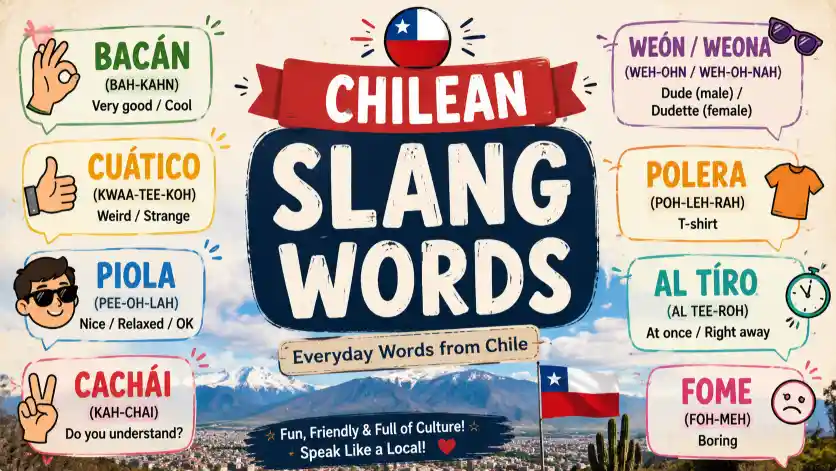
Chilean Slang Words refer to the unique, informal vocabulary and expressions used by people in Chile, known for being some of the fastest and most distinct Spanish slang in Latin America.
Chilean slang words are informal expressions used in everyday conversations across Chile. These words make speech sound more natural, friendly, and expressive. You will hear them in schools, workplaces, social media, TV shows, football discussions, and daily life.
Many Chilean slang terms are unique to Chile. Even native Spanish speakers from other countries may not understand them right away. That is why learning these expressions is useful if you plan to visit Chile or improve your Spanish.
Understanding local slang also helps you enjoy Chilean movies, music, and online content more easily.
Quick Answer:Chilean Slang Words
Chilean slang words are informal expressions commonly used in Chile. Popular examples include Weón (Huevón), Bacán, Pololo, Fome, Cachai, Al Tiro, Luca, Pega, and Carrete.
What Are Chilean Slang Words?
They Make Conversations More Natural
People in Chile use slang every day.
These expressions help speakers:
- Sound friendly.
- Express emotions.
- Speak more naturally.
- Connect with other people.
Most slang words appear in casual conversations.
Context Is Important
Many Chilean slang words have more than one meaning.
The meaning often depends on:
- The speaker.
- The tone of voice.
- The situation.
- The relationship between the people.
Learning the context is just as important as learning the word.
Common Chilean Slang Words
Weón (Huevón)
Meaning:
One of the most common Chilean slang words. It can mean “friend,” “guy,” or “idiot,” depending on the context.
Tone:
Friendly or offensive.
Example:
“Hey, weón! How are you?”
Meaning:
“Hey, buddy! How are you?”
When spoken during an argument, the same word can become an insult.
Bacán
Meaning:
Cool, awesome, or great.
Tone:
Positive.
Example:
“That restaurant is bacán.”
Meaning:
That restaurant is really great.
Pololo
Meaning:
Boyfriend.
Tone:
Friendly.
Example:
“Her pololo is very kind.”
Meaning:
Her boyfriend is very kind.
Polola
Meaning:
Girlfriend.
Tone:
Friendly.
Example:
“His polola lives nearby.”
Meaning:
His girlfriend lives nearby.
Fome
Meaning:
Boring or dull.
Tone:
Neutral.
Example:
“That movie was fome.”
Meaning:
That movie was boring.
Cachai
Meaning:
Do you understand? or Do you get it?
Tone:
Casual.
Example:
“It’s easy, cachai?”
Meaning:
“It’s easy, do you understand?”
Are Chilean Slang Words Offensive?
Most Are Friendly
Most Chilean slang words are harmless when used correctly.
However, some expressions change meaning depending on the situation.
For example, Weón is often friendly between close friends. During an argument, it may become offensive.
Always pay attention to the context.
Where Are Chilean Slang Words Commonly Used?
Everyday Conversations
People use these expressions with friends, classmates, coworkers, and family members.
They are part of everyday life in Chile.
Social Media
You can often find Chilean slang on:
- TikTok
- X (formerly Twitter)
- YouTube
Many creators use local slang to make their content feel authentic.
Football Conversations
Football fans regularly use slang while discussing matches, teams, and players.
These expressions make conversations more lively.
Movies and TV Shows
Many Chilean films and television programs include local slang.
Watching them is a great way to learn natural speech.
Text Messages
Friends often use slang while chatting online.
Example:
“That’s bacán!”
Meaning:
“That’s awesome!”
Origin and Background of Chilean Slang Words
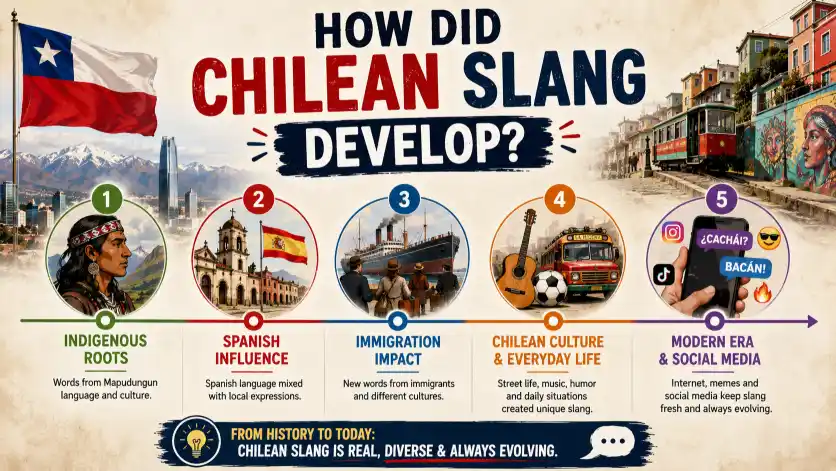
How Did Chilean Slang Develop?
Many Chilean slang words have developed over many years. They come from Spanish, Indigenous languages, and Chile’s unique history and culture.
As people from different backgrounds interacted, new expressions became part of everyday speech. Over time, these words spread across the country through conversations, television, music, and the internet.
Today, Chilean slang is an important part of local identity.
Why Do People Use Chilean Slang Words?
To Sound Friendly
Most people use slang to make conversations feel relaxed.
These expressions help speakers sound:
- Natural
- Friendly
- Casual
- Approachable
That is why you hear them every day in Chile.
To Express Feelings
Slang helps people share emotions quickly.
It can show:
- Happiness
- Surprise
- Excitement
- Frustration
- Humor
Short expressions often say a lot with just one or two words.
To Connect With Others
Using familiar slang helps people build stronger social connections.
Friends often use these expressions because they create a relaxed atmosphere.
More Popular Chilean Slang Words
Al Tiro
Meaning:
Right away or immediately.
Tone:
Casual.
Example:
“I’ll be there al tiro.”
Meaning:
“I’ll be there right away.”
Luca
Meaning:
One thousand Chilean pesos.
Tone:
Informal.
Example:
“It costs five lucas.”
Meaning:
It costs five thousand pesos.
Pega
Meaning:
Work or a job.
Tone:
Casual.
Example:
“I have a new pega.”
Meaning:
I have a new job.
Carrete
Meaning:
A party or social gathering.
Tone:
Friendly.
Example:
“We’re going to a carrete tonight.”
Meaning:
We’re going to a party tonight.
Copete
Meaning:
Alcoholic drinks.
Tone:
Informal.
Example:
“They bought some copete.”
Meaning:
They bought some drinks.
Cabro
Meaning:
A boy, a young man, or simply a kid.
Tone:
Friendly.
Example:
“That cabro is very talented.”
Meaning:
That young man is very talented.
Chilean Slang Words vs Standard Spanish
Many Chilean expressions have standard Spanish alternatives.
| Chilean Slang | Standard Spanish | English Meaning |
| Weón | Amigo (depends on context) | Buddy |
| Bacán | Genial | Awesome |
| Pololo | Novio | Boyfriend |
| Polola | Novia | Girlfriend |
| Pega | Trabajo | Job |
| Luca | Mil pesos | One thousand pesos |
| Carrete | Fiesta | Party |
| Fome | Aburrido | Boring |
These slang words are common in conversations but are rarely used in formal writing.
When Should You Avoid Chilean Slang Words?
Some situations require formal language.
Avoid slang in:
- Business meetings
- Job interviews
- School assignments
- Official emails
- Academic writing
- Professional presentations
Standard Spanish is the better choice in these situations.
Polite Alternatives
If you are unsure about using slang, choose standard Spanish instead.
| Chilean Slang | Polite Alternative |
| Weón | Amigo |
| Bacán | Excelente |
| Pega | Trabajo |
| Carrete | Fiesta |
| Fome | Aburrido |
| Pololo | Novio |
| Polola | Novia |
These alternatives are understood throughout the Spanish-speaking world.
Why Learning Chilean Slang Words Is Helpful
Learning Chilean slang words offers many benefits.
It helps you:
- Understand native speakers.
- Enjoy Chilean movies and TV shows.
- Follow social media posts.
- Join everyday conversations.
- Improve your Spanish listening skills.
- Learn more about Chilean culture.
Even if you do not use every expression, recognizing them will make spoken Spanish much easier to understand.
Impact of Using Chilean Slang Words in Communication
Slang Makes Conversations Sound Natural
Using Chilean slang words can make your Spanish sound more relaxed and authentic. Native speakers use these expressions every day with friends, classmates, coworkers, and family members.
For example:
“That’s bacán!”
This short phrase sounds much more natural than a formal response in a casual conversation.
Slang Helps You Understand Native Speakers
Even if you do not use slang yourself, learning it is very helpful.
It helps you understand:
- Daily conversations
- Social media posts
- Movies
- TV shows
- Podcasts
- Football discussions
The more slang you know, the easier it becomes to follow real conversations.
Use Slang at the Right Time
Not every situation is suitable for slang.
Some expressions:
- Work best with friends.
- Sound too informal at work.
- May confuse people from other countries.
- Have different meanings depending on the context.
When in doubt, use standard Spanish.
Is It Safe to Use Chilean Slang Words on Social Media?
Yes, Most Expressions Are Safe
Most Chilean slang words are safe to use on social media.
People commonly use them on:
- TikTok
- X (formerly Twitter)
- YouTube
These expressions often appear in captions, comments, and short videos.
However, avoid using slang that could sound insulting or disrespectful.
Real Life Examples Of Chilean Slang Words
Friendly Examples
Example 1
“You’re bacán!”
Meaning:
The speaker is saying someone is awesome.
Example 2
“My pololo loves football.”
Meaning:
The speaker is talking about her boyfriend.
Example 3
“We’ll see each other at the carrete.”
Meaning:
The speaker is talking about meeting at a party.
Casual Examples
These expressions are common in everyday speech.
- “I’ll do it al tiro.”
- “That movie was fome.”
- “I started a new pega.”
- “I only have one luca.”
- “She’s my polola.”
Football Examples
Football fans often use slang during matches.
Example 1
“That cabro played really well.”
Meaning:
The young player had an excellent game.
Example 2
“The match was bacán.”
Meaning:
The game was exciting and enjoyable.
Example 3
“The fans celebrated all night after the win.”
Meaning:
The supporters enjoyed the team’s victory.
Social Media Examples
“That beach looks bacán.”
Meaning:
The beach looks amazing.
TikTok
“I’ll upload another video al tiro.”
Meaning:
The creator will post another video right away.
“Time for a carrete this weekend.”
Meaning:
The speaker is excited about a party.
YouTube
“This travel vlog is bacán.”
Meaning:
The viewer thinks the video is excellent.
Common Mistakes People Make
Thinking Every Slang Word Is Friendly
Some words have more than one meaning.
For example, Weón may mean “buddy” between close friends. In an argument, the same word can become an insult.
Always pay attention to the context.
Using Slang in Formal Situations
Avoid Chilean slang in:
- Business emails
- School assignments
- Professional meetings
- Job interviews
Formal Spanish is the better option.
Assuming Every Country Uses the Same Slang
Many Chilean slang words are unique to Chile.
Spanish speakers from other countries may use different expressions for the same idea.
Learning regional differences will improve your communication.
Using Too Much Slang
Adding too many slang words to one sentence can sound unnatural.
Use slang naturally and mix it with standard Spanish.
Tips for Using Chilean Slang Words Correctly
Follow these simple tips.
- Learn one expression at a time.
- Listen to native speakers.
- Practice in casual conversations.
- Avoid slang in formal settings.
- Pay attention to the context.
- Speak respectfully with new people.
These habits will help you communicate more naturally while showing respect for Chilean culture.
Frequently Asked Questions
Q1.What are Chilean slang words?
Answer: Chilean slang words are informal expressions used in Chile. They make everyday conversations sound more natural, friendly, and expressive. Many of these words are unique to Chile.
Q2.What is the most common Chilean slang word?
Answer: One of the most common Chilean slang words is Weón (Huevón). Depending on the context, it can mean “buddy,” “guy,” or “idiot.” The speaker’s tone determines its meaning.
Q3.What does “Bacán” mean?
Answer: Bacán means “awesome,” “great,” or “cool.” It is a positive slang word that people use to describe something they really like.
Q4.What does “Cachai” mean?
Answer: Cachai means “Do you understand?” or “Do you get it?” It is commonly used at the end of a sentence to check if the listener is following the conversation.
Q5.Are Chilean slang words used on social media?
Answer: Yes. Chilean slang words are very common on TikTok, Instagram, Facebook, X (formerly Twitter), YouTube, and in text messages. People use them in captions, comments, and casual chats.
Q6.Can Spanish learners use Chilean slang?
Answer: Yes, but they should first learn the meaning and context. Some expressions are only appropriate in casual conversations and may not be suitable in formal situations.
Key Takeaways
Here are the main points to remember about Chilean slang words:
- They are informal expressions used in everyday life across Chile.
- Popular terms include Weón, Bacán, Pololo, Polola, Fome, Cachai, Al Tiro, Luca, Pega, and Carrete.
- Many slang words have different meanings depending on the context.
- Bacán is a positive word that means “awesome” or “great.”
- Cachai is commonly used to ask if someone understands.
- These expressions are common in conversations, social media, music, and TV shows.
- Formal Spanish is a better choice for business, school, and professional communication.
Conclusion
Chilean slang words are an important part of everyday communication in Chile. They make conversations sound natural, friendly, and full of personality. Popular expressions such as Weón, Bacán, Pololo, Polola, Fome, Cachai, Al Tiro, Luca, Pega, and Carrete are widely used in daily life, social media, music, and local entertainment.
Although these words are easy to hear, their meaning often depends on the speaker, the tone, and the situation. Understanding the context will help you avoid misunderstandings and communicate more confidently.
If you are learning Spanish, planning a trip to Chile, or exploring Chilean culture, learning these slang expressions will improve your listening skills and help you understand native speakers more easily.
Use slang respectfully, choose formal Spanish when needed, and enjoy discovering one of the most distinctive varieties of Spanish.
Discover More Articles:

Hi, I’m Anna Whitmore. I have 7+ years of experience writing about English slang and vocabulary. At SlangShine, I create simple, easy-to-understand content for English learners.