Phoenician slang can mean a person from Phoenix, Arizona, especially in informal local usage. The word also has a much older meaning: a person connected to the ancient Phoenician civilization. So, the meaning depends on the context.
If someone says, “I’m a Phoenician,” they may simply mean they live in or come from Phoenix, Arizona. This modern use is listed in Wiktionary and also appears in informal slang sources.
Quick Answer: Phoenician Slang
In slang or informal usage, “Phoenician” can mean someone from Phoenix, Arizona.
For example:
“I’m a proud Phoenician.”
Here, the speaker is most likely talking about being a resident or local of Phoenix.
However, Phoenician is not mainly a slang word. Its standard meaning refers to the ancient people, language, and culture of Phoenicia. The informal Phoenix meaning is a separate modern usage.
What Does Phoenician Mean in Slang?
In casual American usage, Phoenician can be a nickname or informal label for a person from Phoenix, Arizona.
Phoenix is often shortened to PHX, especially in local and online contexts. Because of this, “Phoenician” can work as a way to describe someone who identifies with the city.
Example
“She’s a Phoenician and knows all the best places downtown.”
In this sentence, “Phoenician” means someone from Phoenix, not someone from the ancient Phoenician civilization.
Another example is:
“I grew up here. I’m a Phoenician.”
The speaker is using the word as a local identity label.
This meaning is not the same as the historical definition found in major dictionaries. Wiktionary lists “an inhabitant of Phoenix, Arizona” as a modern sense, while standard dictionaries focus on ancient Phoenicia.
Phoenician Meaning in Simple English
The easiest way to understand the word is to look at its two main meanings.
| Context | Meaning |
| History | A person from ancient Phoenicia |
| Language | The ancient language of the Phoenicians |
| Modern informal use | A person from Phoenix, Arizona |
| Local identity | Someone who identifies with Phoenix |
The historical meaning is the standard one. The Phoenix meaning is a modern, informal use.
That distinction matters because calling “Phoenician” pure internet slang would be misleading.
Is Phoenician Actually Slang?
Not usually.
“Phoenician” is primarily a normal English word. Major dictionaries define it in relation to ancient Phoenicia, its people, language, and culture. Merriam-Webster traces the word to the 14th century.
At the same time, English speakers can use words in informal ways that are different from their original meanings.
The Phoenix usage is a good example.
When someone from Phoenix calls themselves a Phoenician, they are using the word as a local identity term. It can sound casual, friendly, or community-focused.
Why Do People Call Phoenix Residents “Phoenicians”?
The name naturally connects Phoenix with Phoenician.
It is not a claim that modern Phoenix residents are descendants of the ancient Phoenicians. Instead, it is simply a modern name used for people associated with the city.
Wiktionary records the Phoenix meaning, and an Economist example from 2007 also used “Phoenicians” for people living in the Phoenix area.
Phoenician Meaning in Phoenix Slang
In a Phoenix context, “Phoenician” can be understood as a local person from Phoenix or the surrounding area.
For example:
“Are you a Phoenician?”
This could simply mean:
“Are you from Phoenix?”
Likewise:
“He’s a lifelong Phoenician.”
This suggests that the person has lived in Phoenix for much of their life.
The word can also carry a sense of local pride. Someone may use it to show that Phoenix is their home.
Phoenician vs. Phoenix
These two words are easy to confuse.
Phoenix
Phoenix is the name of the city in Arizona.
Example:
“I live in Phoenix.”
Phoenician
Phoenician can describe a person from Phoenix in informal usage.
Example:
“I’m a Phoenician.”
The second sentence gives the statement a stronger sense of local identity.
However, “Phoenician” also has its historical meaning, so context is important.
Phoenician Historical Meaning
Before looking at the slang use, it helps to understand the original meaning.
The Phoenicians were an ancient people of the eastern Mediterranean. They were known for trade, seafaring, and settlements around the Mediterranean world.
Major dictionaries define a Phoenician as a person connected with ancient Phoenicia. The word can also refer to the ancient Semitic language associated with the Phoenicians.
For example:
“The Phoenicians were skilled seafarers.”
Here, the word has nothing to do with Phoenix, Arizona.
It is purely historical.
Why Context Matters
The word Phoenician can create confusion because the historical and modern meanings look exactly the same.
Consider these two sentences:
“The Phoenicians traded across the Mediterranean.”
This clearly refers to the ancient people.
“She is a Phoenician who loves Phoenix.”
This likely refers to a person from Phoenix, Arizona.
The surrounding words help you understand the intended meaning.
A Simple Trick
If the sentence mentions:
- ancient history
- Mediterranean trade
- ancient languages
- archaeology
- Carthage
- the Phoenician alphabet
Then Phoenician almost certainly has its historical meaning.
If the sentence mentions:
- Phoenix
- Arizona
- PHX
- local life
- Phoenix neighborhoods
- being a local
Then it may mean a person from Phoenix.
Phoenician Meaning on Social Media
On social media, context becomes even more important.
Someone from Phoenix might use Phoenician as a casual identity label in a profile, caption, or conversation.
For example:
“Born and raised in AZ. Proud Phoenician.”
Here, the word expresses local identity and pride.
A person could also write:
“Only a Phoenician understands this summer heat.”
The sentence is clearly about Phoenix life rather than ancient history.
However, there is no strong evidence that “Phoenician” is a major internet slang term across platforms. It is better to describe this use as informal or local rather than claiming it is widespread social-media slang.
Phoenician in Texting
In texting, the meaning is usually easy to understand from context.
For example:
Friend: “Where are you from?”
Reply: “I’m a Phoenician.”
If the conversation is about Arizona, the speaker probably means they are from Phoenix.
Another example:
“My whole family is Phoenician.”
This can mean the family is from Phoenix or has strong ties to the city.
The word is not an abbreviation, acronym, or texting shortcut. It is simply an informal noun used to describe a person.
Is Calling Someone a Phoenician Offensive?
Usually, no.
When “Phoenician” refers to someone from Phoenix, it is generally a neutral local label.
It can even express pride:
“I’m proud to be a Phoenician.”
Still, the tone depends on the speaker and context.
Some user-generated slang entries use “Phoenician” in joking or mocking ways. Because those definitions come from individual contributors rather than established dictionaries, they should not be treated as universal meanings.
So, if you see a strange or insulting definition online, do not assume that it is the standard meaning of Phoenician.
Phoenician Pronunciation
“Phoenician” is commonly pronounced:
fee-NISH-un
or
fee-NEE-shun
Dictionary sources give pronunciations close to /fəˈniːʃən/ and /fəˈnɪʃən/, depending on the variety of English.
The word has three main syllables:
Phoe-ni-cian
The middle sound is similar to “nish.”
Phoenician in Different Contexts
The meaning of Phoenician changes with the context. It can describe an ancient person, a language or culture, or a modern resident of Phoenix.
Here are the most common contexts:
| Context | Meaning |
| Ancient history | A person connected to Phoenicia |
| Archaeology | Related to ancient Phoenician culture |
| Language | The ancient Phoenician language |
| Phoenix, Arizona | A person from Phoenix |
| Casual conversation | A local or Phoenix resident |
This is why you should always look at the words around “Phoenician” before deciding what it means.
Phoenician Meaning for a Person
When Phoenician describes a person today, it may simply identify where that person lives.
For example:
“My friend is a Phoenician.”
If the conversation is about Arizona, this likely means:
“My friend is from Phoenix.”
It can also describe someone who has a strong connection to the city.
For example:
“She has lived in Phoenix her whole life, so she considers herself a Phoenician.”
In this use, the word works more like a local nickname than traditional slang.
Is Phoenician a Nickname for Phoenix Residents?
Yes, Phoenician can be used as a name for residents of Phoenix, Arizona.
This usage is especially easy to understand when the topic is local life.
For example:
“Phoenicians know how hot the summers can get.”
Here, the sentence is talking about people who live in Phoenix.
It does not refer to the ancient Phoenicians.
The modern meaning is also useful because “Phoenix resident” can sound formal, while “Phoenician” gives the sentence a more local feel.
Phoenician Meaning in Casual Conversation
In casual conversation, a person may use “Phoenician” without explaining it.
For example:
“Are you a Phoenician too?”
If both people are discussing Arizona, the meaning is straightforward.
The speaker is asking if the other person is from Phoenix or identifies with the city.
Another example:
“I met a few Phoenicians at the event.”
The intended meaning would normally be people from Phoenix, provided the conversation is about Arizona.
This is informal but not necessarily slang in the same way as words created specifically for internet culture.
Phoenician Meaning in American English
In American English, the word has both a historical meaning and a modern geographic use.
The historical meaning is much older.
The modern geographic use connects the word to Phoenix, Arizona.
That means the word can appear in very different types of writing.
Formal Example
“The Phoenicians developed important trading networks.”
This is historical.
Informal Example
“He is a proud Phoenician.”
This can mean the person is from Phoenix.
The first example would be common in history writing. The second is more likely in casual or local conversation.
Phoenician vs. Phoenix Resident
Both expressions can describe someone from Phoenix, but they have a different feel.
Phoenix resident is neutral and direct.
Phoenician is shorter and can sound more local or personal.
Compare:
“She is a Phoenix resident.”
And:
“She is a Phoenician.”
Both can communicate the same basic idea when the context is modern Phoenix.
The second wording may suggest a stronger sense of local identity.
Common Misunderstandings About Phoenician
Because the word has two major meanings, several misunderstandings are possible.
1. Thinking It Always Means Ancient History
Not necessarily.
If someone says:
“I am a Phoenician.”
They may be talking about Phoenix, Arizona.
Look for clues in the conversation.
2. Thinking It Always Means Phoenix
This is also incorrect.
A sentence about ancient Mediterranean history may use “Phoenician” in its traditional sense.
For example:
“Phoenician sailors traveled widely across the Mediterranean.”
This clearly refers to the ancient people.
3. Assuming It Is Pure Internet Slang
Phoenician is not primarily internet slang.
The word existed long before modern social media.
The Phoenix-related use is better described as a modern informal or local usage.
4. Assuming All Phoenix Residents Use It
It is safer not to make that claim.
Some people may use “Phoenician” as a local identity label, while others may simply say “Phoenix resident” or “I’m from Phoenix.”
How to Use Phoenician Naturally
If you want to use the modern informal meaning, make the context clear.
Natural Examples
“I’m a Phoenician, born and raised in Phoenix.”
This removes any confusion.
“She’s a new Phoenician who moved to Phoenix last year.”
Here, the city context makes the meaning clear.
“A lot of Phoenicians complain about the summer heat.”
The sentence clearly discusses people living in Phoenix.
Historical Examples
“The Phoenicians were skilled traders.”
“Phoenician writing is important in the history of alphabets.”
These examples clearly use the historical meaning.
Phoenician Slang Examples
Here are some simple examples showing the modern informal sense:
| Example | Meaning |
| “I’m a Phoenician.” | I’m from Phoenix. |
| “He’s a lifelong Phoenician.” | He has lived in Phoenix for most or all of his life. |
| “She became a Phoenician after moving here.” | She became a Phoenix resident. |
| “Only a Phoenician gets this joke.” | Only someone familiar with Phoenix life may understand it. |
| “Proud Phoenician!” | Pride in being connected to Phoenix. |
These examples use Phoenician as a local identity term, not as a traditional slang abbreviation.
Can Phoenician Be Used as an Adjective?
Yes.
“Phoenician” can describe something connected to either ancient Phoenicia or Phoenix, depending on context.
For example:
“Phoenician culture influenced the ancient Mediterranean.”
Here it refers to ancient Phoenicia.
In a modern local context:
“Phoenician businesses are dealing with the summer heat.”
Here it can mean businesses in or connected with Phoenix.
The context tells you which meaning is intended.
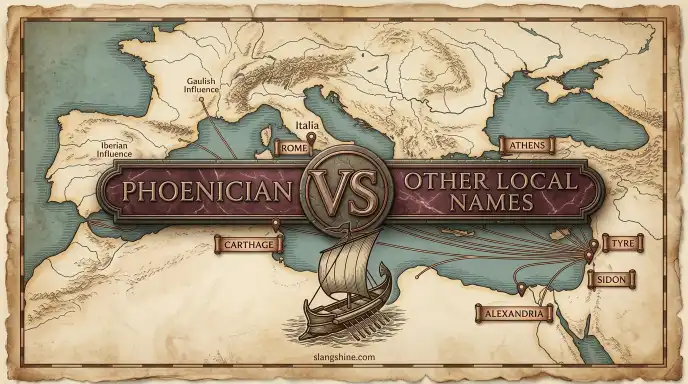
Phoenician vs. Other Local Names
Many cities have informal names for their residents.
For example, people from New York City are often called New Yorkers.
People from Chicago are commonly called Chicagoans.
In the same way, Phoenician can identify someone associated with Phoenix.
The difference is that “Phoenician” already has a famous historical meaning. That makes it more likely to cause confusion than many other city-based names.
Does Phoenician Mean Cool or Attractive?
No, not as a standard slang meaning.
There is no reliable basis for saying that “Phoenician” generally means “cool,” “hot,” “attractive,” or “awesome” in modern slang.
If you see such a definition on a user-generated slang website, treat it carefully.
Slang websites can contain personal definitions that are not widely recognized.
For a reliable explanation, it is better to separate the established historical meaning from the modern Phoenix-related usage.
Is Phoenician Still Used in 2026?
Yes, the word remains in use, but its meaning depends on context.
The historical meaning continues to appear in education, history, archaeology, and discussions of ancient languages.
The modern Phoenix-related use can also be found in informal writing and local references.
However, there is not enough evidence to call “Phoenician” a major trending internet slang term in 2026.
That distinction is important for accurate slang content.
A word can have an informal local meaning without being a viral social-media slang term.
Where Might You See Phoenician?
The modern Phoenix meaning may appear in places such as:
- Local conversations
- Phoenix community groups
- Arizona-related discussions
- Personal profiles
- Social media captions
- Local news or lifestyle writing
- Online discussions about Phoenix
The historical meaning is much more likely in:
- History articles
- Archaeology
- School materials
- Museums
- Academic writing
- Discussions about ancient languages
So, the topic surrounding the word is often the best clue.
FAQs About Phoenician Slang
Q1. What does Phoenician mean in slang?
Answer: In informal modern usage, “Phoenician” can mean a person from Phoenix, Arizona. It is better described as a local or informal term than as widespread internet slang.
Q2. Is Phoenician a slang word?
Answer: Not mainly. “Phoenician” is a standard English word with an ancient historical meaning. Its use for a person from Phoenix is a modern informal usage.
Q3. What does Phoenician mean in Arizona?
Answer: In an Arizona context, “Phoenician” can refer to someone who lives in or comes from Phoenix.
Q4. What is a Phoenician person?
Answer: A Phoenician person can mean someone connected to the ancient Phoenician civilization. In a modern Phoenix context, it can also mean a person from Phoenix, Arizona.
Q5. Is Phoenician an insult?
Answer: No. “Phoenician” is generally neutral. When used for a Phoenix resident, it can even express local pride. Any insulting meaning would depend on a specific context rather than being a standard definition.
Q6. Does Phoenician mean someone from Phoenix?
Answer: Yes, it can. “Phoenician” is used informally as a term for a person from Phoenix, Arizona, although the word also has its older historical meaning.
Q7. How do you pronounce Phoenician?
Answer: It is commonly pronounced approximately fee-NISH-un or fee-NEE-shun, depending on the speaker and variety of English.
Q8. Is Phoenician still used today?
Answer: Yes. The historical term remains widely used, and the Phoenix-related meaning can appear in modern informal and local contexts. It is not, however, best described as a major internet slang trend.
Conclusion
Phoenician has two meanings that are easy to confuse. Its main dictionary meaning relates to the ancient Phoenicians, their culture, language, and history.
In modern informal usage, Phoenician can also mean someone from Phoenix, Arizona. In that context, it works as a local identity term and can show a connection to the city.
So, when you see “Phoenician,” check the context first:
Ancient history → an ancient Phoenician person or something related to Phoenicia
Phoenix, Arizona → a modern local or resident of Phoenix
Calling the second use “slang” is understandable in a casual search, but “informal local term” is the more precise description.
Learn More Slang Terms:
- Haitian Slang: Meanings, Words, Sayings & Examples in 2026
- Monster in Spanish Slang: The Meaning You Might Not Expect
- Snowbelt Slang: Words Used in Snowy U.S. Regions (2026)

Hi, I’m Emma Carter, an English language writer with over 8 years of experience in vocabulary and language learning. At SlangShine, I write simple, accurate, and easy-to-understand articles about slang, synonyms, idioms, and everyday English to help learners build confidence and improve their communication skills.