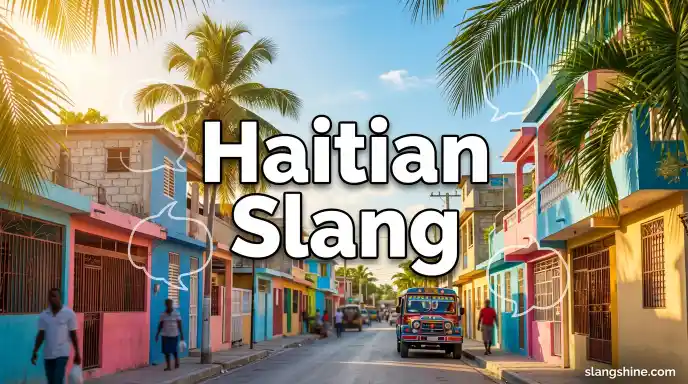
Haitian slang is a common way to describe informal words, phrases, and expressions used in Haitian Creole conversations. If you have heard people speaking Kreyòl with friends, seen Haitian expressions on social media, or listened to Haitian music, you may have noticed words that do not make sense when translated word for word.
That is one reason people search for Haitian slang. A phrase may have a simple literal meaning but carry a different meaning in everyday conversation.
Tone also matters. The same expression can sound friendly, funny, serious, or rude depending on who says it and how it is used.
It is also important to remember that Haitian Creole and Haitian slang are not the same thing. Haitian Creole, or Kreyòl Ayisyen, is a full language. Slang is the informal language people may use within it.
Quick Answer: Haitian Slang
Haitian slang refers to informal Haitian Creole words and expressions used in casual conversation, texting, music, and social settings. Its meaning often depends on context, tone, age, and the relationship between speakers.
What Is Haitian Slang Called?
Haitian slang is commonly described as Haitian Creole slang, Kreyòl slang, or informal Haitian Creole. There is not one separate official name for all Haitian slang.
This distinction is useful because Haitian Creole itself is not slang. It is a language spoken in Haiti and Haitian communities around the world. Slang is simply one informal part of how people may use the language.
For example, Sa k pase? is a casual Haitian Creole expression meaning “What’s up?” or “What’s happening?” It is informal, but that does not mean the entire Haitian Creole language is slang.
You may see different spellings online, including Sak pase? and Sa k pase?. The shortened form is common in informal writing and conversation.
What Does Haitian Slang Mean?
Haitian slang can express friendship, humor, excitement, frustration, affection, confidence, or surprise. Some expressions are used mainly by close friends, while others are simply casual ways of speaking.
The meaning can also change with the situation.
For example, N ap boule literally contains the idea of “burning,” but when used as a casual response, it can mean “We’re doing okay,” “We’re managing,” or “We’re hanging in there.”
A natural conversation might look like this:
Sa k pase?
“What’s up?”
N ap boule.
“We’re doing okay.”
The important lesson is simple: do not translate Haitian slang word for word and assume you have the full meaning.
Haitian Slang vs. Haitian Creole
Haitian Creole includes everyday words, formal language, greetings, slang, sayings, and many other types of expression.
For example:
- Bonjou = hello / good morning
- Mèsi = thank you
- Wi = yes
- Non = no
- Sa k pase? = what’s up?
The first four are ordinary everyday words or phrases. The last one is a casual expression. Calling every one of these “slang” would be too broad.
This difference matters when learning Haitian Creole because a person may search for “Haitian slang” but actually be looking for common Haitian Creole phrases.
Common Haitian Slang Words and Phrases
Haitian slang is easier to understand when you learn expressions in context instead of memorizing random words.
Here are some useful examples:
| Haitian expression | Simple meaning | Tone |
| Sa k pase? | What’s up? / What’s happening? | Casual |
| N ap boule | We’re doing okay / hanging in there | Casual |
| M ap boule | I’m doing okay / managing | Informal |
| Baz | Friend / buddy in informal use | Friendly |
| Sa k ap fèt? | What’s going on? / What’s happening? | Casual |
| Tout bagay anfòm | Everything is fine | Neutral |
Sa k pase? is especially useful because it works as a casual greeting. N ap boule can be used as a response, although its exact feeling depends on the speaker and situation.
Why Context Matters
Imagine someone asks:
Sa k pase?
They may simply be saying “What’s up?” to a friend.
But the same words can also be a genuine question about what is happening. The surrounding conversation and the speaker’s tone help you understand which meaning is intended.
This is common with slang in many languages. A direct dictionary translation does not always explain how people actually use an expression.
Popular Haitian Sayings and Everyday Expressions
Haitian culture has many sayings and expressions that communicate advice, humor, experience, or a lesson about life. These are related to slang, but they should not automatically be treated as slang.
One well-known Haitian Creole proverb is:
Men anpil, chay pa lou.
A natural English meaning is “Many hands make light work.” The literal idea is that when many people help, a heavy burden becomes easier to carry. Haitian Creole has a long tradition of proverbs and metaphorical expressions like this.
Another example is:
Sak vid pa kanpe.
The basic idea is that an empty stomach cannot stand or work properly. It is commonly understood as a reminder that people need food and energy before they can get things done.
These examples show why “Haitian sayings” deserves its own place in an article about Haitian informal language. A saying can be culturally important without being slang.
Haitian Slang for Friends and Casual Conversation
If you are looking for Haitian slang for friend, you may come across baz in informal usage.
Depending on the context, baz can refer to a friend, buddy, or someone within a close social group. Because slang can vary by community and situation, it is better to understand the relationship between speakers before using an unfamiliar term yourself.
For casual conversation, expressions such as Sa k pase? are often more useful for beginners because they are easy to recognize and have a clear conversational purpose.
You can also see expressions used with words such as zanmi, meaning “friend.” Not every friendly expression is slang, so context remains important.
Haitian Slang in Texting and Social Media
Haitian Creole slang and informal expressions can appear in text messages, social media posts, comments, group chats, videos, comedy, and music.
Online writing often makes expressions shorter or more conversational. You may also see different spellings of the same phrase.
For example, Sa k pase? can appear in casual online conversations as a quick way to ask someone what is happening or how things are going. Modern Haitian Creole content also uses everyday expressions heavily in social media and music.
However, seeing a phrase on TikTok or Instagram does not automatically mean it is used by every Haitian speaker. Slang can vary by age, location, family, friend group, and diaspora community.
That is why context is more useful than assuming one expression represents all Haitian speakers.
Haitian Slang in Music and Pop Culture
Haitian slang is also connected with modern music and entertainment. People may encounter informal Kreyòl expressions in Rap Kreyòl, konpa, drill, comedy, interviews, and social media content.
Music can introduce listeners to words they may not hear in a beginner language lesson. But song lyrics can also use exaggeration, jokes, cultural references, or street language.
So if you hear a Haitian slang word in a song, do not assume its meaning is exactly the same in a normal conversation. The setting matters.
Is Haitian Slang Rude or Offensive?
Haitian slang is not automatically rude or offensive. Many informal expressions are simply friendly ways to talk with people you know.
However, some slang can sound disrespectful when used with the wrong person. The meaning may depend on the speaker’s tone, the relationship between the people, and the situation.
A word that friends use jokingly may not be appropriate when speaking with an older person, a teacher, a customer, or someone you have just met.
This is especially important with slang that refers to someone’s behavior, appearance, or character. If you do not fully understand a word, it is better to ask about its meaning before using it.
Haitian Curse Words and Bad Words
People also search for Haitian slang curse words and Creole slang bad words. These are usually informal or insulting expressions rather than ordinary vocabulary.
The safest approach is to learn what an expression means and understand its strength before repeating it. Some words may be mildly insulting, while others can be much harsher.
For language learners, knowing that a word is offensive can be just as useful as knowing its translation.
When Should You Avoid Haitian Slang?
Avoid unfamiliar slang when:
- Speaking in a professional setting
- Talking to someone older whom you do not know well
- Writing a formal message
- Speaking with a teacher or authority figure
- You are unsure if the expression is insulting
- You only know the word from a social media video
When in doubt, use clear and neutral Haitian Creole instead.
Funny Haitian Slang and Playful Expressions
Some Haitian expressions can sound funny when translated literally into English. Others become humorous because of the situation or the speaker’s tone.
For example, N ap boule can sound surprising to an English speaker because its literal wording involves “burning.” In everyday conversation, however, it can be used to express that someone is doing okay or getting by.
Playful expressions are often used between people who already know each other well. A joking tone can make a phrase sound friendly, while the same words may feel strange or rude when said seriously.
This is why there is no single list of “funny Haitian slang” that works in every situation. The humor often comes from the context.
What Does “Sa Pa Se” Mean?
If you searched for “what does sa pa se mean?”, there is an important detail to know: “sa pa se” is not something we should treat as a confirmed standalone Haitian slang expression.
It may be a misspelling, mishearing, or shortened version of another Haitian Creole phrase.
One likely phrase is:
Sak pase? / Sa k pase?
This commonly means “What’s up?” “What’s happening?” or “What’s going on?” in casual conversation.
If you see “sa pa se” in a message, the safest way to understand it is to look at the full sentence and surrounding conversation.
Do not assume that every unusual spelling online represents a separate slang word.
What Is “I Love You” in Haitian Creole?
If you want to say “I love you” in Haitian Creole, a common expression is:
Mwen renmen ou.
You may also see the shorter form:
Mwen renmen w.
Both can express “I love you.” The shorter form is common in informal speech and writing.
For stronger affection, you can say:
Mwen renmen w anpil.
This means “I love you very much.”
Another expression is:
Mwen damou pou ou.
This has the sense of “I am in love with you,” which is more specific than simply saying “I love you.”
These expressions are better described as Haitian Creole expressions of affection, not necessarily slang.
What Does “Zo” Mean in Haitian Slang?
Zo is an interesting example because its meaning changes with context.
In ordinary Haitian Creole, zo means “bone.” It can also have other standard meanings depending on context, including “die” or “dice.”
However, zo or zoe has also been documented as an informal term used in some Haitian diaspora communities to refer to a Haitian or fellow Haitian.
This meaning is context-dependent. It should not be treated as the universal meaning of the word.
For example, if someone is talking about food or the human body, zo may simply mean “bone.” If it appears in a diaspora social context, it may have a different informal meaning.
That difference is a good example of why translating slang without context can cause confusion.
Why Do People Use Haitian Slang?
People use slang for many of the same reasons they use informal language in other communities.
To Sound Natural
Friends usually do not speak exactly like textbooks. Informal expressions can make conversations feel relaxed and natural.
To Show Connection
Shared slang can create a feeling of belonging. Friends, younger speakers, and members of the Haitian diaspora may develop expressions that feel familiar within their community.
To Add Humor
Slang can make a message shorter, funnier, or more expressive.
To Show Emotion
An informal expression can communicate excitement, frustration, surprise, affection, or confidence more strongly than a neutral sentence.
To Reflect Culture
Language carries culture. Haitian expressions can reflect humor, history, social relationships, and experiences within Haitian communities.
How Haitian Slang Changes by Age and Community
One reason Haitian slang can be difficult for learners is that not everyone uses the same expressions.
A phrase popular among younger people may sound unfamiliar to an older speaker. The same can happen between people living in Haiti and Haitians living in places such as the United States, Canada, or France.
Social media can also spread expressions quickly. A word that becomes popular in music or online videos may become familiar to a wider audience, while another expression may remain limited to a particular group.
Therefore, it is better to say that a term is common in a particular context rather than claiming that every Haitian uses it.
How to Use Haitian Slang Naturally
If you are learning Haitian Creole, do not try to use slang in every sentence.
Start by learning common expressions and listening to how native speakers use them.
A good approach is:
- Learn the basic meaning.
- Check if the expression is formal or informal.
- Notice who uses it.
- Listen to the tone.
- Look at several examples.
- Use it only when the situation feels appropriate.
This helps you avoid one of the most common problems with slang: using a word correctly in a dictionary sense but incorrectly in a real conversation.
Real-Life Haitian Slang Examples
Here are some examples showing how informal Haitian Creole can work in different situations.
Friendly Conversation
Person A: Sa k pase?
Person B: N ap boule.
Meaning:
A: “What’s up?”
B: “I’m doing okay.”
This is a relaxed exchange between people who know each other.
Casual Texting
“Sa k pase?”
Someone might send this as a short message to check what a friend is doing or how things are going.
Talking About a Friend
“Se baz mwen.”
Depending on context, this can communicate the idea of someone being a close friend or buddy when baz is being used in its informal sense.
Romantic Conversation
“Mwen renmen w anpil.”
Meaning: “I love you very much.”
This is affectionate rather than slang.
Social Media
Someone may use a short Haitian Creole expression in a comment or caption instead of writing a full formal sentence.
The exact meaning should still be judged from the complete post, because online spelling and tone can vary.
Haitian Slang vs. Similar Language
Haitian slang can sometimes be confused with everyday Haitian Creole, Haitian sayings, or Haitian Creole terms of affection.
| Type | What it means | Example |
| Haitian Creole | The language itself | Mèsi |
| Informal expression | Casual everyday language | Sa k pase? |
| Slang | Informal language linked to particular groups or situations | Context-dependent terms |
| Saying/proverb | An expression that communicates an idea or lesson | Men anpil, chay pa lou |
| Term of affection | Language used to express love or closeness | Mwen renmen w |
This distinction makes the topic easier to understand. Not every interesting Haitian Creole phrase is slang.
Is Haitian Slang Safe for Social Media?
Most ordinary Haitian Creole expressions are safe to use online when used correctly. The main issue is not the language itself but if a particular expression is offensive, insulting, or inappropriate for the audience.
Before posting slang on TikTok, Instagram, Facebook, or another platform, consider:
- Who will see the post?
- Is the expression friendly or insulting?
- Is it appropriate for the situation?
- Are you sure you understand the meaning?
- Could the phrase have another meaning in a different community?
If you are unsure, a neutral Haitian Creole phrase is usually the safer choice.
FAQs About Haitian Slang
Q1. What are some Haitian sayings?
Answer: Haitian Creole has many sayings and proverbs. One well-known example is “Men anpil, chay pa lou,” which expresses the idea that many people working together can make a difficult task easier.
Q2. What is Haitian slang called?
Answer: Haitian slang is commonly called Haitian Creole slang, Kreyòl slang, or informal Haitian Creole. There is no single official name for every slang expression.
Q3. What does “sa pa se” mean?
Answer: “Sa pa se” does not have a clearly verified standalone slang meaning. It may be a misspelling or variation of “Sak pase?” or “Sa k pase?”, meaning “What’s up?” or “What’s happening?”
Q4. What is “I love you” in Haitian Creole?
Answer: “Mwen renmen ou” and “Mwen renmen w” can both mean “I love you” in Haitian Creole. “Mwen renmen w anpil” means “I love you very much.”
Q5. What does “zo” mean in Haitian slang?
Answer: “Zo” normally means “bone” in Haitian Creole, but in some Haitian diaspora contexts it has also been used informally to refer to a Haitian or fellow Haitian. The surrounding context is important.
Q6. Is Haitian slang the same as Haitian Creole?
Answer: No. Haitian Creole is the language, while slang is informal language used within particular social or cultural settings. Some Haitian Creole phrases are everyday language rather than slang.
Conclusion
Haitian slang is best understood through context, tone, and real-life usage. It includes informal expressions that can appear in conversations, texting, social media, music, comedy, and Haitian diaspora communities.
It is also important not to label every Haitian Creole word or phrase as slang. Common greetings, sayings, proverbs, and expressions of affection may simply be part of everyday Kreyòl.
If you are learning Haitian slang, start with common expressions such as Sa k pase? and N ap boule, then pay attention to how native speakers use them. Be more careful with words that may be rude or have different meanings in different communities.
Understanding the difference between Haitian Creole, informal expressions, slang, and sayings will help you use these terms more naturally and avoid misunderstandings.
Learn More Spanish & Regional Slang Terms:
- Grandma in Spanish Slang: Abuela, Nana, Tita & More (2026)
- Paisa Meaning in Spanish Slang: Culture & Pride (2026 Guide)
- Slang Spanish Words: Common Terms Explained

Hi, I’m Emma Carter, an English language writer with over 8 years of experience in vocabulary and language learning. At SlangShine, I write simple, accurate, and easy-to-understand articles about slang, synonyms, idioms, and everyday English to help learners build confidence and improve their communication skills.