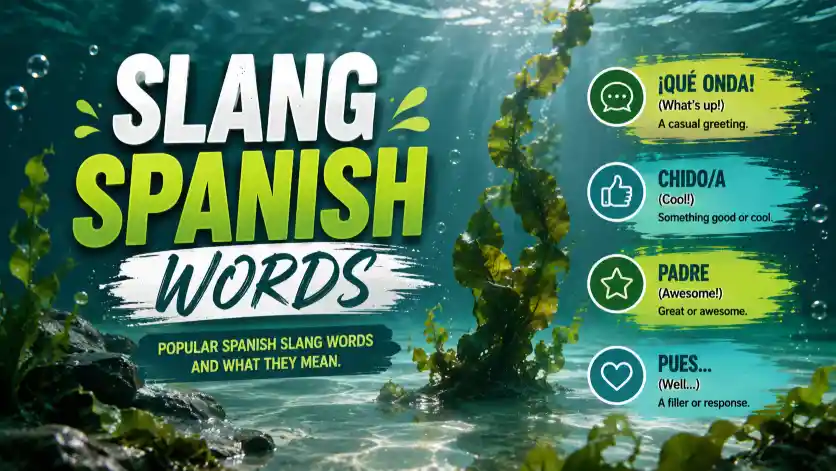
Slang Spanish words are informal words and phrases that people use in casual Spanish conversations. They can make speech sound more natural, friendly, funny, or expressive. However, their meaning can change by country and context.
For example, “guay” means “cool” in Spain, while “chido” is commonly used for “cool” in Mexico. Likewise, “pana” can mean “friend” or “buddy” in several Latin American countries.
These differences can be confusing if you are learning Spanish from movies, social media, music, or conversations with native speakers.
Therefore, learning Spanish slang is useful, but it is important to understand where a word is used and what tone it has. This guide explains common slang Spanish words in simple English, with examples and notes about regional use.
Quick Answer: Slang Spanish Words
Slang Spanish words are informal words and expressions used in everyday Spanish. Their meanings often depend on the country, age group, situation, and tone of the conversation.
Quick Reference Table
| Spanish Slang | Simple Meaning | Common Use |
| Guay | Cool | Spain |
| Chido | Cool / great | Mexico |
| Pana | Friend / buddy | Several Latin American countries |
| Tío / Tía | Guy / girl / mate | Spain |
| Chamba | Job / work | Several Latin American countries |
| Jato | Home / house | Peru |
| Parcero / Parce | Friend / buddy | Colombia |
| Bacano | Cool / great | Colombia and some other countries |
| Che | Hey / a casual way to address someone | Argentina and nearby regions |
| Pisto | Money | Guatemala and parts of Central America |
| Fresa | Preppy / privileged / snobby | Mexico |
As you can see, Spanish slang is not the same everywhere. A word that sounds natural in one country may be uncommon or unfamiliar in another.
What Are Spanish Slang Words?
Spanish slang words are informal expressions that are common in casual speech rather than formal Spanish.
People may use slang with:
- Friends
- Family
- Classmates
- Online communities
- Social media followers
- People in relaxed settings
For example:
“¡Qué guay!”
In Spain, this can mean:
“How cool!”
However, a Spanish learner should not assume that every slang word works in every Spanish speaking country.
That is because Spanish is spoken across many countries, and each region has its own vocabulary and expressions.
1. Guay
Guay means “cool,” “great,” or “awesome” in informal Spanish.
It is strongly associated with Spain.
Example:
“Tu camisa está guay.”
Meaning:
“Your shirt is cool.”
You may hear guay in casual conversations, especially among younger speakers.
However, it is not the usual slang choice across all Spanish speaking countries.
2. Chido
Chido is a common Mexican slang word meaning “cool,” “great,” or “awesome.”
Example:
“¡Qué chido!”
Meaning:
“That’s so cool!”
It can describe a place, idea, object, event, or experience.
For example:
“Tu nuevo teléfono está chido.”
Meaning:
“Your new phone is cool.”
3. Pana
Pana is an informal word for “friend” or “buddy.”
It is used in several Latin American countries, although its popularity and exact use can vary by region.
Example:
“Él es mi pana.”
Meaning:
“He is my buddy.”
The word is informal and friendly.
So, it is more suitable for casual conversations than formal situations.
4. Tío and Tía
In Spain, tío and tía can be used informally to mean “guy,” “girl,” “man,” “woman,” or “mate,” depending on the context.
For example:
“Ese tío es muy divertido.”
This can mean:
“That guy is really funny.”
Likewise:
“Esa tía es mi amiga.”
can mean:
“That girl is my friend.”
Important: The words also have their normal family meanings, uncle and aunt. Context tells you which meaning is intended.
5. Chamba
Chamba is informal Spanish for “work” or “job.”
It is common in several Latin American countries.
Example:
“Tengo mucha chamba hoy.”
Meaning:
“I have a lot of work today.”
Another example:
“Necesito encontrar una chamba.”
Meaning:
“I need to find a job.”
Because regional usage varies, you may hear other words for “job” in different Spanish speaking countries.
6. Jato
Jato is an informal word for “home” or “house,” especially in Peru.
Example:
“Estoy en mi jato.”
Meaning:
“I’m at home.”
It is casual and should not be treated as a formal Spanish word for “house.”
7. Parcero / Parce
Parcero and the shorter form parce are strongly associated with Colombian Spanish.
They can mean “friend,” “buddy,” or “mate.”
Example:
“¿Qué más, parce?”
A natural English meaning would be:
“What’s up, buddy?”
The shorter form parce is especially common in casual Colombian speech.
8. Bacano
Bacano means “cool,” “great,” or “awesome” in informal Spanish.
It is especially associated with Colombia and is also used in some other parts of Latin America.
Example:
“Ese lugar es muy bacano.”
Meaning:
“That place is really cool.”
However, the exact popularity of the word can vary by country.
9. Che
Che is a familiar way of getting someone’s attention or addressing someone. It is strongly associated with Argentina and is also used in nearby parts of South America.
For example:
“Che, ¿vamos?”
This can mean:
“Hey, shall we go?”
It can sound friendly and casual.
Therefore, it is best understood as a conversational expression rather than a direct translation of one English word.
10. Pisto
Pisto can mean “money” in informal Spanish, especially in Guatemala and some other parts of Central America.
Example:
“No tengo pisto.”
Meaning:
“I don’t have any money.”
The word has other meanings in different Spanish speaking contexts, so regional context matters.
11. Fresa
In Mexican slang, fresa can describe someone who seems preppy, privileged, or snobby.
Example:
“Él es muy fresa.”
Depending on the context, this could mean:
“He is very preppy or snobby.”
The word can be teasing, critical, or descriptive.
So, tone matters when calling someone fresa.
Common Spanish Slang by Meaning
| Meaning | Spanish Slang Examples | Region or Context |
| Cool | Guay, chido, bacano | Spain, Mexico, Colombia |
| Friend / buddy | Pana, parce, parcero | Latin America, Colombia |
| Work / job | Chamba | Several Latin American countries |
| Home | Jato | Peru |
| Money | Pisto | Guatemala and parts of Central America |
| Guy / girl | Tío / tía | Spain |
| Hey | Che | Argentina and nearby regions |
| Preppy / snobby | Fresa | Mexico |
Why Does Spanish Slang Change by Country?
Spanish is spoken in many countries, and each region has developed its own informal expressions.
For example:
- Spain uses guay for “cool.”
- Mexico commonly uses chido for “cool.”
- Colombia uses bacano for “cool.”
- Colombia also uses parce for “buddy.”
- Peru uses jato for “home.”
As a result, learning Spanish slang requires more than memorizing translations. You also need to know where a word is commonly used.
Are Spanish Slang Words Safe to Use?
Most common slang words are harmless, but some expressions can be rude, insulting, or inappropriate.
Even a friendly word can sound strange if you use it in the wrong country or situation.
For example, a slang word may be perfectly normal among friends but unsuitable in:
- A job interview
- A formal presentation
- A school assignment
- A business email
- A conversation with someone you do not know well
Therefore, learn the tone and regional use before using an unfamiliar slang word.
When Should English Learners Avoid Spanish Slang?
If you are still learning Spanish, standard Spanish is usually safer in formal situations.
Use formal or neutral Spanish when you are:
- Writing professionally
- Speaking to a customer
- Giving a formal presentation
- Writing an academic paper
- Meeting someone for the first time
Then, as you become more comfortable with the language, you can learn which slang expressions fit casual situations.
Most importantly, do not use a slang word just because you saw it online. Check its meaning, region, and tone first.

How Can You Learn Spanish Slang Safely?
Start with common words and learn them with their context. Do not memorize a slang word without learning where and how people use it.
A simple approach is:
- Learn the meaning.
- Check the country or region.
- Look at a few natural examples.
- Notice if the word is friendly, rude, or neutral.
- Use it first in casual situations.
For example, if you learn chido, remember that it is strongly associated with Mexico. If you learn guay, remember that it is commonly used in Spain.
This approach helps you sound more natural while avoiding awkward mistakes.
Spanish Slang vs. Standard Spanish
Slang and standard Spanish are both useful, but they serve different purposes.
| Type | Main Use | Example |
| Standard Spanish | Formal and general communication | amigo = friend |
| Spanish slang | Casual and informal communication | pana = friend / buddy |
| Regional slang | Informal speech in a specific area | parce = buddy in Colombia |
Therefore, knowing both forms gives you a better understanding of real Spanish conversations.
For example, amigo is widely understood as “friend,” while a regional word such as parce may sound more local and informal.
Why Do People Use Spanish Slang?
People use slang because it can make conversations feel more natural, relaxed, and expressive.
Slang can also:
- Show friendship
- Add humor
- Express excitement
- Reflect local culture
- Make speech sound less formal
- Help people feel connected to a group
For example, saying “¡Qué chido!” can sound more casual and expressive than simply saying something is good.
However, slang is not always better. The right word depends on the person, place, and situation.
Does Spanish Slang Change Over Time?
Yes. Spanish slang can change as language and culture change.
New expressions can become popular through:
- Social media
- Music
- Movies
- Television
- Gaming
- Online communities
- Youth culture
At the same time, older slang words may become less common.
As a result, a slang word that is popular today may not be equally common several years from now.
Common Mistakes When Using Spanish Slang
Mistake 1: Using Every Slang Word in Every Country
Spanish slang is highly regional.
For example, chido is strongly associated with Mexico, while guay is strongly associated with Spain.
So, do not assume that one slang word is universal.
Mistake 2: Using Slang in Formal Situations
Slang is usually casual.
A slang word that sounds natural with friends may sound inappropriate in a formal email or presentation.
Mistake 3: Ignoring Tone
Some slang words can sound friendly in one situation but rude or insulting in another.
Therefore, pay attention to how native speakers use the word.
Mistake 4: Translating Slang Word for Word
A direct translation does not always explain the real meaning.
For example, pana does not mean the literal English word you might expect from a dictionary. In slang, it can mean friend or buddy.
The context gives you the real meaning.
How to Know Which Spanish Slang Word to Use
Before using slang, ask yourself three simple questions:
Where is the speaker from?
A word may be common in Mexico but uncommon in Spain.
Who am I talking to?
Slang is usually easier to use with friends and people you know well.
What is the situation?
Casual conversations allow more slang than formal or professional situations.
If you are unsure, use standard Spanish. It is usually the safer choice.
Frequently Asked Questions
Q1. What are slang Spanish words?
Answer: Slang Spanish words are informal words and phrases used in casual conversations. Their meanings and popularity can vary by country and region.
Q2. What is a Spanish slang word for “cool”?
Answer: Guay is commonly used in Spain, while chido is common in Mexico. Bacano is also used for “cool” in Colombia and some other regions.
Q3. What is Spanish slang for “friend”?
Answer: Pana can mean “friend” or “buddy” in several Latin American countries. Parce and parcero are strongly associated with Colombia.
Q4. What does “chamba” mean?
Answer: Chamba is informal Spanish for “work” or “job” and is used in several Latin American countries.
Q5. Is Spanish slang the same in every country?
Answer: No. Spanish slang varies by country and region. A word that is common in Mexico may be uncommon in Spain or Argentina.
Q6. Should Spanish learners use slang?
Answer: Yes, but carefully. Learn the meaning, region, and tone first. Standard Spanish is usually better for formal situations.
Conclusion
Slang Spanish words can make casual Spanish more colorful and natural, but their meanings often depend on region and context. Words such as guay, chido, pana, chamba, parce, bacano, and jato have different uses and regional connections.
The most important thing is not to treat Spanish slang as one universal list. Spanish speakers in different countries use different informal words. Therefore, always check where a slang term is commonly used before adding it to your vocabulary.
For formal situations, standard Spanish is usually the safest choice. However, learning common slang can help you understand conversations, social media posts, videos, music, and everyday speech more naturally.
Learn More Slang Terms
- Crybaby in Spanish Slang: Learn It in One Minute
- Nicaraguan Slang Bad Words: What to Know Before You Visit
- Jamaican Slang for Pretty Girl: Where These Words Come From

Hi, I’m Anna Whitmore. I have 7+ years of experience writing about English slang and vocabulary. At SlangShine, I create simple, easy-to-understand content for English learners.