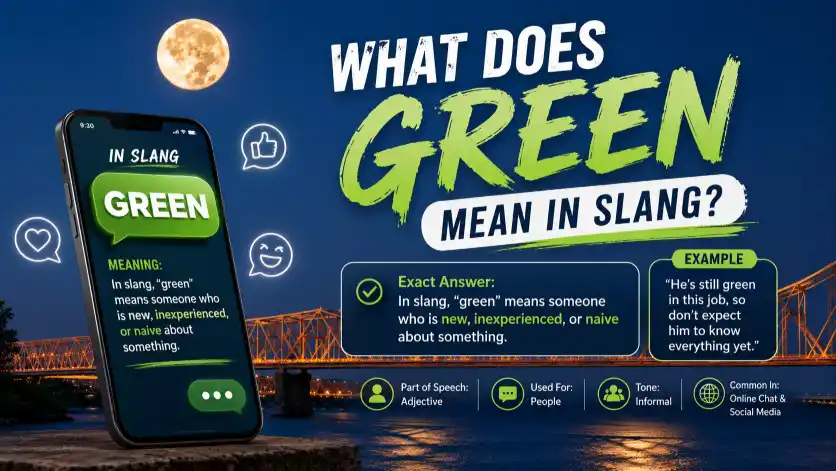
What Does Green Mean in Slang? “Green” can have several slang or informal meanings, depending on the context. Most commonly, it describes someone who is new, inexperienced, or naive. It can also relate to money, jealousy, cannabis, or a positive sign in “green flag.”
If you are searching what does green mean in slang, the sentence around the word matters. For example, “He is still green” may mean he is inexperienced, while “green with envy” means jealous.
In gaming, “green” can have a more specific meaning in some games, while “green flag” usually means a good sign or positive trait.
This guide separates these meanings clearly so you do not confuse one use with another. It also explains how green appears in texting, social media, gaming, relationships, and everyday conversation.
Quick Answer: What Does Green Mean in Slang?
In slang, “green” most often means inexperienced, new, or naive. Depending on context, it can also refer to money, jealousy, or cannabis. In phrases such as “green flag,” it means a positive sign or good quality.
What Does “Green” Mean in Slang?
The most common slang use of “green” describes someone who is inexperienced or new to a situation.
For example:
“She’s still green at this job.”
This means she is new and still learning.
Green can also suggest that someone is naive, especially when they do not have enough experience to understand a situation.
“He was too green to notice the warning signs.”
Here, green means inexperienced and not fully aware of what was happening.
This use is usually informal. It can be neutral when someone is simply learning, but it may sound critical if the speaker is making fun of that person’s lack of experience.
Green Meaning “Inexperienced” or “Naive”
Green can describe a person who lacks experience, knowledge, or practical understanding.
You might hear it when talking about:
- A new employee
- A beginner
- A new player
- Someone learning a skill
- A person unfamiliar with a situation
For example:
“The new employee is a little green, but she’s learning quickly.”
Here, the speaker is not necessarily insulting the employee. They are saying that she is still gaining experience.
However, green and naive are not always exactly the same.
Inexperienced means someone has not done something much before.
Naive suggests that the person may also lack practical knowledge or good judgment.
So, context matters.
What Does “Green” Mean When Talking About Money?
In informal English, “green” can mean money or cash, especially U.S. dollars.
The meaning comes from the green appearance of U.S. currency.
For example:
“He’s trying to make some green.”
This means he is trying to make money.
Another example:
“I need some green before I buy that.”
Here, green means cash or money.
This use is casual. In professional writing, words such as money, funds, revenue, or cash are usually clearer.
What Does “Green” Mean When Someone Is Jealous?
Green can be connected with jealousy or envy, especially in the expression “green with envy.”
For example:
“She was green with envy when she saw his new car.”
This means she felt very jealous.
You may also see informal wording such as:
“He got green when his friend got promoted.”
The intended meaning may be jealousy, but this use is less clear by itself. “Green with envy” is the clearer and more established expression.
So, if someone simply says:
“He’s green.”
you should not automatically assume they mean jealous. They may mean inexperienced instead.
What Does “Green” Mean in Cannabis Slang?
“In some cannabis related contexts, ‘green’ may refer to cannabis, but this use is highly context dependent and is not a universal slang meaning.”
For example, someone discussing cannabis might use green as a short reference to it.
However, this meaning is highly dependent on context. The word “green” does not normally mean marijuana in everyday English.
For example:
“The new employee is still green.”
This clearly refers to experience, not cannabis.
Because of this, you should not interpret every online use of green as a drug reference. Look at the surrounding conversation first.
What Does “Green Flag” Mean in Slang?
A “green flag” is a positive sign that a person, relationship, or situation is healthy, safe, or worth continuing.
It is commonly used as the opposite of “red flag.”
For example:
“He respects her boundaries. That’s a green flag.”
The speaker sees respectful behavior as a good sign.
Another example:
“Being honest about your feelings is a green flag.”
Here, green flag means a positive quality.
Green Flag vs. Red Flag
| Term | Meaning |
| Green flag | Positive sign or good quality |
| Red flag | Warning sign or concerning behavior |
The phrase is common in conversations about dating, friendships, relationships, and personal behavior.
It is also used more broadly online when people talk about good signs in a person, product, situation, or community.
What Does “Green Eyed” Mean?
“Green eyed” is often connected with jealousy or envy.
The phrase “green eyed monster” is a well known expression for jealousy. It became strongly associated with Shakespeare’s Othello.
For example:
“She became green eyed when she saw her ex with someone new.”
This means she became jealous.
Green vs. Green Eyed
These expressions are related, but they are not identical.
- Green: Can have several meanings, including inexperienced.
- Green with envy: Clearly refers to jealousy.
- Green eyed: Often describes someone showing jealousy or envy.
Therefore, context is important when you see green by itself.
What Does “Green” Mean in Gaming?
“In some games, ‘green’ has a game specific meaning related to a successful or perfectly timed result.”
For example, in games such as NBA 2K, a “green” or “green release” can refer to a perfectly timed shot.
A player might say:
“That was green!”
In that context, they may mean the shot had perfect timing.
However, you should not assume that “green” means a perfect play in every game. Gaming slang can vary by title and community.
This is different from saying:
“He’s green at this game.”
That sentence means the player is inexperienced.
Green Around the Gills Meaning
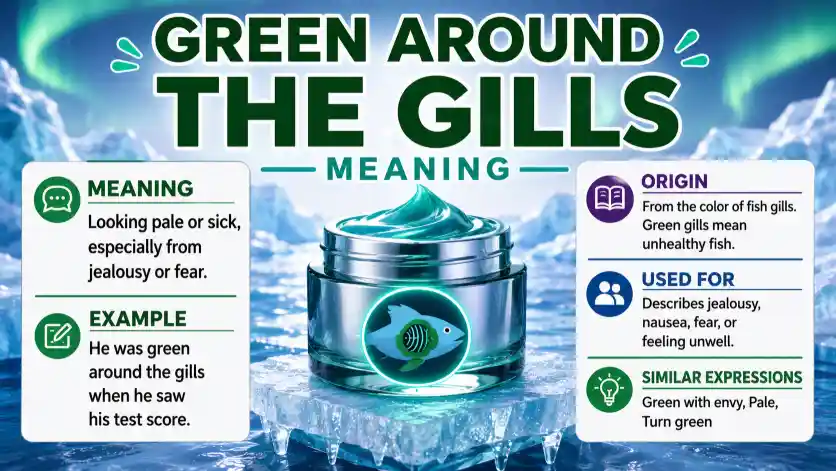
“Green around the gills” means looking or feeling sick, nauseous, or unwell.
For example:
“You look green around the gills. Are you okay?”
The phrase is an idiom rather than a general slang meaning of green.
It is often used when someone looks pale or sick.
Do Not Confuse These Meanings
- Green at a game = inexperienced
- Green with envy = jealous
- Green flag = positive sign
- Green around the gills = sick or nauseous
- Green in a gaming context = may mean a perfect result in some games
- Green for money = cash or money
- Green in cannabis context = marijuana
The surrounding words make the intended meaning much easier to identify.
Where Is “Green” Used in Slang?
Green appears in many informal settings, but the meaning changes with the topic.
Texting
A friend might write:
“I’m still green at this.”
Meaning: I’m still inexperienced.
TikTok and Instagram
You may see green flag in relationship posts:
“He listens when you speak. Green flag.”
Meaning: That is a good sign.
Gaming
A player may say:
“That shot was green.”
In a game such as NBA 2K, this can refer to a perfectly timed shot.
Casual Conversation
Someone might say:
“He’s green when it comes to business.”
Meaning: He lacks experience in business.
This shows why the word should always be read in context.
Is “Green” a Bad or Offensive Slang Word?
No. “Green” is not normally a bad or offensive slang word.
Most of its uses are harmless. However, describing someone as green can sound negative if you are using it to mock their lack of experience.
For example:
“You’re too green to understand this.”
This can sound dismissive.
A kinder version would be:
“You’re still learning how this works.”
The meaning is similar, but the second sentence sounds more supportive.
Also, some meanings are context specific. A reader should not assume that green refers to money, cannabis, or jealousy without enough context.
Is “Green” Appropriate at Work?
Yes, but it depends on the meaning and the level of formality.
Using green to mean inexperienced is possible in casual workplace speech:
“He’s still green, but he’s doing well.”
However, formal writing is clearer with:
“He’s new to the role and is still gaining experience.”
Using green to mean money is much less suitable in a formal report. Say money, funds, revenue, or another precise term instead.
Green vs. Green Flag vs. Red Flag
These three terms are related, but they do not have the same meaning.
| Term | Meaning | Example |
| Green | Often means inexperienced or naive | “He’s still green at the job.” |
| Green flag | A positive sign or good quality | “Her honesty is a green flag.” |
| Red flag | A warning sign or concern | “His constant lying is a red flag.” |
So, if someone says “green flag,” do not interpret it as simply “green.” The full phrase changes the meaning.
Real Life Examples of “Green” Slang
Example 1: New at Work
“I’m still green at this job.”
Meaning: The speaker is new and still learning.
Example 2: Naive
“He was too green to know they were joking.”
Meaning: He lacked enough experience to understand the situation.
Example 3: Money
“She’s saving her green for a new laptop.”
Meaning: She is saving her money.
Example 4: Jealousy
“He was green with envy after seeing their vacation photos.”
Meaning: He was jealous.
Example 5: Relationship
“She communicates openly. That’s a green flag.”
Meaning: Her behavior is a positive sign.
Example 6: Gaming
“That shot was green!”
Meaning: In a game where this term is used, it can mean the shot was perfectly timed.
These examples show why the words around green matter.
Common Misunderstandings About “Green”
“Green” always means inexperienced.
No. It can also refer to money, jealousy, cannabis, or other context specific meanings.
“Green flag” and “green” mean the same thing.
No. A green flag is a positive sign. Green by itself has several possible meanings.
“Green” always means jealous.
No. Jealousy is clearer in expressions such as “green with envy” or “green eyed.”
“Green” always refers to cannabis online.
No. That meaning only makes sense when the conversation is about cannabis.
“Green” is always an insult.
No. Calling someone green can simply mean they are new or inexperienced. The tone determines if it sounds critical.
Every gamer uses “green” in the same way.
No. Gaming slang can vary from one game to another. A meaning used in one gaming community may not apply to another.
How Can You Tell Which Meaning “Green” Has?
Look at the topic and words around it.
If the conversation is about a new worker:
“She’s green.”
Likely meaning: inexperienced.
If the conversation is about dating:
“That’s a green flag.”
Likely meaning: positive sign.
If someone says:
“He’s green with envy.”
Meaning: jealous.
If the conversation is about money:
“He needs more green.”
Possible meaning: money.
If the conversation is about gaming:
“That was green.”
The meaning may depend on the specific game.
This context based approach is much safer than assuming that every use has the same definition.
When Should You Avoid Using “Green”?
There is no general need to avoid green. It is a normal English word and is not offensive by itself.
However, be careful when using it to describe another person as inexperienced or naive.
For example:
“You’re so green.”
Depending on your tone, this could sound like you are mocking the person.
A clearer and kinder option is:
“You’re still learning.”
You should also avoid using a slang meaning when the audience may not understand it. In formal writing, direct words are usually better.
Polite Alternatives to “Green”
The best alternative depends on what you mean.
If “green” means inexperienced:
- New
- Inexperienced
- Still learning
- New to the role
- Unfamiliar with the process
If it means naive:
- Inexperienced
- Unaware
- New to the situation
If it means jealous:
- Jealous
- Envious
If it means money:
- Money
- Cash
- Funds
Using the direct word can prevent confusion, especially in professional or formal communication.
Why Does “Green” Have So Many Meanings?
Green has several meanings because slang often builds on existing words and expressions.
The word can describe experience, jealousy, money, or other ideas depending on the phrase and community using it.
This does not mean every meaning is equally common. Some uses are much more familiar than others.
For example, “green flag” is widely understood in modern online relationship discussions, while a gaming meaning may only be familiar to players of a particular game.
That is why context is more important than the word alone.
Frequently Asked Questions
Q1. What does green mean in slang?
Answer: In slang, green most commonly means inexperienced, new, or naive. Depending on context, it can also refer to money, jealousy, cannabis, or a game specific meaning.
Q2. What does green flag mean in slang?
Answer: A green flag is a positive sign. It often describes a good quality or healthy behavior in a person, relationship, or situation.
Q3. What does green eyed mean?
Answer: Green eyed can describe someone who is jealous or envious. The related expression “green eyed monster” is also associated with jealousy.
Q4. What does green mean in gaming?
Answer: The meaning depends on the game. In some games, including NBA 2K, green can refer to a perfectly timed shot or successful timing result. In other games, it may mean something different.
Q5. What does green around the gills mean?
Answer: “Green around the gills” means someone looks or feels sick or nauseous. It is an English idiom rather than a general slang meaning of green.
Q6. Is green a bad word in slang?
Answer: No. Green is not normally offensive. However, calling someone green can sound dismissive if you are using it to criticize their lack of experience.
Conclusion
What does green mean in slang? Most often, green describes someone who is new, inexperienced, or naive. However, its meaning can change with the context.
You may see green connected with money, jealousy, cannabis, gaming, or phrases such as “green flag,” “green eyed,” and “green around the gills.”
The best way to understand the word is to look at the full sentence. “He’s green at his job” points to inexperience, while “She’s a green flag” describes a positive quality.
So, do not assume that every use of green has the same meaning. Check the surrounding words, topic, and situation first.
Explore More Slang Terms
- Cook Slang: What Does “Let Him Cook” & “Cooked” Mean?
- STG Slang Meaning: What Does STG Stand For in Texting?
- Cheese Meaning Slang: What Does “Cheese” Really Mean?

Hi, I’m Emma Carter, an English language writer with over 8 years of experience in vocabulary and language learning. At SlangShine, I write simple, accurate, and easy-to-understand articles about slang, synonyms, idioms, and everyday English to help learners build confidence and improve their communication skills.