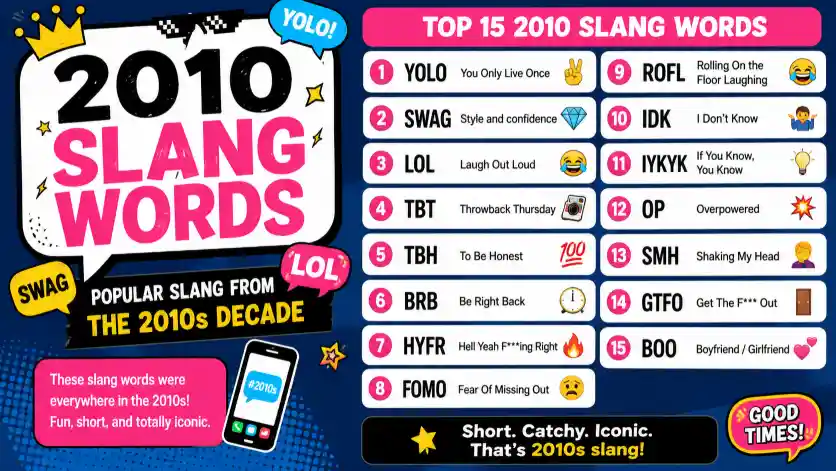
2010 slang words are informal terms that became popular around 2010 and the early 2010s. Many came from texting, social media, music, gaming, and youth culture.
The year 2010 was an interesting point in internet language. Facebook, Twitter, YouTube, and texting were becoming a bigger part of everyday life, while older chat shortcuts were still common.
As a result, people used a mix of short abbreviations, playful phrases, and terms that later became part of mainstream speech.
If you are trying to understand an old Facebook post, text message, meme, or conversation from that period, knowing these words can help. Some are still common today, while others now sound dated.
Quick Answer: 2010 Slang Words?
Popular 2010 slang words included YOLO, swag, bae, LOL, OMG, TMI, noob, epic, fail, and troll. Some were already used before 2010, but they became especially visible in online and youth culture during the early 2010s.
What Slang Was Popular in 2010?
Early 2010s slang mixed internet abbreviations with words from music, gaming, and social media. People often used these terms in texts, status updates, comments, and online conversations.
YOLO
YOLO stands for “You Only Live Once.” It became a popular phrase for taking a chance or doing something exciting.
Example:
“I’m going on the trip. YOLO.”
The phrase became strongly associated with early 2010s youth culture.
Swag
Swag was used to describe someone’s style, confidence, or cool appearance.
Example:
“He has serious swag.”
The word became widely popular through music and internet culture.
Bae
Bae was a casual term for a romantic partner or someone considered especially close.
Example:
“Going out with bae tonight.”
It became common in social media posts and text messages.
Epic
Epic was often used to describe something extremely impressive, exciting, or memorable.
Example:
“That concert was epic.”
The word was not new in 2010, but its casual internet use was very common.
Fail
Fail was used online to describe an embarrassing mistake or something that went badly.
Example:
“That was an epic fail.”
The expression became especially common in memes and viral internet content.
2010 Texting Slang
Texting in 2010 relied heavily on short abbreviations because people wanted to type messages quickly.
LOL
LOL means “laughing out loud.” It was used to show amusement or make a message feel lighter.
“That was so funny LOL.”
OMG
OMG means “Oh my God.” It was commonly used to show surprise, excitement, or shock.
“OMG, you won!”
TMI
TMI means “too much information.” People used it when someone shared an overly personal or unnecessary detail.
“You did not need to tell me that. TMI.”
IDK
IDK means “I don’t know.” It was one of the most common shortcuts in casual texting.
“IDK what time they are coming.”
BRB
BRB means “be right back.” It was used when someone temporarily left a chat.
“BRB, dinner is ready.”
These abbreviations were especially useful when texting was the main way people kept conversations moving on mobile phones.
2010 Internet Slang
Internet culture also created or spread terms that were closely connected with forums, memes, and online communities.
Troll
A troll was someone who deliberately posted something provocative or annoying to get a reaction from other users.
Example:
“Don’t reply to him. He’s just trolling.”
The word became especially useful as online discussions grew.
Noob
Noob referred to a new or inexperienced person, especially in gaming or online communities.
Example:
“I’m still a noob at this game.”
It was often used teasingly, although it could also be insulting.
Meme
A meme was an image, phrase, joke, or idea that spread online and was repeatedly adapted by users.
Example:
“That meme is everywhere.”
The term existed before 2010, but internet memes became a major part of online culture during this period.
Viral
Viral described online content that spread rapidly among many people.
Example:
“That video went viral overnight.”
The term became increasingly common as social media and video sharing platforms grew.
2010 Slang Words vs. Modern Slang
Some early 2010s slang still feels normal today, while other terms now sound dated.
| 2010 era term | Meaning | Today |
| LOL | Laughing out loud | Still common |
| OMG | Oh my God | Still common |
| IDK | I don’t know | Still common |
| BRB | Be right back | Less common |
| YOLO | You only live once | Recognizable, but dated |
| Swag | Style or confidence | Often feels dated |
| Bae | Romantic partner | Less dominant |
| Noob | Inexperienced person | Still used in gaming |
| Troll | Someone provoking others online | Still common |
| Epic fail | Very embarrassing mistake | Often feels dated |
Slang does not disappear at the same speed. Some terms become ordinary vocabulary, while others remain tied to a particular period.
Why Did 2010 Slang Become So Popular?
The growth of social media and mobile communication helped informal language spread quickly.
People were posting short updates, sending texts, sharing videos, and commenting online every day. Short expressions were useful because they saved time and fit small text boxes.
Music, television, gaming, and viral content also helped certain words move from small communities into mainstream conversation.
That is why 2010 slang is a mix of texting shortcuts, internet terms, gaming language, and youth expressions rather than one single style.
Were These Words Really New in 2010?
No. Many popular 2010 slang words existed before that year. The important point is that they became highly visible or widely used around the early 2010s.
For example, LOL, OMG, IDK, and BRB were already established online abbreviations. Likewise, words such as epic and troll have much older histories.
So, calling them “2010 slang words” does not mean every term was invented in 2010. It means these expressions were strongly associated with the language and online culture of that era.
2010 Slang Words in Social Media
Social media helped early 2010s slang reach a much larger audience. Facebook statuses, Twitter posts, YouTube comments, and online forums gave people new places to use short and playful expressions.
On Facebook
Facebook users often mixed everyday language with abbreviations such as LOL, OMG, IDK, and TMI.
Example:
“OMG, that picture is hilarious LOL.”
On Twitter
Twitter’s short post format encouraged brief expressions and abbreviations. Terms such as YOLO and swag were often used in casual posts.
On YouTube
YouTube comments helped spread words such as epic, fail, troll, and viral.
The exact slang depended on the community, so not every term was equally common among all users.
2010 Slang in Gaming
Gaming communities had their own vocabulary, much of which was already established before 2010.
Noob
A noob was a new or inexperienced player.
“I’m still a noob at this game.”
Pwned
Pwned was internet and gaming slang meaning someone had been defeated or dominated.
“You just got pwned.”
The spelling was often intentionally different from owned, which helped give the term its online identity.
GG
GG means “good game.” Players used it at the end of a match.
“GG, everyone.”
It could be sincere or, depending on the situation, sarcastic.
2010 Slang From Pop Culture
Music and entertainment also influenced the language of the early 2010s. Words that appeared in songs, interviews, memes, and celebrity culture could quickly become familiar to younger audiences.
Swag
Swag became strongly associated with style and confidence.
YOLO
YOLO became a popular way to justify a bold or spontaneous choice.
Bae
Bae became a popular affectionate term for a romantic partner.
These expressions were often used jokingly online, especially in captions and status updates.
Which 2010 Slang Words Sound Dated?
Some terms from 2010 are still understood but may sound old fashioned or strongly tied to early internet culture.
Words such as YOLO, swag, and epic fail are recognizable today, but using them seriously can make a speaker sound like they are copying early 2010s internet culture.
Other terms, including LOL, OMG, IDK, and troll, remain widely understood.
The difference shows how slang changes. A word can survive while its original style or popularity fades.
When Should You Use 2010 Slang?
Use early 2010s slang when you want to recreate the language or humor of that period. It can work well in nostalgic posts, fictional dialogue, historical content, or jokes about early social media culture.
For everyday communication, however, some terms may sound dated.
If your goal is to sound natural in modern English, use these expressions only when they genuinely fit the conversation.
Common Mistakes About 2010 Slang
Assuming every term started in 2010
Many expressions were older. The year mainly represents a period when they were highly visible.
Treating all slang as American
Early 2010s internet language spread across countries. Users from different English speaking regions adopted and adapted terms differently.
Assuming old slang disappeared completely
Some expressions changed from trendy slang into normal internet vocabulary.
Thinking every term had one meaning
Words such as lit, epic, and troll could change meaning based on context and community.
Frequently Asked Questions
Q1. What were popular slang words in 2010?
Answer: Popular terms included YOLO, swag, bae, LOL, OMG, TMI, noob, epic, fail, and troll.
Q2. What did YOLO mean in 2010?
Answer: YOLO meant “You Only Live Once.” It was commonly used when someone wanted to justify taking a chance or doing something exciting.
Q3. What did swag mean in 2010?
Answer: Swag described someone’s style, confidence, or cool appearance. It was especially popular in youth and music culture.
Q4. Was bae popular in 2010?
Answer: Bae became increasingly popular during the early 2010s and was commonly used online as a casual term for a romantic partner or loved one.
Q5. What texting slang was popular around 2010?
Answer: Common texting abbreviations included LOL, OMG, IDK, BRB, and TMI. They helped people communicate quickly in casual messages.
Q6. Is 2010 slang still used today?
Answer: Some terms remain common, especially LOL, OMG, IDK, and troll. Others, such as YOLO and swag, are more strongly associated with the early 2010s.
Conclusion
2010 slang words reflect a major period in the growth of internet and mobile communication. Expressions such as LOL, OMG, YOLO, swag, bae, noob, and troll appeared across texting, gaming, social media, and pop culture.
Not every term was invented in 2010. Instead, many were already developing and became especially visible during the early 2010s.
Some survived and became ordinary parts of online English. Others now mainly bring back the feel of early social media. That difference makes 2010 slang useful for understanding how internet language changes over time.
Explore More Articles:

Hi, I’m Anna Whitmore. I have 7+ years of experience writing about English slang and vocabulary. At SlangShine, I create simple, easy-to-understand content for English learners.