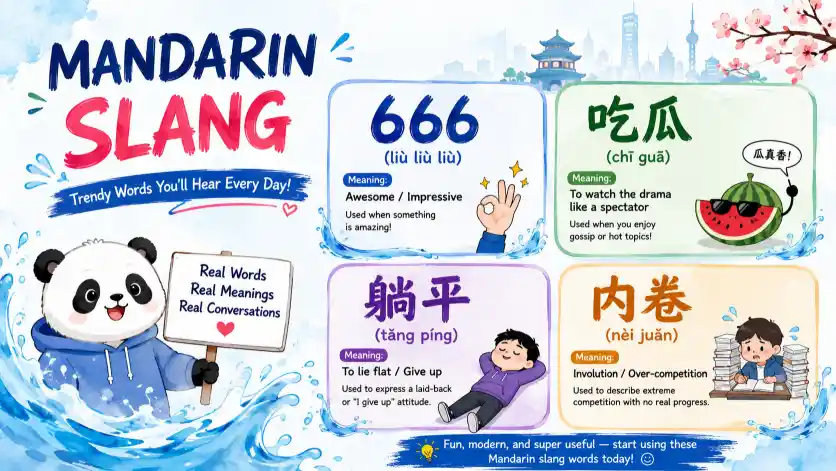
Mandarin slang refers to informal words and expressions used by Mandarin Chinese speakers in everyday conversations, social media, texting, and online communities.
These words are different from formal Mandarin and often reflect modern culture, humor, and internet trends.
Many English speakers search for Mandarin slang before traveling to China, learning Chinese, chatting with native speakers, or watching Chinese videos online.
While textbooks teach standard Mandarin, real conversations often include slang that you may not recognize in a classroom.
In this guide, you’ll learn what Mandarin slang is, where it is commonly used, how it differs from standard Mandarin, and some of the most popular slang expressions with simple English explanations.
Quick Answer:
Mandarin slang is informal Chinese language used in casual conversations instead of standard or formal Mandarin. It includes modern words, internet expressions, texting shortcuts, and popular phrases that are widely understood by native speakers.
What Makes Mandarin Slang Different from Standard Mandarin?
Standard Mandarin follows grammar and vocabulary taught in schools, while Mandarin slang is more casual and changes over time.
Friends, classmates, gamers, and social media users often choose slang because it sounds more natural in everyday conversation.
For example:
- Standard Mandarin is common in classrooms and business settings.
- Mandarin slang is common among friends and online communities.
Many slang words become popular because of memes, television shows, livestreams, or social media trends.
Where Is Mandarin Slang Commonly Used?
Most Mandarin slang appears in informal situations where people communicate quickly and naturally.
Text Messages
Friends often use short slang expressions when chatting on their phones.
These phrases save time and make conversations feel more relaxed.
Social Media
Many slang terms spread through short videos, comments, and online discussions.
Popular expressions can become widely recognized within weeks.
Gaming Communities
Online games encourage fast communication, so players often use slang instead of longer phrases.
Gamers may also create new expressions that later become popular outside gaming.
Everyday Conversations
Native speakers regularly use casual expressions while talking with friends or family.
The exact slang depends on age, region, and the situation.
Why Do Mandarin Slang Words Change So Quickly?
Mandarin slang changes because internet culture changes quickly.
A popular phrase may appear after:
- A viral video
- A funny meme
- A television show
- A celebrity interview
- A gaming trend
- A social media challenge
Some expressions stay popular for years, while others disappear after only a few months.
This is one reason Mandarin learners continue discovering new slang every year.
Common Mandarin Slang Words
| Mandarin Slang | Pinyin | English Meaning | Common Use |
| 666 | Liù liù liù | Awesome, impressive | Praising someone’s skills or success |
| 吃瓜 | Chī guā | Watching gossip | Following drama without getting involved |
| 躺平 | Tǎng píng | Lie flat | Choosing a low-pressure lifestyle |
| 内卷 | Nèi juǎn | Involution | Describing unhealthy competition |
| 加油 | Jiā yóu | You can do it | Encouragement or support |
| 牛 | Niú | Amazing, awesome | Complimenting someone or something |
| 给力 | Gěi lì | Cool, effective | Saying something is impressive or helpful |
| 菜鸟 | Cài niǎo | Newbie | Referring to a beginner |
| 摸鱼 | Mō yú | Slacking off | Avoiding work or taking it easy |
| 真香 | Zhēn xiāng | I changed my mind | Admitting your opinion has changed |
| YYDS | Yǒng yuǎn de shén | GOAT | Praising someone as the best |
| 萌 | Méng | Cute | Describing someone or something adorable |
Are All Mandarin Slang Words Internet Slang?
No. Some slang is much older than the internet.
Certain expressions have been part of spoken Mandarin for many years.
Others were created online and later became part of everyday speech.
Because of this, Mandarin slang includes both:
- Traditional informal expressions
- Modern internet slang
This mix makes the language interesting for learners.
Is Mandarin Slang the Same Everywhere?
No. Mandarin slang can vary across different Chinese-speaking communities.
Age also plays an important role.
For example:
- Teenagers may use newer internet slang.
- Older adults may prefer traditional informal expressions.
- Online gamers may know slang that many other people never use.
Some expressions become popular nationwide, while others remain common only in certain communities or during a particular trend.
For learners, understanding the general meaning is usually more important than memorizing every new slang word.
Word at a Glance
| Feature | Details |
| Language | Mandarin Chinese |
| Used in | Casual conversations, texting, gaming, social media |
| Formal or informal | Informal |
| Common users | Friends, students, gamers, online creators |
| Changes over time | Yes |
| Suitable for business writing | Usually no |
Can Non Native Speakers Use Mandarin Slang?
Yes, but you should learn the meaning and context first. Using slang correctly can make conversations feel more natural. However, using the wrong expression or saying it at the wrong time may confuse people.
If you are learning Mandarin, start with common slang that is widely understood. As your skills improve, you can learn newer expressions that appear online.
Should You Use Mandarin Slang in Formal Situations?
Usually, no. Mandarin slang is best for casual conversations, not professional communication.
Use standard Mandarin when speaking with:
- Teachers
- Employers
- Business clients
- Government offices
- Formal events
Slang is more appropriate when chatting with friends, classmates, or people who know informal language.
| Situation | Use Mandarin Slang? |
| Chatting with friends | ✅ Yes |
| Text messages | ✅ Yes |
| Social media comments | ✅ Yes |
| Gaming | ✅ Yes |
| Business meeting | ❌ No |
| School presentation | ❌ No |
How Can You Learn Mandarin Slang Naturally?
The best way is to see how native speakers use it in real conversations.
Helpful ways to learn include:
Watch Chinese Videos
Short videos often include modern slang that younger speakers use every day.
Read Social Media Comments
Comments can help you understand how slang fits into natural conversations.
Talk with Native Speakers
Friendly conversations teach you when a slang word sounds natural and when it does not.
Learn the Context
Instead of memorizing long lists, focus on how and when each expression is used.
Common Mistakes English Speakers Make
Translating Every Word Literally
Many Mandarin slang expressions do not make sense when translated word for word.
For example, 吃瓜 literally means “eat melon,” but native speakers understand it as watching gossip without getting involved.
Using Slang Too Early
Learning a few common expressions is helpful, but relying only on slang can make conversations confusing.
Build a strong foundation in standard Mandarin first.
Assuming Every Slang Word Is Popular
Internet trends change quickly. Some expressions become outdated after a short time, while others remain common for years.
Is Mandarin Slang Still Changing?
Yes. New slang appears every year.
Online culture has made Mandarin slang change faster than ever. Viral videos, livestreams, games, and social media discussions regularly introduce new expressions.
At the same time, many older slang terms remain popular because people continue using them in everyday conversations.
Learning both classic and modern slang will help you understand a wider range of conversations.

Why Do People Use This Slang?
People use Mandarin slang because it makes conversations feel relaxed, expressive, and natural.
Slang can:
- Save time while typing
- Add humor to conversations
- Express emotions more clearly
- Build a sense of community
- Reflect current trends
For many native speakers, slang is simply part of everyday communication with friends and online communities.
Frequently Asked Questions
Q1. What is Mandarin slang?
Answer: Mandarin slang is informal Chinese language used in casual conversations, texting, gaming, and social media instead of formal Mandarin.
Q2.Is Chinese slang different from Standard Mandarin?
Answer: Yes. Standard Mandarin is used in formal settings, while slang is more relaxed and common among friends and online communities.
Q3. Can beginners learn Chinese slang?
Answer: Yes. Beginners can start with common expressions, but learning standard Mandarin first makes slang easier to understand and use correctly.
Q4. Is Mandarin slang used across all Chinese-speaking regions?
Answer: Many slang terms are widely recognized, but some are more common in certain communities, age groups, or online platforms.
Q5. Should I use Mandarin slang at work?
Answer: No. Standard Mandarin is the better choice for business, school, and other formal situations.
Q6. Why does Mandarin slang change so often?
Answer: Social media, online trends, entertainment, and gaming introduce new expressions quickly, causing slang to evolve over time.
Conclusion
Mandarin slang helps you understand how native speakers communicate in everyday life. While formal Mandarin is important for school, work, and official situations, slang gives you a better understanding of casual conversations, social media, and online culture.
If you are new to Mandarin, begin with a few common expressions and pay attention to how native speakers use them.
Learning the context behind each phrase is more valuable than memorizing long vocabulary lists. As trends change, your understanding of Mandarin slang will continue to grow.
Read More Articles:

Hi, I’m Anna Whitmore. I have 7+ years of experience writing about English slang and vocabulary. At SlangShine, I create simple, easy-to-understand content for English learners.