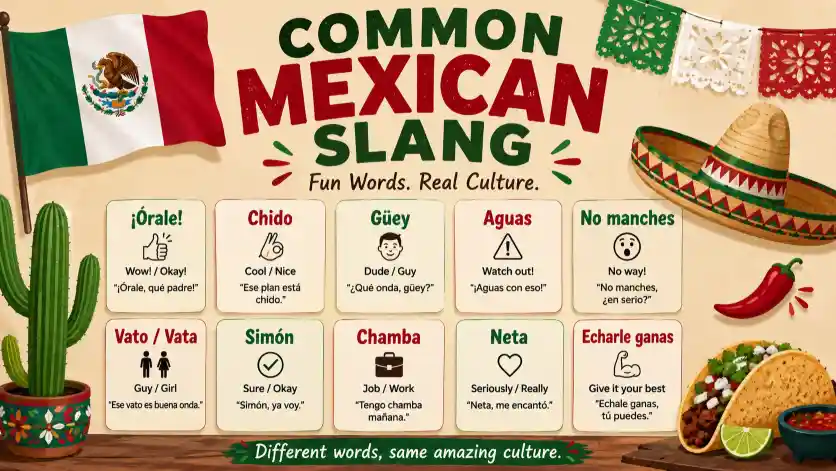
Common Mexican Slang refers to the informal, everyday words and expressions used across Mexico that often differ from standard Spanish taught in textbooks.
Common Mexican slang includes informal words and phrases that people in Mexico use in everyday conversations. Popular examples include güey, órale, chido, no manches, and neta.
These expressions make conversations sound more natural, but their meanings can change depending on the situation and tone.
If you are learning Spanish, planning to visit Mexico, or watching Mexican movies and TV shows, understanding common Mexican slang can help you follow real conversations with confidence.
In this guide, you will learn the meanings of the most popular Mexican slang words, where they are used, if they are polite or rude, and how to use them correctly.
Quick Answer: Common Mexican Slang
Common Mexican slang refers to informal words and expressions used in Mexico during everyday conversations. Popular examples include güey (dude), órale (come on, wow, or let’s go), chido (cool), no manches (no way), and neta (really or honestly).
What Is Common Mexican Slang?
Common Mexican slang is the informal language people use with friends, classmates, family members, and coworkers in casual situations.
These words are not usually taught in beginner Spanish classes. However, they are very common in daily life throughout Mexico.
Learning them can help you:
- Understand native speakers
- Watch Mexican TV shows
- Follow social media posts
- Enjoy Mexican music
- Have more natural conversations
Most Common Mexican Slang Words
Güey
Güey (sometimes written as wey) is one of the most popular Mexican slang words.
It usually means “dude,” “mate,” or “guy.”
Friends often use it when talking to each other.
Example:
Carlos: Güey, where have you been?
Miguel: I just got here.
Meaning: Carlos is saying, “Dude, where have you been?”
Órale
Órale is a very flexible Mexican expression.
Depending on the situation, it can mean:
- Come on!
- Let’s go!
- Wow!
- Okay!
Example:
Friend: We’re leaving now.
Reply: Órale!
Meaning: “Okay, let’s go!”
Chido
Chido means “cool,” “awesome,” or “great.”
People use it to describe something they like.
Example:
Friend: Your new shoes look chido.
Meaning: Your shoes look cool.
No Manches
No manches is one of the best known Mexican expressions.
People often say it when they are surprised or cannot believe something.
It usually means:
- No way!
- You’re kidding!
- Seriously?
Example:
Friend: I won free concert tickets.
Reply: No manches!
Meaning: “No way!”
Neta
Neta means “really,” “honestly,” or “the truth.”
It is often used to ask if something is true or to show honesty.
Example:
Friend: Neta? You met the actor?
Reply: Yes!
Meaning: “Really?”
Are These Words Used Everywhere in Mexico?
Most of these expressions are understood across Mexico.
However, some regions may use certain words more often than others.
For example:
| Slang Word | Common Meaning | Used Across Mexico? |
| Güey | Dude, guy | Yes |
| Órale | Come on, wow, okay | Yes |
| Chido | Cool | Yes |
| No manches | No way | Yes |
| Neta | Really, honestly | Yes |
You may also hear local slang that is only common in a particular city or state.
Are These Words Formal?
No.
These are informal expressions.
They are best used with:
- Friends
- Family
- Classmates
- Casual conversations
They are usually not appropriate in:
- Job interviews
- Business meetings
- School essays
- Professional emails
- Official documents
In formal situations, standard Spanish is the better choice.
More Common Mexican Slang Words
Mexico has many slang words that people use every day. Here are some of the most common ones.
Lana
Lana means money.
It is one of the most popular informal words for cash.
Example:
Friend: I don’t have enough lana today.
Meaning: I don’t have enough money today.
Feria
Feria is another informal word for money.
In some situations, it can also mean small change.
Example:
Customer: Do you have feria?
Meaning: Do you have any change?
Chela
Chela means beer.
Friends often use this word when making plans.
Example:
Friend: Let’s grab a chela after work.
Meaning: Let’s have a beer after work.
Padre
Although padre normally means father, it also means cool, great, or excellent in Mexican slang.
Example:
Friend: That concert was padre.
Meaning: The concert was great.
Ahorita
Ahorita literally means “right now.” However, in Mexico, it can have different meanings depending on the situation.
It may mean:
- Right now
- In a little while
- Soon
The speaker’s tone usually makes the meaning clear.
Example:
Mom: Can you help me?
Son: Ahorita.
Meaning: I’ll help you soon.
Where Is Common Mexican Slang Used?
You can hear common Mexican slang almost everywhere in daily life.
People often use it in:
- Conversations with friends
- Family gatherings
- School
- College
- Sports
- Social media
- Text messages
These expressions make conversations sound friendly and natural.
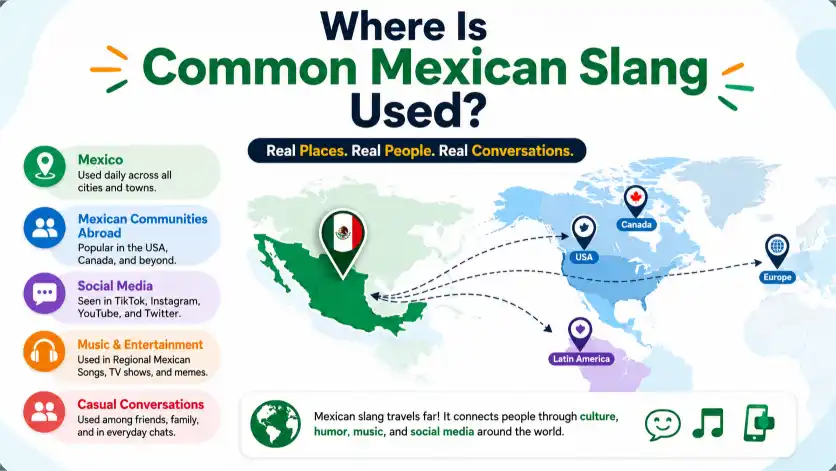
On TikTok
Many Mexican creators use slang in short videos.
Words like güey, órale, and no manches appear in comedy videos, reactions, and daily vlogs.
On Instagram
Instagram captions and comments often include slang to make posts feel more relaxed.
For example:
“Qué chido!”
This simply means “How cool!”
In Text Messages
Mexican slang is very common in texting.
Example:
Friend: Güey, where are you?
Reply: Ahorita llego.
Meaning: Dude, I’m arriving soon.
In Everyday Conversations
You will hear these expressions in shops, restaurants, schools, and homes across Mexico.
They help conversations sound natural and friendly.
Is Common Mexican Slang Rude, Offensive, or Harmless?
Most common Mexican slang is harmless when used with the right people.
However, the tone and situation matter.
Friendly Use
Many words are used between close friends.
For example:
- Güey
- Chido
- Órale
- Neta
These usually sound friendly.
Words That Need Care
Some slang can sound rude if you use it with strangers or older people.
For example, güey may sound disrespectful in a formal conversation, even though friends use it every day.
It is always a good idea to learn the relationship between the speakers before copying their slang.
Can You Use Mexican Slang at Work?
Usually, no.
Most slang belongs in casual conversations.
Avoid using it in:
- Business emails
- Job interviews
- School assignments
- Professional meetings
- Official presentations
In these situations, standard Spanish is a better choice.
Quick Comparison Table
| Slang | Meaning | Common Situation | Formal? |
| Güey | Dude, guy | Friends | No |
| Órale | Okay, come on, wow | Casual conversation | No |
| Chido | Cool, great | Everyday speech | No |
| No manches | No way | Surprise | No |
| Neta | Really, honestly | Casual conversation | No |
| Lana | Money | Friends | No |
| Feria | Money or change | Everyday speech | No |
| Chela | Beer | Social gatherings | No |
| Padre | Cool, great | Casual conversation | No |
| Ahorita | Right now or soon | Daily conversation | No |
Real Life Examples of Common Mexican Slang
The best way to learn common Mexican slang is to see how people use it in real conversations.
Example 1: Meeting a Friend
Carlos: Güey, it’s been a long time!
Miguel: I know! It’s great to see you.
Meaning: Güey means “dude” or “mate.”
Example 2: Talking About Money
Friend: I don’t have enough lana for the movie.
Reply: Don’t worry. I’ll pay.
Meaning: Lana means money.
Example 3: Showing Surprise
Friend: I won two concert tickets.
Reply: No manches!
Meaning: “No way!”
Example 4: Giving a Compliment
Friend: Do you like my new bike?
Reply: Está bien chido.
Meaning: “It’s really cool.”
Example 5: Making Plans
Friend: Want to grab a chela later?
Reply: Sure, let’s go.
Meaning: Chela means beer.
Example 6: Asking if Something Is True
Friend: I’m moving to Mexico City next month.
Reply: ¿Neta?
Meaning: “Really?”
Origin and History of Mexican Slang
Mexican slang has developed over many generations.
It is influenced by:
- Everyday conversations
- Regional traditions
- Indigenous languages
- Music
- Television
- Movies
- Social media
Some expressions, such as órale and güey, have been used for decades and are now recognized across much of Mexico.
New slang continues to appear online, especially on TikTok, Instagram, and other social platforms. At the same time, many classic expressions remain popular in everyday speech.
Similar Spanish Expressions
Some Mexican slang words have similar expressions in other Spanish speaking countries.
| Mexican Slang | Similar Meaning | Common in Other Countries |
| Güey | Dude, mate | Similar words exist, but güey is strongly linked to Mexico |
| Chido | Cool | Other countries may use bacán, chévere, or genial |
| No manches | No way | Many countries use different expressions with the same meaning |
| Neta | Really, honestly | Other regions often say de verdad or en serio |
| Chela | Beer | Some countries use different slang names for beer |
The meaning may stay the same, but the slang often changes from one country to another.
When Should You Avoid Using Mexican Slang?
Although common Mexican slang is popular, it is not suitable in every situation.
Avoid using slang in:
- Business meetings
- Job interviews
- School essays
- Professional emails
- Government offices
- Formal presentations
It is also best to avoid slang if you are speaking with someone who may not understand informal Mexican Spanish.
Polite Alternatives
If you want to sound more formal, try these standard Spanish words.
| Mexican Slang | Polite Alternative |
| Güey | Amigo (friend) |
| Chido | Excelente or Muy bueno |
| No manches | No puede ser |
| Neta | De verdad |
| Lana | Dinero |
| Chela | Cerveza |
These words work well in professional, academic, and respectful conversations.
Common Misunderstandings
Many Spanish learners make the same mistakes when learning common Mexican slang.
All Spanish Speakers Use Mexican Slang
This is not true.
People in Spain, Argentina, Colombia, Chile, and other countries often use different slang words.
Güey Is Always Rude
Not always.
Among friends, güey is usually friendly.
However, using it with strangers or in formal situations may sound disrespectful.
Ahorita Always Means Right Now
Not necessarily.
In Mexico, ahorita can mean right now, very soon, or in a little while.
The meaning depends on the speaker and the situation.
Mexican Slang Never Changes
This is also incorrect.
Some classic expressions have existed for many years, while new slang appears regularly through music, social media, and online culture.
Why Do People Use Common Mexican Slang?
People use common Mexican slang because it makes conversations sound natural, friendly, and relaxed.
These expressions help speakers:
- Talk casually with friends
- Express emotions quickly
- Sound like native speakers
- Understand movies and TV shows
- Enjoy music and social media
- Connect with Mexican culture
Many slang words are part of daily life, so learning them can make spoken Spanish much easier to understand.
Frequently Asked Questions
Q1. What is the most common Mexican slang word?
Answer: One of the most common Mexican slang words is güey (or wey). It usually means “dude,” “mate,” or “guy” and is widely used in casual conversations.
Q2. What does órale mean?
Answer: Órale is a flexible Mexican expression. Depending on the situation, it can mean “okay,” “come on,” “let’s go,” or “wow.”
Q3. What does no manches mean?
Answer: No manches is a popular expression that usually means “No way!”, “You’re kidding!”, or “I can’t believe it!” It is often used to show surprise.
Q4. What does chido mean?
Answer: Chido means “cool,” “awesome,” or “great.” People use it to describe something they really like.
Q5. Is Mexican slang rude?
Answer: Most Mexican slang is friendly when used with friends or family. However, some expressions, such as güey, may sound disrespectful in formal situations or when speaking to strangers.
Q6. Can I use Mexican slang at work?
Answer: It is better not to. Use standard Spanish in business meetings, professional emails, school assignments, and other formal settings.
Q7. Is Mexican slang the same as Spanish slang from Spain?
Answer: No. Mexico and Spain share the same language, but many slang words are different. Each country has its own informal expressions.
Q8. Is Mexican slang still changing?
Answer: Yes. New slang appears through music, social media, and younger generations, while many classic expressions like güey, órale, and chido remain popular.
Conclusion
Common Mexican slang helps you understand how people really speak in Mexico. Popular expressions such as güey, órale, chido, no manches, neta, lana, and chela are heard every day in conversations, text messages, movies, and social media.
While these words make casual conversations sound more natural, they are best used with friends and in informal settings. In professional or academic situations, standard Spanish is the better choice.
By learning the meaning, tone, and context of common Mexican slang, you will understand native speakers more easily and communicate with greater confidence when speaking or listening to Mexican Spanish.
Discover More Articles:

Hi, I’m Emma Carter, an English language writer with over 8 years of experience in vocabulary and language learning. At SlangShine, I write simple, accurate, and easy-to-understand articles about slang, synonyms, idioms, and everyday English to help learners build confidence and improve their communication skills.