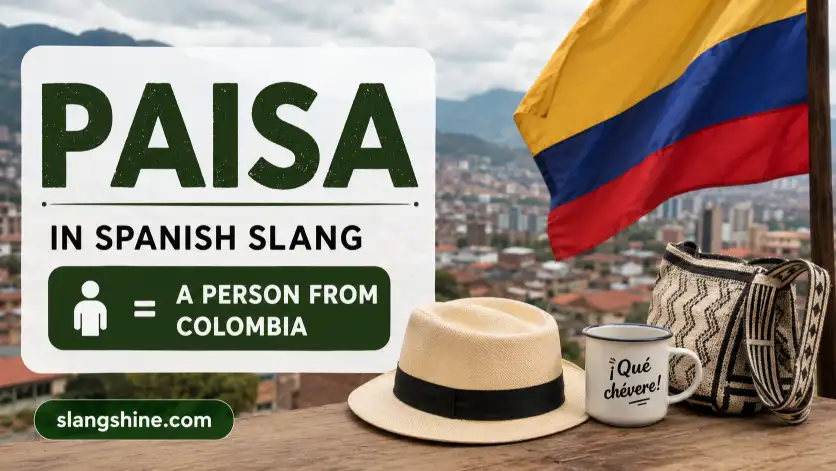
Paisa meaning Spanish slang can be confusing because the word does not have exactly the same meaning in every Spanish-speaking country.
If you have seen paisa in a Colombian video, TikTok comment, Spanish conversation, or travel post, you may be wondering if it means “Colombian,” “friend,” or something else.
In Colombia, paisa is strongly associated with people from Antioquia and the wider Paisa cultural region.
However, paisa also has other regional meanings in Latin America. The word is documented as a shortened form of paisano, and its meaning depends on where and how it is used.
This guide explains paisa meaning Spanish slang in simple English, including its full form, Colombian meaning, use in conversations, and the difference between paisa, paisano, and colombiano.
Quick Answer: Paisa Meaning Spanish Slang
Paisa is a regional Spanish term that can mean someone from the same place or community. In Colombia, it commonly refers to a person from Antioquia and the broader Paisa region.
What Does Paisa Mean in Spanish Slang?
The meaning of paisa changes according to the country and context.
In Colombia, paisa is most strongly connected with Antioquia and the Paisa regional identity.
ASALE’s Diccionario de Americanismos specifically records the Colombian meaning as a person native to the department of Antioquia.
In other parts of Latin America, the word can have a broader meaning. It may refer to someone who comes from the same place as another person.
In some regional uses, it can also mean a close friend or inseparable companion.
This is why translating paisa with one English word can sometimes give the wrong impression.
For example:
“Él es colombiano.”
Means:
“He is Colombian.”
But:
“Él es paisa.”
Can mean:
“He is Paisa.”
The second statement gives more specific regional information.
Not every Colombian is Paisa. Colombia has many regional identities, so colombiano is a national identity, while paisa is a more specific regional or cultural label.
What Is the Paisa Full Form?
There is no “full form” of paisa in the way there is for an internet acronym such as LOL or BRB.
Instead, paisa is an apócope of paisano, meaning it developed as a shortened form of that word. ASALE directly identifies paisa as a shortened form of paisano.
The word paisano is connected with the idea of someone from the same place or community. Over time, paisa developed different regional uses throughout Latin America.
So, if you are searching for “what does paisa stand for?”, the most accurate short answer is:
Paisa is a shortened form of paisano, but its meaning depends on regional usage.
It is therefore better to explain the context than to give paisa one fixed definition.
Origin and History of “Paisa”
The history of paisa in Spanish slang is closely connected to the Spanish word paisano, which refers to someone from the same country, region, or community.
Paisa developed as a shortened form of paisano, and its meaning became more specialized in different parts of Latin America.
In Colombia, the word became strongly associated with Antioquia and the wider Paisa cultural region.
Over time, paisa became more than a shortened form of paisano. It developed into a recognizable regional identity connected with local culture, traditions, speech, and community.
This is why the Colombian use of paisa should not simply be translated as “Colombian.” Colombian refers to nationality, while Paisa identifies a more specific regional and cultural connection.
The word also has other documented regional meanings in Latin America. In some countries, paisa can refer to someone from the same place or community, while certain regional varieties use it for a close friend or companion.
Because these meanings developed in different Spanish-speaking communities, there is no single definition of paisa that works in every country.
The speaker’s location and the surrounding conversation are important for understanding which meaning is intended.
Why Did “Paisa” Become a Regional Identity?
In Colombia, regional identity has an important role in everyday language. People may identify themselves through their city, department, accent, traditions, food, and cultural background.
For people connected with the Paisa region, paisa became a convenient way to express that shared identity.
For example:
“Soy paisa.”
Can communicate more than simply:
“Soy colombiano.”
The first statement gives a sense of regional and cultural belonging, while the second only identifies the person’s nationality.
In short, Paisa evolved from a shortened form of paisano into a regional identity term with particularly strong cultural significance in Colombia.
Why Do Colombians Say “Paisa”?
Colombians use paisa as a regional identity term, particularly for people connected with Antioquia.
Saying:
“Soy paisa.”
Means:
“I am Paisa.”
Here, the speaker is identifying with a regional and cultural background rather than simply saying they are Colombian.
You may also see:
“Los paisas”
Which means:
“The Paisas.”
This plural form is commonly used when talking about Paisa people as a group.
The word can appear in conversations about Antioquia, Medellín, Colombian culture, food, traditions, regional accents, and local expressions.
However, it is important not to simplify the term to “Colombian.” Paisa is more specific than Colombian, and using it for every person from Colombia would be inaccurate.
What Does “Paisa Girl” Mean?
If you see “paisa girl” online, it usually means a girl or woman who is Paisa, particularly someone connected with the Paisa region of Colombia.
For example:
“She is a Paisa girl from Medellín.”
The basic meaning is that she is a woman associated with the Paisa regional identity.
The phrase does not automatically mean “girlfriend,” “beautiful girl,” or another romantic expression.
Social media can sometimes give ordinary regional terms extra meanings, but paisa girl itself is not a separate slang expression with one fixed romantic definition.
The tone depends on the surrounding conversation. Someone might use it simply to describe a woman’s background, while another person could use it in a friendly, affectionate, or romantic way.
So when you see “paisa girl,” focus first on the regional meaning before assuming there is a hidden romantic meaning.
Is Paisa a Slur?
Paisa is not inherently a slur.
In Colombian usage, it is a regional identity term associated with Antioquia. ASALE also records neutral or informal meanings in other countries, including someone from the same place and, in some areas, a close friend or companion.
For example:
“Soy paisa.”
is simply a statement about regional identity.
However, context and tone can change how almost any label is received. If someone uses paisa sarcastically, aggressively, or alongside an insulting stereotype, the interaction may become offensive.
That does not make the word itself a slur.
A good rule is to use Paisa as a regional or cultural description rather than turning it into a stereotype.
Does Paisa Mean Money in Spanish?
No. The Spanish regional term paisa and the South Asian word paisa are different words.
This is an especially common source of confusion because they have the same spelling.
In Hindi and Urdu, paisa is associated with money. In Spanish, paisa has documented regional meanings connected with people, place, community, and identity.
For example:
“Mi amigo es paisa.”
In Spanish, this does not mean:
“My friend is money.”
It refers to the person’s regional or community identity.
The spelling is similar, but the meanings and linguistic origins are different.
Is Paisa the Same as Paisano?
Paisa and paisano are closely related, but they are not always interchangeable.
The connection is important because ASALE identifies paisa as a shortened form of paisano.
| Term | Basic meaning |
| Paisa | Regional or community identity; meaning varies by country |
| Paisano | Someone connected with the same place or community |
| Colombiano | A person from Colombia |
| Medellinense | A person from Medellín |
The difference becomes especially useful when discussing Colombia.
Someone can be both Colombian and Paisa. But someone being Colombian alone does not tell you that they are Paisa.
For example:
“Soy colombiano.”
Means:
“I am Colombian.”
While:
“Soy paisa.”
provides additional regional information.
This distinction helps avoid one of the most common misunderstandings about the word.
Does Paisa Mean “Friend”?
Sometimes, but not everywhere.
ASALE records paisa as meaning a close friend or inseparable companion in certain regional varieties, including uses documented in Mexico, Panama, Puerto Rico, Ecuador, Peru, and Cuba.
That means you should not automatically translate every occurrence of paisa as “friend.”
For example, in a Colombian context:
“Ella es paisa.”
Is generally about regional identity.
In another Spanish-speaking context, the same word may have a different local meaning.
The speaker’s country and the surrounding sentence are essential for interpreting paisa correctly.
What Does Paisa Mean in Different Countries?
One of the biggest mistakes when explaining paisa meaning Spanish slang is treating it as though the word has one universal definition.
Its documented meanings vary by region.
| Context | Possible meaning |
| Colombia | Person native to Antioquia / Paisa regional identity |
| Several Latin American countries | Person from the same place or community |
| Some regional uses | Close friend or companion |
| Other local contexts | Meaning may depend on regional usage |
So the statement “paisa always means Colombian” is too broad.
If you encounter the word in a Spanish post, first consider who is speaking, where they are from, and what the surrounding sentence says.
How Is “Paisa” Used in Real Conversations?
The meaning of paisa becomes easier to understand when you see it in context. In Colombian Spanish, it is commonly connected with regional identity, while in other Spanish-speaking communities it may have a different local meaning.
The tone can be neutral, friendly, casual, or informal depending on the speaker and situation.
Friendly Example
“Mi amigo es paisa y vive en Medellín.”
Meaning: “My friend is Paisa and lives in Medellín.”
Here, paisa simply describes the person’s regional background.
Casual Example
“Soy paisa, pero ahora vivo en Bogotá.”
Meaning: “I’m Paisa, but I live in Bogotá.”
The speaker is explaining their regional identity while also saying where they currently live.
Social Media Example
“Los paisas siempre tienen algo bueno que decir.”
Meaning: “Paisas always have something good to say.”
Here, paisas refers to a group of people associated with the Paisa identity. The exact tone depends on the rest of the post.
Cultural Example
“Quiero conocer más sobre la cultura paisa.”
Meaning: “I want to learn more about Paisa culture.”
In this sentence, paisa describes a regional culture rather than a specific person.
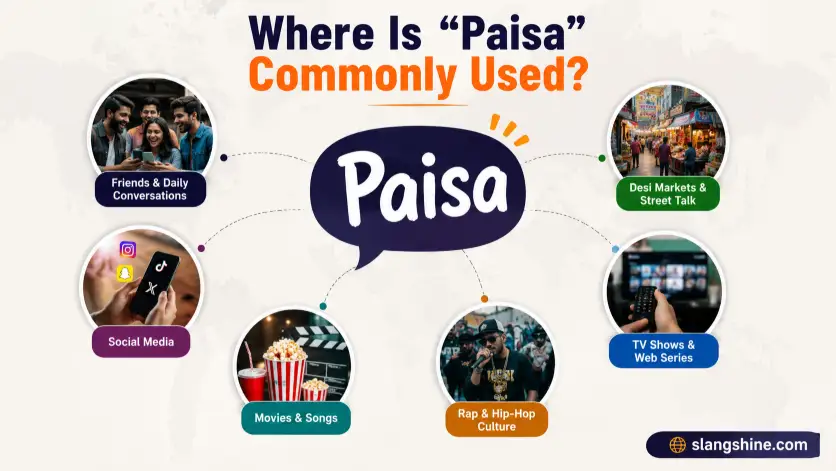
Where Is “Paisa” Commonly Used?
You can encounter paisa in everyday Spanish, especially in conversations involving Colombian regional identity.
Online, the word may appear in:
- WhatsApp and text conversations
- TikTok captions and comments
- Instagram posts
- YouTube videos about Colombia
- Travel discussions
- Colombian culture content
- Conversations about Medellín and Antioquia
- Spanish-learning communities
- Discussions about Colombian food, accents, and traditions
Social media can make the word especially visible because people often discuss where they are from, regional accents, local traditions, and cultural identity.
However, seeing paisa online does not automatically mean the speaker is Colombian. Always consider the country and context before deciding what the word means.
Is “Paisa” the Same as “Paisa Spanish”?
No. Paisa and Paisa Spanish refer to different things.
Paisa can describe a person or regional identity.
Paisa Spanish refers to the variety of Spanish associated with the Paisa region.
For example:
“He is Paisa.”
describes a person’s regional identity.
But:
“She is learning Paisa Spanish.”
refers to a regional variety of Spanish.
Paisa Spanish is associated with particular pronunciation, vocabulary, expressions, and speech patterns.
It should not be treated as exactly the same thing as all Colombian Spanish, because Colombia has many different regional varieties.
Is Every Colombian a Paisa?
No.
This is one of the most important points to understand about paisa meaning Spanish slang.
Colombiano is a national identity. Paisa is a more specific regional and cultural identity.
For example:
“Soy colombiano.”
Means:
“I am Colombian.”
This tells you the person’s nationality but does not tell you which region they identify with.
On the other hand:
“Soy paisa.”
gives additional regional information.
Someone can therefore be Colombian and Paisa at the same time, but it would be inaccurate to assume that every Colombian is Paisa.
Colombia has many regional cultures and identities, so a person’s nationality alone is not enough to determine their regional label.
Paisa vs. Antioqueño
Paisa and Antioqueño are closely related, but they are not exactly the same word. Both can describe someone connected with Antioquia, but paisa has a broader regional and cultural meaning, while antioqueño directly identifies a person or thing associated with the department of Antioquia.
What Does “Antioqueño” Mean?
Antioqueño is the standard Spanish adjective and noun associated with Antioquia, a department of Colombia.
For example:
“Él es antioqueño.”
Meaning: “He is from Antioquia.”
The feminine form is:
“Ella es antioqueña.”
Meaning: “She is from Antioquia.”
So antioqueño is primarily a geographic identity. It tells you that a person or thing is connected with Antioquia.
What Does “Paisa” Mean?
Paisa is a regional and cultural identity term. In Colombia, it is strongly associated with Antioquia and the wider Paisa cultural region.
For example:
“Él es paisa.”
This means:
“He is Paisa.”
The term can communicate more than someone’s exact birthplace. It may also suggest a connection with Paisa culture, traditions, accent, or regional identity.
The Simple Difference
| Term | Main idea |
| Antioqueño | Specifically connected to Antioquia |
| Paisa | Broader Paisa regional or cultural identity |
| Colombiano | National identity: from Colombia |
A person from Antioquia can therefore be both antioqueño and paisa.
However, the terms should not always be treated as perfect synonyms. Antioqueño is more directly geographic, while paisa can carry a broader cultural or regional meaning.
Example
Someone might say:
“Soy antioqueño y paisa.”
A natural interpretation would be:
“I am from Antioquia, and I identify with the Paisa culture.”
That gives more information than:
“Soy colombiano.”
The first statement provides regional and cultural information, while the second only identifies nationality.
Which Word Should You Use?
Use antioqueño/antioqueña when you specifically mean someone or something from Antioquia.
Use paisa when you are discussing the broader Paisa regional or cultural identity.
If you only know that someone is from Colombia, use colombiano/colombiana rather than assuming they are Paisa.
In short, Antioqueño is more geographically specific, while Paisa is more strongly connected with regional and cultural identity.
When Should You Avoid Using “Paisa”?
There is no general reason to avoid the word. Paisa is not inherently offensive, and many people use it naturally when talking about their own regional background.
The main thing to avoid is making assumptions.
For example, do not automatically call someone paisa simply because they are Colombian. If their regional identity has not been established, Colombian is the safer and more general description.
You should also avoid using paisa as part of a stereotype. A regional identity is not a shortcut for someone’s personality, intelligence, accent, appearance, or behavior.
A respectful approach is simple:
Use Paisa when the regional context is clear, and do not turn the term into an insult or stereotype.
Why Do People Use the Word “Paisa”?
People use paisa because it provides a quick way to communicate regional belonging.
Instead of explaining a person’s connection to a particular region and culture in several sentences, someone can simply say:
“Soy paisa.”
That short statement can communicate a connection with the Paisa region and its cultural identity.
Regional labels can also create a sense of familiarity. People may use them when discussing shared traditions, food, accents, hometowns, family backgrounds, or cultural experiences.
This is why paisa can communicate more information than simply saying colombiano.
At the same time, the word does not have one universal meaning across Latin America. Regional context remains essential.
Common Mistakes About Paisa Meaning Spanish Slang
Mistake 1: Assuming “Paisa” Means Money
The South Asian word paisa is associated with money, but the Spanish regional term has different meanings.
They are not the same word simply because they are spelled alike.
Mistake 2: Calling Every Colombian “Paisa”
A person can be Colombian without being Paisa.
Colombiano is national; Paisa is regional or cultural.
Mistake 3: Assuming “Paisa” Always Means Friend
Some regional varieties use paisa for a close friend or companion, but that meaning is not universal.
Always consider the country and surrounding sentence.
Mistake 4: Treating “Paisa” as an Automatic Insult
The word itself is not inherently a slur.
Its tone can become negative if someone deliberately uses it to mock or stereotype another person, but that is different from the basic meaning of the term.
Mistake 5: Thinking “Paisa” Only Means Someone From Medellín
Medellín is strongly associated with Paisa culture, but paisa is a broader regional identity and should not simply be translated as “person from Medellín.”
FAQs About Paisa Meaning Spanish Slang
Q1. What does “Paisa girl” mean?
Answer: A Paisa girl usually means a girl or woman who identifies with the Paisa regional culture, particularly the Colombian region associated with Antioquia. It does not automatically mean girlfriend or romantic partner.
Q2. Is “paisa” a slur in Colombia?
Answer: No. In ordinary Colombian usage, paisa is a regional identity term and is not inherently a slur. It can become disrespectful if someone deliberately uses it to mock or stereotype another person.
Q3. Why do Colombians call themselves Paisas?
Answer: Colombians who identify with the Paisa region may use the word to express their regional and cultural identity. It gives more specific information than simply saying they are Colombian.
Q4. What does “paisa” mean outside Colombia?
Answer: Its meaning varies by country. In some Latin American varieties, paisa can refer to someone from the same place or community, while certain regional uses can mean a close friend or companion.
Q5. Can you call someone from Medellín “Paisa”?
Answer: Yes, a person from Medellín may identify as Paisa because Medellín is strongly associated with Paisa culture. However, paisa is a broader regional identity and is not simply another word for Medellín resident.
Q6. Is “paisa” a Spanish word or Colombian slang?
Answer: Paisa is a Spanish regional term with documented uses across several Latin American varieties. In Colombia, its best-known use is connected with the Paisa regional identity and Antioquia.
Conclusion
The meaning of paisa in Spanish slang depends on where and how the word is used. In Colombia, it is strongly connected with the Paisa regional identity, particularly Antioquia and the broader cultural region associated with it.
In some other Spanish-speaking communities, paisa can have different meanings, including someone from the same place or, in certain regional uses, a close companion.
The word is not the Spanish equivalent of the South Asian word “paisa” for money, and it is not automatically a slur. Likewise, not every Colombian is Paisa.
If you see paisa in a conversation, look at the speaker’s location, the surrounding sentence, and the tone before deciding what it means. Context is what helps you identify the intended meaning accurately.
In short, paisa is best understood as a context-dependent Spanish regional term rather than slang with one fixed definition.
Read More Spanish & Regional Slang:
- Paisa Slang Meaning: Pride, Culture, and Identity in One Word
- Slang Spanish Words: Common Terms Explained
- Cuban Slang Phrases: Common Words and Expressions

Hi, I’m Anna Whitmore. I have 7+ years of experience writing about English slang and vocabulary. At SlangShine, I create simple, easy-to-understand content for English learners.