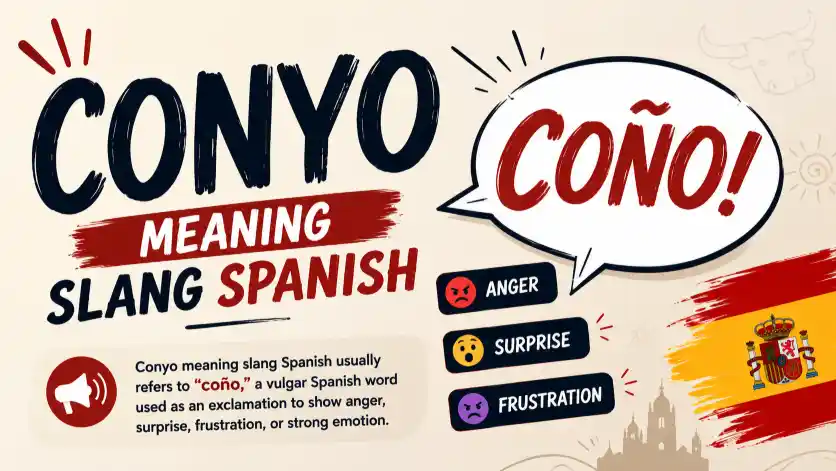
Conyo meaning slang Spanish usually refers to “coño,” a vulgar Spanish word used as an exclamation to show anger, surprise, frustration, or strong emotion.
In casual speech, it can be similar to English expressions such as “fuck,” “damn,” or “what the hell,” depending on the sentence and region.
People searching for conyo meaning slang Spanish may have seen the word written without the Spanish letter ñ. In informal online writing, people sometimes type conyo instead of coño. However, the standard Spanish spelling is coño.
The word can be confusing because its meaning changes with context. It can work as a strong exclamation, appear inside a question, or refer to female anatomy in its literal vulgar sense.
This guide explains these meanings separately so you can understand the word without mixing them up.
Quick Answer: Conyo Meaning Slang Spanish
“Conyo” is commonly used online as a spelling of the Spanish “coño.” As slang, coño is a vulgar expression used for strong emotion, often meaning something like “fuck,” “damn,” or “what the hell.”
What Does Conyo Mean in Spanish Slang?
In Spanish slang, the intended word is usually “coño,” not “conyo.” The letter ñ is part of the normal Spanish spelling.
As an interjection, coño can express a strong reaction. The exact English translation depends on what is happening in the conversation.
For example, someone might use it to show:
- Surprise
- Anger
- Frustration
- Shock
- Annoyance
- Strong emphasis
Because English does not have one perfect translation for every use, the same Spanish word may become “damn,” “fuck,” “what the hell,” or another strong expression in English.
For example:
“¡Coño! Me asustaste.”
A natural English translation could be:
“Damn! You scared me.”
The exact translation depends on the speaker, situation, and region.
Why Is “Conyo” Sometimes Written Without the Ñ?
“Conyo” is often an informal way of typing “coño” when someone does not use the Spanish ñ character.
The standard spelling is:
coño
The informal spelling may appear as:
conyo
This can happen in online chats, comments, or other places where people type quickly or use a keyboard without easy access to ñ.
However, conyo is not the standard Spanish spelling of the word. Spanish dictionaries list coño as the word.
So, if you are learning Spanish, it is better to recognize coño as the correct spelling.
Coño as an Exclamation
One of the most common slang uses of coño is as an emotional exclamation.
It can appear at the beginning of a sentence or on its own. The speaker uses it to show a strong reaction.
Showing Surprise
“¡Coño! I didn’t see you there.”
Here, the word expresses surprise.
Showing Frustration
“¡Coño! We missed the train.”
In this case, it shows annoyance or frustration.
Showing Shock
“¡Coño! That’s a huge dog.”
Here, the speaker is reacting strongly to something unexpected.
As these examples show, the English translation can change even though the Spanish word stays the same.
What Does “Qué Coño” Mean?
“Qué coño” is a vulgar Spanish expression that can mean “what the fuck” or “what the hell,” depending on the tone. It is often used when someone is confused, angry, surprised, or demanding an explanation.
For example:
“¿Qué coño haces?”
A natural translation is:
“What the hell are you doing?”
The phrase is stronger than a neutral question.
Therefore, a learner should not treat qué coño as a polite way to ask a simple question.
Is Coño Rude or Offensive?
Yes. Coño is vulgar, so it is not a neutral everyday word.
However, its strength can vary by region and context. In some Spanish-speaking communities, people use it frequently as an emotional exclamation. That does not make it appropriate for formal situations.
| Situation | Suitable? |
| Close friends | Sometimes |
| Casual conversation | Depends on the group |
| Online slang | Sometimes |
| School assignment | No |
| Job interview | No |
| Formal email | No |
| Professional meeting | No |
In short, understanding the word is useful, but using it yourself requires attention to the audience.
Does Coño Have a Literal Meaning?
Yes. The word also has a literal vulgar meaning referring to female genitalia.
This is different from its common exclamatory use. Because the word can have both meanings, context is especially important.
When used as an exclamation, the speaker is usually expressing emotion rather than referring to anatomy.
For example:
“¡Coño, qué frío!”
Here, the speaker is reacting to the cold.
On the other hand, a sentence using coño as a noun may have the literal anatomical meaning.
So, do not assume that every appearance of the word has the same meaning.
Where Is Coño Used?
Coño is especially associated with Spain and several Caribbean varieties of Spanish, although its use and strength vary across regions. Sources also document its use in places such as Venezuela and Panama.
This regional variation matters because slang does not always work the same way everywhere.
Spain
The word is well established in informal Spanish and can appear as a strong emotional exclamation.
Caribbean Spanish
It is also used in several Caribbean varieties, including Puerto Rican, Cuban, and Dominican Spanish. The tone can range from surprise to frustration.
Other Spanish-Speaking Areas
Usage can be less common or may carry a different feel in other regions. Therefore, hearing the word in one country does not mean everyone uses it in exactly the same way.
Conyo vs. Coño: Are They the Same?
They can refer to different slang terms, so the spelling and context matter.
| Term | Meaning |
| Coño | Vulgar Spanish word and exclamation |
| Conyo | Often an informal spelling of “coño” online |
| Conyo in Filipino slang | A separate slang term connected with mixed English and Filipino speech |
The third meaning is not the same Spanish slang meaning discussed in this article. It is associated with Filipino usage and should not be treated as a Spanish definition.
This distinction is important because a search for conyo meaning slang Spanish can bring together two different cultural uses of a similar-looking word.
How Strong Is “Coño”?
Coño is a strong and vulgar expression, but its force can change with the situation. In some conversations, it may sound like a sharp “damn!” while in others it can be much stronger.
The speaker’s tone matters too. A frustrated shout can sound more aggressive than a casual use between people who know each other well.
For Spanish learners, the safest approach is to recognize the word before trying to use it.
| Context | Possible English Sense | Strength |
| Sudden surprise | “Damn!” | Strong |
| Frustration | “Damn it!” | Strong |
| Anger | “Fuck!” | Very strong |
| Shock | “What the hell?” | Strong |
| Casual emotional reaction | Strong exclamation | Varies |
Because there is no single English translation that works in every situation, context should always guide your interpretation.
Coño vs. Common English Swear Words
Coño can overlap with several English swear words, but it is not a perfect one-to-one translation.
| Spanish Expression | Possible English Equivalent | Main Use |
| ¡Coño! | Damn! / Fuck! | Strong reaction |
| ¿Qué coño…? | What the hell…? / What the fuck…? | Anger or confusion |
| Coño, qué frío. | Damn, it’s cold. | Frustration or emphasis |
| Coño, qué sorpresa. | Damn, what a surprise. | Shock or surprise |
The best translation depends on the speaker’s emotion. For example, translating every use as “fuck” can make the original sound stronger than intended.
How Can Tone Change the Meaning?
Tone can change how a listener understands coño.
A person may say the word with surprise, irritation, excitement, or disbelief. The surrounding words also provide clues.
Surprise
“¡Coño! I didn’t expect you here.”
The speaker is surprised.
Frustration
“¡Coño! The computer stopped again.”
Here, the word shows annoyance.
Strong Anger
“¿Qué coño estás haciendo?”
This is much more aggressive because the speaker is confronting someone.
Therefore, the same word does not always carry the same emotional force.
Can Spanish Learners Use Coño?
Spanish learners should be careful with coño because it is vulgar.
Understanding the word is useful because you may hear it in movies, shows, songs, conversations, or online content. However, recognizing a swear word is different from knowing when it is appropriate to say it.
If you are still learning Spanish, neutral expressions are usually safer.
For example, instead of using a strong swear word, you could use:
- Vaya = an expression of surprise
- Qué pena = what a shame
- Dios mío = my God
- Qué sorpresa = what a surprise
These alternatives are much safer in everyday situations.

Conyo vs. Coño: A Common Spelling Confusion
If you are searching for “conyo meaning slang Spanish,” the key point is that standard Spanish uses “coño” with the letter ñ.
The difference is simple:
Coño → standard Spanish spelling
Conyo → informal spelling sometimes used online when ñ is not typed
However, conyo can also refer to a completely different slang term in Filipino English. Therefore, you should not automatically assume that every use of “conyo” refers to Spanish.
When the context is Spanish profanity, coño is the spelling to learn.
When Should You Avoid Using Coño?
Avoid coño in formal or unfamiliar settings because it is vulgar.
It is especially better to avoid it in:
- Job interviews
- Professional emails
- School assignments
- Academic writing
- Formal presentations
- Conversations with people you do not know well
Instead, choose a neutral expression when you want to show surprise or frustration.
For example:
“Dios mío, qué sorpresa.”
is much safer than using a vulgar exclamation.
Why Do People Use Coño?
People use coño to express strong emotion quickly.
It can add force to a sentence without requiring a long explanation. Depending on the situation, the speaker may want to show surprise, frustration, anger, or disbelief.
The word can also make informal speech sound more emotional and direct.
However, that strong effect is exactly why it should not be treated like a normal neutral word.
Common Mistakes With Coño
Mistake 1: Treating It as a Polite Word
Coño is vulgar. So, it should not be used simply because you hear native speakers saying it casually.
Mistake 2: Translating It the Same Way Every Time
The English meaning changes with context. For example, one sentence may call for “damn,” while another may be closer to “what the fuck.”
Mistake 3: Confusing Coño With Conyo
The spelling coño belongs to Spanish. Conyo may be an informal online spelling, but it can also describe a separate Filipino slang term.
Mistake 4: Ignoring Regional Differences
Spanish slang can vary between countries. As a result, the frequency and strength of coño may not be identical everywhere.
Is Coño Safe for Social Media?
Coño can appear on social media, but it is still a vulgar expression.
People may use it in comments, captions, memes, or casual messages. However, if it is acceptable depends on the platform, audience, and type of content.
For a public or professional account, a neutral expression is safer. In a private conversation with friends, the word may be understood as casual profanity.
In short, seeing coño online does not mean it is polite language.
Frequently Asked Questions
Q1. What does conyo mean in Spanish slang?
Answer: In Spanish slang, conyo usually refers to coño, a vulgar Spanish expression used to show strong emotion. The standard Spanish spelling is coño with ñ.
Q2. What does coño mean in English?
Answer: Depending on context, coño can be translated as “damn,” “fuck,” or “what the hell.” It can also have a literal vulgar anatomical meaning.
Q3. Is coño a bad word in Spanish?
Answer: Yes. Coño is vulgar, although its strength and frequency can vary by region and situation.
Q4. Can I say coño around Spanish speakers?
Answer: You can hear it in casual speech, but learners should use caution. Because it is vulgar, a neutral expression is safer until you understand the local style and context.
Q5. Is conyo the correct Spanish spelling?
Answer: No. The standard Spanish spelling is coño. “Conyo” is sometimes used online as a way to write the word without the ñ.
Q6. Is coño used in all Spanish-speaking countries?
Answer: No. Its use and strength vary by region. It is strongly associated with informal speech in Spain and is also used in several Caribbean varieties of Spanish.
Conclusion
The phrase “conyo meaning slang Spanish” usually points to the Spanish word “coño.” It is a vulgar expression that can show surprise, frustration, anger, or another strong reaction. The exact English meaning depends on the context and tone.
For learners, the most important detail is the spelling: coño is the standard Spanish form. Also, remember that conyo can have a separate meaning in Filipino slang.
Overall, it is best to understand coño before using it. Since it contains strong language, neutral expressions are a better choice in school, work, and other formal situations.
Discover More Articles:

Hi, I’m Anna Whitmore. I have 7+ years of experience writing about English slang and vocabulary. At SlangShine, I create simple, easy-to-understand content for English learners.