Have you ever been texting a friend or scrolling through TikTok and wondered how people actually say okay in spanish slang? If you rely solely on traditional textbooks, you might think vale or está bien are your only options.
However, digital communication across Latin America, Spain, and bilingual online communities relies heavily on dynamic, informal expressions that carry specific nuances, energy, and regional flair.
Understanding these informal terms helps you decode group chats, social media comments, and casual conversations without feeling out of the loop.
If you are trying to confirm plans, show enthusiasm, or simply send a quick agreement in a direct message, learning Spanish slang for “okay” allows you to sound natural and context-aware.
Quick Answer: Okay in Spanish Slang
Saying okay in spanish slang depends on the country: expressions like dale (Argentina/Caribbean), sale or órale (Mexico), bacán/chevere (general enthusiasm), and va (Central America/Mexico) serve as informal equivalents of “okay,” “sure,” or “let’s do it.”
What Does Okay in Spanish Slang Mean in Text?
In messaging apps like WhatsApp, Instagram, and Discord, using standard Spanish to say “okay” can sometimes sound formal, dry, or overly distant.
Texting slang bridges that gap by adding personality, tone, and regional identity to simple responses.
When native speakers use slang equivalents of “okay,” they are usually doing one of three things:
- Confirming agreement: Acknowledging a statement or plan quickly.
- Expressing enthusiasm: Showing excitement about an upcoming event or shared idea.
- Ending a topic: Softly wrapping up a conversation turn before moving on.
Unlike English, where “OK” or “k” covers almost everything, Spanish slang varies significantly based on regional culture and the relationship between speakers.
Popular Expressions for Okay in Spanish Slang
Because Spanish is spoken across more than 20 countries, there is no single universal slang word for “okay.”
Instead, several widely recognized regional variations exist across the Spanish-speaking world.
1. Dale (Argentina, Uruguay, Cuba, Colombia)
Literally translating to “give it,” dale is one of the most versatile ways to say okay in spanish slang. In text, it functions as “okay,” “let’s do it,” or “go ahead.”
- Tone: Energetic, agreeable, friendly.
- Best used for: Confirming plans or agreeing to a suggestion.
2. Sale / Sale y Vale (Mexico)
In Mexican slang, sale comes from the verb salir (to leave/turn out) and is used to signify agreement or confirmation.
- Tone: Casual, cooperative.
- Best used for: Quick acknowledgments in casual texts.
3. Va / Va que va (Mexico, Central America, Spain)
Va literally means “it goes.” As slang, it means “okay, sounds good” or “I’m in.”
- Tone: Relaxed, direct.
- Best used for: Agreeing to hang out or confirming a quick instruction.
4. Órale (Mexico)
While órale can express surprise (“wow!”), it is extremely common as an emphatic “okay!” or “all right then!”
- Tone: Expressive, enthusiastic.
- Best used for: Acknowledging a call to action or showing strong agreement.
5. De Ley / De Una (Ecuador, Colombia, Argentina)
These phrases mean “definitely” or “right away,” serving as an enthusiastic “okay, absolutely!”
- Tone: Decisive, eager.
- Best used for: Accepting an invitation immediately.
Full Form and Linguistic Origin of Spanish Slang Terms
Unlike acronyms in English slang (such as LOL or BRB), slang for okay in spanish slang generally consists of conjugated verbs or shortened idiomatic phrases rather than initials.
| Slang Term | Root Word / Literal Meaning | Functional Meaning in Text |
| Dale | Dar (to give) | “Okay, let’s do it / Go ahead” |
| Sale | Salir (to leave/outcome) | “Okay, agreed” |
| Va | Ir (to go) | “Okay / Sounds good” |
| De una | De una vez (at once) | “Okay, right away” |
| A huevo | Vulgar literal reference | “Heck yeah / Absolutely okay” |
Is Spanish Slang for Okay Rude, Offensive, or Neutral?
Most casual ways to say okay in spanish slang are entirely neutral or friendly. However, social context and tone dictate if an expression is polite or inappropriate.
- Neutral / Friendly: Terms like dale, va, sale, and está bien are perfectly acceptable for friends, peers, close colleagues, and online gaming groups.
- Potentially Rude or Dismissive: Sending a single-letter response like “k” or responding with an overly short “ya” can come across as abrupt, dismissive, or annoyed just as in English.
- Vulgar or Overly Informal: Phrases containing vulgarities (e.g., a huevo or regional profanities used as agreement) should never be used in professional or academic contexts.
Where Is Spanish Slang Commonly Used?
Digital platforms have accelerated the spread of regional Spanish slang across borders. You will frequently encounter these terms in several online and offline environments:
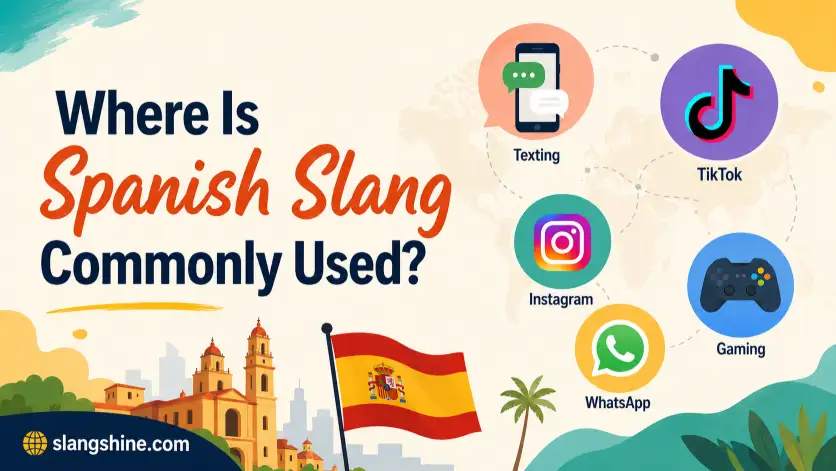
Social Media Platforms (TikTok, Instagram, X)
Short video comments and posts heavily feature terms like dale, va, or órale to agree with content creators, participate in trends, or reply to followers.
Texting & Direct Messaging (WhatsApp, Telegram, Snapchat)
WhatsApp is the primary messaging platform across Latin America and Spain. Quick slang confirmations are standard practice in both group chats and individual threads.
Online Gaming (Discord, Twitch, In-Game Voice/Text Chat)
In fast-paced multiplayer games, players rely on short slang words like va, sale, or dale to acknowledge team strategies, confirm moves, or signal readiness.
Real-Life Examples of Usage in Texting
To help you understand context and tone, here are practical texting scenarios illustrating how to use okay in spanish slang naturally.
Friendly Confirmation
- Person A: ¿Nos vemos a las 7 pm en el café? (Are we meeting at 7 pm at the cafe?)
- Person B: Dale, ahí nos vemos. (Okay, see you there.)
Casual Agreement
- Person A: Tráete unas papas para la reunión. (Bring some chips for the hangout.)
- Person B: Va, yo las llevo. (Okay, I’ll bring them.)
Enthusiastic Acceptance
- Person A: ¿Quieres ir al concierto este sábado? (Do you want to go to the concert this Saturday?)
- Person B: ¡De una! Compremos los boletos. (Okay, absolutely! Let’s buy the tickets.)
Gaming / Discord Call
- Person A: Cubre la puerta izquierda. (Cover the left door.)
- Person B: Sale, voy. (Okay, on it.)
Origin and Background of Spanish Slang Expressions
The origin of slang terms for okay in spanish slang stems from the natural shortening of everyday spoken interactions:
- Commercial & Trade Origins: Phrases like sale originated in commercial exchanges in Mexico, signaling that a transaction or agreement was finalized (“it comes out well”).
- Imperative Commands: Words like dale come from imperative verb forms used to motivate or grant permission during physical tasks or athletic activities, which eventually transitioned into digital conversation markers.
- Globalization & Media: The popularity of Mexican television, Argentine music, and international streamers on Twitch and YouTube has cross-pollinated these slang terms across different Spanish-speaking regions.
Comparison with Similar English and Spanish Slang
Understanding how Spanish terms line up with familiar English slang makes adoption much easier.
| Spanish Slang Term | English Equivalent | Primary Region |
| Dale | “Alright” / “Let’s do it” | Argentina, Caribbean, Miami |
| Sale | “Deal” / “Okay then” | Mexico |
| Va | “Sounds good” / “Bet” | Mexico, Central America, Spain |
| De una | “For sure” / “100%” | Colombia, Argentina, Ecuador |
| Vale | “Okay” / “All right” | Spain |
When to Avoid Using Spanish Slang
While using slang adds personality, there are situations where standard Spanish is necessary:
- Professional Emails & Workplace Messaging: Stick to standard expressions like de acuerdo, entendido, or está bien.
- Customer Service & Formal Inquiries: Avoid terms like sale or órale when speaking with service representatives, clients, or elders.
- Academic Writing: Academic papers, formal presentations, and official documentation require standard grammar and vocabulary.
Polite Alternatives to Spanish Slang
If you want to maintain a respectful tone while still sounding natural, consider these formal and semi-formal alternatives:
- De acuerdo: “Agreed” or “In agreement” (Professional and polite).
- Entendido: “Understood” (Clear, respectful, and direct).
- Está bien: “It’s fine / Okay” (Versatile and neutral for any audience).
- Con gusto: “With pleasure” (Polite way to accept a request).
Why People Use Slang for “Okay” in Digital Communication
Slang serves several practical and social functions in modern text-based communication:
- Efficiency: Typing va or dale requires fewer keystrokes than formal phrases.
- Tone Moderation: Plain text lacks vocal inflection. Slang helps signal friendliness and warmth, preventing simple messages from sounding cold.
- In-Group Identity: Using regional slang demonstrates cultural awareness, shared identity, and familiarity within a friend group or online community.
Impact of Using Slang in Online Communication
Using regional slang correctly builds rapport and makes conversations feel effortless. However, using the wrong regional slang in the wrong context can occasionally lead to minor confusion:
- Cross-Regional Differences: A phrase widely used in Mexico (sale) might sound unusual or unfamiliar to someone from Spain, where vale is dominant.
- Overuse: Flooding every message with slang can hinder clarity. Striking a balance between standard language and casual expressions ensures clear communication.
Is Spanish Slang Safe for Social Media and Gaming?
Yes, informal terms for okay in spanish slang (like dale, va, sale, and vale) are completely safe and widely used across all major public platforms, including TikTok, Instagram, Discord, Twitch, and YouTube.
They contain no hateful, explicit, or offensive meanings when used in standard agreement contexts.
FAQs About Okay In Spanish Slang
Q1. Is “vale” considered slang or standard Spanish?
Answer: Vale is standard informal Spanish widely used in Spain to mean “okay.” While it is casual, it is considered universally polite and acceptable in almost all informal and semi-formal situations across Spain.
Q2. Can I use “OK” when texting Spanish speakers?
Answer: Yes, “OK” or “Ok” is universally understood across the Spanish-speaking world due to global media exposure and is frequently used in casual texting alongside native slang words.
Q3. What is the shortest way to say okay in Spanish slang when texting?
Answer: The shortest native slang term is va, which consists of just two letters and effectively conveys “okay” or “sounds good” in Mexican and Central American contexts.
Q4. Which Spanish slang for okay is best for professional group chats?
Answer: In semi-professional group chats (like Slack or Microsoft Teams), standard expressions such as de acuerdo, está bien, or perfecto are preferred over regional slang.
Q5. Does “dale” mean anything other than okay?
Answer: Yes, dale can also mean “hurry up,” “keep going,” or “come on,” depending on the vocal tone or context of the conversation.
Q6. Why do some people write “sip” instead of “sí” in texts?
Answer: Sip (or seep) is a playful, casual text variation of sí (yes), similar to how English speakers text “yep” or “yup” instead of a formal “yes.”
Conclusion
Understanding how to say okay in spanish slang allows you to navigate casual conversations, social media threads, and group texts with confidence.
By matching your choice of expression if it’s dale, sale, va, or vale to the context and regional background of your conversational partner, you can communicate naturally and build stronger connections in any digital environment.
Learn More Slang Terms:
- Cuh Meaning Slang: What Does “Cuh” Really Mean? (2026)
- Bofa Slang: The Joke That Confuses Everyone Online (2026)
- What Is a Baller Slang? Meaning, Origin & Examples (2026)

Hi, I’m Emma Carter, an English language writer with over 8 years of experience in vocabulary and language learning. At SlangShine, I write simple, accurate, and easy-to-understand articles about slang, synonyms, idioms, and everyday English to help learners build confidence and improve their communication skills.