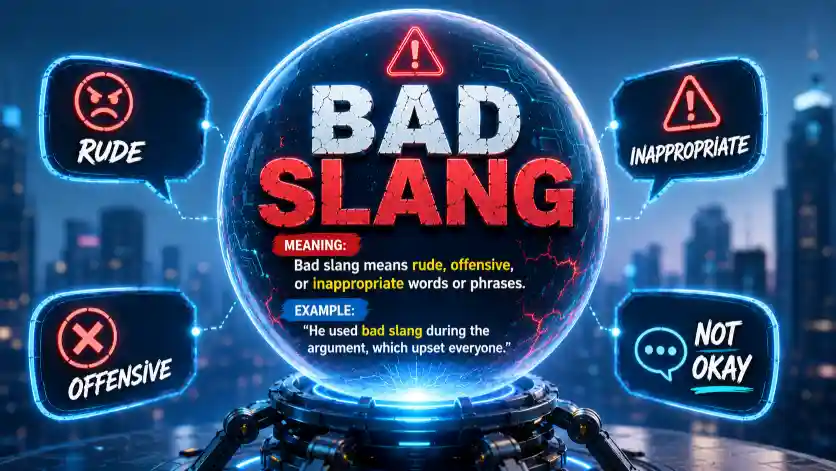
“Bad slang” usually refers to informal language that may be rude, vulgar, offensive, disrespectful, or inappropriate for a certain situation. However, slang is not automatically bad just because it is informal. The meaning, tone, context, and audience all matter.
People often search for bad slang after seeing an unfamiliar word online or hearing a term that sounds offensive. Understanding the word first can help you decide if it is safe to use. A phrase that feels normal among close friends may sound rude at school or work.
This guide explains the main types of inappropriate slang. It also shows how context changes meaning and when casual language may cause problems.
Quick Answer:
Bad slang is informal language that may be rude, vulgar, offensive, disrespectful, or unsuitable for a particular audience or setting. A word can be harmless in one situation but inappropriate in another.
What Does “Bad Slang” Mean?
“Bad slang” is a general label, not the name of one specific type of slang.
People may use this phrase when talking about language that has a negative or inappropriate tone.
A slang term may be considered unsuitable because:
- It contains profanity.
- It insults another person.
- It has a sexual meaning.
- It targets a person or group.
- It sounds disrespectful.
- It is unsuitable for children.
- It sounds unprofessional.
- Its meaning may cause harm or confusion.
However, context matters. A word that sounds harsh in one conversation may have a playful meaning among close friends.
That does not mean the word is safe everywhere. The relationship between the speakers, the setting, and the audience can all change how the language is received.
Is All Slang Bad?
No. Slang is not automatically rude or offensive.
Slang is simply informal language used by certain groups or in certain situations. Many slang terms are harmless and common in everyday speech.
For example:
- Cool can mean good or enjoyable.
- Awesome can show strong approval.
- Chill can describe a relaxed person or situation.
These words are informal, but they are not normally offensive.
The problem begins when an expression is vulgar, insulting, degrading, or unsuitable for the setting.
A Simple Comparison
| Type of language | Example | General tone |
| Standard English | “That is excellent.” | Neutral |
| Casual slang | “That is cool.” | Informal |
| Rude language | An insult | Disrespectful |
| Vulgar language | Profanity | Crude or strong |
| Offensive language | A degrading term | Harmful |
So, informal does not automatically mean inappropriate.
Types of Bad Slang
Not all inappropriate expressions are problematic for the same reason. Some are crude, while others can directly hurt or target people.
1. Vulgar Slang
Vulgar slang includes profanity or crude expressions.
You may hear this type of language in casual conversations, movies, music, gaming, or online discussions. However, frequent use does not make it suitable for every audience.
For example, someone may use a strong expression when they are angry or surprised.
Tone: Strong, crude, or inappropriate
Best approach: Consider the audience before using it, especially in formal settings.
2. Insulting Slang
Insulting slang is language used to criticize, mock, or put another person down.
Some insults are exchanged playfully between close friends. However, the same words can be hurtful when used seriously or with someone you do not know well.
For example:
“You’re such an idiot.”
The speaker’s relationship with the listener and their tone can affect how this sentence is understood.
Even when meant as a joke, an insult may not be received that way.
Tone: Teasing, rude, or hostile
If you are unsure how someone will react, a neutral expression is safer.
3. Sexual Slang
Sexual slang includes informal terms related to sex, sexual behavior, or body parts.
Some expressions are common in adult conversations or online communities. However, they may be unsuitable for school, work, public communication, or conversations with children.
A word being popular online does not automatically make it appropriate.
Tone: Adult, sexual, or vulgar
When explaining such a term, focus on its meaning and context rather than encouraging people to use it casually.
4. Offensive Slang
Offensive slang can insult, degrade, or target a person or group.
Some terms have a history of being used to discriminate against people. These expressions should not be treated like ordinary casual slang simply because they appear frequently online.
Tone: Offensive, disrespectful, or harmful
If you encounter an unfamiliar expression that may fall into this category, check its meaning before repeating it.
Why Can the Same Slang Word Be Fine in One Situation but Bad in Another?
Context can completely change how informal language is understood.
Imagine two close friends using a mild insult as a joke. They may both understand that no harm is intended.
Now imagine a manager using the same word toward an employee. The power difference can make the comment feel disrespectful or hostile.
The same thing happens online.
A joke shared in a private group chat may seem harmless to the people involved. If the same message is posted publicly, other readers may not understand the relationship or the intended tone.
Written communication can create another problem because readers cannot hear your voice or see your facial expression.
That is why intent is only part of the picture. The effect on the listener or reader also matters.
Bad Slang in Texting
Texting makes informal language common because people often want messages to feel short, relaxed, and natural.
Friends may use:
- Abbreviations
- Shortened words
- Profanity
- Playful insults
- Internet expressions
However, not every expression is suitable for every person.
For example:
“That game was wild.”
This is casual but generally harmless.
A message containing a personal insult or strong profanity has a very different effect.
Before sending an unfamiliar expression, think about who will read it and how they might understand it.
Bad Slang on Social Media
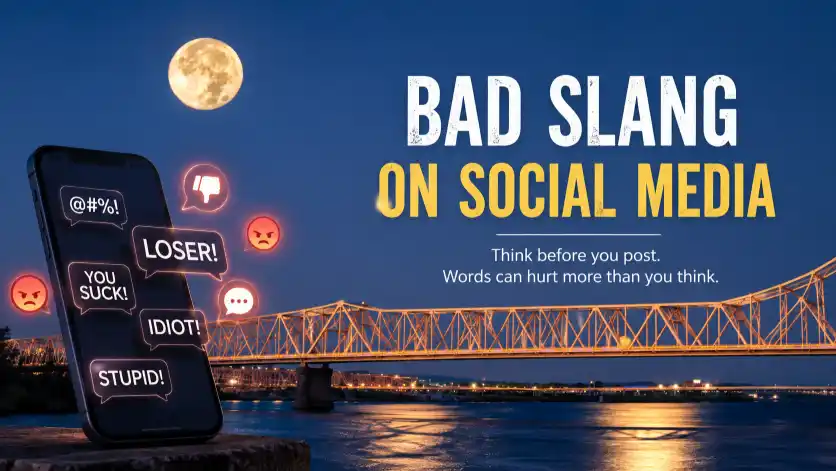
Rude and offensive expressions can spread quickly on platforms such as TikTok, Instagram, Snapchat, Reddit, and Discord.
Someone may see an unfamiliar term in a comment and repeat it without knowing its meaning. This can create problems if the expression has a sexual, insulting, or offensive use.
Social media also removes much of the context behind a private joke. A phrase that makes sense between friends may look harsh or confusing to strangers.
A Simple Rule for Social Media
If you do not fully understand an expression, check its meaning before using it.
This is especially important when a term:
- Sounds insulting
- Refers to sex
- Contains profanity
- Targets a person or group
- Has several meanings
Understanding the expression first can help you avoid accidental misuse.
Is This Type of Slang Appropriate at School?
Most rude, vulgar, or offensive slang should be avoided at school.
Students may hear informal expressions from friends, games, videos, or social media. Knowing what a word means is useful, but that does not mean it belongs in schoolwork.
For essays, presentations, and assignments, standard English is usually the better choice unless the topic itself is about slang or language.
For example:
Informal:
“That movie was super cool.”
More formal:
“The movie was very enjoyable.”
Neither sentence is necessarily wrong. The second simply fits a formal setting better.
Is It Appropriate at Work?
Rude, vulgar, and offensive expressions are usually unsuitable for professional communication.
This includes:
- Workplace emails
- Reports
- Meetings
- Job applications
- Client messages
- Professional presentations
Even harmless slang can sometimes make professional writing sound too casual.
Instead, choose language that is:
- Clear
- Respectful
- Professional
- Easy to understand
This is especially important when communicating with clients, managers, employers, or people you do not know well.
How Can You Tell If Slang Is Inappropriate?
There is no single rule that works for every slang term. However, a few simple questions can help you decide if an expression is suitable.
Before using a term, ask:
- Does it contain profanity?
- Could it insult someone?
- Does it have a sexual meaning?
- Could it target a person or group?
- Would I use it with a teacher or employer?
- Could someone misunderstand my intention?
If you have concerns about any answer, choose a more neutral expression.
This is especially useful when you find a new term on social media. Online popularity does not automatically make a word appropriate.
Why Do People Use Offensive Slang?
People use strong or inappropriate slang for many reasons. Using it does not always mean that someone wants to offend another person.
Common reasons include:
- To sound casual
- To express strong emotions
- To fit in with a group
- To make a joke
- To sound more expressive
- To copy language seen online
- To make a conversation feel less formal
For example, close friends may use a rude expression as an inside joke. However, the same expression can feel insulting when used toward a stranger.
So, intent matters, but the effect on the listener matters too.
Does Slang Change Over Time?
Yes. Slang changes as language, culture, and online communities change.
A term that is popular today may become less common later. Some expressions also develop new meanings over time.
A word can even move from slang into more widely accepted everyday language. Other expressions may become dated or sound unnatural to younger speakers.
Because informal language changes quickly, it is useful to check the current meaning of an unfamiliar term before using it.
How Does Slang Differ by Age and Community?
Different age groups and communities may use different expressions.
Teenagers may know words that older adults rarely use. Gamers may also use terms that are familiar inside gaming communities but confusing to people outside those groups.
However, it is important not to assume that everyone in an age group or community uses the same language.
Personal preferences, social groups, location, and online activity can all affect the words people choose.
The safest approach is to learn the meaning and context instead of assuming that everyone uses a term in the same way.
When Should You Avoid Offensive Slang?
It is best to avoid language that may be rude, vulgar, or offensive when you are unsure about the audience.
Be especially careful in:
- Job interviews
- Workplace emails
- School assignments
- Academic writing
- Professional meetings
- Customer communication
- Formal presentations
- Conversations with people you do not know well
You should also avoid offensive terms even when they appear frequently online.
Popularity does not make harmful language appropriate.
What Can You Say Instead?
If an expression feels too strong, replace it with a neutral alternative.
| Instead of | Try |
| Strong insult | “That was unkind.” |
| Profanity | “That is frustrating.” |
| Harsh reaction | “I can’t believe that.” |
| Crude expression | “That is inappropriate.” |
| Casual insult | “That person was being rude.” |
The best replacement depends on what you are trying to say.
For example, if you are angry, you do not need an insult to show emotion. A sentence such as “That really frustrated me” can communicate the feeling clearly without attacking another person.
Common Misunderstandings About Bad Slang
Not All Slang Is Offensive
Correct. Slang is simply informal language. Many slang words are harmless and useful in casual conversations.
A Popular Word Must Be Safe
Not necessarily. A term can be popular online and still have an offensive or inappropriate meaning.
Slang Always Shows Disrespect
No. Some expressions are used casually, playfully, or affectionately between people who know each other well.
Formal English Is Always Better
Not always. Slang can sound natural in casual conversations. The important thing is to choose language that fits the situation.
A Joke Cannot Be Offensive
Not necessarily. A speaker may intend a joke, but another person can still find the language hurtful or disrespectful.
Context Does Not Matter
Context matters a lot. The same word can have different meanings or different levels of offensiveness depending on the situation, speaker, audience, and tone.
Is Bad Slang Safe to Use on Social Media?
It depends on the specific expression and the audience.
Mild slang may be fine in a casual post. However, profanity, sexual language, insults, and offensive terms can create problems.
Public posts can also reach people outside your intended audience. A joke that seems harmless to friends may be misunderstood by other readers.
Before posting, consider if the wording is:
- Clear
- Respectful
- Suitable for the audience
- Free from unnecessary insults
If you are unsure, neutral language is usually the safer choice.
Why Understanding Slang Matters
Learning slang is not only about learning new words. It also helps you understand what people mean in conversations, messages, videos, and online posts.
You may come across an unfamiliar expression in a text or social media comment. Without knowing its meaning, you might misunderstand the speaker or accidentally repeat a word that is inappropriate.
Understanding the difference between casual, rude, vulgar, and offensive language gives you more control over how you communicate.
You do not need to use every slang term you learn. Sometimes, knowing what a word means is more useful than using it yourself.
Frequently Asked Questions
Q1. What does bad slang mean?
Answer: Bad slang generally refers to informal language that may be rude, vulgar, offensive, disrespectful, or unsuitable for a particular situation.
Q2. Is all slang considered bad?
Answer: No. Slang is informal language, and many slang words are harmless. if a term is appropriate depends on its meaning, tone, audience, and setting.
Q3. What makes a slang word offensive?
Answer: A term may be offensive when it insults, degrades, or targets a person or group. Its history and context can also affect how people understand it.
Q4. Is bad slang okay in texting?
Answer: Some mild slang may be fine when texting close friends. However, vulgar or offensive expressions should be used carefully because the reader may understand them differently.
Q5. Should I use bad slang at work or school?
Answer: It is best to avoid rude, vulgar, or offensive language in professional and academic settings. Clear and respectful English is usually a better choice.
Q6. Can slang have different meanings?
Answer: Yes. Some slang terms have different meanings depending on the community, platform, or context. Checking the specific meaning before using an unfamiliar expression can help prevent misunderstandings.
Conclusion
Bad slang is a broad term for informal language that may be rude, vulgar, offensive, disrespectful, or inappropriate in a particular setting. However, not all slang is bad.
Casual expressions can work well between friends. On the other hand, professional, academic, and public situations often require clearer and more neutral language.
The best approach is to understand a slang term before using it. Check its meaning, context, audience, and tone. If you are unsure if a word could offend someone, choose a neutral alternative.
Knowing what a slang term means gives you the choice to use it, avoid it, or explain it clearly.
Read More Slang Terms
- Oyakodon Slang: The Connection Between Food and Slang
- PITA Slang Meaning: Why Do People Call Something a “PITA”?
- Slang Words for Boobs: Meanings, Tones & Examples

Hi, I’m Anna Whitmore. I have 7+ years of experience writing about English slang and vocabulary. At SlangShine, I create simple, easy-to-understand content for English learners.