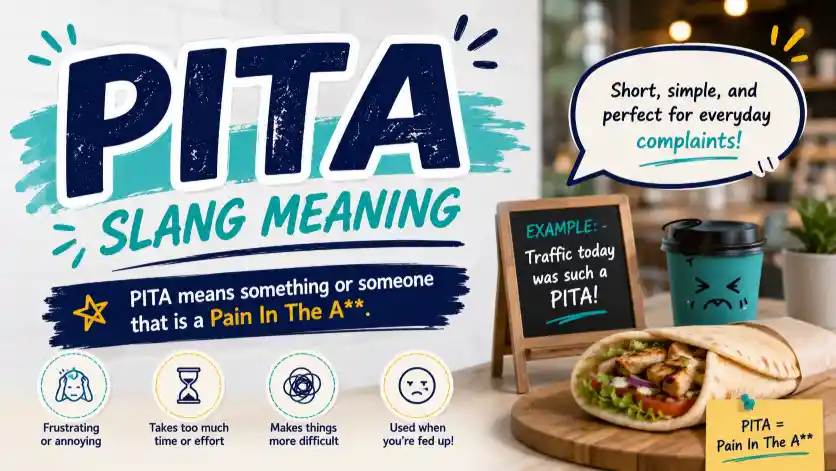
Pita slang meaning usually refers to “PITA,” an abbreviation for “pain in the ass.” It describes a person, task, problem, or situation that is very annoying, difficult, or frustrating. PITA is very informal and is commonly understood in casual written communication.
The word can be confusing because pita also means a type of flatbread. However, PITA can have a completely different meaning when it appears in a text, chat, or online conversation.
For example, someone might write, “This paperwork is such a PITA.” They mean that the paperwork is frustrating or difficult to deal with.
So, context is important. In this guide, you will learn what PITA means, how people use it, how strong the expression sounds, and when it is better to choose a polite alternative.
Quick Answer: Pita Slang Meaning
PITA means “pain in the ass” in slang. It describes someone or something that causes annoyance, trouble, or frustration.
What Does PITA Mean in Slang?
PITA is an abbreviation of “pain in the ass.”
People use it when they want to describe something that is irritating or hard to deal with.
For example:
“Getting my computer fixed was a real PITA.”
This means:
“Getting my computer fixed was very frustrating.”
PITA can describe a person, task, problem, object, or situation.
For example:
“My new coworker is a PITA.”
Here, the speaker is saying that the coworker is difficult or annoying to deal with.
However, the tone can vary. A person may use PITA as a serious complaint, while friends may use it jokingly.
PITA Full Form and Pronunciation
PITA stands for “pain in the ass.”
The word PITA is normally pronounced like “pee-tuh” when spoken as the abbreviation.
| Word | Full Form | Pronunciation | Type |
| PITA | Pain in the ass | PEE-tuh | Informal slang |
The full phrase contains the word “ass,” which gives it a casual and somewhat rude tone.
Therefore, PITA is better suited to informal communication than formal writing.
What Does “Pain in the Ass” Mean?
“Pain in the ass” is an informal expression for someone or something that causes trouble or annoyance.
For example:
“This traffic is a pain in the ass.”
The speaker means that the traffic is very frustrating.
It can also describe a person:
“He’s being a pain in the ass today.”
Here, the speaker is annoyed by that person’s behavior.
PITA simply shortens this longer expression. That makes it quicker to type in casual messages and online conversations.
PITA Meaning in Texting
PITA is useful in texting because it is much shorter than writing “pain in the ass.”
For example:
“This app is a PITA to use.”
Meaning:
“This app is very annoying to use.”
Another example:
“Waiting for this repair has been a PITA.”
The speaker is saying that the repair process has been frustrating.
Because it is an abbreviation, PITA works naturally in short messages and casual online conversations.
Pita Slang Meaning in Social Media
Pita Slang Meaning can appear on social media when people complain about frustrating situations.
For example:
“Trying to get tickets was such a PITA.”
This means the process was difficult or annoying.
Someone might also write:
“My internet has been a PITA all day.”
Here, the person is complaining about a frustrating internet problem.
Still, PITA is informal. It may not be suitable for every audience.
Is PITA a Bad Word?
PITA is not a swear word by itself, but it comes from a phrase containing the word “ass.”
Because of this, it is considered very informal and somewhat rude. Cambridge also labels the abbreviation as very informal.
For example:
“This software is a PITA.”
This is a casual complaint.
In a formal setting, a better choice would be:
“This software is difficult to use.”
That version sounds more professional.
How Strong Is the Word PITA?
PITA is usually stronger than simply saying “annoying,” but it is not necessarily an aggressive insult.
Its strength depends on what the speaker is describing.
| Example | Likely Tone |
| “This form is a PITA.” | Mild frustration |
| “That website is a PITA.” | Stronger complaint |
| “He’s such a PITA.” | More personal |
| “You’re being a PITA.” | Direct and potentially insulting |
| “My dog is being a PITA.” | Often playful |
As you can see, using PITA for a task or object is usually less personal than using it directly for someone.
Is Pita Slang Meaning Offensive?
Pita Slang Meaning can sound rude, but the level of offense depends on the situation.
If someone says:
“This task is a PITA.”
they are complaining about the task.
If they say:
“You are a PITA.”
they are directly calling another person annoying.
Therefore, the second example can sound more insulting.
Close friends may use the expression jokingly. However, it is safer to avoid it with people you do not know well.
PITA for a Person
When PITA describes a person, it means that the person is annoying, difficult, or troublesome.
For example:
“My neighbor is becoming a real PITA.”
The speaker is saying that dealing with the neighbor has become frustrating.
Another example:
“Don’t be a PITA.”
This means:
“Don’t be difficult or annoying.”
However, this can sound insulting, especially when said directly to someone.
PITA for a Problem or Task
PITA can also describe something that is frustrating without referring to a person.
For example:
“Filling out all these forms is a PITA.”
The speaker is complaining about the task.
You can also say:
“Fixing this printer has been a PITA.”
Here, the printer problem is causing frustration.
This use is useful because it lets someone express annoyance in a short and informal way.
PITA vs. Pita Bread
The slang abbreviation PITA and the food word pita have completely different meanings.
PITA as Slang
PITA = pain in the ass
Example:
“This project is a PITA.”
Pita as Food
Pita = a type of flatbread
Example:
“I ordered a pita with chicken.”
Therefore, context matters. A food conversation is likely referring to the bread, while a complaint may use PITA as slang.
How Can You Tell Which Meaning Is Intended?
Look at the topic of the conversation.
If people are discussing:
- Food
- Bread
- Restaurants
- Cooking
- Sandwiches
then pita probably means the food.
If the conversation is about:
- Annoying tasks
- Difficult people
- Frustrating problems
- Work complaints
- Online conversations
then PITA may mean “pain in the ass.”
In short, the surrounding words usually make the intended meaning clear.
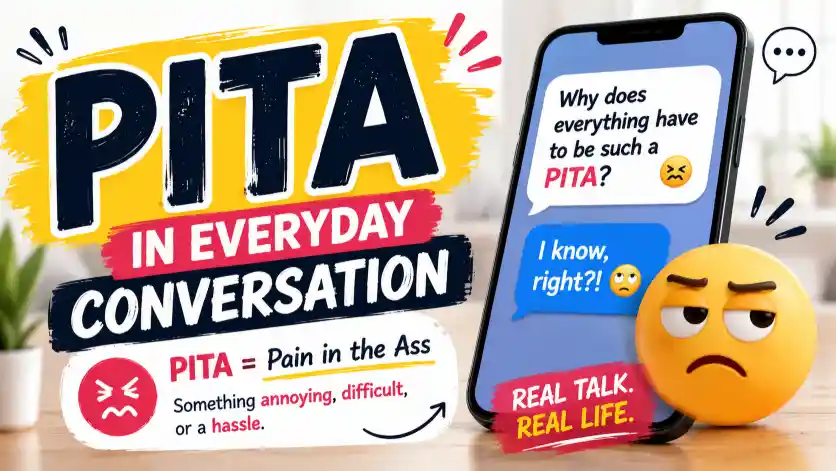
PITA in Everyday Conversation
PITA is usually used when someone wants to complain about something annoying or difficult.
For example:
“Getting this printer to work is a PITA.”
The speaker is frustrated with the printer.
It can also describe a person:
“My little brother can be a PITA sometimes.”
Here, the speaker means that the brother can be annoying or difficult to deal with.
However, friends may use the expression in a joking way. The relationship between the speakers can change the tone.
Is PITA Still Used Today?
Yes. PITA is still recognized as very informal slang. It can appear in texts, social media posts, online discussions, and other casual communication.
Some people use the abbreviation PITA, while others simply write the full phrase “pain in the ass.”
Others may choose simpler words such as annoying or frustrating.
So, PITA is useful to understand, but you do not need to use it in every casual conversation.
Can PITA Be Used as a Joke?
Yes, PITA can sometimes be used playfully between friends or family members.
For example:
“My dog is being a PITA today.”
The speaker may be annoyed, but the comment can also sound affectionate or humorous.
Another example is:
“This puzzle is a PITA.”
Here, the speaker is simply saying that the puzzle is difficult.
Therefore, the expression does not always show serious anger.
PITA in a Sentence: Natural Examples
Here are some simple examples showing different uses:
Talking About a Task
“Filling out this form is a PITA.”
Meaning: The form is frustrating or difficult.
Talking About Technology
“This software is a PITA to install.”
Meaning: Installing the software is annoying.
Talking About a Person
“He’s being a PITA today.”
Meaning: He is being annoying or difficult.
Talking About a Situation
“The whole trip became a PITA.”
Meaning: The trip became troublesome or frustrating.
Joking With Friends
“My cat is such a PITA when she wants food.”
Meaning: The cat is being annoying in a playful way.
As these examples show, PITA can fit many casual situations.
What Does “A Real PITA” Mean?
“A real PITA” means that something or someone is especially annoying or troublesome.
For example:
“That repair was a real PITA.”
This means the repair was particularly frustrating.
Another example:
“He’s a real PITA when he’s stressed.”
Here, the speaker means that the person becomes difficult to deal with.
The word “real” adds emphasis.
What Does “Being a PITA” Mean?
“Being a PITA” means behaving in an annoying or troublesome way.
For example:
“Stop being a PITA.”
This means:
“Stop being annoying or difficult.”
The phrase is direct, so it can sound rude if said seriously.
On the other hand, close friends may use it as a joke.
PITA vs. Annoying
“Annoying” is more neutral than PITA.
Compare these sentences:
“This website is annoying.”
“This website is a PITA.”
Both express frustration. However, the second sentence is more informal and blunt.
For a general audience, annoying is safer.
For casual online communication, PITA can sound more expressive.
PITA vs. Pain in the Neck
PITA and “pain in the neck” have similar meanings, but their tones are different.
| Expression | Meaning | Tone |
| PITA | Annoying or troublesome | Very informal |
| Pain in the ass | Annoying or troublesome | Informal and blunt |
| Pain in the neck | Annoying or troublesome | Softer |
| Annoying | Causing irritation | Neutral |
| Frustrating | Causing frustration | Neutral |
For example, “This process is a pain in the neck” sounds softer than “This process is a PITA.”
When Should You Avoid Using PITA?
It is better to avoid PITA when the situation is formal or when you are speaking to someone you do not know well.
Avoid it in:
- Formal business emails
- Academic writing
- Job applications
- Official reports
- Professional presentations
- Customer service messages
Instead, use words such as difficult, frustrating, inconvenient, or troublesome.
This keeps your message clear and professional.
Polite Alternatives to PITA
If you want to express the same basic idea without slang, you can use:
- Annoying
- Frustrating
- Difficult
- Troublesome
- Inconvenient
- Hard to deal with
For example:
“This process is frustrating.”
sounds more professional than:
“This process is a PITA.”
Therefore, choose the alternative based on your audience.
Common Mistakes About Pita Slang Meaning
Mistake 1: Thinking PITA Always Means Food
The word pita commonly refers to flatbread. However, PITA can also be an abbreviation for “pain in the ass.” Context tells you which meaning is intended.
Mistake 2: Thinking PITA Is Formal
PITA is very informal slang. It should not be treated like a standard professional abbreviation.
Mistake 3: Thinking PITA Only Describes People
PITA can describe a person, but it can also describe a task, problem, object, or situation.
Mistake 4: Thinking It Is Always an Insult
The expression can be playful between people who know each other well. Still, it can sound insulting when directed at someone seriously.
Is Pita Slang Meaning Safe for Social Media?
PITA is generally understandable in casual social media communication, but it is not completely neutral.
If you use it in a post such as:
“This update is a PITA.”
most readers will understand that you are frustrated.
However, if you are creating educational, professional, or family-friendly content, a neutral word such as frustrating may be a better choice.
FAQs About Pita Slang Meaning
Q1. What does PITA stand for in slang?
Answer: PITA stands for “pain in the ass.” It describes someone or something that is annoying, troublesome, or frustrating.
Q2. Is PITA a rude word?
Answer: PITA is very informal and can sound mildly rude because it comes from the phrase “pain in the ass.”
Q3. Can PITA describe a person?
Answer: Yes. Calling someone a PITA means that the person is annoying or difficult to deal with.
Q4. Can PITA describe a situation?
Answer: Yes. You can use PITA for a frustrating task, problem, process, object, or situation.
Q5. Is PITA the same as pita bread?
Answer: No. PITA can mean “pain in the ass,” while pita can also mean a type of flatbread. The context determines the meaning.
Q6. Should I use PITA at work?
Answer: It is better to avoid PITA in formal workplace communication. Words such as frustrating, difficult, or troublesome sound more professional.
Conclusion
PITA is very informal slang for “pain in the ass.” It describes a person, task, problem, object, or situation that causes annoyance or frustration. The abbreviation is useful to recognize in casual texts and online conversations, but it is not suitable for every setting.
The key point is that PITA has a different meaning from pita bread. Context helps you understand which one a speaker or writer intends.
Therefore, use PITA mainly in casual situations where informal language is appropriate. For professional or formal communication, choose words such as annoying, frustrating, difficult, or troublesome instead.
Discover More:
- HMO Slang: Decode This Short and Common Texting Term
- Oyakodon Slang: The Connection Between Food and Slang
- WYS Meaning Slang: The Meaning You Might See in Online Chats

Hi, I’m Anna Whitmore. I have 7+ years of experience writing about English slang and vocabulary. At SlangShine, I create simple, easy-to-understand content for English learners.