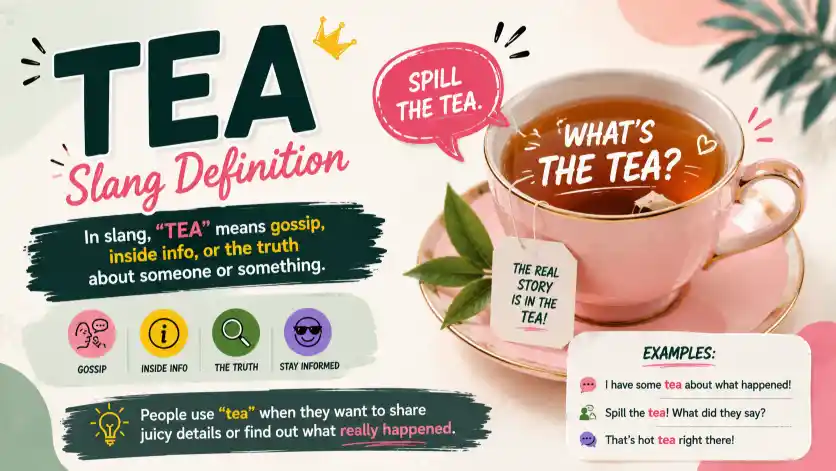
Tea Slang Definition means gossip, inside information, or interesting personal news that people want to hear about. It is often used when talking about drama, relationships, secrets, or surprising events. The word is especially common in phrases such as “spill the tea,” which means to share the details.
If you see someone write “What’s the tea?”, they are usually asking, “What happened?” or “What’s the gossip?” This does not normally mean they are asking about a drink.
This guide explains the tea slang definition in simple English. You will learn what “tea” means in slang, how it is used in texting and social media, where the expression came from, if it is rude, and when you should avoid using it.
Quick Answer: Tea Slang Definition
In slang, “tea” means gossip, news, or personal information that people find interesting. For example, “What’s the tea?” means “What’s the gossip?” and “spill the tea” means “Tell me the details.”
What Does Tea Mean in Slang?
The slang word tea refers to information that is interesting, juicy, or worth discussing.
It is often connected to gossip, but the meaning is not always negative. Someone may use “tea” for harmless news, relationship updates, celebrity drama, or details about something that happened between friends.
For example:
“Girl, what’s the tea?”
This can mean:
“What happened? Tell me everything.”
The word is usually used in a playful or curious way.
Tea vs. Gossip
Although tea and gossip are closely related, they are not always exact synonyms.
Gossip usually means talking about other people’s private or personal matters, sometimes in a negative way.
Tea is more casual. It can simply mean interesting information or the details behind a situation.
For example:
“Give me the tea about the party.”
This could mean:
“Tell me what happened at the party.”
The speaker may be asking for fun details rather than trying to spread harmful rumors.
What Does “Spill the Tea” Mean?
“Spill the tea” means to reveal or share interesting information, gossip, or details about a situation.
It is one of the most common phrases connected with tea slang.
Example
“You said something happened at school. Spill the tea!”
Meaning:
“Tell me what happened!”
The phrase is normally informal and playful.
You may also see shorter versions such as:
- Spill the tea
- Spill the tea!
- Drop the tea
- What’s the tea?
- I need the tea
These expressions all relate to getting or sharing interesting information.
What Does “What’s the Tea?” Mean?
“What’s the tea?” means “What happened?” or “What’s the gossip?”
The phrase is often used when someone knows there is a story but does not know the details.
Example
“You two were talking for an hour. What’s the tea?”
This means:
“What were you talking about? Tell me what happened.”
It can also be used online:
“Okay, what’s the tea here?”
This asks someone to explain the situation.
The tone is usually curious, playful, or excited.
Is Tea Slang Rude or Offensive?
Tea slang is usually harmless and informal, but it can become rude if it involves spreading private or false information about someone.
The word itself is not normally offensive.
For example:
“What’s the tea about the new movie?”
This is harmless. The speaker simply wants interesting information.
However:
“Spill the tea about your friend’s private problem.”
This can cross a line if the information is personal and was not meant to be shared.
So, the word tea is generally safe, but the information being shared matters.
Where Is Tea Slang Used?
Tea slang is common in casual communication, especially online.
Texting
Friends may use phrases like:
“What’s the tea?”
or
“Spill!”
These are short ways to ask for more details.
Social Media
The expression appears in comments, captions, videos, and discussions about celebrities, relationships, trends, and online drama.
TikTok and Instagram
People may use tea when discussing a situation, creator, celebrity, relationship, or online controversy.
For example:
“I need the tea on this situation.”
This means:
“I want to know what really happened.”
Reddit and Online Communities
Users may use “tea” when asking for background information or details about a story.
Everyday Conversation
The slang is not limited to the internet. Friends can also use it when talking face to face.
Is Tea Slang Used in Gaming?
Yes, but it is not mainly a gaming term.
Gamers may use tea when discussing drama, player disputes, team issues, or community news. However, the word does not specifically describe gaming.
For example:
“What’s the tea between those two players?”
This means:
“What is going on between those two players?”
The slang keeps its general meaning of gossip or interesting information.
Real Life Examples of Tea Slang
The meaning becomes easier to understand when you see the phrase in different situations.
Friendly Example
Friend 1: “You won’t believe what happened yesterday.”
Friend 2: “Wait, spill the tea!”
Meaning: Tell me what happened.
Texting Example
“What’s the tea? You disappeared all weekend.”
Meaning: What happened? Tell me the details.
Social Media Example
“The comments are asking for the tea.”
Meaning: People want to know the details behind the situation.
Celebrity Example
“Everyone wants the tea about their breakup.”
Meaning: People are curious about what happened in the breakup.
Harmless Example
“What’s the tea on the new restaurant?”
Meaning: What have you heard about the restaurant?
This shows that tea does not always mean personal gossip. It can simply mean interesting information.
Tea Slang in Texting
Tea slang works especially well in short messages because the meaning is easy to understand from context.
Common examples include:
| Phrase | Meaning | Tone |
| What’s the tea? | What happened? / What’s the gossip? | Casual |
| Spill the tea | Tell me the details | Playful |
| I need the tea | I want the details | Casual |
| Give me the tea | Tell me what happened | Informal |
| Drop the tea | Share the information | Informal |
| That’s the tea | That’s the truth or situation | Casual |
These phrases are generally used with friends, online communities, and other informal audiences.
What Does “That’s the Tea” Mean?
“That’s the tea” usually means “That’s the truth,” “That’s how it is,” or “Those are the facts.”
It can be used after someone gives an opinion or explains a situation.
Example
“She stopped replying because she was upset. That’s the tea.”
Here, the speaker is presenting that information as the real story.
The phrase can also have a humorous or confident tone.
It does not necessarily mean someone is literally sharing gossip.
What Does “Tea” Mean on Social Media?
On social media, tea usually refers to interesting information, gossip, drama, or details about a situation.
The exact meaning depends on the post.
For example:
“I have some tea for you.”
This suggests that the person has interesting information to share.
Another example:
“The tea is getting wild.”
This suggests that the situation or drama is becoming more interesting.
Because social media language changes quickly, the phrase can also be used humorously or as part of memes and trends.
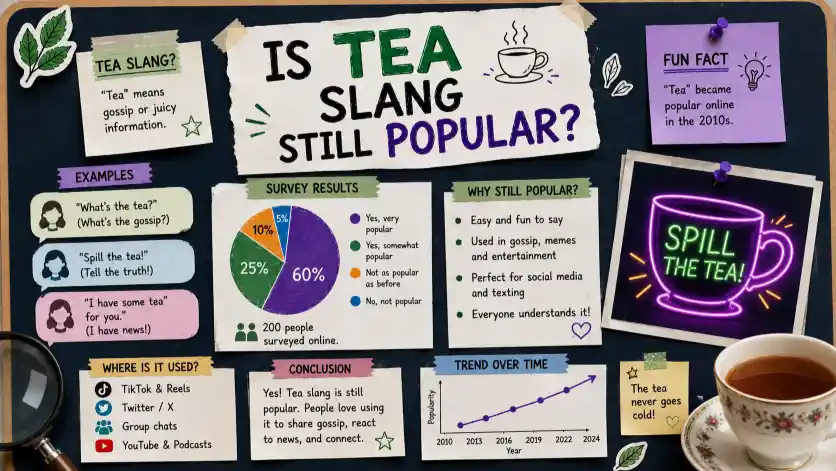
Is Tea Slang Still Popular?
Yes. “Tea” remains widely recognizable as informal slang, especially in phrases such as “spill the tea” and “what’s the tea?”
However, how often people use it can vary by age, platform, and personal style.
Some people use it naturally. Others may use it mainly as a playful internet expression.
It is best understood as established informal slang, rather than assuming that every person uses it in everyday speech.
Origin and Background of Tea Slang Definition
The slang use of tea has a longer history than many people realize. It is commonly linked to Black LGBTQ+ ballroom culture in the United States, where “T” was used in connection with personal truth or private information.
The expression later spread more widely through popular culture and online communication. The exact path from “T” to the modern spelling tea is not completely settled, so it is better not to claim one single origin as certain.
Today, tea is widely understood as a casual word for gossip, inside information, or interesting details. Its modern online use has helped make phrases such as “spill the tea” familiar to a much broader audience.
Why Is It Written as “Tea”?
The spelling tea also works as a playful word connection because tea is traditionally associated with sitting down and talking.
However, the slang meaning should not be reduced to a simple joke about drinking tea. Its history and cultural use are more specific than that.
Tea vs. Similar Slang Terms
Several English slang expressions can describe gossip or interesting information, but they are not always interchangeable.
| Slang | Meaning | Main Difference |
| Tea | Gossip or interesting information | Broad and casual |
| Gossip | Talk about other people’s lives | Can sound more negative |
| Drama | Conflict or a difficult social situation | Focuses on the conflict |
| Juice | Inside information or useful details | Often suggests valuable information |
| Receipts | Evidence supporting a claim | Usually means proof |
| Rumor | Unconfirmed information | May be true or false |
For example, “spill the tea” asks for details, while “show me the receipts” asks for evidence.
That difference is important. Someone can have the tea without having any proof.
When Should You Avoid Using Tea Slang Definition?
You should avoid tea slang when the setting is formal or when the information involves someone’s private life.
Avoid It In:
- Formal business emails
- Academic writing
- Official documents
- Job applications
- Professional reports
- Serious conversations about private matters
The phrases “spill the tea” and “what’s the tea?” are strongly informal.
They can also be inappropriate when someone is dealing with a sensitive personal issue.
For example, asking for “the tea” about someone’s health, family problems, or private relationship may sound intrusive.
The safest rule is simple: use tea slang for casual situations, and respect people’s privacy.
Polite Alternatives to Tea Slang Definition
If you need a more neutral or professional way to ask for information, choose wording that matches the situation.
Instead of:
“What’s the tea?”
You can say:
- “What happened?”
- “What’s going on?”
- “Can you tell me what happened?”
- “Do you know what happened?”
- “Could you explain the situation?”
Instead of:
“Spill the tea.”
You could say:
- “Tell me what happened.”
- “Can you give me the details?”
- “What happened exactly?”
These alternatives work better when you are speaking with someone you do not know well or when the conversation is serious.
Why Do People Use Tea Slang?
People use tea because it makes a conversation sound casual, playful, and curious.
It can also make a request for information feel less serious.
For example:
“Tell me what happened.”
sounds direct.
But:
“Okay, spill the tea!”
sounds more playful and excited.
The phrase can also create a sense of shared interest between friends. Online, it is often used to make comments or captions feel more expressive.
However, the tone depends on the situation. If the topic is sensitive, the same playful wording may feel disrespectful.
Common Misunderstandings About Tea Slang Definiton
Tea Does Not Always Mean Harmful Gossip
A common mistake is assuming that tea always means spreading rumors.
It can simply mean interesting information.
For example:
“What’s the tea on that new phone?”
This could mean:
“What have you heard about that phone?”
There is no need for the information to be personal or negative.
“Tea” Does Not Mean a Literal Drink in Every Context
If someone says:
“Spill the tea!”
they are not asking you to spill a cup of tea.
The surrounding words help identify the slang meaning.
Tea and Rumor Are Not the Same
A rumor is unconfirmed information.
Tea can refer to confirmed facts, personal details, gossip, or simply interesting news.
So, calling something “tea” does not automatically mean it is false.
Is Tea Slang Definition Safe for Social Media?
Yes, the expression itself is generally safe for social media. The main concern is how you use it.
Using “spill the tea” in a harmless conversation is normally not a problem.
However, using the phrase to encourage people to spread someone’s private information can create problems.
For example:
“Spill the tea about the new movie.”
is harmless.
But:
“Spill the tea about her private family problems.”
could encourage unwanted sharing of personal information.
So, the slang is not inherently harmful. The subject and context matter more than the word itself.
Tea Slang in Different Settings
| Setting | Example | Suitability |
| Friends | “What’s the tea?” | Very suitable |
| Texting | “Spill the tea!” | Suitable |
| TikTok | “I need the tea!” | Common informal use |
| “What’s the tea here?” | Casual | |
| “Can someone explain the tea?” | Casual | |
| Gaming chat | “What’s the tea between them?” | Informal |
| School chat | “Spill the tea.” | Casual |
| Workplace email | “Please spill the tea.” | Not recommended |
| Academic writing | “The tea shows…” | Not appropriate |
The key difference is audience and purpose. Informal slang works best when the conversation itself is informal.
FAQs About Tea Slang Definition
Q1. What does tea mean in slang?
Answer: In slang, tea means gossip, inside information, personal news, or interesting details about a situation. The exact meaning depends on context.
Q2. What does “spill the tea” mean?
Answer: “Spill the tea” means to share gossip, information, or details about something that happened. It is a casual and playful expression.
Q3. What does “What’s the tea?” mean?
Answer: “What’s the tea?” usually means “What happened?” or “What’s the gossip?” It is commonly used when someone wants more details about a situation.
Q4. Is tea slang rude?
Answer: Usually, no. Tea slang is generally casual and harmless, but it can sound intrusive if you use it to ask for someone’s private or sensitive information.
Q5. Is “tea” still popular slang?
Answer: Yes. Tea remains a widely recognized informal expression, especially in phrases such as “spill the tea” and “what’s the tea?”
Q6. Can I use tea slang at work?
Answer: It is better to avoid it in formal workplace communication. In relaxed conversations with coworkers, it may be understood, but professional wording is safer.
Q7. Is “tea” the same as gossip?
Answer: Not exactly. Tea can mean gossip, but it can also refer to interesting information, details, or news that is not necessarily harmful or negative.
Q8. What is the difference between tea and a rumor?
Answer: A rumor is unconfirmed information, while tea can refer to confirmed information, gossip, or interesting details. Tea does not automatically mean the information is false.
Q9. Why do people say “spill the tea”?
Answer: People use the phrase to make asking for information sound playful and informal. It often shows curiosity about an interesting situation or story.
Q10. Can “tea” be used for harmless information?
Answer: Yes. Tea can describe harmless information too. For example, asking for “the tea” about a new movie, restaurant, game, or event can simply mean asking for details or opinions.
Conclusion
The tea slang definition is simple: tea means gossip, inside information, personal news, or interesting details in casual communication.
You will most often see it in expressions such as “spill the tea,” “what’s the tea?”, and “that’s the tea.” These phrases are common in texting, social media, online communities, and conversations between friends.
The word itself is usually harmless. Still, context matters. Using tea slang to discuss a movie or funny story is very different from using it to expose someone’s private information.
For formal writing, choose clearer and more professional expressions. In casual conversations, however, tea can be a natural way to ask for the details behind an interesting situation.
Discover More:
- What Does Fly Mean in Slang? How “Fly” Became a Compliment
- What Does OMM Mean in Slang? Texting and Social Media Guide
- Dayroom Slang Meaning: What It Means and How to Use It

Hi, I’m Emma Carter, an English language writer with over 8 years of experience in vocabulary and language learning. At SlangShine, I write simple, accurate, and easy-to-understand articles about slang, synonyms, idioms, and everyday English to help learners build confidence and improve their communication skills.