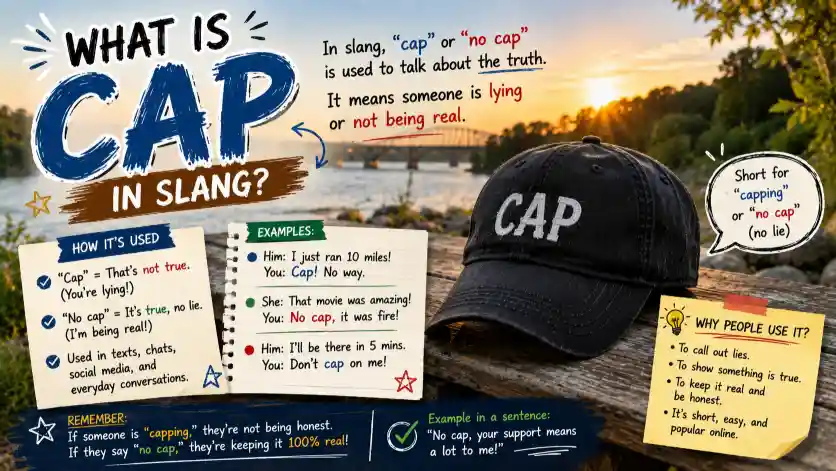
What is cap in slang? “Cap” means a lie, false statement, or something that is not true. When someone says “That’s cap,” they usually mean “That’s a lie” or “I don’t believe you.” In casual online speech, the word is often used to question a statement that sounds false or exaggerated.
You may see cap in text messages, social media comments, gaming chats, memes, and everyday conversations. The word is short and easy to use, so it works well in quick conversations.
The meaning becomes clearer when you see phrases such as “no cap” and “stop capping.” These expressions are closely related, but each one has a slightly different use.
Quick Answer: What Is Cap in Slang?
Cap means a lie, false claim, or exaggeration in slang. If someone says “You’re capping,” they mean that the person is lying or not telling the full truth.
What Does Cap Mean in Slang?
Cap is used when someone believes another person is not being honest.
For example:
“You said you met the singer? That’s cap.”
This means:
“I think you’re lying.”
The word can also describe an exaggerated claim. So, the statement does not always have to be completely false.
For example:
“He says he can finish the whole project in ten minutes. That’s cap.”
Here, the speaker thinks the claim sounds unrealistic.
What Does “No Cap” Mean?
“No cap” means “no lie,” “seriously,” or “I’m telling the truth.”
People use it when they want others to know that they are being honest.
For example:
“No cap, that was the best burger I’ve ever had.”
The speaker is stressing that the opinion is genuine.
Another example:
“No cap, I studied for eight hours.”
Here, the speaker is saying they are not exaggerating.
Because “no cap” shows honesty, it works almost opposite to cap.
What Does “Stop Capping” Mean?
“Stop capping” means “stop lying” or “stop exaggerating.”
Someone may say this when they do not believe another person’s story.
For example:
“Stop capping. You didn’t finish all that work in one hour.”
The speaker thinks the claim is not believable.
The phrase can sound serious, but friends may also use it as a joke. Therefore, the tone of the conversation matters.
What Does “You’re Capping” Mean?
“You’re capping” means “you’re lying” or “you’re not being completely honest.”
For example:
“You’re capping if you say you never liked that song.”
The speaker believes the other person is hiding the truth.
It can also be used when someone makes a very large claim:
“You’re capping. There is no way you ran ten miles in thirty minutes.”
Here, the speaker doubts the statement.
In casual conversations, this phrase can be playful. However, it can sound more direct during an argument.
Cap vs. No Cap
These expressions are closely connected, but they communicate opposite ideas.
| Slang | Simple Meaning | Example |
| Cap | Lie or false claim | “That’s cap.” |
| No cap | Truth / honestly | “No cap, I loved it.” |
| Capping | Lying or exaggerating | “You’re capping.” |
| Stop capping | Stop lying | “Stop capping.” |
In short, cap suggests that something is untrue, while no cap tells the listener that the speaker is being honest.
Is Cap Always About Lying?
Not necessarily. Cap can also refer to exaggeration.
A person may say something that is partly true but make it sound much bigger than it really is.
For example:
“I waited forever for you.”
If the person actually waited for twenty minutes, a friend might jokingly respond:
“That’s cap.”
The friend may not mean that the entire story is fake. Instead, they may be pointing out that the statement is exaggerated.
This is why context matters when someone uses cap.
How Is Cap Used in Texting?
Cap is especially common in short online messages.
Someone can reply with just:
“Cap.”
This means:
“I don’t believe that.”
A person can also write:
“No cap.”
This means:
“I’m serious.”
Example Conversation
Alex: “I got the highest score in the class.”
Sam: “Cap.”
Alex: “No cap. Look at the results.”
In this conversation, Sam doubts the claim, while Alex insists that it is true.
Because the expressions are short, they work well in fast conversations.
Cap Slang in Everyday Life
Cap is not limited to social media. People can also use it in casual conversations with friends.
For example:
“You finished that whole pizza by yourself?”
“No cap.”
Here, the speaker is saying the claim is true.
Another example:
“You said you never watch reality shows. That’s cap.”
The speaker is calling the other person’s statement untrue.
Friends may also use cap jokingly when someone tells an unbelievable story. As a result, the word does not always create a serious argument.
Cap in Social Media
On social media, cap is often used when someone questions a claim.
For example:
“He says he bought that car with cash. Cap.”
The commenter does not believe the statement.
Similarly, someone may post:
“No cap, this is the best movie I’ve seen all year.”
Here, no cap adds emphasis and shows that the opinion is sincere.
However, social media users sometimes use slang playfully. Therefore, the word is not always a serious accusation.
Cap in Gaming
Gamers may use cap when they doubt another player’s claim.
For example:
“You beat that boss on your first try? Cap.”
The player thinks the claim sounds unlikely.
A gamer might also say:
“No cap, that was the hardest level.”
In this case, the speaker is stressing that the opinion is genuine.
The basic meaning stays the same even though the setting changes.
Is Cap Rude?
Cap is informal, but it is not a swear word. Still, calling someone’s statement a lie can sound rude depending on the situation.
For example:
“That’s cap.”
can sound playful between friends.
On the other hand:
“Everything you say is cap.”
can sound more aggressive.
Therefore, the relationship between the speakers and the tone both matter.
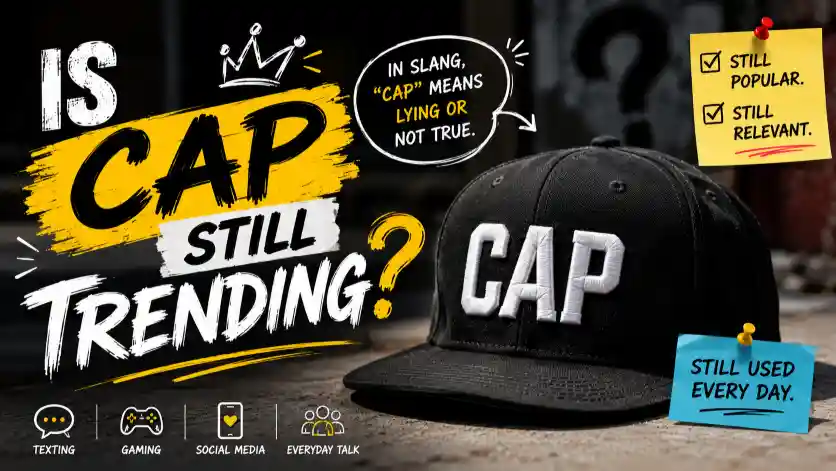
Is Cap Still Trending?
Yes, “cap” is still widely recognized in modern informal English. It remains common in online conversations, social media, gaming, memes, and casual texting.
However, slang changes over time. Some people may use cap often, while others may prefer newer expressions or simply say “lie.”
So, the word is still useful to understand, even if its popularity can vary by age group and online community.
Where Did Cap Come From?
The slang use of “cap” is strongly connected to African American English and later spread widely through internet culture.
The exact history is more complex than one simple origin story. However, the modern slang meaning became especially popular through music, social media, memes, and online conversations.
As the expression spread, phrases such as “no cap” became familiar to a much wider audience.
Today, you can find the term far beyond its earlier communities.
Why Do People Use Cap?
People use cap because it is a short way to question if something is true.
Instead of saying:
“I don’t believe what you are saying.”
someone can simply say:
“Cap.”
Likewise, no cap allows a speaker to stress that they are being honest.
The short wording also fits fast conversations. For example, a person can type one word instead of writing a full response.
Cap in Different Types of Conversations
The meaning stays similar, but the tone can change depending on the setting.
With Friends
Among friends, cap can be playful.
“You ate the whole cake?”
“No cap.”
The exchange may simply be casual joking.
During an Argument
The same word can sound more serious.
“You said you never saw my message.”
“That’s cap.”
Here, the speaker is directly challenging the other person’s claim.
In Online Comments
A short reply such as:
“Cap.”
can show disbelief without a long explanation.
Therefore, the same slang can feel friendly or confrontational depending on the conversation.
Can Cap Mean Exaggeration?
Yes. Cap can describe exaggeration as well as a direct lie.
For example:
“I waited three hours for you.”
If the person actually waited thirty minutes, a friend may call the statement cap.
In this case, the speaker may not have invented the event. Instead, they made it sound much bigger than it was.
This is why cap can be better understood as calling out something that seems untrue, exaggerated, or unbelievable.
What Is the Difference Between Cap and Lie?
“Lie” is a standard English word, while “cap” is informal slang.
| Word | Meaning | Style |
| Lie | Something untrue | Standard |
| Cap | Something untrue or exaggerated | Slang |
| Capping | Lying or exaggerating | Slang |
| No cap | Honestly / seriously | Slang |
For formal writing, lie is usually the better choice.
For casual texting, cap can sound more natural among people who know the slang.
Is Cap Appropriate in Formal English?
Usually, no.
Cap is informal, so it is better suited to casual communication.
Avoid relying on it in:
- School assignments
- Business emails
- Job applications
- Academic writing
- Formal reports
- Professional presentations
Instead, use words such as:
- Lie
- False
- Untrue
- Exaggerated
- Incorrect
These words make your meaning clear and professional.
Common Mistakes With Cap
Mistake 1: Thinking Cap Always Means a Hat
In standard English, cap can mean a type of hat. In slang, however, it can mean a lie or false claim.
Context tells you which meaning is intended.
Mistake 2: Thinking No Cap Means No Hat
In slang, no cap does not refer to clothing.
It means:
“I’m being honest.”
Mistake 3: Using Cap in Every Situation
Cap is informal. Therefore, it may sound strange in a formal conversation.
Mistake 4: Assuming Every Use Is Serious
Friends may use cap as a joke or playful challenge.
As a result, you should consider the speaker’s tone before treating it as a real accusation.
How Can You Tell If Someone Is Using Cap Seriously?
Look at the situation and the relationship between the speakers.
If friends are laughing or joking, cap may simply be playful.
If two people are arguing, the same word can be a direct accusation.
Online, punctuation can also give a clue:
“Cap 😂”
may sound playful.
While:
“That’s cap.”
during an argument may sound more serious.
Still, online messages do not always show tone clearly, so misunderstandings can happen.
Polite Alternatives to Cap
If you want to question a statement without sounding too direct, use a softer phrase.
You can say:
- “Are you sure?”
- “Really?”
- “I’m not sure I believe that.”
- “That sounds unlikely.”
- “Is that true?”
These expressions work better when speaking with someone you do not know well.
For example, instead of:
“That’s cap.”
you could say:
“Are you sure that’s true?”
The second version sounds less confrontational.
Is Cap Safe for Social Media?
Yes, cap itself is generally harmless slang. It is not a swear word or an offensive term.
However, calling someone a liar can still create conflict.
For example, replying “cap” to someone’s personal story may make them feel challenged or mocked.
So, the word is generally safe from a language perspective, but the way you use it still matters.
Frequently Asked Questions
Q1. What is cap in slang?
Answer: Cap means a lie, false statement, or exaggeration. “That’s cap” means the speaker does not believe something is true.
Q2. What does no cap mean?
Answer: No cap means “honestly,” “seriously,” or “I’m telling the truth.” It is used to show that the speaker is not lying or exaggerating.
Q3. What does stop capping mean?
Answer: Stop capping means “stop lying” or “stop exaggerating.” It can be serious or playful depending on the situation.
Q4. Is cap a bad word?
Answer: No. Cap is informal slang, not a swear word. However, saying someone is capping can sound rude if the situation is serious.
Q5. Is cap still used today?
Answer: Yes. Cap is still widely understood and used in casual online communication, social media, gaming, and texting.
Q6. Can I use cap in formal writing?
Answer: It is better to avoid it in formal writing. Use standard words such as lie, false, or untrue instead.
Conclusion
Cap is modern slang for a lie, false claim, or exaggeration. Expressions such as “that’s cap,” “you’re capping,” and “no cap” are common ways to question a statement or show honesty.
The word is mainly used in casual communication. Therefore, it fits texting, social media, gaming, and conversations with friends better than professional or academic writing.
Most importantly, remember the difference between cap and no cap: cap suggests something is not true, while no cap emphasizes that the speaker is being honest.
Discover More:
- What Does Fly Mean in Slang? How “Fly” Became a Compliment
- Tea Slang Definition: Why “Tea” Means More Than a Drink
- Dayroom Slang Meaning: What It Means and How to Use It

Hi, I’m Emma Carter, an English language writer with over 8 years of experience in vocabulary and language learning. At SlangShine, I write simple, accurate, and easy-to-understand articles about slang, synonyms, idioms, and everyday English to help learners build confidence and improve their communication skills.