Jerk meaning in slang usually refers to a person who behaves in a rude, selfish, annoying, or inconsiderate way. When someone calls another person a “jerk,” they are criticizing that person’s behavior or attitude. The word is an informal insult, but it is generally not considered one of the strongest or most vulgar insults in English.
People often search for this term after seeing it in a text, comment, movie, relationship conversation, or social media post.
The meaning can also change slightly with context. For example, “You’re such a jerk” may express genuine anger, while “You jerk 😂” can be playful teasing between friends.
Quick Answer: Jerk Meaning in Slang
A jerk is usually someone who acts rude, selfish, mean, or inconsiderate. It is an insult, but its strength depends on the situation and tone.
What Does “Jerk” Mean?
In everyday English, jerk can describe someone whose behavior annoys, hurts, or disrespects other people.
For example:
“He ignored her when she needed help. What a jerk.”
Here, the speaker is not saying that the person is physically unusual or unintelligent. The word criticizes his behavior toward another person.
You may also hear:
“Don’t be a jerk.”
“He’s acting like a jerk.”
“Why is she being such a jerk?”
These sentences all express some level of disapproval.
The important point is that “jerk” usually describes how someone behaves, rather than giving a precise description of their personality. Someone can act like a jerk in one situation without being a jerk all the time.
What Does “Jerk” Mean in Slang?
The slang or informal sense of jerk is a person who behaves badly toward others, especially by being rude, selfish, inconsiderate, or unpleasant.
It is common in casual American English and has been used this way for much longer than modern social media platforms have existed.
The word can describe behavior such as:
- Being unnecessarily rude
- Ignoring someone’s feelings
- Acting selfishly
- Treating someone unfairly
- Deliberately annoying someone
- Showing little consideration for others
For example:
“He took credit for her work. He’s such a jerk.”
The insult comes from the person’s unfair behavior.
Does “Jerk” Have a Full Form?
No. “Jerk” does not have a standard full form or acronym.
If you see an online post claiming that each letter in J-E-R-K represents a phrase, it is most likely a made-up or humorous expansion rather than the actual meaning.
So, searches such as “jerk full form” or “what does jerk stand for” can be answered simply: it is a complete English word, not an acronym.
Is “Jerk” a Very Bad Word?
No, “jerk” is generally not considered a very bad or highly vulgar word. However, it is still an insult.
Its strength usually falls somewhere between a mild criticism and a stronger personal insult. The exact effect depends on who says it and how they say it.
For example:
“You forgot my birthday, you jerk!”
This could be playful between close friends.
But:
“You’re a selfish jerk. I never want to see you again.”
Sounds much more serious because the surrounding language makes the insult stronger.
How Offensive Is “Jerk”?
“Jerk” is usually less offensive than many vulgar insults. It does not normally contain explicit sexual or obscene language.
Still, calling someone a jerk can hurt their feelings because you are directly judging their behavior or character.
A useful way to think about it is:
Informal + insulting + usually mild to moderate
That makes it unsuitable for some formal situations even though it is not generally viewed as a severe swear word.
Why Do You Call Someone a Jerk?
People usually call someone a jerk when they believe that person’s behavior is rude, selfish, unfair, or inconsiderate.
For example, imagine someone cuts in front of you in a long line. You might say:
“What a jerk.”
You are reacting to the person’s lack of consideration for everyone waiting.
Someone might also use the word after a friend behaves selfishly:
“You knew I wanted the last piece, and you ate it anyway. Jerk!”
The reason behind the word is therefore important. “Jerk” is usually a reaction to behavior that violates ordinary expectations of respect or kindness.
It can also be used when someone repeatedly makes others uncomfortable or deliberately causes problems.
What Does “Jerk” Mean in Love or Romance?
In a romantic context, calling someone a “jerk” usually means that the person is behaving badly toward their partner or someone who has romantic feelings for them.
For example:
“He promised to call, but then disappeared for a week. He’s a jerk.”
Here, “jerk” suggests that the person’s behavior was inconsiderate or hurtful.
It does not automatically mean that the relationship is over. The meaning depends on what happened.
When “Jerk” Is Used Playfully in Love
Romantic partners can sometimes use “jerk” as playful teasing.
For example:
“You ate my chocolate again, you jerk ❤️”
In this situation, the word may sound affectionate rather than hostile because the context shows that the speaker is joking.
However, if someone says:
“You’re a jerk. You never listen to me.”
The meaning is probably much more serious.
So, when you see “jerk meaning in love” or “jerk meaning in romance,” remember that the word itself does not have a special romantic definition. The relationship context simply changes its tone.
What Does “You Are a Jerk” Mean?
“You are a jerk” means that the speaker thinks you are behaving in a rude, selfish, mean, or inconsiderate way.
For example:
“You borrowed my car and returned it without gas. You are a jerk.”
The speaker is criticizing the person’s action and attitude.
The phrase can be:
- Serious: “You are a jerk. I can’t believe you lied to me.”
- Casual: “You are a jerk for taking the last cookie.”
- Playful: “You are a jerk 😂 You scared me!”
Tone is especially important in spoken English. In text messages, emojis, punctuation, and the previous conversation can help show if the statement is serious or playful.
Jerk Behavior: What Does It Mean?
Jerk behavior refers to actions that are rude, selfish, disrespectful, or inconsiderate.
Some examples include:
- Interrupting someone repeatedly
- Taking advantage of another person
- Deliberately embarrassing someone
- Ignoring reasonable requests
- Taking credit for someone else’s work
- Treating service workers disrespectfully
- Breaking a promise without caring about the consequences
For example:
“Making fun of someone after they told you they were hurt is jerk behavior.”
The phrase does not necessarily mean that the person is always terrible. It identifies a specific type of conduct.
This is also why “jerk behavior” and “being a jerk” are closely related expressions.
WWhere Is “Jerk Meaning in Slang” Commonly Used?
“Jerk” is common in everyday informal English, so you may come across it in many different communication settings.
You may see or hear the word in:
- Text messages
- Instagram comments
- TikTok discussions
- Snapchat chats
- Reddit conversations
- Discord servers
- Gaming chats
- Movies and television
- Everyday spoken conversations
Unlike many modern internet slang terms, “jerk” did not originate online. English speakers have used it as an insult for many years, long before social media became popular.
The meaning can still change with the situation, especially in online conversations. For example, “What a jerk” might show real anger, mild annoyance, or even playful criticism.
The speaker’s tone and the situation usually make the intended meaning clear.
How Is “Jerk” Used in Different Tones?
The same word can communicate very different emotions.
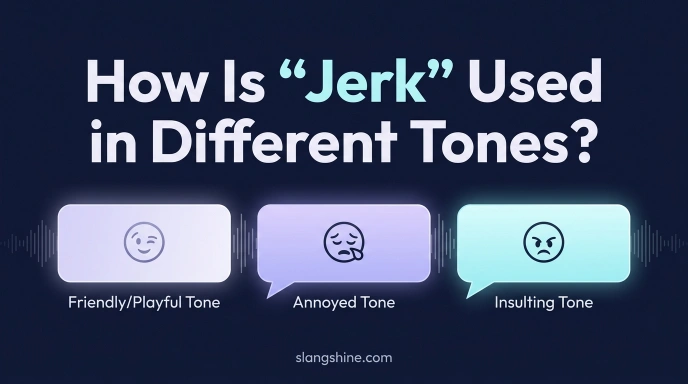
Friendly or Playful
“You hid my phone again, you jerk! 😂”
This sounds playful if close friends regularly tease each other.
Casual
“That guy pushed past everyone. What a jerk.”
The speaker is simply criticizing rude behavior.
Angry
“Stop being a jerk and apologize.”
Here, the word is clearly confrontational.
Romantic
“You forgot our date again. You’re such a jerk.”
This may show genuine disappointment or frustration within a relationship.
Gaming
“He took all the rewards and left the team. What a jerk.”
In gaming, the word can describe a player who acts selfishly toward teammates.
“Jerk” vs. Similar Words
“Jerk” overlaps with several insults, but each one focuses on something slightly different.
| Word | Main idea | Typical strength |
| Jerk | Rude, selfish, or inconsiderate person | Mild–moderate |
| Idiot | Person seen as foolish or unintelligent | Moderate |
| Brat | Spoiled or badly behaved person | Mild |
| Mean | Unkind behavior or attitude | Mild |
| Asshole | Extremely rude or unpleasant person | Stronger |
| Loser | Person viewed as unsuccessful or unimpressive | Insulting |
For example, calling someone a jerk usually focuses on how they treat others. Calling someone an idiot focuses more on perceived stupidity.
Other Meanings of “Jerk”
“Jerk” does not always refer to an unpleasant person.
The word also has ordinary meanings connected with sudden movements.
For example:
“The car jerked forward.”
Here, “jerked” means the car moved suddenly or unevenly.
You may also hear:
“He jerked his head toward the door.”
In this sentence, “jerked his head” means he moved his head suddenly or quickly in a particular direction.
This is completely different from the slang insult.
The word also appears in food terminology, such as jerk seasoning or jerk chicken, referring to a style of Caribbean cooking. Context tells you which meaning is intended.
When Should You Avoid Using “Jerk Meaning in Slang”?
Even though “jerk” is relatively mild, it is still a negative label. You should avoid it when a respectful or professional tone is important.
For example, saying:
“My manager is a jerk.”
may be fine when chatting privately with a friend, but it would not be appropriate in a formal workplace email.
Instead, you could describe the actual problem:
“I found his response unnecessarily rude.”
This approach is clearer and less confrontational.
It is also better to avoid the word when you do not know if someone will understand your humor. A playful “jerk” between friends can sound insulting when used with a stranger.
Polite Alternatives to “Jerk”
If you want to criticize someone’s behavior without directly insulting them, try a more specific word.
Rude:
“That was rude.”
Inconsiderate:
“That was very inconsiderate.”
Selfish:
“That was a selfish thing to do.”
Unkind:
“That comment was unkind.”
Unprofessional:
“His behavior was unprofessional.”
These alternatives often work better because they identify the problem without attacking the person’s entire character.
Is “Jerk” Safe to Use on Social Media?
Generally, “jerk” is a mild insult and is commonly seen in ordinary online conversations. However, that does not mean every use is appropriate.
A single comment such as:
“That was a jerk move.”
Is different from repeatedly targeting a person with insults.
Social media also removes much of the tone people rely on in face-to-face conversations. A joke that sounds harmless when spoken may look serious in a text comment.
If you use “jerk” online, consider the audience and context before posting it.
Is “Jerk” the Same as “Jerk Off”?
No. These expressions have different meanings and different levels of appropriateness.
When you say:
“He’s a jerk.”
You are calling the person rude or inconsiderate.
“Jerk off” is a separate vulgar expression with an explicit sexual meaning. It should not be treated as a stronger form of the same insult.
This distinction is useful for English learners because the words look connected, but their everyday meanings are quite different.
FAQs About Jerk Meaning in Slang
Q1. Is “jerk” a very bad word?
Answer: No. “Jerk” is an insult, but it is generally considered a mild-to-moderate one rather than a very strong swear word. Its effect depends on context and tone.
Q2. What does “jerk” mean in love?
Answer: In a romantic context, “jerk” usually describes someone who behaves selfishly, rudely, or hurtfully toward a partner. Couples may also use it playfully when teasing each other.
Q3. What does “jerk” mean?
Answer: “Jerk” usually means a person who behaves in a rude, selfish, mean, or inconsiderate way. It can also have non-slang meanings related to sudden movement or food.
Q4. Why do you call someone a jerk?
Answer: People usually call someone a jerk when that person acts rude, selfish, unfair, disrespectful, or inconsiderate. The word criticizes their behavior.
Q5. What does “you are a jerk” mean?
Answer: “You are a jerk” means the speaker believes you are behaving badly or treating someone poorly. It can sound serious or playful depending on the situation.
Q6. What does “jerked his head” mean?
Answer: “Jerked his head” means he moved his head suddenly or quickly in a particular direction. This is a literal meaning of “jerk,” not the slang insult.
Conclusion
Jerk meaning in slang is mainly used for a person who behaves rudely, selfishly, or inconsiderately. It is an informal insult, but it is usually not considered one of the strongest bad words in English.
The context matters greatly. In a serious argument, “jerk” can clearly express anger. Between close friends or romantic partners, it may be playful teasing.
The word can also have completely different meanings when it describes sudden movement, food, or an action such as “jerked his head.”
If you understand the tone, relationship, and situation, you can usually tell what the speaker means. When you need a more respectful option, words such as “rude,” “unkind,” or “inconsiderate” are safer choices.
Learn More Slang Terms:
- HGS Slang: What Does It Mean in Text and Social Media?
- ABC Meaning Slang: What Does ABC Mean in Text, and Roblox?
- Brooklyn Slang: Words, Meanings, and How Locals Talk

Hi, I’m Anna Whitmore. I have 7+ years of experience writing about English slang and vocabulary. At SlangShine, I create simple, easy-to-understand content for English learners.