Looking for slang words for good? English slang has plenty of cool, casual alternatives.
These words add personality to your conversations. They work great in everyday chats and social media captions too.
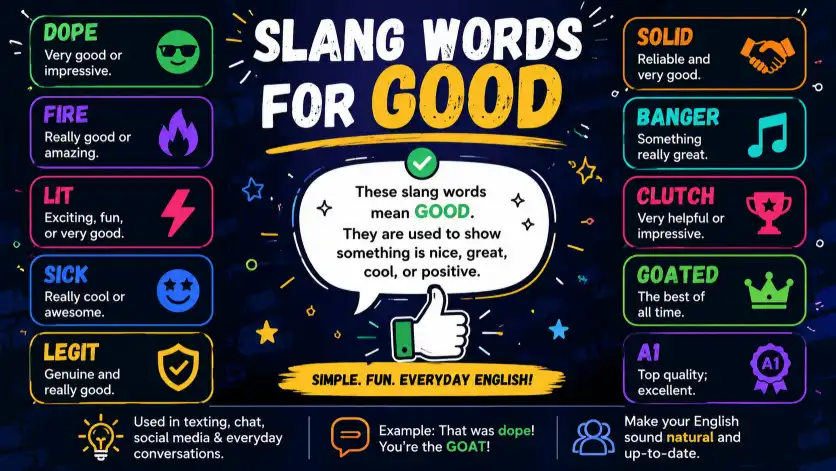
Instead of “good,” people often say things like “lit,” “fire,” “dope,” or “solid.” Each word makes a sentence feel more casual. Every word also carries its own vibe.
These slang terms are popular among younger generations. You’ll hear them a lot in the US and UK.
Want to sound more natural in conversations? Or just want to understand what your friends mean? Here’s a list of popular slang words for good and what they actually mean.
Quick Answer: Slang Words For Good
Slang words for good are informal ways to describe something that is excellent, impressive, enjoyable, or high quality. Common examples include fire, dope, lit, awesome, sweet, and solid.
| Meaning | Tone | Offensive? | Common Users | Common Places |
| Informal words meaning good, great, or excellent | Casual | ❌ No | Teenagers, adults, gamers, social media users | Text messages, TikTok, Instagram, gaming, everyday conversations |
What Do Slang Words for Good Mean?
Slang words for good are casual alternatives that make conversations sound more natural and expressive.
Instead of simply saying good, people often choose slang that better matches their excitement or opinion.
Some slang words describe something amazing, while others simply mean acceptable or reliable.
A Simple Example
Emma: How was the movie?
Jake: It was fire!
Here, fire means the movie was extremely good.
Common Characteristics
Casual and friendly
Common on social media
Popular among younger speakers
Used to praise people, things, or experiences
Meanings can vary depending on the context
Do Slang Words for Good Stand for Anything?
No. Most slang words for good are not abbreviations or acronyms.
They are informal words or expressions that have developed through everyday speech, music, gaming, and internet culture.
Popular Slang Words for Good
Fire
Fire means something is extremely good, exciting, or impressive.
Example:
“That new song is fire.”
Dope
Dope means excellent, cool, or impressive.
Example:
“Your new shoes are dope.”
Lit
Lit describes something exciting, fun, or full of energy.
Example:
“The concert was lit.”
Sweet
Sweet means nice, enjoyable, or very good.
Example:
“That’s a sweet idea.”
Solid
Solid describes something dependable, well done, or of good quality.
Example:
“You did a solid job on the project.”
Awesome
Awesome means extremely good or impressive.
Example:
“Your presentation was awesome.”
Sick
In modern slang, sick often means amazing or impressive.
Example:
“That skateboard trick was sick.”
Cool
Cool is one of the most common slang words for something good or enjoyable.
Example:
“That’s a really cool jacket.”
Where Are Slang Words for Good Commonly Used?
People use these expressions in many everyday situations.
| Platform or Situation | How They’re Used |
| Text messages | Complimenting friends or sharing opinions |
| TikTok | Reacting to videos and trends |
| Comments and captions | |
| YouTube | Reviews and reactions |
| Gaming | Praising teammates or gameplay |
| Everyday conversations | Talking about people, places, or experiences |
Many of these slang words change in popularity over time.
For example, cool has remained common for decades, while words like lit and fire became especially popular through social media and music.
Are Slang Words for Good Rude, Offensive, or Harmless?
Most slang words for good are harmless and are used to compliment people, places, events, or experiences.
They help conversations sound more natural and expressive.However, some slang words may not be suitable in formal situations.
For example, dope, lit, or sick are common in casual speech but may sound unprofessional in business meetings or academic writing.
| Situation | Appropriate? | Notes |
| Casual conversations | ✅ Yes | Natural and friendly |
| Text messages | ✅ Yes | Very common |
| Social media | ✅ Yes | Frequently used in posts and comments |
| Workplace chats | ⚠️ Sometimes | Use with coworkers you know well |
| Job interviews | ❌ No | Choose formal words like “excellent” or “great” |
| Academic writing | ❌ No | Avoid slang |
Real Life Examples Of Slang Words For Good
Friendly Conversation
Emma: How was your vacation?
Noah: It was awesome. I had a great time.

Text Message
Friend: Did you try the new burger place?
Reply: Yeah, it was fire.
Social Media
“That new album is absolutely dope.”
Gaming
Player 1: Nice shot!
Player 2: Thanks! That was sick.
Everyday Conversation
Olivia: What do you think of my new bike?
Lucas: It looks cool.
Origin and History Of Slang Words For Good:
People have used informal words instead of good for generations. As music, television, movies, and the internet influenced everyday language, new slang expressions became popular.
Some terms have been around for decades:
- Cool became widely popular in the mid-20th century.
- Awesome became common in everyday English during the 1980s.
- Dope later evolved from earlier slang to mean excellent or impressive.
- Lit gained popularity through hip-hop culture and social media.
- Fire became widely used online to describe something outstanding.
Today, social media platforms like TikTok, Instagram, YouTube, and X continue to introduce and spread new slang words for good.
Similar Slang or Related Terms
| Slang | Meaning | Tone |
| Fire | Excellent or amazing | Casual |
| Lit | Exciting or fun | Casual |
| Dope | Impressive or cool | Casual |
| Awesome | Extremely good | Friendly |
| Cool | Nice or enjoyable | Casual |
| Sick | Amazing or impressive | Casual |
| Sweet | Nice or pleasing | Friendly |
| Solid | Reliable or well done | Neutral |
Although these words all suggest something positive, they are not always interchangeable. For example, solid often describes dependable quality, while fire expresses strong excitement.
When Should You Avoid Using Slang Words for Good?
Slang works best in relaxed conversations, but it is not appropriate everywhere.
Avoid using slang when:
- Writing business emails.
- Preparing school assignments.
- Attending job interviews.
- Giving professional presentations.
- Writing official reports or documents.
In these situations, formal words such as good, great, excellent, outstanding, or high-quality are better choices.
Why Do People Use Slang Words for Good?
People use slang because it makes conversations feel more expressive and personal.
Common reasons include:
- Showing excitement.
- Complimenting someone or something.
- Sounding more natural.
- Following modern trends.
- Connecting with friends and online communities.
Many slang words also help express different levels of enthusiasm. Saying something is fire usually shows more excitement than simply saying it is good.
Common Misunderstandings
A common misunderstanding is that all slang words for good mean exactly the same thing.
They don’t.
For example:
- Fire usually means extremely impressive.
- Lit often describes an exciting event.
- Solid means dependable or well done.
- Cool means nice or enjoyable.
- Sick usually means amazing, not unhealthy.
Understanding these differences helps you choose the right word for the right situation.
Frequently Asked Questions
Q1. What are the most common slang words for good?
Answer: Some of the most common slang words for good are fire, dope, lit, cool, awesome, solid, sweet, and sick. These words are widely used in casual conversations and on social media.
Q2. Is fire slang for good?
Answer: Yes. In modern slang, fire means something is excellent, exciting, or very impressive. People often use it to describe music, food, clothes, videos, or performances.
Q3. What does lit mean in slang?
Answer: Lit means something is exciting, fun, or full of energy. It is commonly used to describe parties, concerts, celebrations, or memorable experiences.
Q4. Is dope a positive slang word?
Answer: Yes. In modern slang, dope usually means excellent, cool, or impressive. Although the word has other meanings in different contexts, it is often used as a compliment in everyday conversations.
Q5. Can I use slang words for good at work?
Answer: You can use them in casual conversations with coworkers if the workplace culture is informal. However, in meetings, presentations, emails, or professional documents, it is better to use words like good, great, excellent, or outstanding.
Q6. Which slang word for good is the most popular?
Answer: Cool is one of the most widely recognized slang words for good because people of all ages understand it. Among younger speakers, fire, dope, and lit are also very popular.
Q7. Are slang words for good still changing?
Answer: Yes. Slang changes over time as language evolves. New expressions often become popular through TikTok, Instagram, YouTube, music, and online communities, while older slang may become less common.
| Word | Common Meaning |
| Fire | Excellent or amazing |
| Lit | Exciting and fun |
| Dope | Impressive or cool |
| Cool | Nice or enjoyable |
| Awesome | Extremely good |
| Solid | Reliable or well done |
Q8. What are slang terms for good?
Answer: Common slang words for good include awesome, dope, lit, fire, sick, solid, sweet, and cool. The best choice depends on the situation.
Q9. What is Gen Z slang for good?
Answer: Gen Z slang for good includes fire, bussin’, slay, W, peak, and ate. These words are popular on TikTok and social media.
Q10. What is a slang word for “very good”?
Answer: Slang words for very good include awesome, amazing, fire, top-tier, elite, and next-level. They express strong approval or praise.
Q11. What is a slang word for nice?
Answer: Slang words for nice include cool, sweet, dope, chill, solid, and lit. These words are commonly used in casual conversations and online chats.
Conclusion
Slang words for good make conversations more expressive, friendly, and engaging.If you say fire, dope, lit, awesome, cool, or solid, each expression adds its own style and personality to the way you describe something positive.
The best slang word depends on the situation and your audience.
Casual conversations, social media posts, and text messages are great places to use these expressions, while formal settings usually call for more traditional words like good, great, or excellent.
Learning these popular slang terms will help you better understand modern English and communicate more naturally.
Keep Exploring:

Hi, I’m Emma Carter, an English language writer with over 8 years of experience in vocabulary and language learning. At SlangShine, I write simple, accurate, and easy-to-understand articles about slang, synonyms, idioms, and everyday English to help learners build confidence and improve their communication skills.