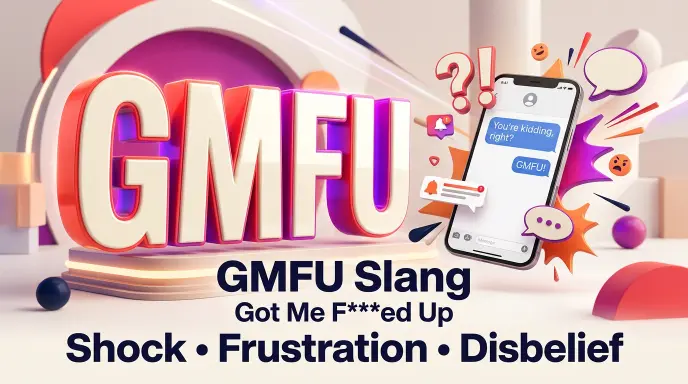
GMFU Slang usually means “got me fucked up” in texting and internet slang. People use it when something makes them feel shocked, annoyed, confused, hurt, or strongly surprised.
You may see GMFU slang in text messages, social media comments, memes, and private chats. For example, someone might say, “That price GMFU,” meaning the price shocked or upset them.
The abbreviation contains profanity, so its tone is much stronger than a phrase like “that surprised me” or “that annoyed me.” It is mainly used in casual conversations. This guide explains what GMFU means, how people use it, what tone it carries, and when it is better to avoid it.
Quick Answer: GMFU Slang
GMFU usually means “got me fucked up.” It is a vulgar internet abbreviation used to show that something has strongly shocked, annoyed, confused, hurt, or upset someone.
What Does GMFU Mean in Texting?
GMFU means “got me fucked up” when it is used as casual texting slang.
The phrase does not always mean that someone is literally upset. Instead, it often shows a strong emotional reaction.
For example:
“You really thought I would pay $200 for that? GMFU.”
Here, the person is saying that the situation is unreasonable or insulting.
Another example is:
“She said she forgot my birthday. GMFU.”
In this case, the speaker may feel hurt or disappointed.
So, the exact emotion depends on the situation.
Simple Meaning
Depending on the context, GMFU can mean:
- That shocked me.
- That upset me.
- That annoyed me.
- That is unbelievable.
- You must be joking.
- That is really bothering me.
The common idea is a strong negative reaction.
What Does GMFU Stand For?
GMFU stands for “got me fucked up.”
Here is the breakdown:
| Letter | Word |
| G | Got |
| M | Me |
| F | Fucked |
| U | Up |
The F-word makes GMFU vulgar slang. That is why it is mostly found in casual online communication rather than formal writing.
You may also see the phrase written with the profanity partly censored, such as “got me f*ed up.”** The meaning is generally the same.
What Does GMFU Mean in Different Contexts?
GMFU can express different emotions. The basic phrase stays the same, but the reason for using it can change.
1. When Something Is Shocking
Someone may use GMFU after hearing surprising news.
“You paid $500 for that? GMFU.”
The speaker is shocked by the price.
2. When Something Is Annoying
GMFU can show frustration with a situation.
“This app keeps logging me out. GMFU.”
The person is saying that the situation is seriously annoying them.
3. When Someone Feels Hurt
The abbreviation can also express emotional disappointment.
“You invited everyone except me? GMFU.”
Here, the speaker feels hurt or offended.
4. When Something Seems Unreasonable
People may use GMFU when they think someone has made an unfair or ridiculous request.
“You want me to work all weekend for free? GMFU.”
The speaker strongly rejects the idea.
Is GMFU a Bad Word?
GMFU is considered vulgar because it contains the F-word.
The abbreviation may look less obvious than the full phrase, but people who know the slang will understand the profanity.
It is therefore important to consider the audience.
| Situation | GMFU? |
| Private chat with close friends | Usually okay |
| Casual social media comment | Possible |
| Gaming chat | Common in casual spaces |
| Public professional account | Avoid |
| Workplace message | Avoid |
| School assignment | Avoid |
| Formal email | Avoid |
If you want to express the same feeling without profanity, use a cleaner phrase such as “That really upset me” or “You have got to be kidding me.”
Is GMFU Offensive?
GMFU can sound offensive, but it depends on how it is used.
When someone says:
“This situation GMFU.”
they may simply be expressing frustration.
However, saying:
“You GMFU.”
directly toward another person can sound more aggressive or confrontational.
The difference is important. A person describing their reaction may sound frustrated, while directing the phrase at someone can feel like an insult.
Where Is GMFU Commonly Used?
GMFU is mainly used in informal online communication.
You may encounter it in:
- Text messages
- Group chats
- Instagram comments
- TikTok comments
- Snapchat messages
- Discord chats
- Gaming communities
- Memes
- Casual social media posts
The meaning usually stays the same across these platforms.
GMFU on TikTok
A TikTok comment might say:
“The ending GMFU.”
This means the ending caused a strong reaction, such as shock or frustration.
GMFU on Instagram
Someone might comment:
“That price GMFU.”
They are saying the price is unbelievable or upsetting.
GMFU on Snapchat
A friend might text:
“You really forgot? GMFU.”
The message shows disappointment or frustration.
GMFU on Discord or Gaming Chats
A player might write:
“That lag GMFU.”
They mean the lag is extremely frustrating.
GMFU in Gaming Slang
GMFU can be used in gaming chats when a player has a strong reaction to something that happens in a game.
For example:
“That boss fight GMFU.”
The player may mean the fight was extremely frustrating or difficult.
Another example:
“My teammate left at the last second. GMFU.”
Here, the abbreviation shows annoyance.
GMFU is not a gaming-specific abbreviation, though. Gamers use it because it already belongs to casual internet slang.
Real-Life Examples of GMFU
Friendly Example
“You ate the whole pizza? GMFU 😂”
The speaker is jokingly surprised.
Frustrated Example
“My internet stopped working during the meeting. GMFU.”
The person is annoyed.
Social Media Example
“They raised the ticket price again. GMFU.”
The writer is frustrated by the price increase.
Argument Example
“You knew about this and didn’t tell me? GMFU.”
This sounds more serious and confrontational.
Gaming Example
“I lost because the game crashed. GMFU.”
The player is expressing strong frustration.
Is GMFU Appropriate at Work?
No. GMFU is not a good choice for professional communication.
Even if your coworkers use casual language, the profanity can make the message sound unprofessional.
Instead of:
“This deadline GMFU.”
you could write:
“This deadline is really stressful.”
Or:
“This deadline is causing some problems.”
These alternatives communicate the same general feeling without profanity.
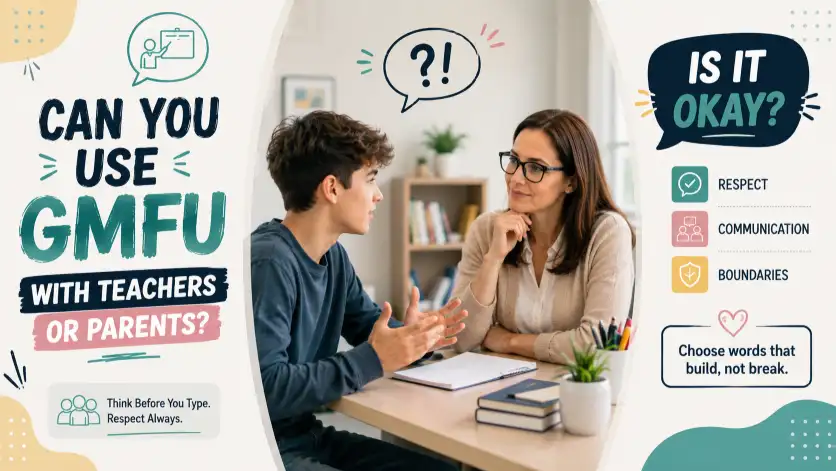
Can You Use GMFU With Teachers or Parents?
It is better to avoid GMFU with teachers, parents, or other people who expect respectful language.
The abbreviation contains profanity, so it may sound disrespectful even when you do not intend it that way.
For a cleaner message, use:
- That really surprised me.
- That really upset me.
- I can’t believe that.
- That is really frustrating.
- Are you serious?
These phrases are easier to use with a wider range of people.
Why Do People Use GMFU?
People use GMFU because it expresses a strong reaction in only four letters.
It can make a message feel:
- More emotional
- More direct
- More dramatic
- More casual
- More expressive
It is especially useful in short online messages where people want to show their reaction quickly.
However, the abbreviation does not tell you the exact emotion by itself. You need to look at the surrounding message to know if the person is shocked, angry, hurt, annoyed, or joking.
GMFU vs. Similar Slang
GMFU is close to several other internet expressions, but the tone is not exactly the same. Some alternatives are less vulgar, while others show a different type of reaction.
| Slang | Common meaning | Tone |
| GMFU | Got me fucked up | Vulgar, strong |
| WTF | What the fuck | Vulgar, surprised |
| WTH | What the heck | Milder |
| FR | For real | Casual |
| SMH | Shaking my head | Annoyed or disappointed |
| OMG | Oh my God | Surprise or excitement |
| Are you serious? | Strong disbelief | Neutral |
For example, GMFU often describes how a situation affects you, while WTF is commonly used as a direct reaction to something unexpected.
GMFU vs. “Got Me Fucked Up”
GMFU and “got me fucked up” usually mean the same thing.
The main difference is format.
- GMFU = shortened internet form
- Got me fucked up = full phrase
The abbreviation is more common in quick messages, comments, and online conversations.
For example:
“That comment GMFU.”
and:
“That comment got me fucked up.”
express the same basic reaction. The first one simply feels shorter and more like internet slang.
Does GMFU Always Mean “Angry”?
No. GMFU does not always mean anger.
It can describe several strong reactions.
For example:
- Shock: “That price GMFU.”
- Frustration: “This update GMFU.”
- Disappointment: “You really forgot? GMFU.”
- Disbelief: “You paid that much? GMFU.”
- Hurt: “You said that in front of everyone? GMFU.”
The surrounding words and situation tell you which emotion the person means.
When Should You Avoid Using GMFU?
Avoid GMFU when you need to sound polite, professional, or respectful.
It is better not to use it in:
- Job applications
- Workplace emails
- School assignments
- Academic writing
- Formal complaints
- Professional presentations
- Messages to teachers
- Official communication
You should also be careful when speaking to people you do not know well.
The abbreviation contains strong profanity. Even when used casually, it can make your message sound aggressive.
Polite Alternatives to GMFU
If you want to express a strong reaction without profanity, you have many options.
For Surprise
“I can’t believe that.”
For Frustration
“That is really frustrating.”
For Disbelief
“Are you serious?”
For Disappointment
“That really disappointed me.”
For Shock
“That really surprised me.”
These phrases are safer for school, work, family conversations, and public communication.
Common Misunderstandings About GMFU
GMFU Is Not a Positive Slang Term
GMFU normally expresses a strong negative reaction. It is not usually used to say that something is fun, cool, or impressive.
GMFU Does Not Always Mean Someone Is Angry
The person could be shocked, hurt, frustrated, or simply unable to believe something.
The Abbreviation Does Not Remove the Profanity
Writing GMFU instead of the full phrase does not make the expression formal or completely clean. People familiar with the slang understand what the letters represent.
GMFU Is Not Only Used in Text Messages
It can appear in comments, captions, memes, gaming chats, and other informal online spaces.
Is GMFU Safe to Use on Social Media?
“GMFU is not inherently harmful, but it is vulgar slang and may sound offensive or inappropriate in some situations.”
It can be used casually on social media, but the audience matters. A public post may be seen by coworkers, teachers, parents, younger users, or people who dislike profanity.
If you want your content to be suitable for a broad audience, a cleaner expression is usually better.
For example:
“That price GMFU.”
could become:
“That price is unbelievable.”
The second version is clear without using profanity.
What Does GMFU Mean for Younger Users?
Younger people may encounter GMFU through social media, memes, comments, or online chats.
The important point is that GMFU is an informal abbreviation containing profanity. Understanding it does not mean someone needs to use it.
If a student sees GMFU online, the simple explanation is:
It is slang for “got me fucked up,” used to show a strong reaction such as shock, frustration, or disbelief.
For school or other formal settings, a neutral expression is more appropriate.
Frequently Asked Questions
Q1. What does GMFU mean in slang?
Answer: GMFU usually means “got me fucked up.” It is vulgar internet slang used to show a strong reaction such as shock, frustration, disbelief, or hurt.
Q2. What does GMFU stand for in texting?
Answer: GMFU stands for “got me fucked up.” It is mainly used in informal texts, chats, comments, and social media conversations.
Q3. Is GMFU a bad word?
Answer: GMFU is considered vulgar slang because it represents a phrase containing the F-word. It is best avoided in formal or professional settings.
Q4. What does GMFU mean on TikTok or Instagram?
Answer: On TikTok and Instagram, GMFU usually has the same meaning: “got me fucked up.” People often use it in comments or captions to show shock, frustration, or disbelief.
Q5. Can I use GMFU at work or school?
Answer: It is better not to. GMFU contains profanity and can sound unprofessional. Use phrases such as “that is frustrating” or “I can’t believe that” instead.
Q6. Does GMFU always mean someone is angry?
Answer: No. GMFU can express anger, but it can also show surprise, disappointment, frustration, hurt, or disbelief. The context determines the exact emotion.
Conclusion
GMFU slang usually means “got me fucked up.” It is an informal and vulgar expression used to show a strong reaction to something.
People may use it when they feel shocked, frustrated, disappointed, hurt, or unable to believe what happened. The abbreviation is common in casual texts, social media, gaming chats, and online conversations.
However, GMFU is not suitable for formal communication because it contains profanity. If you are talking to a teacher, employer, client, or someone you do not know well, choose a cleaner phrase such as “That really surprised me” or “That is really frustrating.”
The easiest way to remember it is: GMFU = “got me fucked up,” a strong and vulgar way to describe an intense reaction.
Discover More Articles:
- PITA Slang Meaning: Why Do People Call Something a “PITA”?
- Slang Words for Boobs: Meanings, Tones & Examples
- Cook Slang: What Does “Let Him Cook” & “Cooked” Mean?

Hi, I’m Anna Whitmore. I have 7+ years of experience writing about English slang and vocabulary. At SlangShine, I create simple, easy-to-understand content for English learners.