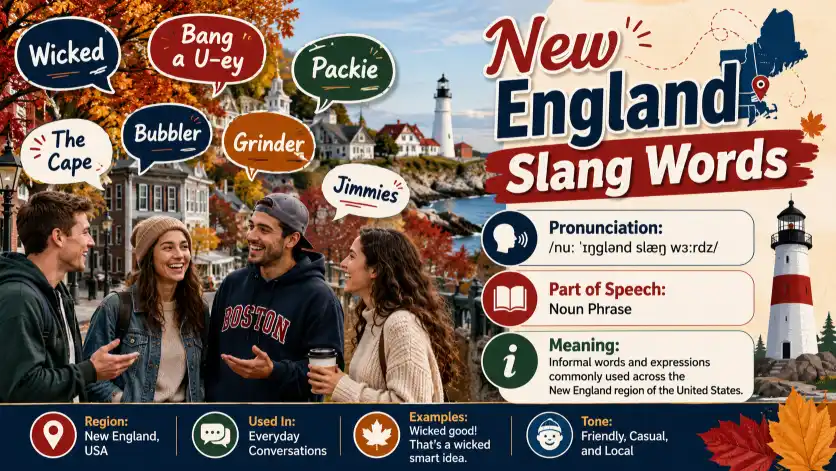
New England slang words are informal expressions and phrases used by people living in Massachusetts, Connecticut, Rhode Island, Maine, New Hampshire, and Vermont, shaped heavily by the region’s history, weather, and local accent.
Many of these words are common in the Boston area. However, each New England state may use them a little differently.
You may have heard someone from New England Slang Words use a word like “wicked” or “grinder” and wondered what it actually meant, especially if you’re not from the area.
These words are part of local culture. So, they can confuse visitors or people who see them online for the first time.
Understanding New England slang words helps you follow conversations, social media posts, and even TV shows or movies set in the region without missing the meaning.
Quick Answer: New England Slang
New England slang words are regional expressions used across states like Massachusetts, Maine, and Connecticut, including terms like “wicked” (very), “grinder” (a sandwich), and “packie” (liquor store), many rooted in the area’s distinct Boston influenced accent and culture.
What Are New England Slang Words?
New England slang words are regional terms that developed within specific communities across the six New England states.
These words are common across New England. Others are common only in one city or state, especially around Boston.
These words usually fall into a few categories: describing intensity (“wicked”), naming everyday local items (“grinder,” “packie”), or referring to local geography and culture in a shorthand way.
Common New England Slang Words and Meanings
| Word | Meaning |
| Wicked | Very, extremely (e.g., “wicked cold today”) |
| Grinder | A submarine sandwich |
| Packie | A liquor store (short for “package store”) |
| Bubbler | A water fountain |
| Rotary | A traffic roundabout |
| Frappe | A milkshake made with ice cream |
| Kid | Used casually to address someone, regardless of age |
| Down cellar | Referring to the basement |
Do New England Slang Words Have a Full Form?
No. New England slang words don’t have a full form.
Unlike text abbreviations such as LOL or BRB, these are regional English words and phrases, not acronyms.
Some words, like “grinder” and “bubbler,” are local names for everyday things. Others, like “wicked,” mean “very” or “really.”
Are New England Slang Words Rude, Offensive, or Neutral?
New England slang words are almost entirely neutral and harmless. People use these words in everyday conversations. They are not meant to offend anyone.
Neutral, Everyday Usage
Most of these words simply describe common things or add local flavor to a sentence.
Examples:
- “It’s wicked hot out today.”
- “I’ll grab a grinder for lunch.”
- “Can you fill my bottle at the bubbler?”
Words That Can Sound Odd Outside the Region
A few terms, like “packie,” can sound unfamiliar or even confusing to outsiders, since they reference something specific to New England culture (a liquor store) that isn’t obvious from the word itself.
This isn’t offensive it’s simply regional shorthand that non locals may not recognize right away.
Context Sensitivity
These words are not rude in normal conversations.The main thing to keep in mind is that some words, especially “packie,” may need explaining to someone from outside New England to avoid confusion.
Where Do People Use New England Slang?
| Platform | Common Usage |
| Everyday Conversation | Used naturally in daily speech across New England |
| Text Messages | Common between locals, especially words like “wicked” |
| Social Media | Used in captions or comments referencing local culture |
| TV Shows/Movies | Frequently featured in media set in Boston or New England |
| Tourism/Travel Content | Explained for visitors unfamiliar with the region |
Everyday Conversation
People who grow up in New England use these words every day. They use them without thinking about it.
Social Media
Locals often use terms like “wicked” or “grinder” in posts as a way of showing regional pride or identity.
TV Shows and Movies
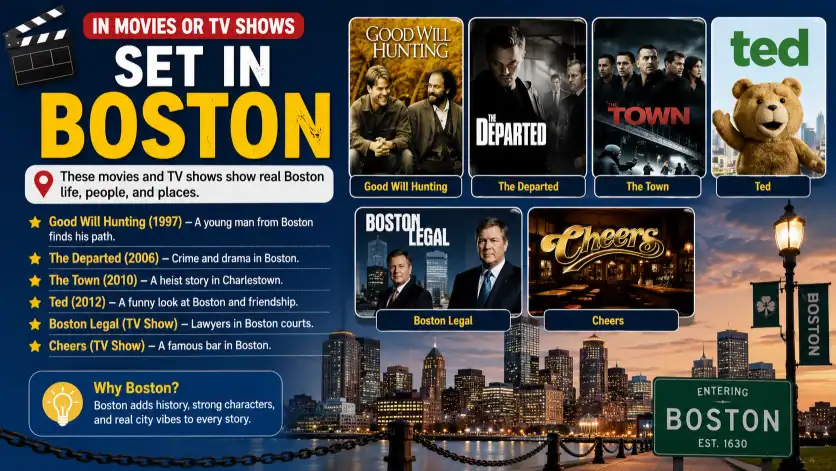
Films and shows set in Boston or New England frequently use this slang to make dialogue sound authentic to the setting.
Real Life Examples of New England Slang Words
These words are part of local culture. So, real examples make their meaning easy to understand.
These words are part of everyday life in New England. Real sentences show how people use them.
Everyday Conversation
- “It’s wicked cold out, grab a jacket.”
- “I’m starving, let’s stop for a grinder on the way home.”
- “Fill up your water bottle at the bubbler before we leave.”
Text Messages Between Friends
- The traffic is wicked bad today.
- “Meet me at the rotary near the mall.”
- “Can you swing by the packie before the party?”
Social Media Captions
- “Nothing beats a frappe on a wicked hot summer day 🍦”
- “Down cellar doing laundry, send help.”
In Movies or TV Shows Set in Boston
- “You’re wicked smart, kid.”
- Grab your stuff. We’re headed down cellar.
These examples show how naturally the words fit into ordinary sentences, without needing extra explanation for someone from the region.
Origin and Background of New England Slang Words
Most New England slang grew over many years. Local people started using these words in everyday life. Because of that, no one knows the exact origin of many terms.
The word “wicked” is closely linked to the Boston area. People use it to mean “very.” Over time, Boston speech and pop culture made it popular across the country.
Many people believe the word “grinder” came from eating a large sandwich that takes time to chew. However, no official record proves this idea.
“Packie” is short for “package store,” an older New England term for a liquor store, which is why the shortened slang version stuck in everyday conversation.
“Bubbler” is thought to trace back to an early drinking fountain brand name that used a bubbling water design, with the term sticking around in parts of New England (and separately in Wisconsin) long after the original product name faded from common use.
“Rotary” simply reflects an older, still common regional term for what much of the rest of the U.S. calls a “roundabout.”
Overall, most of this slang reflects a mix of local history, immigrant influence, and the strong regional identity tied to the Boston accent, rather than any single traceable event.
Comparison with Similar Regional Slang
New England isn’t the only U.S. region with its own distinct slang. Comparing it with other regional dialects helps show how localized American English really is.
| Region | Similar Slang | Meaning |
| New England | Wicked | Very, extremely |
| Midwest (Wisconsin) | Bubbler | A water fountain |
| Southern U.S. | Y’all | You all |
| Philadelphia | Jawn | A generic word for any object or thing |
| New York | Deadass | Seriously, for real |
| Pittsburgh | Yinz | You all (plural “you”) |
Although some words, like “bubbler,” overlap between New England and the Midwest, most of these terms developed independently and reflect the distinct culture of each region rather than shared origins.
When Should You Avoid Using New England Slang Words?
- Avoid using heavy regional slang in formal writing, such as school assignments, business reports, or professional emails, since terms like “wicked” or “grinder” don’t fit a formal tone.
- Avoid assuming everyone will understand the words, especially outside New England terms like “packie” or “bubbler” can confuse people unfamiliar with the region.
- Avoid overusing slang when trying to sound authentic, since forcing too many regional words into a sentence can come across as exaggerated rather than natural, especially to actual locals.
- It’s generally fine to use in casual, everyday conversation, texting, or social media, especially when talking with others from the region.
Why Do People Use New England Slang Words?
People use these words for a few genuine reasons, not just habit:
- To express strong regional identity and pride in being from New England.
- To communicate quickly and naturally with others who understand the same local terms.
- To make everyday speech feel more familiar and less formal among friends and family.
- To keep a connection to older generations, since many of these words have been passed down for decades.
Common Misunderstandings About New England Slang Words
- Misunderstanding 1: Some assume all New England slang is used the same way across all six states. In reality, some words, like “packie,” are mostly heard in Massachusetts and nearby areas, while others vary by state.
- Misunderstanding 2: People sometimes think “wicked” is always used to mean something negative, when it actually functions as a positive or neutral intensifier, similar to “very” or “really.”
- Misunderstanding 3: Outsiders occasionally assume “bubbler” is a made up or joke word, when it’s simply the standard regional term for a water fountain.
Impact of Using This Slang in Communication
Because New England slang is tied so closely to a specific accent and culture, it can shape how a message comes across depending on who’s reading it.
Someone from the region will likely understand these words instantly and may even feel a sense of familiarity or connection.
Someone unfamiliar with New England, however, might need extra context to understand terms like “grinder” or “rotary,” especially in writing where tone and accent aren’t obvious.
Using clear language alongside regional slang, when talking to a wider audience, helps:
- Avoid confusion for readers unfamiliar with the region.
- Keep the local flavor of a message while still being understood.
- Prevent regional pride from accidentally coming across as exclusionary.
Frequently Asked Questions
Q1.What does “wicked” mean in New England slang?
“Wicked” is used as an intensifier meaning “very” or “extremely,” as in “wicked cold” or “wicked good.”
Q2.What is a grinder in New England slang?
A grinder refers to a submarine sandwich, a term commonly used across New England instead of “sub” or “hoagie.”
Q3.What does “packie” mean?
“Packie” is short for “package store,” New England slang for a liquor store.
Q4.Is New England slang only used in Boston?
No. While many terms are strongly associated with Boston, they’re used across other New England states too, though usage can vary.
Q5.What is a bubbler in New England slang?
A bubbler is the regional term for a water fountain, also used in parts of Wisconsin.
Q6.Is New England slang considered rude or offensive?
No. These words are casual and neutral, mainly reflecting regional identity rather than anything offensive.
Q7.What is a rotary in New England slang?
A rotary is the New England term for what many other parts of the U.S. call a roundabout.
Q8.Should I use New England slang in professional writing?
No. It’s best kept to casual conversation, texting, or social media rather than formal or professional writing.
Q9.What does “down cellar” mean?
“Down cellar” is New England slang for going to or being in the basement.
Q10.Where did New England slang words come from?
Most developed gradually through local history, immigrant influence, and the region’s distinct accent, rather than from one specific documented origin.
Q11.What are some New England slang?
Common New England slang includes words like wicked (very), packie (liquor store), bubbler (drinking fountain), and grinder (sub sandwich). The exact terms vary by state.
Q12.What are 10 slang words?
Ten popular slang words are bruv, rizz, cap, no cap, bet, slay, sus, lit, vibe, and GOAT. These are common in texting and social media.
Q13.What are some Boston slang words?
Popular Boston slang includes wicked, packie, bang a U ey (make a U turn), frappe (milkshake), and the T (Boston’s subway system).
Q14.What is the slang term for New Englanders?
People from New England are commonly called New Englanders. There is no widely used slang nickname for all New England residents, although some local nicknames exist in specific areas.
Conclusion
New England slang words reflect the strong regional identity of states like Massachusetts, Maine, Connecticut, Rhode Island, New Hampshire, and Vermont, shaped by decades of local history and accent.
Words like “wicked,” “grinder,” and “packie” are neutral, everyday expressions rather than anything offensive, though they can confuse people unfamiliar with the region.
If you’re visiting New England, watching a show set there, or just came across the slang online, understanding the context descriptions makes the local culture a lot easier to follow.
You might find these useful too:
- Mommy Slang: The Trendy Word Everyone’s Using Wrong
- Hand Necklace Meaning Slang:Meaning & Real Life Use
- Mulholland Meaning Slang: The Meaning Might Surprise You

Hi, I’m Emma Carter, an English language writer with over 8 years of experience in vocabulary and language learning. At SlangShine, I write simple, accurate, and easy-to-understand articles about slang, synonyms, idioms, and everyday English to help learners build confidence and improve their communication skills.