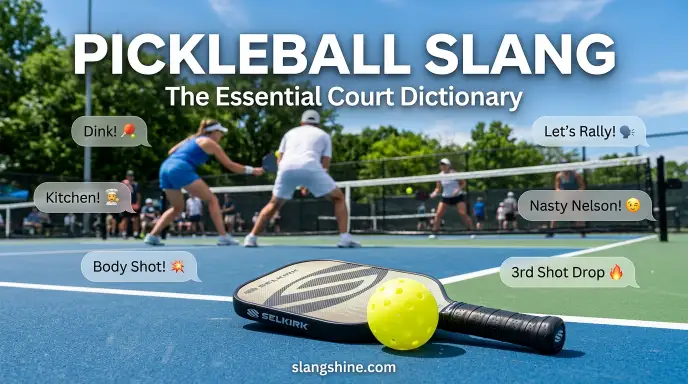
Pickleball slang refers to the informal words, nicknames, and expressions players use to talk about shots, court positions, strategies, playing styles, and game situations. Common examples include dink, kitchen, banger, Erne, ATP, reset, and pickled.
Some of these terms are casual slang, while others are technical pickleball terms that players commonly use in conversation.
If you are new to the sport, these words can sound confusing at first. You may hear them during a match, in pickleball group chats, or on social media and wonder what they mean.
Learning pickleball slang helps you understand other players, follow pickleball discussions, and communicate more easily on and off the court.
Quick Answer: What Is Pickleball Slang?
Pickleball slang refers to the informal words, nicknames, and expressions players use to describe shots, court positions, playing styles, strategies, and situations during a game. Common examples include kitchen, dink, banger, Erne, ATP, reset, stacking, and pickled.
These terms are not all official rulebook language. Some are everyday player slang, while others describe real shots or strategies. Learning the difference makes pickleball conversations much easier to follow.
What Does Pickleball Slang Mean?
Pickleball slang is the casual language used by players on and around the court. It helps players describe a shot, position, mistake, strategy, or type of player without giving a long explanation.
For example, if someone says:
“Stay out of the kitchen and give me a good dink.”
A beginner may wonder why a player is talking about cooking. In pickleball, “kitchen” is the common nickname for the non-volley zone, while a “dink” is a soft shot that lands in the opponent’s non-volley zone.
So, pickleball slang is not just random vocabulary. Much of it gives players a quick way to communicate during fast rallies.
It is also useful for spectators, coaches, beginners, and people watching pickleball videos online.
Is Pickleball Slang the Same as Official Pickleball Terms?
No. This is one of the most important things to understand.
Pickleball has official rules and technical terms, but players also use informal names on the court. For example, non-volley zone is the official term, while kitchen is the common nickname.
USA Pickleball uses “non-volley zone” in its rules while also explaining that players commonly call it the kitchen.
| Official or technical term | Common player language |
| Non-volley zone | Kitchen |
| Soft shot into the NVZ | Dink |
| Around-the-post shot | ATP |
| Advanced sideline volley | Erne |
| Soft defensive shot | Reset |
| Hard-hitting player | Banger |
This distinction matters because not every slang word is an official rule term.
For example, “kitchen” is widely understood by players, but you would not use it as a replacement for every technical rule explanation.
Common Pickleball Slang Terms
If you are new to pickleball, these are some of the most useful terms to learn first.
1. Kitchen
The kitchen is the informal name for the non-volley zone (NVZ) near the net.
It extends seven feet from the net on each side. Players can stand in the kitchen, but they cannot volley the ball while standing in it or touching its line.
Example:
“Get to the kitchen line.”
This means the player should move toward the line near the net.
2. Dink
A dink is a soft, controlled shot that goes over the net and lands in the opponent’s kitchen.
Dinks are usually played with patience rather than power. They are an important part of pickleball strategy because a well-placed soft shot can make it harder for an opponent to attack.
Example:
“Keep dinking until she gives you a high ball.”
3. Dinking War
A dinking war is a long exchange of soft shots between players near the kitchen.
Neither side wants to give the opponent an easy attacking ball, so both players keep the shots low and controlled.
Example:
“That was a long dinking war before they finally sped it up.”
4. Banger
A banger is a player who relies heavily on hard, fast shots.
The word is often used casually rather than as a formal player category. It can be positive, neutral, or slightly teasing depending on the situation.
Example:
“He’s a serious banger, so keep your paddle ready.”
A banger may try to win points with pace, while another player may prefer soft dinks and resets.
5. Reset
A reset is a soft shot used to slow down an attacking rally and bring the point back under control.
For example, if an opponent is hitting hard at you, a soft reset can reduce the pace and give you time to recover.
Example:
“Great reset! Now we’re back in the point.”
USA Pickleball also uses the term “reset” when describing developing players’ skills and strategies.
6. Erne
An Erne is an advanced shot in which a player moves outside the kitchen area to hit a volley near the sideline.
It can look unusual to beginners because the player may appear to jump around the kitchen rather than simply stand at the net. The shot is legal when performed correctly.
The term is associated with pickleball player Erne Perry, and it has become a recognized part of pickleball vocabulary.
Example:
“Did you see that Erne? That was perfectly timed.”
7. ATP
ATP means Around the Post.
Instead of hitting the ball over the net, the player sends it around the side of the net post. It is an advanced shot that can surprise an opponent because the ball does not need to travel directly over the net.
Example:
“She hit an ATP from almost behind the kitchen line.”
Pickleball Slang for Playing Styles and Strategies
Some pickleball expressions describe how someone plays, rather than one specific shot.
| Term | Simple meaning |
| Banger | Player who uses lots of hard, powerful shots |
| Dinker | Player who relies heavily on soft dinks |
| Stacking | Doubles positioning strategy |
| Poaching | Taking a ball that would normally go to your partner |
| Reset | Soft shot that slows an attacking rally |
| Speed-up | Suddenly increasing pace to attack |
| Third-shot drop | Soft third shot designed to help the serving team move forward |
Some of these are better described as pickleball terminology or strategy language than pure slang.
That distinction is useful because pickleball vocabulary includes a mixture of official concepts, technical descriptions, and informal court expressions.
Where Is Pickleball Slang Commonly Used?
Pickleball slang is most common on the court, in recreational games, tournaments, coaching sessions, and online pickleball communities.
You may hear it in several places:
On the Pickleball Court
This is where slang is most useful. Players need quick words during rallies.
“Kitchen!”
“Reset!”
“Nice dink!”
Short expressions are easier to understand than long explanations in the middle of a point.
In Texting and Group Chats
Players may use terms such as dink, banger, kitchen, Erne, and DUPR when discussing games, partners, or upcoming matches.
For example:
“Ready for our game tomorrow? Hope your dink is working 😂”
On TikTok and Instagram
Pickleball creators often use court vocabulary in videos about funny moments, advanced shots, beginner mistakes, and player types.
A beginner who sees “Erne,” “banger,” or “kitchen” in a caption may search for the meaning after watching the video.
On Reddit and Online Communities
Players often use pickleball terms when discussing equipment, strategy, tournaments, recreational games, and unusual points.
The tone is usually casual and community-focused.
At Work
Pickleball slang is generally not appropriate as formal workplace language unless you are specifically discussing pickleball.
For example, saying:
“Our team got kitchened.”
May confuse coworkers who do not play.
If everyone in the conversation plays pickleball, however, the phrase may be perfectly natural.
Is Pickleball Slang Rude or Offensive?
Most pickleball slang is harmless and sport-specific. Words such as “dink,” “kitchen,” “reset,” and “Erne” are not normally insults.
Some player labels can be more personal.
For example, calling someone a banger is usually neutral or playful, but the tone can change if it is used to criticize someone’s playing style.
Likewise, some newer expressions can sound mocking when they describe mistakes or poor decisions.
The safest rule is simple:
Understand the meaning and tone before using a slang term about another player.
In friendly recreational play, teasing is common. In a tournament or unfamiliar group, neutral language is usually the better choice.
Pickleball Slang Examples in Real Conversations
Pickleball slang is easiest to understand when you see how players use it in real situations. The same word can sound different depending on the tone and context.
Example 1 Talking about a shot
“That dink was perfect. I couldn’t attack it.”
Here, dink means a soft shot that lands in the opponent’s kitchen.
Example 2 Talking about playing style
“He’s a total banger.”
This means the player often hits hard, fast shots instead of relying mainly on soft shots and controlled rallies.
Example 3 Talking about defense
“Nice reset!”
A player might say this after a difficult shot is softened into the kitchen, helping slow down an aggressive rally.
Example 4 Talking about the court
“Stay out of the kitchen until you’re ready to volley.”
Here, kitchen is the common nickname for the non-volley zone.
Example 5 Talking about a special shot
“Did you see that Erne?”
An Erne is an advanced shot in which a player hits the ball near or outside the sideline while jumping or positioning themselves around the non-volley zone.
These examples show why context matters. Pickleball slang is not just a list of unusual words. Players use it to describe shots, tactics, positions, and moments during a game.
Pickleball Slang You May Hear in 2026
Pickleball vocabulary continues to grow as the sport becomes more popular. Some terms are long-established, while others are informal expressions that players use within certain communities.
Common terms you may still hear in 2026 include:
| Term | Meaning |
| Kitchen | The non-volley zone near the net |
| Dink | A soft shot that lands in the kitchen |
| Banger | A player who likes hitting hard shots |
| Reset | A soft defensive shot that slows an aggressive rally |
| Erne | An advanced shot played around the kitchen area |
| ATP | A shot hit around the outside of the net post |
| Third-shot drop | A soft shot designed to land in the opponent’s kitchen |
| Stacking | A doubles positioning strategy |
| Poaching | Moving across to take a ball intended for your partner |
| Pickled | An informal way to describe losing a game without scoring |
Not every term has the same level of formality. Kitchen and dink, for example, are widely recognized pickleball terms, while expressions such as “banger” or “pickled” are more conversational.
USA Pickleball’s official materials also use specialized vocabulary such as dink, stacking, ATP, Erne, and reset-related terminology.
Is “Pickled” Pickleball Slang?
Yes. “Pickled” is commonly used as informal pickleball slang for losing a game without scoring any points.
For example:
“We got pickled in the first game.”
The speaker means their team lost the game while scoring zero.
You may also hear players joke about someone being “pickled” after a very one-sided game.
However, this is best treated as informal pickleball language, not as an official rulebook term.
That distinction matters because many pickleball expressions used on courts do not appear as formal terminology in the rules.
The meaning can also vary slightly between groups. If you are new to the sport, it is usually easy to understand from the score and context.
Pickleball Slang vs. Pickleball Jargon
Pickleball slang and pickleball jargon overlap, but they are not exactly the same.
Slang is usually informal language used naturally by players. It can include playful descriptions, nicknames, and expressions.
Jargon is specialized vocabulary used to describe the sport accurately.
For example:
| Word | More like | Why |
| Kitchen | Jargon/common sport term | Names a specific court area |
| Dink | Jargon/common sport term | Describes a specific type of shot |
| Banger | Slang | Informal label for an aggressive player |
| Pickled | Slang | Informal expression about a score |
| ATP | Technical jargon | Names a specific shot |
| Erne | Technical jargon | Names a specific advanced shot |
This distinction helps explain why some websites call almost every pickleball term “slang.” In reality, the vocabulary includes rules terminology, technical terms, strategy language, and true slang.
That is one reason beginners may find pickleball conversations confusing at first.
Why Do Pickleball Players Use Slang?
Players use pickleball slang because it makes communication faster, easier, and more social.
Instead of saying:
“That player prefers hitting powerful shots from the back of the court.”
A player can simply say:
“He’s a banger.”
The shorter expression communicates the basic idea quickly.
Pickleball slang also creates a sense of community. Once players understand terms such as dink, kitchen, banger, Erne, reset, and stacking, they can follow conversations that previously sounded like another language.
There is also a playful side to pickleball vocabulary. Players often use humorous expressions when talking about mistakes, unusual shots, or one-sided games.
So pickleball slang serves two purposes:
- Practical: It makes communication quicker.
- Social: It helps players feel part of the pickleball community.
When Should You Avoid Using Pickleball Slang?
Pickleball slang is usually harmless in casual settings, but it is not always the best choice.
Avoid heavy slang when you are:
- Explaining pickleball to a complete beginner
- Teaching children or new players
- Writing formal instructional material
- Speaking to someone who may not know the term
- Discussing official rules
- Communicating in a professional setting
For example, telling a beginner:
“Just reset after the banger attacks your dink.”
May sound confusing.
A clearer explanation would be:
“If your opponent hits hard, use a soft defensive shot to slow the rally down.”
Once the person understands the basic concepts, you can introduce the shorter slang terms.
Context is more important than sounding like an experienced player.
Common Misunderstandings About Pickleball Slang
Some pickleball words are misunderstood because their everyday meanings are different from their sports meanings.
1. “Kitchen” Does Not Mean a Real Kitchen
In pickleball, kitchen is the common name for the non-volley zone near the net.
It is a court area, not a place where food is prepared.
USA Pickleball describes the non-volley zone as the 14-foot area extending 7 feet from each side of the net.
2. “Dink” Is Not an Insult
Outside pickleball, the word may have other meanings. In pickleball, a dink is a soft, controlled shot.
The meaning comes from the sporting context.
3. “Banger” Does Not Mean a Noisy Person
A banger is generally a player known for hitting powerful shots.
It describes a playing style rather than someone’s personality.
4. Not Every Pickleball Term Is Slang
Words such as ATP, Erne, stacking, and dink can function as specialized pickleball terminology rather than ordinary slang.
Knowing this difference makes it easier to understand pickleball discussions without assuming every unusual word is slang.
Is Pickleball Slang Outdated or Still Popular?
Pickleball slang is still widely used in 2026.
The sport has developed a large vocabulary around shots, court positions, strategies, player styles, and doubles play.
Current pickleball glossaries continue to explain terms such as kitchen, dink, Erne, ATP, banger, reset, stacking, and other player expressions.
However, popularity can vary by region, age group, skill level, and pickleball community.
A beginner may know kitchen and dink but not understand a more specialized expression. An experienced tournament player may use technical terms much more often.
Online communities can also introduce new playful expressions faster than formal rulebooks do.
That means pickleball language is not completely fixed. Some terms become widely accepted, some remain community-specific, and others may gradually disappear.
FAQs About Pickleball Slang
Q1. What is pickleball slang?
Answer: Pickleball slang is informal language players use to describe shots, strategies, player styles, court areas, scores, and situations. Common examples include kitchen, dink, banger, reset, and pickled.
Q2. What does “dink” mean in pickleball?
Answer: A dink is a soft, controlled shot that lands in the opponent’s kitchen. It is one of the most common terms in pickleball.
Q3. What does “banger” mean in pickleball?
Answer: A banger is a player who prefers hitting hard, powerful shots. The term is informal and usually describes an aggressive playing style.
Q4. What does “kitchen” mean in pickleball?
Answer: Kitchen is the common nickname for the non-volley zone near the net. Players cannot simply volley the ball while standing inside this zone.
Q5. What does “pickled” mean in pickleball?
Answer: Pickled is informal pickleball slang for losing a game without scoring any points. Players often use it jokingly after a very one-sided game.
Q6. Is pickleball slang used outside the court?
Answer: Yes. Players may use pickleball slang in text messages, group chats, social media posts, online communities, and conversations with other players. The exact terms people use can vary by group.
Conclusion
Pickleball slang makes the sport easier to discuss once you know the basic vocabulary. Words such as kitchen, dink, banger, reset, Erne, ATP, and stacking can describe specific shots, positions, strategies, or playing styles in just a few words.
The key is to remember that not every pickleball term is technically slang. Some are formal or technical terms, while others are casual expressions used by players.
If you are new to pickleball, start with the most common words and learn their meaning from context.
As you play more, terms that once sounded confusing will quickly become part of your normal pickleball vocabulary.
Learn More Slang Terms:
- Mug Slang Meaning: What Does “Mug” Mean in Slang in 2026?
- Bofa Slang: The Joke That Confuses Everyone Online (2026)
- What Is a Baller Slang? Meaning, Origin & Examples (2026)

Hi, I’m Emma Carter, an English language writer with over 8 years of experience in vocabulary and language learning. At SlangShine, I write simple, accurate, and easy-to-understand articles about slang, synonyms, idioms, and everyday English to help learners build confidence and improve their communication skills.