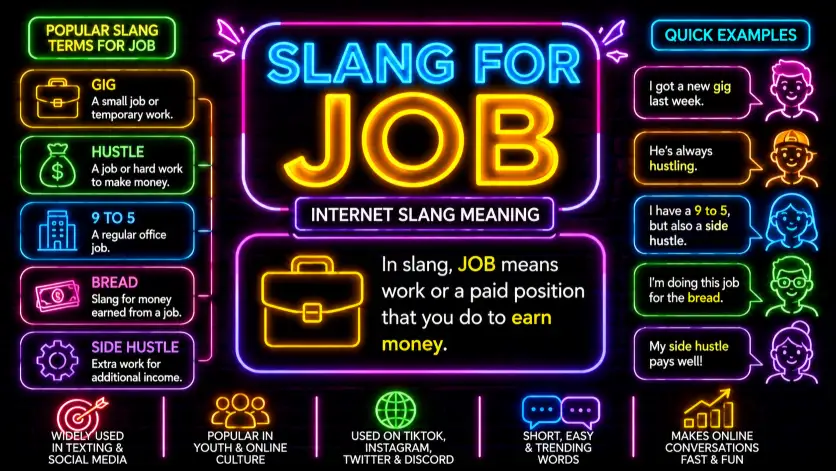
Slang for job refers to informal terms like “gig,” “hustle,” or “9-to-5” used to describe someone’s employment, profession, or way of earning money.
While traditional words like “career” sound formal, modern slang completely changes how we talk about work.
From calling a quick freelance project a “gig” to describing a side business as a “side hustle,” these terms make professional life sound more casual and relatable.
Using this kind of slang helps people connect, vent about corporate culture, or modernise their daily routine.
If you are working a corporate shift or running an online setup, these words perfectly capture the vibe of today’s fast-paced work world.
Quick Answer: Slang for job
Slang for job includes informal terms people use to describe work or employment. Popular examples include gig, grind, hustle, 9 to 5, and side hustle.
| Meaning | Tone | Offensive? | Common Users | Common Places |
| Informal words for a job or work | Casual | ❌ No | Workers, students, freelancers, social media users | Conversations, texting, social media, workplace chats |
What Does Slang for Job Mean?
Slang for job includes casual words and expressions that people use instead of saying job or work. These words often make conversations sound more relaxed and natural.
Some slang terms simply mean employment, while others describe a specific type of work, such as freelance projects, part time work, or demanding jobs.
A Simple Example
Emma: Did you find a new job?
Liam: Yeah, I finally landed a new gig.
Here, gig is a slang word that means a job or work opportunity.
Common Characteristics
Used in casual conversations
Common on social media
Often heard in workplaces
Popular among freelancers and younger speakers
May describe different kinds of work
Does Slang for Job Stand for Anything?
No. Slang for job is not an abbreviation or acronym.
Instead, it refers to a collection of informal words people use when talking about work or employment.
These expressions have developed naturally through everyday speech and online communication.
Popular Slang Words for Job
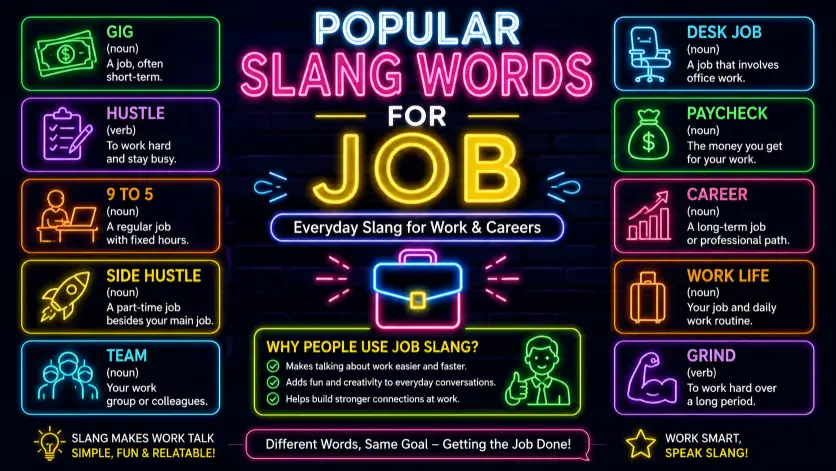
Different slang words can describe different types of jobs. Here are some of the most common ones.
Gig
A gig is a job, project, or short term work opportunity. It is especially common among freelancers, musicians, and delivery workers.
Example:
“I picked up a weekend gig at a local café.”
Grind
Grind refers to hard, regular work, especially when it feels tiring or repetitive.
Example:
“Back to the daily grind tomorrow.”
Hustle
A hustle usually means working hard to earn money. It can also describe extra work done outside a regular job.
Example:
“She’s building her own business while working a full time job. That’s her side hustle.”
9 to 5
A 9 to 5 refers to a traditional full time office job with regular working hours.
Example:
“He left his 9 to 5 to become a freelancer.”
Side Hustle
A side hustle is extra work someone does to earn additional income besides their main job.
Example:
“Selling handmade crafts is my side hustle.”
Where Is Slang for Job Commonly Used?
People use slang for job in many everyday situations.
| Platform or Situation | How It’s Used |
| Text messages | Talking casually about work |
| Social media | Sharing work updates or career goals |
| Workplace chats | Informal conversations with coworkers |
| Discussing careers, freelancing, or jobs | |
| Discord | Talking about work while gaming or chatting |
| Everyday conversations | Referring to work in a relaxed way |
Although these slang terms are common in casual communication, they may not be suitable for formal job applications, business reports, or professional documents.
Is Slang for Job Rude, Offensive, or Harmless?
Most slang for job is harmless. These words are commonly used in casual conversations and are not considered offensive.
However, some terms sound more informal than others, so choosing the right one depends on the situation.
For example, gig and side hustle are widely accepted, while grind may suggest that work feels difficult or tiring.
| Situation | Appropriate? | Notes |
| Casual conversations | ✅ Yes | Sounds natural and friendly |
| Text messages | ✅ Yes | Common among friends |
| Social media | ✅ Yes | Frequently used in posts and captions |
| Workplace chats | ✅ Yes | Suitable in informal discussions |
| Job interviews | ⚠️ Sometimes | Use “job” or “position” for a more professional tone |
| Business reports | ❌ No | Avoid slang in formal writing |
Real Life Examples Of Slang for job
Friendly Conversation
Olivia: Did you find work after college?
Daniel: Yes, I found a great gig with a marketing company.
Text Message
Friend: Busy today?
Reply: Yeah, the grind never stops.
Workplace Chat
Emma: Are you still doing photography?
Lucas: Yes, it’s my side hustle on weekends.
Social Media
“Finally landed my dream gig. Excited for this new chapter!”
Everyday Conversation
Sophia: Why are you always so busy?
Noah: Between my full time job and my side hustle, I barely have free time.
Origin and History Of Slang for job
People have always created informal words for work and employment. As workplaces changed and new industries grew, different slang terms became popular.
The word gig was first used by musicians to describe a performance or paid engagement. Over time, it expanded to mean almost any short term or freelance job.
The word grind became popular because it compares daily work to something that requires steady effort. People often use it when talking about long workdays or demanding routines.
Hustle originally meant pushing hard to achieve something. Today, it often refers to working hard or earning extra income through one or more jobs.
As freelancing, remote work, and the gig economy became more common, expressions like gig and side hustle became part of everyday language.
Similar Slang or Related Terms
| Term | Meaning | Tone |
| Gig | A job or short term project | Casual |
| Hustle | Working hard to earn money | Casual |
| Side Hustle | Extra work besides a main job | Casual |
| Grind | Daily hard work | Casual |
| 9 to 5 | A regular full time job | Neutral |
| Freelance | Working independently for clients | Neutral |
| Shift | A scheduled period of work | Neutral |
Although these words relate to jobs, each has its own meaning and is used in different situations.
When Should You Avoid Using Slang for Job?
Informal terms are not always the best choice.
Avoid using slang when:
- Writing a résumé or CV.
- Attending a job interview.
- Sending formal business emails.
- Preparing official reports.
- Speaking with clients in professional settings.
In these situations, words like job, position, employment, or occupation sound more appropriate.
Polite Alternatives
If you want to sound more professional, consider using these words instead of slang.
- Job
- Position
- Employment
- Occupation
- Profession
- Career
- Role
- Work
These alternatives are suitable for schools, workplaces, interviews, and formal communication.
Why Do People Use Slang for Job?
People use slang because it makes conversations feel more relaxed and natural. It can also describe specific types of work more clearly than the word job alone.
Some people use slang to:
- Talk casually with friends.
- Describe freelance or temporary work.
- Explain extra sources of income.
- Make conversations sound less formal.
- Express feelings about their work.
Different slang words also help explain different work experiences. For example, gig often suggests flexible work, while grind highlights the effort involved in working every day.
Common Misunderstandings
One common misunderstanding is that all slang words for job mean the same thing. They don’t.
For example:
- Gig usually means temporary or freelance work.
- Side hustle means extra work done in addition to a main job.
- Grind refers to the effort or routine of working.
- 9 to 5 describes a traditional full time office job.
Understanding these differences helps you choose the right word for the right situation.
Frequently Asked Questions
Q1. What is the most common slang for a job?
Answer: The most common slang words for a job are gig, grind, hustle, 9 to 5, and side hustle. Each one has a slightly different meaning depending on the type of work and the situation.
Q2. Does gig mean a job?
Answer: Yes. Gig is a popular slang word for a job, especially short term, freelance, or contract work. It is commonly used by freelancers, musicians, and delivery drivers.
Q3. What does grind mean in slang?
Answer: Grind refers to working hard every day, especially when the work feels repetitive or demanding. It often describes the routine of a regular job.
Q4. Is hustle the same as a job?
Answer: Not exactly. Hustle usually means working hard to earn money. It can refer to a main job, but it often describes extra work or a business someone does alongside their regular employment.
Q5. What is a side hustle?
Answer: A side hustle is a part time job or business that earns extra income in addition to a person’s main job.
Q6. Is it okay to use slang for a job at work?
Answer: Yes, in casual conversations with coworkers. However, in interviews, business emails, or official documents, it is better to use professional words like job, position, or employment.
Q7. What is the difference between job and gig?
Answer: A job usually refers to regular employment, while a gig often means temporary, freelance, or project based work.
Q8. What is the slang word for job?
Answer: Common slang words for job include gig, hustle, and grind. The right word depends on the situation.
Q9. What is a slang word for work?
Answer: Slang words for work include grind, hustle, shift, and gig. They are often used in casual conversations.
Q10. What are Gen Z slang words?
Answer: Popular Gen Z slang words include rizz, sigma, delulu, cap, no cap, bet, slay, ate, and mid.
Q11. How do you say good job in Gen Z slang?
Answer: In Gen Z slang, you can say “You ate,” “W,” “Slay,” or “Big W.” These phrases all mean someone did a great job.
Conclusion
Slang for job includes informal words people use instead of saying job or work. Popular terms like gig, grind, hustle, 9 to 5, and side hustle are common in conversations, text messages, and social media.
Each slang word has its own meaning, so choosing the right one depends on the situation.
While these expressions are perfect for casual communication, professional settings usually call for more formal words such as job, position, or employment.
Understanding these slang terms will help you communicate more naturally and better understand modern conversations.
Read More Articles:

Hi, I’m Emma Carter, an English language writer with over 8 years of experience in vocabulary and language learning. At SlangShine, I write simple, accurate, and easy-to-understand articles about slang, synonyms, idioms, and everyday English to help learners build confidence and improve their communication skills.