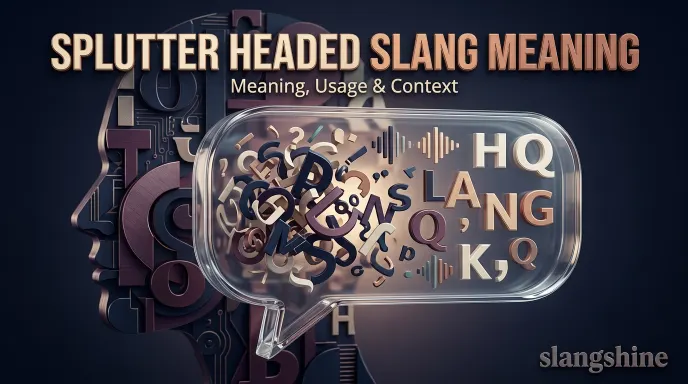
The splutter headed slang meaning describes a person who talks a lot or talks loudly. It is an old and unusual regional expression rather than a common piece of modern internet slang.
The term combines “splutter,” which can suggest rapid or unclear speech, with “headed” to describe the person doing it.
You are unlikely to see splutter headed in everyday texting or popular social media conversations today.
Instead, the expression is more useful when studying older regional English and the colorful ways people once described talkative behavior.
Because the phrase is uncommon, its meaning can seem confusing at first. Once you break down the two parts, however, the basic idea becomes easier to understand.
Quick Answer: Splutter Headed Slang Meaning
Splutter headed is a regional slang expression for someone who talks a lot or talks loudly. It is an old fashioned term and is not widely used in modern everyday English.The expression usually focuses on a person’s speech. Depending on the situation, it can suggest that someone is noisy, overly talkative, or difficult to quiet down.
What Does Splutter Headed Mean?
A splutter headed person is someone who is known for talking a great deal, especially in a loud or energetic way.
The word does not describe someone’s physical head. Instead, “headed” forms part of the expression used to characterize the person’s behavior.
For example:
“That splutter headed fellow talked through the whole meeting.”
The sentence suggests that the person talked continuously and made their presence noticeable through their speech.
Simple Meaning
In modern English, you could explain splutter headed as:
- very talkative
- loud when speaking
- noisy
- constantly talking
- difficult to quiet
The exact tone depends on the context. It can sound humorous, teasing, or critical.
Is Splutter Headed a Slang Word?
Yes, it can be classified as an old regional slang expression, but it should not be confused with current internet slang.
The phrase belongs to a type of informal vocabulary that developed in particular speech communities.
Regional expressions like this can survive in dictionaries and language collections even after they become rare in everyday conversation.
Regional Slang vs. Internet Slang
Modern slang often spreads through social media, music, gaming, texting, or online communities.
Splutter headed has a different background.
It is an older regional expression connected with spoken English. Its unusual form reflects the creativity of local vocabulary rather than the fast moving language of platforms such as TikTok or Discord.
That distinction is important when describing the term.
Why Does It Sound Unusual?
Most modern speakers are familiar with words such as talkative, chatty, and loudmouth.
Splutter headed sounds different because it comes from an older style of informal English. Such expressions often use vivid combinations of ordinary words to describe a person’s habits.
What Does “Splutter” Mean?
Understanding splutter makes the expression easier to understand.
As a verb, splutter can describe speaking quickly, excitedly, or with difficulty. It can suggest speech that comes out in short, broken bursts.
For example:
“He spluttered his reply in frustration.”
Here, the person’s words come out in an uneven or excited manner.
The word can also describe sounds made by liquids, engines, or flames. However, that physical meaning is not the main idea behind splutter headed.
Splutter + Headed
The phrase turns the idea of splutter into a description of a person.
Instead of simply saying that someone is talking, the expression gives the person a colorful label.
That is one reason older regional slang can sound more vivid than a straightforward modern synonym.
What Kind of Person Is Splutter Headed?
The expression mainly points to talking behavior.
A splutter headed person may be someone who:
- talks continuously
- speaks loudly
- speaks with great energy
- interrupts with frequent comments
- fills a conversation with their own speech
The term does not necessarily mean the person is unintelligent or dishonest. Its focus is on how much or how noisily they talk.
Is It Always Negative?
Not necessarily.
The phrase can be used critically when someone’s constant talking becomes annoying. It can also be used in a playful way when describing a particularly chatty person.
Tone comes from the speaker and the situation.
How Is Splutter Headed Used in a Sentence?
Because the expression is rare, modern examples should be treated as illustrations of its meaning rather than evidence of widespread current usage.
Example 1: Too Much Talking
“The splutter headed man never stopped talking.”
Here, the expression describes someone who talks constantly.
Example 2: A Loud Speaker
“We could hear the splutter headed neighbor from across the street.”
This example emphasizes loud speech.
Example 3: A Playful Description
“My little brother is such a splutter headed storyteller.”
In this sentence, the phrase can sound teasing rather than harsh.
These examples show how the expression can describe different forms of excessive or noticeable speech.
What Tone Does Splutter Headed Have?
Splutter headed has an informal and somewhat humorous tone.
It is not the kind of expression you would normally choose for a formal report or professional communication.
Playful Tone
A speaker might use the phrase jokingly about a friend or family member who talks nonstop.
“You old splutter headed thing!”
In a friendly relationship, unusual slang can make the description sound playful.
Critical Tone
The same expression can become less friendly when someone is annoyed by another person’s constant talking.
The surrounding words and relationship between the speakers therefore matter.
Where Is Splutter Headed Used?
The term belongs to regional and historical English vocabulary rather than a single modern online community.
Regional slang can be difficult to locate because different communities preserve unusual words for different lengths of time.
Some expressions remain familiar locally, while others survive mainly in historical records.
For splutter headed, the important point is that its documented meaning relates to a talkative or loud person.
Not a Mainstream Social Media Term
There is no good reason to present splutter headed as a trending TikTok, Instagram, Snapchat, or Gen Z expression.
Someone searching for the term today is more likely to be researching unusual vocabulary, regional speech, or an older text.
Why Do Older Slang Terms Use “Headed”?
Expressions ending in “ headed” have appeared throughout English.
The structure allows speakers to attach an idea or quality to a person. English has many examples, such as hot headed or absent minded, although each expression has its own meaning.
In splutter headed, the unusual first part creates a vivid picture of someone whose speech is noisy, rapid, or excessive.
This kind of word formation is one reason regional English can contain expressions that sound inventive to modern readers.
Splutter Headed vs. Talkative
The easiest modern comparison is talkative.
Both can describe someone who speaks a lot, but their style is very different.
Talkative is common, neutral, and widely understood.
Splutter headed is unusual, informal, and strongly old fashioned or regional in flavor.
If clarity is your priority, talkative is the better choice. If you are discussing historical or regional vocabulary, splutter headed provides a much more distinctive expression.
Splutter Headed vs. Loudmouth
Loudmouth is another useful comparison, but the two expressions are not exact matches.
A loudmouth is generally someone who talks too much or speaks too freely, often in an annoying or boastful way.
Splutter headed focuses more broadly on a person who talks a lot or loudly.
So, loudmouth can carry a stronger negative judgment, while splutter headed may sound more playful or old fashioned.
Why Is Splutter Headed Interesting?
The phrase shows how English speakers have created colorful ways to describe ordinary human behavior.
Instead of using a simple word such as talkative, an older speaker could use a more expressive phrase.
That makes splutter headed valuable for people studying regional English. It also shows why unusual slang terms should be interpreted through their historical and cultural context rather than judged only by modern usage.
How Do People Use Splutter Headed?
Because splutter headed is rare today, it works best when the speaker wants an old fashioned or humorous description.
For Someone Who Talks Nonstop
The expression can describe a person who keeps a conversation going without giving others much chance to speak.
“That splutter headed guest talked until midnight.”
The focus is on the person’s constant speech.
For Loud or Excited Speech
It can also fit a situation where someone speaks with lots of energy.
“The splutter headed storyteller had everyone looking his way.”
Here, the phrase adds personality to the description rather than simply stating that the person was talkative.
Is Splutter Headed a Bad Word?
Splutter headed is not a profanity or slur. However, it can be unkind when used directly about someone.
The phrase describes a person’s speaking habits in a negative or teasing way. A close friend might use it jokingly, while the same expression could sound insulting when directed at a stranger.
Friendly Use
Among people who know each other well, unusual expressions can sound playful.
“You’re a real splutter headed one today!”
The speaker may simply be teasing someone who has been talking a lot.
Negative Use
In an argument, the phrase could sound dismissive.
“Nobody can get a word in with that splutter headed man.”
Here, the speaker is clearly criticizing the person’s behavior.
Is Splutter Headed Still Used in 2026?
Splutter headed is not common modern slang in 2026.
It is better understood as an unusual regional or historical expression. Modern speakers are far more likely to choose words such as talkative, chatty, or loudmouth.
You may still encounter the phrase while reading older material or researching regional English.
Why Rare Words Survive
A word does not need to remain common to have linguistic value.
Historical dictionaries and dialect collections preserve expressions that might otherwise disappear. These records help show how everyday English once differed between regions and generations.
Splutter headed is interesting for exactly this reason.
What Are Modern Alternatives to Splutter Headed?
If you want your meaning to be immediately clear, several modern expressions can replace it.
Talkative
Talkative is the simplest neutral alternative. It describes someone who likes to talk a lot.
Chatty
Chatty usually sounds friendly. It can describe someone who enjoys conversation.
Loudmouth
Loudmouth is more negative. It can describe someone who talks too much, especially when their speech is unwanted.
Chatterbox
Chatterbox is often playful. It describes someone who talks a great deal.
Long Winded
Long winded focuses on speech that takes too long or contains more detail than necessary.
The right alternative depends on the tone you want.
When Should You Use Splutter Headed?
The expression is most suitable when discussing regional vocabulary, historical slang, or creative language.
In Historical Contexts
A writer discussing older speech can use the term to preserve the flavor of the period.
In Dialect Discussions
Language researchers may use it when explaining unusual regional expressions.
In Creative Writing
A character’s dialogue can include the word if the setting and character fit an older or regional style.
For everyday communication, a familiar term will usually be easier for readers to understand.
Common Misunderstandings About Splutter Headed Slang Meaning
Mistake 1: Thinking It Means Confused
The word may look as though it describes someone’s mental state, but its documented sense concerns speech and talkative behavior.
Mistake 2: Treating It as Modern Slang
The expression should not be marketed as a new Gen Z or social media term.
Its interest comes from older regional English.
Mistake 3: Assuming It Means “Foolish”
Being talkative does not automatically mean someone lacks intelligence.
The expression focuses on speech, not a person’s mental ability.
Mistake 4: Using It as a Universal Insult
Most modern readers may not recognize the phrase. Without context, they may not understand what you mean.
A short explanation is useful when introducing the term.
Why Does Regional Slang Matter?
Regional slang gives us a look at how language develops within communities.
People often create expressive words for familiar behaviors, objects, and personalities. Some spread widely, while others remain local.
Over time, a regional expression can become rare. Even then, historical records can preserve its meaning.
Studying splutter headed therefore helps show that slang is not limited to social media. Informal English has always produced creative descriptions of everyday life.
FAQs About Splutter Headed Slang Meaning
Q1. What does splutter headed mean in slang?
Answer: Splutter headed describes someone who talks a lot or talks loudly. It is an old and uncommon regional expression rather than a popular modern slang term.
Q2. Is splutter headed still used today?
Answer: The expression is rare in modern everyday English. It is more likely to appear in historical or regional language discussions than in ordinary conversations or social media posts.
Q3. Is splutter headed an insult?
Answer: It can be used as a mild insult because it criticizes someone’s talking habits. However, it is not a profanity or slur and can also be used playfully between people who know each other.
Q4. Does splutter headed mean talkative?
Answer: Yes. “Talkative” is one of the clearest modern ways to explain the expression. Depending on context, splutter headed can also suggest loud, excessive, or energetic speech.
Q5. Is splutter headed modern internet slang?
Answer: No. It should not be described as mainstream TikTok, Instagram, Discord, or Gen Z slang. Its documented character is regional and historical.
Q6. What is a modern synonym for splutter headed?
Answer: Possible alternatives include talkative, chatty, chatterbox, loudmouth, and long winded. Each has a slightly different tone, so the best choice depends on the sentence.
Key Takeaways: Splutter Headed Slang Meaning
- Splutter headed describes someone who talks a lot or loudly.
- It is an old regional slang expression.
- The term is not mainstream modern internet slang.
- It can sound playful, humorous, or critical depending on context.
- Talkative is the clearest neutral modern alternative.
- Loudmouth is a stronger negative alternative.
- The expression is useful for studying historical and regional English.
Conclusion
The splutter headed slang meaning is connected with a person who talks a lot or speaks loudly. Unlike current internet expressions, the term belongs to an older layer of regional and informal English.
Its unusual structure gives the phrase a colorful character, but most modern readers may not recognize it immediately. For everyday communication, words such as talkative or chatty are much clearer.
If you encounter splutter headed in older or regional writing, the simplest interpretation is to think of someone who is very talkative or noticeably loud when speaking.
Learn More Slang Terms:
- What Does Wapatuli Mean in Slang? Explained for 2026
- Splintereens Slang Meaning: A Playful Word for Tiny Pieces (2026)
- What Does Slaps Mean in Slang? Meaning, Usage & Examples

Hi, I’m Anna Whitmore. I have 7+ years of experience writing about English slang and vocabulary. At SlangShine, I create simple, easy-to-understand content for English learners.