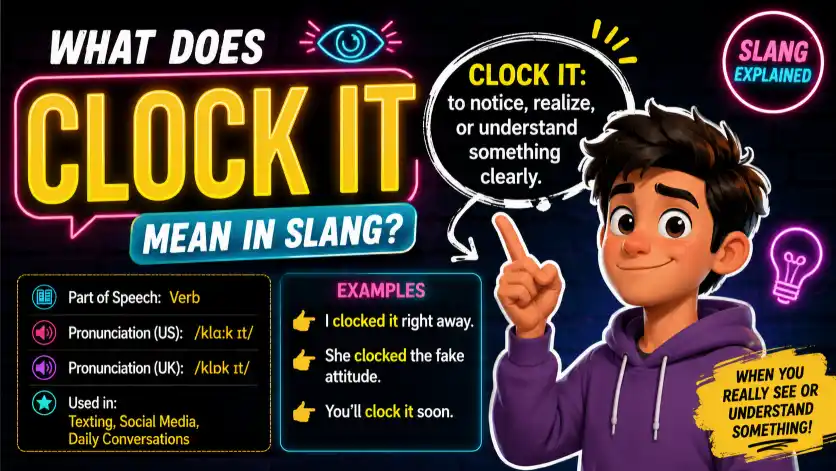
What Does Clock It Mean in Slang? means to notice or call out something a hidden truth, a slip-up, or a detail someone tried to hide.
Born in ballroom culture and now taking over TikTok comment sections, “clocking” someone has become the internet’s favorite way to expose what’s really going on without saying a single extra word.
What Does Clock It Mean in Slang? is usually used in a casual and playful way, especially in online conversations.
If you are wondering What Does Clock It Mean in Slang?, the meaning often depends on the context, but it always relates to noticing or recognizing something.
This guide explains What Does Clock It Mean in Slang? with simple examples, common uses, and when people use it in everyday conversations.
Quick Answer: What does clock it mean in slang
In slang, clock it means to notice, recognize, or understand something quickly. It often refers to spotting a detail, realizing the truth, or identifying someone’s behavior before others do.
| Meaning | Tone | Offensive? | Common Users | Common Places |
| To notice, recognize, or figure something out | Casual | ❌ No | Teenagers, young adults, social media users | TikTok, X, Instagram, text messages, everyday conversations |
What Does Clock It Mean in Slang?
When someone says “clock it,” they mean to notice or understand something that may not be obvious at first.
The phrase is often used after someone points out a detail, recognizes a lie, understands a hidden message, or realizes what’s really happening.
It usually has a positive meaning because it shows that someone is observant and quick to understand.
A Simple Example
Emma: Did you notice he kept changing the story?
Lily: I clocked it right away.
In this example, clocked it means Lily noticed the inconsistency immediately.
Common Characteristics
Used to describe noticing something quickly
Often means recognizing hidden details
Popular in online conversations
Common in casual speech
Usually expresses awareness or understanding
Does “Clock It” Stand for Anything?
No. Clock it is not an abbreviation or acronym.
It is a slang expression based on the verb clock, which can mean to notice, observe, or recognize someone or something.
Different Meanings of Clock It
The meaning of clock it depends on the conversation.
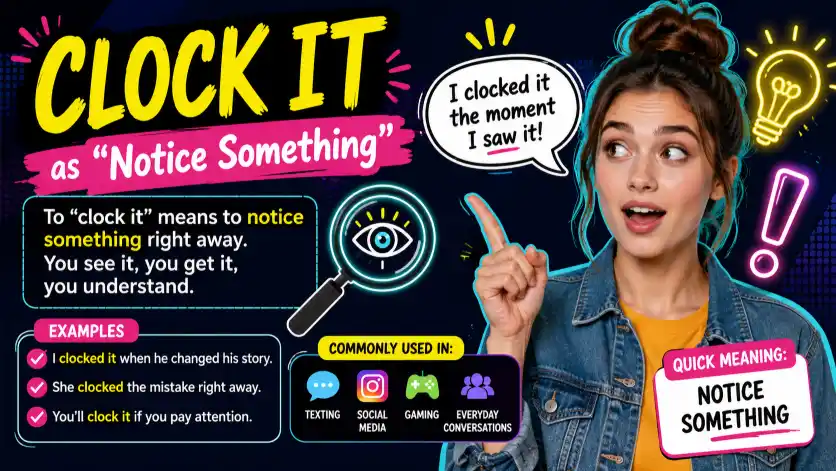
Clock It as “Notice Something”
This is the most common meaning.
It means someone noticed something that others may have missed.
Example:
“Did you clock her new haircut?”
Clock It as “Figure Something Out”
Sometimes clock it means realizing the truth or understanding a situation.
Example:
“Everyone believed him, but I clocked the lie.”
Clock It as “Recognize Someone”
The phrase can also mean recognizing a person or remembering who they are.
Example:
“I didn’t clock him at first because he changed his hairstyle.”
Where Is Clock It Commonly Used?
The phrase clock it appears in many casual conversations and online spaces.
| Platform or Situation | How It’s Used |
| TikTok | Reacting to videos or hidden details |
| Commenting on someone’s appearance or behavior | |
| X | Pointing out something others missed |
| Text messages | Saying you noticed something |
| Discussing observations or opinions | |
| Everyday conversations | Talking about something you recognized or understood |
The phrase is especially popular on social media, where people use it to show they noticed something before everyone else.
Is “Clock It” Rude, Offensive, or Harmless?
Clock it is generally harmless. Most people use it to say they noticed or understood something. It is a casual slang phrase and is not considered offensive.
However, the tone matters. If you use clock it while criticizing someone’s appearance or behavior, it may sound rude or judgmental.
| Situation | Appropriate? | Notes |
| Casual conversations | ✅ Yes | Sounds natural and friendly |
| Text messages | ✅ Yes | Common among friends |
| Social media | ✅ Yes | Frequently used in comments and posts |
| Workplace chats | ⚠️ Sometimes | Better with coworkers you know well |
| Formal writing | ❌ No | Use “noticed” or “recognized” instead |
Real Life Examples
Friendly Conversation
Jake: Did you notice Emma got a new tattoo?
Olivia: Yeah, I clocked it as soon as she walked in.
Text Message
Friend: Nobody else noticed the mistake.
Reply: I clocked it immediately.
Social Media
“Only a few people clocked the hidden message in the video.”
School
Student: Did you realize the teacher changed the due date?
Classmate: I clocked it during class.
Everyday Conversation
Sarah: You knew he was joking?
Emily: Of course. I clocked it from the start.
Origin and History
The slang use of clock has been around for many years. It originally meant to notice or observe someone.
The expression became especially popular in LGBTQ+ communities, particularly within drag culture and ballroom culture, where clock was often used to mean recognizing or identifying something about a person.
Later, the phrase spread through social media, especially on platforms like TikTok, X, and Instagram.
Today, many people use clock it simply to mean notice something, figure something out, or understand what’s happening.
While the phrase has become more mainstream, its connection to ballroom culture is an important part of its history.
Similar Slang or Related Terms
| Term | Meaning | Tone |
| Notice | See or become aware of something | Neutral |
| Spot | See something quickly | Casual |
| Catch | Notice something | Casual |
| Figure out | Understand something | Neutral |
| Pick up on | Notice a detail or clue | Casual |
| Recognize | Identify someone or something | Neutral |
Although these expressions are similar, clock it often suggests noticing something before other people do.
When Should You Avoid Using “Clock It”?
Avoid using clock it when:
- Writing formal emails or reports.
- Speaking in professional presentations.
- Talking to people who may not understand modern slang.
- The phrase could be misunderstood as criticism.
In these situations, words like noticed, recognized, or understood are clearer and more professional.
Why Do People Use “Clock It”?
People use clock it because it is short, expressive, and easy to understand in casual conversations.
It is often used to:
- Show they noticed something quickly.
- Point out hidden details.
- Say they understood a situation.
- React to someone’s behavior.
- Join conversations on social media.
The phrase has become popular because it quickly communicates awareness without needing a long explanation.
Common Misunderstandings
One common misunderstanding is that clock it always means looking at a clock.
In slang, it has nothing to do with telling time.
Instead, it usually means:
- Noticing something.
- Recognizing a person.
- Understanding a hidden meaning.
- Realizing what is happening.
The surrounding conversation will usually make the meaning clear.
Frequently Asked Questions
Q1. What does clock it mean in slang?
Answer: In slang, clock it means to notice, recognize, or understand something quickly. People often use the phrase when someone spots a detail, figures something out, or realizes what is happening before others do.
Q2. Is clock it a compliment?
Answer: Sometimes. If someone says, “You clocked it,” they usually mean you noticed or understood something correctly. In that context, it can be a compliment because it recognizes your awareness or observation.
Q3. Is clock it rude?
Answer: No. The phrase itself is not rude. However, if it is used to point out or criticize someone’s appearance or behavior, it may come across as impolite depending on the tone and situation.
Q4. Where is clock it commonly used?
Answer: Clock it is popular on TikTok, Instagram, X, Reddit, and in everyday conversations. It is often used in comments, videos, and text messages when someone notices something important or unexpected.
Q5. Does clock it mean the same as notice?
Answer: Yes, in many situations. However, clock it usually suggests noticing something quickly or recognizing a detail that other people may have missed.
Q6. Can I use clock it at work?
Answer: You can use it in casual conversations with coworkers who understand modern slang. For formal meetings, emails, or professional documents, it’s better to use words like noticed, recognized, or observed.
Q7. Is clock it still popular?
Answer: Yes. Clock it remains popular, especially on social media platforms like TikTok and X. It is commonly used in discussions about reactions, observations, and understanding hidden details.
| Phrase | Meaning |
| Clock it | Notice or recognize something quickly |
| Notice | Become aware of something |
| Recognize | Identify or understand someone or something |
Q8. Why does Gen Z say “clock it”?
Answer: Gen Z says “clock it” to mean notice something, recognize it, or point it out. It is often used when someone spots a hidden detail or calls out someone’s behavior.
Q9. What does “clocking me” mean in slang?
Answer: “Clocking me” means someone noticed, recognized, or figured you out. It can also mean they pointed out something about you.
Q10. What does Hailey Bieber “clock it” mean?
Answer: In discussions about Hailey Bieber, “clock it” means people noticed or called out something she said or did. The phrase itself has the same slang meaning regardless of the person.
Q11. What does “clocked” mean in current slang?
Answer: In current slang, “clocked” means noticed, recognized, or correctly identified. For example, “She clocked my new haircut” means she noticed it.
Conclusion
What does clock it mean in slang? It means to notice, recognize, or understand something quickly.
The phrase is widely used in casual conversations and across social media platforms when someone spots a detail, figures out the truth, or catches something others may have missed.
Because clock it is informal, it’s best suited for conversations with friends, text messages, and online discussions.
In formal settings, using words like noticed, recognized, or observed is usually a better choice.
Understanding the context will help you use this popular slang naturally and confidently.
Before You Go Check Out:

Hi, I’m Emma Carter, an English language writer with over 8 years of experience in vocabulary and language learning. At SlangShine, I write simple, accurate, and easy-to-understand articles about slang, synonyms, idioms, and everyday English to help learners build confidence and improve their communication skills.