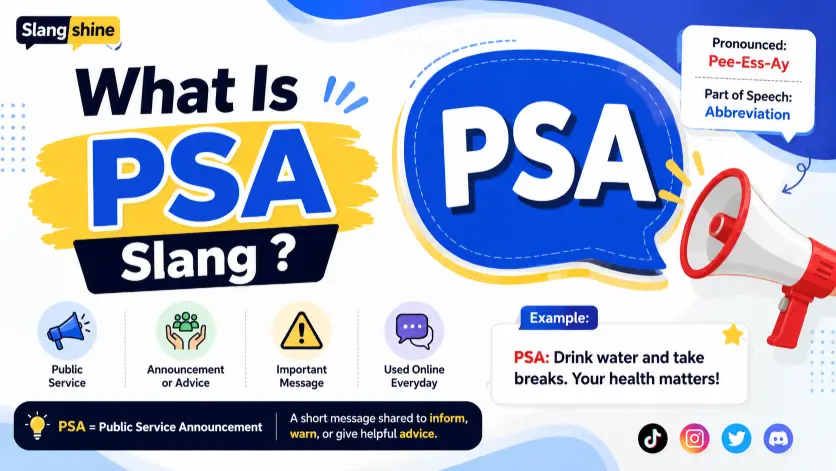
What is PSA slang refers to the casual use of “PSA” (Public Service Announcement) to grab people’s attention before sharing useful, important, or sometimes humorous information.
PSA slang originally came from “Public Service Announcement,” a phrase used in official broadcasts to share important information with the public.
Online, PSA slang has taken on a more casual tone, often used jokingly or seriously to introduce a piece of advice, warning, or update.
People often see PSA slang in social media captions, group chats, or forum posts right before someone shares something they think others should know.
Today, PSA slang remains a popular way to grab attention quickly, whether the message is lighthearted, informative, or genuinely important.
Quick Answer:
PSA stands for Public Service Announcement. In online conversations, it is used before an important message, reminder, warning, or helpful tip that the sender wants everyone to notice.
What Does PSA Mean in Text?
When someone writes PSA in a text message or online post, they are letting readers know that an important piece of information is about to follow.
Instead of writing a long sentence to grab attention, they simply type PSA and then share their message.
For example:
- PSA: Don’t forget tomorrow’s meeting starts at 9 AM.
- PSA: Save your game before installing the latest update.
- PSA: This café closes earlier on weekends.
In each example, PSA helps the message stand out so people are more likely to read it.
Why Does PSA Appear Before a Message?
People use PSA because it quickly tells others that the next sentence is worth reading. It works like a headline before the main information.
Common reasons include:
- Sharing reminders
- Giving helpful advice
- Warning others about a problem
- Announcing updates
- Informing a group about an event
Because it is short and easy to understand, PSA has become popular in everyday online conversations.
PSA Full Form
The PSA full form is Public Service Announcement.
The phrase was originally used for official messages that informed the public about important topics such as safety, health, or community news.
Television stations, radio programs, and government organizations often used Public Service Announcements to spread information that could benefit everyone.
Today, internet users use the same abbreviation in a much more relaxed way. Instead of official announcements, people now use PSA for everyday reminders, tips, and updates.
Common Types of PSA Messages
You may see PSA used for:
- Important announcements
- Helpful advice
- Friendly warnings
- Event reminders
- Gaming updates
- Shopping alerts
- Social media tips
The message can be serious or lighthearted, but the goal is always to catch people’s attention.
Is PSA Rude, Offensive, or Neutral?
PSA is considered a neutral abbreviation. It is not offensive or inappropriate, and people of all ages use it in everyday conversations.
The tone depends on what follows the abbreviation.
Friendly Tone
These messages are helpful and polite.
Examples:
- PSA: Remember to bring your notebook tomorrow.
- PSA: Drink plenty of water during the hot weather.
- PSA: The library will be closed on Monday.
Humorous Tone
Sometimes people use PSA to make a funny point.
Examples:
- PSA: Coffee is not a replacement for sleep.
- PSA: Reading the instructions first can save a lot of time.
Slightly Sarcastic Tone
In some situations, PSA is used to express frustration in a playful way.
Examples:
- PSA: Ignoring messages won’t make them disappear.
- PSA: Being the loudest person doesn’t mean you’re right.
The abbreviation itself remains polite. Only the wording of the message changes the tone.
Where Is PSA Commonly Used?
PSA is widely used across the internet because it is short, easy to recognize, and quickly grabs attention.
Text Messages
Friends often use PSA before sharing reminders or updates.
Example:
PSA: We’ll meet at the restaurant at 7 PM instead.
Group Chats
Family, school, and workplace groups use PSA to highlight important information.
Example:
PSA: Please submit your project before Friday evening.
Gaming Communities
Players use PSA to announce server maintenance, game updates, or special events.
Example:
PSA: Double XP Weekend starts tonight.
TikTok
Content creators often begin videos with PSA before giving useful advice or sharing information.
Example:
PSA: Clean your phone regularly because it collects more germs than you think.
Instagram users add PSA to captions and Stories when sharing reminders, travel tips, or product updates.
Example:
PSA: Back up your photos before updating your phone.
Snapchat
Friends use PSA in private chats or group conversations to make sure everyone notices an important message.
Example:
PSA: Don’t forget the birthday party starts at 6 PM.
Reddit users often write PSA at the beginning of posts to warn others about bugs, scams, or useful discoveries.
Example:
PSA: The latest update may reset your settings if you don’t create a backup first.
Origin and Background of PSA
The abbreviation PSA has been around for many years. It first stood for Public Service Announcement, a message created to inform the public about important topics like health, safety, or community events.
These announcements were often shared on television, radio, and in newspapers.
As online communication became more popular, people started using PSA in a much more casual way. Instead of official announcements, friends, creators, and online communities began using it before sharing reminders, tips, or warnings.
Today, PSA is a common part of internet conversations and is understood by many people across different platforms.
How Its Meaning Changed
Although the full form has stayed the same, the way people use it has changed.
Before:
- Official safety announcements
- Health campaigns
- Community information
- Emergency alerts
Now:
- Friendly reminders
- Helpful advice
- Group updates
- Online warnings
- Funny observations
The modern version is much less formal but still serves the same purpose—getting people’s attention before sharing useful information.
Why Do People Use PSA?
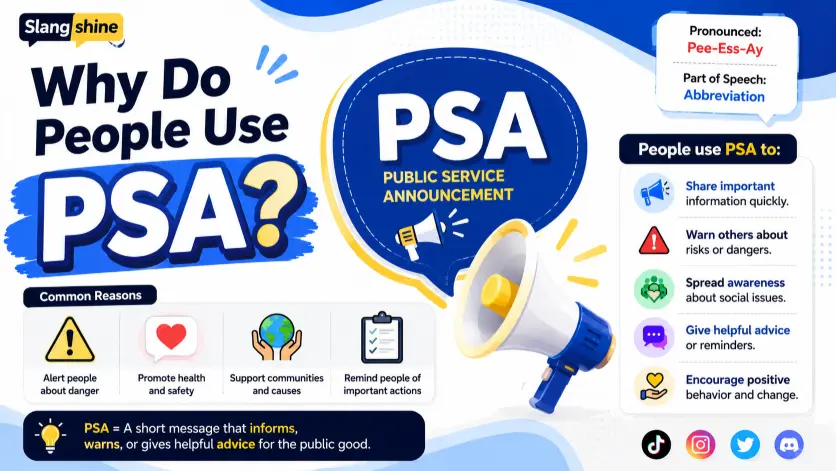
People use PSA because it makes an important message stand out without needing a long explanation.
It Grabs Attention
When readers see PSA, they immediately know the next sentence is worth reading.
It Saves Time
Typing three letters is much faster than writing, “Here’s an important announcement for everyone.”
It Works Well for Groups
PSA is especially useful when sharing information with several people at once.
It Makes Messages Clear
Adding PSA at the beginning helps readers understand that the message is meant to inform rather than start a casual conversation.
Real Life Examples of PSA Usage
The meaning of PSA stays the same, but the message can sound different depending on the situation.
Friendly Examples
These examples are helpful and caring.
- PSA: Don’t forget to carry an umbrella today.
- PSA: Dinner will be ready at 7 PM.
- PSA: Remember to charge your phone before the trip.
Casual Examples
These are common in everyday conversations.
- PSA: This new café has amazing coffee.
- PSA: The movie is much better than I expected.
- PSA: Today’s traffic is heavier than usual.
Argumentative Examples
Sometimes PSA is used to make a strong point.
- PSA: Respecting other people’s time is important.
- PSA: Reading the full post before commenting avoids confusion.
- PSA: Not every opinion needs to become an argument.
The abbreviation remains neutral, but the wording can make the message feel stronger.
Gaming Examples
PSA is very common in gaming communities.
- PSA: Servers will be offline for maintenance at midnight.
- PSA: Claim your daily rewards before they expire.
- PSA: Update your game before joining today’s tournament.
Social Media Examples
Many creators and users begin posts with PSA to highlight useful information.
- PSA: Always double check information before sharing it.
- PSA: Save your important files before updating your device.
- PSA: Read the full caption for important details.
PSA vs Similar Slang
Some abbreviations have similar purposes, but they are not exactly the same.
| Term | Full Form | Main Purpose |
| PSA | Public Service Announcement | Shares an important reminder, warning, or announcement |
| FYI | For Your Information | Shares useful information without suggesting urgency |
| Heads Up | — | Gives someone advance warning |
| Reminder | — | Helps people remember something |
| Note | — | Draws attention to a specific point |
PSA vs FYI
These two abbreviations are often confused.
PSA
- Usually addresses a group.
- Sounds more important.
- Often introduces reminders or warnings.
FYI
- Simply shares information.
- Can be sent to one person.
- Usually feels less urgent.
PSA vs Heads Up
A Heads Up usually warns someone before something happens.
A PSA shares information that the writer believes everyone should know.
Although they are similar, PSA is generally used for a wider audience.
When Should You Avoid Using PSA?
While PSA is useful in casual conversations, it is not the best choice in every situation.
Avoid using PSA when writing:
- Formal business reports
- Legal documents
- Academic papers
- Official letters
- Professional applications
In these situations, clear and formal wording is usually more appropriate.
Better Alternatives
Instead of PSA, you can use:
- Important Notice
- Important Update
- Friendly Reminder
- Please Note
- Announcement
These phrases sound more professional while keeping the message clear.
Impact of Using PSA in Communication
Using PSA can make a message easier to notice and understand. Instead of hiding important information in a long paragraph, the abbreviation tells readers that something useful is coming next.
Benefits of Using PSA
- Makes important messages stand out.
- Saves time while typing.
- Works well in group conversations.
- Helps readers quickly understand the purpose of a message.
- Can be used for both serious and casual announcements.
Things to Keep in Mind
Although PSA is widely recognized, not everyone knows what it means. If you’re speaking to children, older adults, or people who are unfamiliar with internet slang, writing the full message may be clearer.
Choosing the right words for your audience always leads to better communication.
Is PSA Safe for Social Media?
Yes, PSA is generally safe to use on social media.
The abbreviation itself is neutral and does not contain offensive language. People regularly use it to share helpful information, reminders, updates, and community announcements.
You can safely use PSA in:
- Text messages
- Instagram captions and Stories
- TikTok videos
- Reddit posts
- Snapchat chats
- Gaming communities
- Workplace group chats
The content that follows PSA is what matters. As long as your message is respectful and appropriate, using the abbreviation is perfectly acceptable.
Frequently Asked Questions
1. What does PSA stand for?
PSA stands for Public Service Announcement. In online conversations, it is used to introduce an important reminder, warning, tip, or announcement.
2. What is PSA slang?
PSA slang is a casual way of getting people’s attention before sharing useful information. It is commonly used in texting, social media posts, and online communities.
3. Is PSA rude or offensive?
No. PSA is considered neutral. The tone depends on the message that follows, not the abbreviation itself.
4. Where is PSA most commonly used?
PSA is commonly used in text messages, group chats, Reddit, Discord, TikTok, Instagram, Snapchat, and gaming communities.
5. Can I use PSA in everyday conversations?
Yes. You can use PSA whenever you want to share an important reminder or helpful update with a group of people.
6. Is PSA only used online?
No. The term existed long before the internet as an official Public Service Announcement. Today, it is also widely used in casual online communication.
Conclusion
PSA means Public Service Announcement, but its modern use goes far beyond official announcements.
In today’s online conversations, people use PSA to introduce reminders, helpful tips, warnings, and updates that they want others to notice.
If you see it in a group chat, a gaming community, or a social media post, PSA is usually friendly, neutral, and easy to understand.
Knowing what is PSA slang helps you follow conversations with confidence and use the abbreviation naturally when sharing important information with others.
You might also like:
- 50s Slang for Cool: Popular Words, Meanings & Examples
- Yayo Drug Slang: What Does “Yayo” Mean?
- Crib Slang Meaning: More Than Just a Home

Hi, I’m Emma Carter, an English language writer with over 8 years of experience in vocabulary and language learning. At SlangShine, I write simple, accurate, and easy-to-understand articles about slang, synonyms, idioms, and everyday English to help learners build confidence and improve their communication skills.