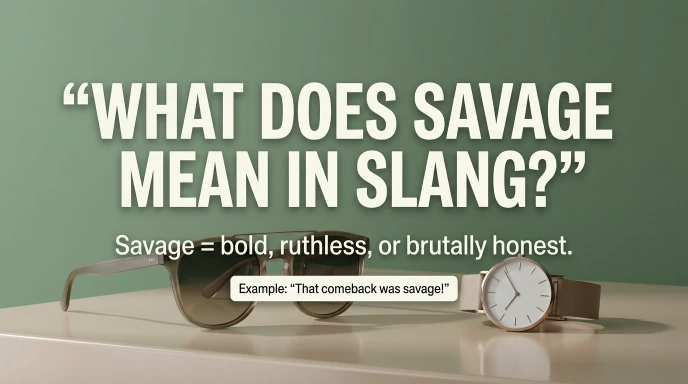
What does savage mean in slang usually refers to someone or something bold, fearless, ruthless, or extremely direct. It can be a compliment when someone gives a clever comeback or does something impressive.
However, it can also describe cruel or harsh behavior, so the meaning depends on the context.
If you searched what does savage mean in slang, you may have seen the word in a text, TikTok comment, Instagram caption, meme, or everyday conversation.
Online, people often use it to praise a strong comeback, a bold decision, or someone who does not hold back.
This guide explains the savage meaning in slang, how people use it, if it is positive or negative, and how it differs from similar slang words.
You will also see realistic examples that make the meaning easy to understand.
Quick Answer: What Does Savage Mean in Slang?
Savage usually means very bold, fearless, ruthless, or brutally direct. In online slang, people often use it as praise when someone gives a sharp comeback, does something daring, or handles a situation without hesitation.
For example:
“She shut down that rude comment with one sentence. That was savage.”
Here, savage means the response was bold, sharp, and effective.
However, the word is not always positive. If someone behaves cruelly or says something intentionally hurtful, calling the behavior savage can have a negative meaning.
What Does Savage Mean in Slang?
The slang word savage often describes behavior that is unusually bold, harsh, fearless, or direct.
Online, it is commonly used as a reaction to something that feels unexpectedly strong. Someone may give a clever comeback, win an argument, take a bold action, or refuse to back down. A person watching the situation might simply comment:
“Savage.”
In this use, the word is often close to bold, ruthless, brutally honest, or fearless.
For example:
“He told the truth even though everyone disagreed with him. Savage.”
The speaker may be praising his confidence and willingness to speak openly.
Still, savage does not always mean that someone is cruel. The same word can be used playfully between friends or positively after an impressive action.
That is why the situation matters more than the word by itself.
Is “Savage” Positive or Negative?
Savage can be either positive or negative. When it describes a clever comeback, bold action, or impressive performance, it is usually positive or humorous.
When it describes cruel, humiliating, or unnecessarily harsh behavior, it can be negative.
When Savage Is Positive
People often use savage as praise when someone does something bold or gives a strong response.
For example:
“She answered his rude comment perfectly. Savage.”
The speaker is probably impressed by her response.
Another example:
“He completed the challenge without any help. That was savage.”
Here, savage suggests confidence, strength, and determination.
When Savage Is Negative
The word can have a negative meaning when someone behaves in a cruel or insensitive way.
For example:
“Making fun of him after he made a mistake was savage.”
Here, the speaker is criticizing the behavior rather than praising it.
So, “savage” does not have one fixed emotional meaning. Tone, context, and the action being described all matter.
How to Use “Savage” in a Sentence
You can use savage as an informal reaction, adjective, or description of someone’s behavior.
As a Short Reaction
“Savage!”
This can be a quick response to a bold comeback or impressive action.
To Describe a Comeback
“That was a savage reply.”
This usually means the reply was sharp, direct, and possibly embarrassing for the other person.
To Describe an Action
“That was a savage move.”
This can mean the action was bold, ruthless, or unexpectedly strong.
To Describe a Person
“She can be savage when someone insults her.”
This suggests that she responds in a very sharp or fearless way.
The word is most natural in casual conversations, social media, texting, gaming, and other informal settings.
Where Is Savage Commonly Used?
Savage is widely understood in casual communication. You may see it in texts, social media comments, memes, gaming chats, and everyday conversations.
Savage in Texting
Friends may use the word after someone gives a strong response.
“You really said that to him? Savage.”
The speaker is reacting to how direct the comment was.
Savage on TikTok
TikTok users may write savage in comments about a clever comeback, funny response, or bold action.
“That comeback was savage.”
Here, the word usually expresses admiration or amusement.
Savage on Instagram
On Instagram, savage can appear in comments, captions, or posts about confidence and bold behavior.
“Savage reply.”
This means the reply was sharp and did not hold back.
Savage on Discord and Gaming
Gamers may use savage to describe a decisive move or a strong response to another player.
“That was a savage play.”
The speaker is usually praising how effective the move was.
Savage in Everyday Speech
The word is not limited to the internet. Friends may call something savage after hearing a particularly bold joke, comeback, or decision.
Real-Life Examples of Savage
The meaning becomes easier to understand when you see how people use it in different situations.
Example 1: A Clever Comeback
“She answered his rude comment with one sentence. Savage.”
Meaning: Her response was sharp, bold, and effective.
Example 2: A Bold Decision
“He left the job he hated and started his own business. Savage move.”
Meaning: The speaker sees the decision as bold and fearless.
Example 3: Gaming
“That was a savage finish.”
Meaning: The player ended the match in a very strong or decisive way.
Example 4: Friendly Humor
“You really told your friend his haircut looked terrible? Savage.”
Meaning: The speaker thinks the comment was extremely direct, possibly in a joking way.
Example 5: Negative Use
“Making fun of her mistake in front of everyone was savage.”
Meaning: The behavior was harsh or cruel.
The last example shows why context matters. The word can express admiration in one situation and criticism in another.
Why Do People Use Savage?
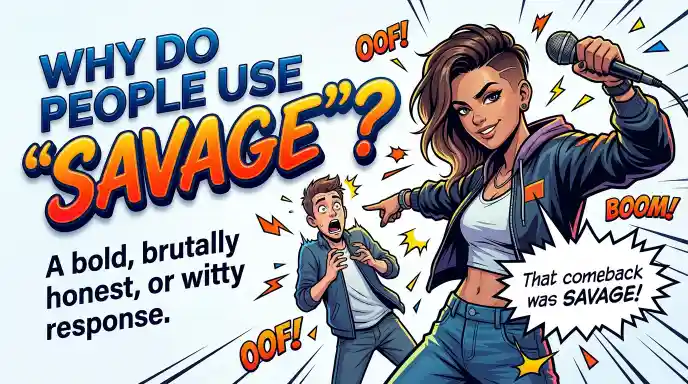
People use savage because it gives a strong reaction in one short word.
Instead of saying:
“That was an extremely bold and direct response.”
someone can simply say:
“Savage.”
The slang is shorter and often feels more emotional or humorous.
People may use it to show:
- Surprise
- Admiration
- Amusement
- Respect
- Shock
- Disapproval
For example, if a friend gives an unexpectedly clever comeback, saying “That was savage” shows that the response was much stronger than expected.
The word can also make a social media comment feel more expressive without requiring a long explanation.
Related Slang Words
Several slang and informal words overlap with savage, but they do not all have exactly the same meaning.
| Related word | Common meaning | How it differs from “savage” |
| Badass | Tough, confident, or impressive | Usually focuses on strength or confidence |
| Ruthless | Showing little or no mercy | More strongly connected to harshness |
| Fearless | Not easily scared | Focuses mainly on courage |
| Brutal | Very harsh or extremely direct | Can describe honesty, criticism, or cruelty |
| Bold | Confident and willing to take risks | More neutral than savage |
| Beast | Extremely skilled, powerful, or impressive | Often used for strong performance |
| Epic | Extremely impressive or memorable | Usually positive and less aggressive |
For example, fearless focuses on courage, while ruthless focuses more on having little mercy. Badass can be similar to savage when praising someone who is tough or impressive.
Therefore, these words are related, but they are not perfect synonyms. The best choice depends on exactly what you want to describe.
Is Savage Rude or Offensive?
Savage is not a swear word, and using it is not automatically rude. In casual slang, it is often a harmless way to praise a clever comeback, bold action, or strong performance.
However, the word can sound negative when it describes cruelty, humiliation, or intentionally hurtful behavior.
For example:
“That comeback was savage.”
This is usually casual praise.
But:
“He was savage toward the new student.”
This may suggest that he treated the student harshly.
The word is therefore context-sensitive. Before using it, consider what happened and if the person being described is likely to understand the intended tone.
When Should You Avoid Using “Savage”?
You should avoid using savage when you need formal, precise, or professional language. The word is common in casual speech, but it can sound too informal in serious situations.
It is better to avoid it in:
- Academic writing
- Job applications
- Professional emails
- Business reports
- Formal presentations
- Official complaints
- Workplace messages that require a neutral tone
For example:
“Her response was savage.”
In a professional setting, you could write:
“Her response was very direct.”
That version explains the idea more clearly without relying on slang.
You should also be careful when describing another person’s behavior as savage.
If the behavior involved humiliation or cruelty, the word may sound as if you are making fun of a serious situation.
Is “Savage” Still Used Today?
Yes, savage is still widely understood and used in casual conversations and online communication.
It is especially familiar in social media comments, memes, texting, gaming, and other informal spaces.
The word became strongly associated with online reactions to sharp comebacks, bold actions, and unexpected responses.
However, slang changes over time, and people do not all use every slang term in the same way.
In some conversations, calling everything “savage” may sound exaggerated or dated. Therefore, it is better to use the word when it naturally fits the situation rather than forcing it into every reaction.
The meaning can also depend on the community. A gaming group may use savage to praise a strong move, while another person may use it to criticize harsh behavior.
Savage in Slang vs. Its Literal Meaning
The slang meaning should not be confused with the older or literal uses of savage.
In ordinary English, the word has historically been used to describe something wild, violent, or uncivilized.
That usage can be sensitive because describing people or groups as “savages” has been used in insulting and dehumanizing ways.
In modern casual slang, however, savage is often used differently. Someone might say:
“That comeback was savage.”
They usually mean the comeback was very bold, sharp, or ruthless, not that the person is literally wild or uncivilized.
This distinction matters because the slang use and the older literal use do not carry the same meaning or tone.
Common Misunderstandings About Savage
Savage Does Not Always Mean “Cruel”
A common mistake is assuming that savage always means cruel.
For example:
“That comeback was savage.”
The speaker may simply mean the comeback was clever and bold.
The word becomes negative when the context shows that someone was intentionally cruel or unnecessarily harsh.
Savage Does Not Always Mean “Fearless”
Fearless means not easily frightened. Savage can suggest fearlessness, but it can also focus on being ruthless, sharp, or brutally direct.
For example:
“She was fearless during the competition.”
This focuses on courage.
But:
“Her response was savage.”
focuses more on the strength or sharpness of the response.
Savage Is Not Always a Compliment
The tone changes with the situation.
Calling a funny comeback savage can be praise. Calling someone’s treatment of another person savage may be criticism.
Always look at what happened, who is speaking, and why they are using the word.
How Is Savage Different From Similar Words?
The closest word depends on what the speaker means.
If savage means brave or confident, fearless or bold may be closer.
If it means harsh or merciless, ruthless may be more accurate.
If it means extremely direct, brutal may fit better.
If it means impressive and tough, badass or beast may work in casual conversation.
This is why replacing savage with one fixed synonym can sometimes change the meaning.
For example:
“That was a savage comeback.”
Could become:
“That was a brutal comeback.”
The second sentence sounds more focused on how harsh the comeback was.
Or:
“That was a fearless move.”
This focuses more on courage than harshness.
Can You Use “Savage” at Work or School?
You can use the word if the setting is very casual, but it is safer to avoid it in formal school or workplace writing.
A teacher, employer, or client may understand the slang, but slang is usually less precise than standard English.
Instead of:
“That was a savage response.”
You could write:
“That was a very direct response.”
Instead of:
“She made a savage move.”
You could write:
“She made a bold decision.”
These alternatives are clearer and more suitable for formal communication.
Frequently Asked Questions
Q1. What does savage mean in slang?
Answer: Savage usually means bold, fearless, ruthless, or extremely direct. In online slang, it often describes a clever comeback, daring action, or strong response.
Q2. Is savage a compliment?
Answer: It can be a compliment. People often use savage to praise someone who gives a clever comeback or does something bold. However, it can also describe cruel or harsh behavior.
Q3. What does savage mean on TikTok?
Answer: On TikTok, savage often describes a sharp comeback, bold action, funny insult, or unexpectedly strong response. It is usually used in a humorous or approving way.
Q4. Is savage a bad word?
Answer: Savage is not a swear word. However, it can sound negative when it describes cruelty, humiliation, or unnecessarily harsh behavior.
Q5. Can I use savage at work?
Answer: Savage is informal slang, so it is better to use clearer words in professional communication. Depending on the context, bold, direct, decisive, or strong may be better choices.
Q6. What are some slang words similar to savage?
Answer: Related informal words include badass, ruthless, fearless, brutal, bold, and beast. They overlap with savage but emphasize different qualities.
Conclusion
What does savage mean in slang? It usually describes something bold, fearless, ruthless, or extremely direct.
In online conversations, it is often a positive reaction to a clever comeback, daring action, or impressive performance.
However, savage can also describe genuinely harsh behavior. That is why the surrounding context is important.
“That comeback was savage” usually sounds like praise, while “That was savage of him” can suggest criticism if the action was cruel.
The word is common in casual texting, social media, gaming, and everyday conversations. For school assignments, professional emails, and other formal situations, clearer words such as bold, direct, fearless, or decisive are usually better.
The simplest rule is: use savage when the context clearly supports its intended tone, and choose a more precise word when the situation is formal or sensitive.
Explore More Articles:
- Epic Meaning Slang: What People Mean When They Say “Epic”
- Roach Slang: Cannabis & Common Meanings
- Wig Slang Meaning: From Hair to Internet Reactions

Hi, I’m Anna Whitmore. I have 7+ years of experience writing about English slang and vocabulary. At SlangShine, I create simple, easy-to-understand content for English learners.