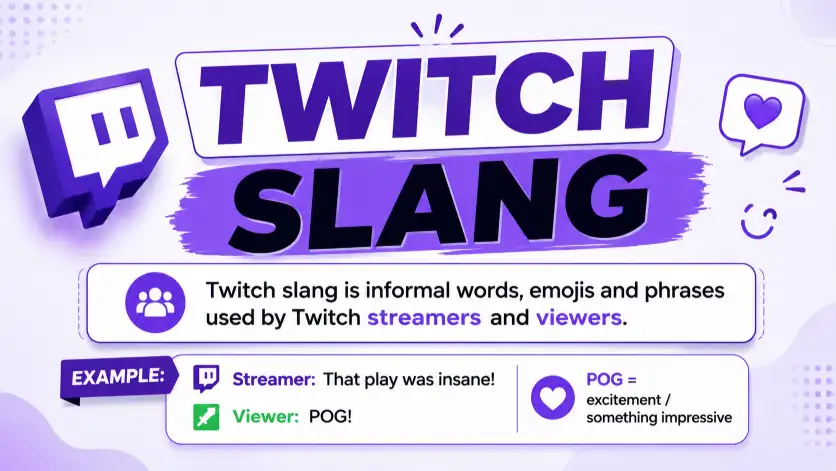
Twitch slang is the informal language used by streamers and viewers in Twitch chats and communities. It includes short expressions, abbreviations, emote names, and community phrases that can be confusing if you are new to Twitch.
If you have seen words such as Kappa, Pog, SAJ, Andy, or TOS in a stream, you may have wondered what they mean. Twitch chat moves quickly, so viewers often use short expressions instead of full sentences.
This guide explains Twitch slang in simple English. You will learn what common expressions mean, how they are used, and why some terms can have different meanings depending on the community. You will also learn the difference between actual slang and broader Twitch terms.
Quick Answer: Twitch Slang
Twitch slang is the informal language used by streamers and viewers to communicate reactions, jokes, emotions, and community references during livestreams. It includes chat expressions, abbreviations, emote-related language, and phrases that may have different meanings depending on the context.
Some expressions are common across Twitch, while others are mainly used by a particular streamer or community.
What Is Twitch Slang?
Twitch slang refers to informal words and expressions that people use while watching or creating livestreams.
A busy chat can move very quickly. Viewers may want to react to a funny moment, an impressive play, or an unexpected mistake without writing a full sentence. A short expression can communicate that reaction almost instantly.
Twitch slang has also been influenced by gaming culture, internet memes, emotes, livestream communities, and recurring jokes. Because of these different influences, a new viewer may understand the individual words in a message but still not understand what the message means.
For example, someone might type Pog after an impressive play. Another viewer might use KEKW after a funny mistake. Both expressions work as quick reactions to what is happening on stream.
Twitch Slang vs. Twitch Terms
Twitch slang and Twitch terms are related, but they are not exactly the same.
Slang is usually informal community language. Twitch terms can be broader and may describe platform features, streaming activities, or rules.
| Type | Meaning | Example |
| Chat slang | Informal language used by viewers | Andy |
| Emote language | Expressions used to show reactions | Kappa |
| Platform terms | Words connected to Twitch features | VOD |
| Rule-related terms | Words connected to platform rules | TOS |
| Streaming terms | Words connected to livestream activities | Raid |
This distinction is useful because not every word found in a Twitch slang list is technically slang. Some are simply common words that Twitch viewers need to understand.
Popular Twitch Slang Words
There is no single official dictionary that defines every expression used in Twitch communities. Some terms are widely recognized, while others are specific to certain streamers or groups.
Here are several expressions that can help new viewers understand Twitch chat.
Andy
Andy is commonly added to another word or description to jokingly label someone based on a particular activity, behavior, or type of content.
You may see phrases such as React Andy or GTA Andy. The word before “Andy” usually provides the main context and explains what the person is being associated with.
The wider “X Andy” pattern developed from Twitch and livestream community culture, including its association with Ice Poseidon’s streams. It later became a broader way to describe people by the activity or behavior they were known for.
For example:
“He is such a React Andy.”
Here, “React” tells you what type of behavior the speaker is referring to. The meaning is therefore easier to understand when you read the complete phrase.
SAJ
SAJ is used as a reaction to sadness or disappointment in Twitch-style chat. It is associated with Sadge, an internet expression used for an unhappy or disappointing situation.
For example:
“We lost at the last second. SAJ.”
The tone is usually light or playful. It normally describes disappointment about what happened rather than making a serious statement about someone’s emotions.
Kappa
Kappa is a well-known Twitch emote and expression associated with sarcasm, irony, or playful trolling.
For example:
“That was definitely your best play. Kappa.”
The word signals that the statement should not be taken completely seriously.
Because Twitch chat is text-based, expressions such as Kappa can help communicate a tone that might otherwise be missing.
Pog and PogChamp
Pog and PogChamp have been used in Twitch culture to express excitement, surprise, or approval after an impressive or unexpected moment.
For example:
“That clutch was Pog!”
The popularity of individual expressions changes over time. A phrase that was extremely common several years ago may not be used as often today.
Therefore, a useful Twitch slang list should explain context instead of suggesting that every older term remains equally popular.
KEKW
KEKW is commonly used to express strong laughter when something funny or unexpected happens during a stream.
For example:
“He made the same mistake again. KEKW.”
The expression became part of Twitch emote culture through an internet meme based on the laughing reaction of Spanish comedian Juan Joya Borja.
Its meaning is generally easy to understand from the situation. If viewers use KEKW after an unexpected mistake or funny moment, they are usually showing that they find the situation amusing.
PJSalt
PJSalt is associated with frustration, irritation, or being upset about an unfavorable outcome, especially during gaming.
For example:
“He lost the same round three times. PJSalt.”
It can be used playfully when viewers tease a streamer about being frustrated. The exact tone depends on the conversation and the community.
How Does Twitch Chat Slang Work?
Twitch chat slang works because viewers share familiar references and use short expressions to react quickly.
Imagine that a streamer makes an unexpected mistake during a difficult game. One viewer might write “No way!” Another might post KEKW, while someone else uses an emote.
The messages look different, but each one communicates a reaction to the same moment.
Why Is Twitch Chat So Fast?
A busy Twitch chat can move rapidly, especially during popular livestreams. Viewers often do not have time to write long messages.
That encourages the use of:
- Short expressions
- Abbreviations
- Emote names
- Inside jokes
- Gaming references
- Repeated community phrases
As a result, Twitch chat slang can look like a different language to someone who has never watched a livestream.
The good news is that you do not need to memorize every term. Watching how people use a word is often enough to understand its meaning.
Key Takeaway
Twitch slang is not one fixed set of words. It is a changing mix of reactions, emote-related expressions, gaming language, memes, and community jokes.
The same expression can also feel different depending on the streamer and the situation. For that reason, context is one of the most important parts of understanding Twitch chat.
What Does TOS Mean in Twitch Slang?
TOS means “Terms of Service” on Twitch. It refers to the rules and conditions that apply to using Twitch’s services.
You may see someone write:
“That could be against TOS.”
The person is usually suggesting that something may violate Twitch’s rules or policies.
TOS is more accurately described as a platform or policy term than slang. However, viewers commonly encounter it alongside slang and other Twitch vocabulary in chat.
Why Do People Say “Against TOS”?
The phrase can be serious or humorous depending on the situation.
For example:
“Maybe don’t show that private information on stream. That’s against TOS.”
Here, the viewer may be giving a genuine warning.
In another conversation, viewers may use “against TOS” as a joke when a streamer does something unusual or unexpected.
So, if you are searching for what does TOS mean on Twitch, the direct answer is “Terms of Service.” The surrounding conversation tells you if the person is being serious or joking.
Twitch Slang on Different Platforms
Slang that starts on Twitch can spread to other platforms, but its meaning and popularity may change depending on where it is used.
Twitch
On the platform itself, this type of language is most commonly used in live chats and gaming communities.Chat expressions often relate to streamers, games, emotes, jokes, and events happening in real time.
Twitch expressions can appear in Reddit discussions about streamers, livestreams, gaming, and online communities. This is why people may search for Twitch slang Reddit.
However, Reddit has its own slang as well. A word appearing on Reddit does not automatically make it Twitch slang.
Discord
Discord communities often continue the language used by a streamer and their Twitch audience. A community may carry its jokes, nicknames, and favorite expressions into its Discord server.
TikTok and Other Social Platforms
Twitch expressions can spread through livestream clips and short videos. Once a phrase becomes popular outside Twitch, people may use it even if they are not regular Twitch viewers.
This movement between platforms helps explain why internet slang can change quickly.
Old Twitch Slang vs. Current Twitch Slang
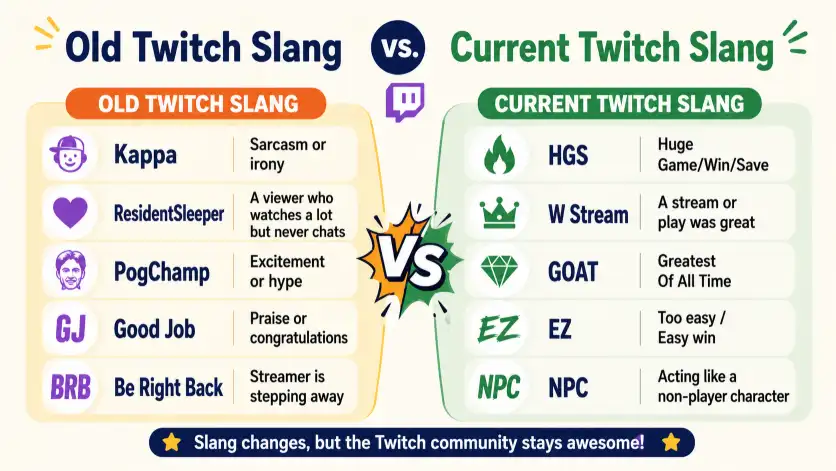
Old Twitch slang can remain familiar even after its popularity changes. Some expressions become part of Twitch history, while others slowly disappear as new memes, emotes, and community phrases become popular.
This matters when looking at old Twitch slang. A term that was common several years ago may still be recognizable today without being something viewers use regularly.
Twitch culture has also expanded beyond traditional gaming. Different types of streamers, games, communities, and social platforms have influenced the language used around livestreaming.
Why Does Twitch Slang Change?
Twitch slang changes because viewers and streamers constantly create new jokes, references, and expressions. A phrase may become popular after a memorable stream moment, viral clip, or widely used emote.
A term can spread when:
- A popular streamer uses it repeatedly.
- Viewers turn a funny moment into a running joke.
- An emote becomes widely recognized.
- A gaming community adopts the expression.
- Clips spread the phrase to other platforms.
- New viewers copy language used by regular viewers.
Because of this, Twitch slang in 2026 should not be treated as a permanent list. Some expressions remain common, while others become less popular over time.
The same applies to searches for Twitch slang 2025. A list from one year may not accurately represent every expression people use the following year.
How to Understand Twitch Slang as a New Viewer
The easiest way to learn Twitch slang is to study the context instead of trying to memorize a huge list.
First, look at what happened immediately before someone used an expression. If viewers post the same term after a funny moment, it may be a humorous reaction. If they use it after a failed play, it may show disappointment, teasing, or frustration.
You should also consider who is using the expression. A streamer may use a phrase differently from a viewer, while a specific community may give a familiar word its own meaning.
Look at the Whole Message
Short Twitch messages can be confusing when they are viewed alone.
For example:
“That was clean. Kappa.”
The word Kappa changes the tone. The viewer is likely being sarcastic rather than giving straightforward praise.
Likewise, Andy may not make sense until you see the activity or description connected to it.
This is why context is often more useful than assuming every slang word has one fixed definition.
Learn Community-Specific Expressions Slowly
Some Twitch communities develop their own phrases, nicknames, and inside jokes.
Regular viewers may understand these references immediately because they have seen them many times. A new viewer may need some time to catch up.
That is completely normal.
Start with terms you see regularly, then learn community-specific expressions as you encounter them. You do not need to understand every message on your first visit.
Twitch Slang List: Useful Terms to Know
A useful Twitch slang list should explain both the basic meaning of a term and the situation in which people use it.
| Term | Basic meaning | Typical context |
| Andy | A label used in phrases describing a person or behavior | Community jokes |
| SAJ | Sadness or disappointment | Chat reactions |
| Kappa | Sarcasm or irony | Jokes and teasing |
| Pog | Excitement or approval | Impressive moments |
| KEKW | Laughter | Funny moments |
| PJSalt | Frustration or irritation | Gaming reactions |
| TOS | Terms of Service | Rules and policies |
| VOD | Video on demand | Watching previous streams |
| Raid | Sending viewers to another live channel | Streamer activity |
Not every term in this table is technically slang. TOS, VOD, and raid are better described as Twitch or streaming terms. They are included because beginners often encounter them alongside slang while watching a stream.
This distinction keeps the information accurate instead of labeling every piece of Twitch vocabulary as slang.
Twitch Streamer Slang vs. Twitch Chat Slang
Twitch streamer slang and Twitch chat slang often overlap, but they are not always used in the same way.
Streamers use language while speaking to their audience, while viewers often use short reactions in the chat.
For example, a streamer might say:
“We’re going to raid another channel after this.”
A viewer might respond:
“Pog!”
The streamer is using a streaming term, while the viewer is using a short reaction.
This difference explains why some Twitch streamer slang sounds different from the expressions that appear repeatedly in fast-moving chat.
Why Do Streamers Create Their Own Terms?
A streamer may develop a phrase or nickname that becomes familiar to regular viewers.
It might come from:
- A memorable stream
- A recurring joke
- A game
- A viewer interaction
- A funny mistake
- A community nickname
Once viewers repeat the phrase, it can become part of that channel’s culture.
However, a community-specific expression should not automatically be treated as universal Twitch slang. Its meaning may only be clear to people who follow that streamer.
Is Twitch Slang Rude or Offensive?
Most Twitch slang is informal rather than automatically offensive, but the tone depends on the expression and how it is used.
A harmless reaction such as Pog is very different from language that attacks another person or group.
Before using an unfamiliar term, consider:
- What does it actually mean?
- Is it directed at another person?
- Is it sarcastic or insulting?
- Does it contain sexual language?
- Could it offend someone?
- Does the streamer or community allow that type of language?
Twitch has rules covering areas such as harassment, hateful conduct, and sexual content. Therefore, seeing an expression in a Twitch chat does not automatically mean that it is appropriate in every situation.
Can You Use Twitch Slang at Work?
Twitch slang is usually better suited to casual conversations than professional communication.
For example, saying “Pog!” to a friend after exciting news may feel natural. Using the same expression in a formal email could confuse the reader or make the message sound too casual.
In professional settings, standard language is usually clearer.
When Should You Avoid Using Twitch Slang?
Avoid Twitch slang when your audience may not understand it or when the situation requires formal language.
Be especially careful in:
- Workplace emails
- Job applications
- Formal reports
- School assignments
- Academic writing
- Customer service
- Professional presentations
- Messages to people unfamiliar with Twitch
You should also avoid repeating an expression simply because it appears frequently in chat. Some terms are sarcastic, teasing, or specific to one community.
If you are unsure about the meaning or tone, check the surrounding conversation before using it.
A simple explanation is often better than an unfamiliar slang term when clarity matters.
Why Do People Use Twitch Slang?
People use Twitch slang because it makes fast online communication easier and helps viewers feel connected to a community.
A short expression can communicate a reaction almost instantly. This is especially useful when many messages are moving through chat at the same time.
Twitch slang can also create a sense of belonging. Regular viewers recognize the same expressions, jokes, and references, which can make a community feel more familiar.
For example, a streamer may have a recurring joke from an earlier broadcast. Regular viewers might use the same phrase whenever a similar situation happens again.
The expression then becomes part of the community’s shared history rather than simply another slang word.
Common Misunderstandings About Twitch Slang
Is Every Twitch Term Slang?
No. Twitch has slang, emotes, abbreviations, platform terms, moderation language, and general streaming vocabulary. These categories can overlap, but they are not identical.
Is Twitch Slang Only Used by Gamers?
No. Twitch has communities focused on gaming, chatting, music, creative content, and many other forms of livestreaming. The language can vary between communities.
Does Everyone on Twitch Know the Same Slang?
No. Some expressions are widely recognized, while others are strongly connected to individual streamers or specific communities.
Is Old Twitch Slang Still Used?
Some older expressions are still recognizable, while others have become less common. Slang changes as new memes, creators, and community phrases become popular.
Does Twitch Have an Official Slang Dictionary?
No. Twitch provides official rules and platform documentation, but it does not maintain an official dictionary defining every community expression. Many slang meanings develop through repeated use by streamers and viewers.
Frequently Asked Questions
Q1. What does Twitch slang mean?
Answer: Twitch slang is the informal language used by streamers and viewers to communicate reactions, jokes, emotions, and community references during livestreams.
Q2. What are some common Twitch slang words?
Answer: Common examples include Pog, Kappa, KEKW, PJSalt, SAJ, and Andy. Their exact meaning can depend on the situation and community.
Q3. What does TOS mean in Twitch slang?
Answer: TOS means Terms of Service. On Twitch, people commonly use it when discussing if something follows the platform’s rules.
Q4. What does Andy mean on Twitch?
Answer: Andy is often added to another word or description to jokingly characterize a person associated with a particular activity or behavior. The exact meaning depends on the phrase.
Q5. What does SAJ mean on Twitch?
Answer: SAJ is used to express sadness or disappointment and is associated with Sadge. It is generally used as a quick reaction in chat.
Q6. Is Twitch slang appropriate for work?
Answer: Usually, no. Twitch slang is mainly informal, so standard language is clearer and more professional for workplace communication.
Conclusion
Twitch slang is the informal language that helps streamers and viewers communicate quickly during livestreams. It includes reactions, community expressions, abbreviations, and emote-related language, while broader Twitch terms can describe features, rules, and streaming activities.
The most important thing to remember is context. Words such as Kappa, Pog, KEKW, SAJ, and Andy can communicate a reaction or community reference, but their meaning may depend on how and where they are used.
Twitch language also changes over time. Some older expressions remain familiar, while others become less common as new memes and community phrases appear.
If you are new to Twitch, you do not need to memorize every term. Start with the expressions you see regularly, look at the surrounding conversation, and learn community-specific phrases as you encounter them. This approach will make fast-moving Twitch chats much easier to understand.
Explore More Slang Terms:
- Peg Slang: What Does It Mean and How Is It Used?
- What Does BMF Mean in Slang? A Clear Meaning Guide
- What Does Granola Mean Slang? Real Meaning and Online Usage

Hi, I’m Emma Carter, an English language writer with over 8 years of experience in vocabulary and language learning. At SlangShine, I write simple, accurate, and easy-to-understand articles about slang, synonyms, idioms, and everyday English to help learners build confidence and improve their communication skills.