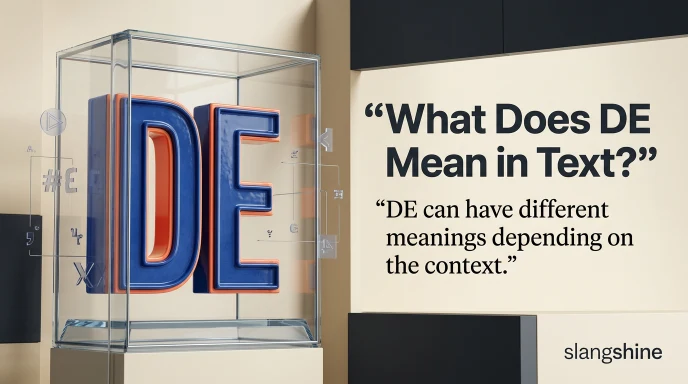
What does DE mean in text? DE can mean different things depending on the conversation. In casual messages, it may be a shortened form of a word or phrase, so the surrounding message usually reveals the intended meaning.
Unlike common texting abbreviations such as LOL, IDK, or BRB, DE does not have one universally accepted meaning in every chat.
It can appear as an abbreviation, informal spelling, or short form in different online communities.
This guide explains the possible meanings of DE, how people use it in texts and social media, and how to understand its intended meaning from context.
What Does DE Mean in Text?
DE can have several meanings in text messages, depending on how and where it is used.
In some casual conversations, people may type de as an informal spelling of “the,” especially when imitating a particular style of speech or writing.
It can also appear as part of a name, abbreviation, or phrase rather than functioning as texting slang.
For example:
“I’m going to de store.”
Here, “de” may simply represent an informal pronunciation or spelling of “the.”
Another message might use DE as an abbreviation with an entirely different meaning. That is why the complete sentence matters.
Common Meanings of DE in Texting
The meaning of DE is not always obvious from the letters alone. Several possibilities can appear in casual digital communication.
DE as an Informal Form of “The”
One possible use is de as an informal or phonetic spelling of “the.”
This style can appear when someone wants to reproduce the way a word sounds in a particular accent or speech pattern.
For example:
“Meet me by de door.”
The writer is most likely using “de” in place of “the.”
This is more of a stylized spelling than a standard texting abbreviation.
DE as Part of a Phrase
Sometimes DE is not intended to stand alone at all. It may simply be part of a longer expression, username, nickname, or phrase.
In these cases, trying to expand the two letters into a texting abbreviation can create confusion.
DE as an Abbreviation
In some conversations, DE may represent a longer term or name that is familiar to a particular group.
For instance, a school, workplace, gaming community, or online group might use DE as internal shorthand.
The meaning may be obvious to members of that group but unfamiliar to everyone else.
Why Does DE Have Different Meanings?
Short forms often become popular because they save time. However, not every abbreviation develops one standard definition.
Two people may use the same letters differently because they belong to different communities or have different texting habits.
The meaning can depend on:
- The words around DE
- The subject of the conversation
- The platform being used
- The sender’s writing style
- The relationship between the people chatting
- If the conversation is casual or formal
- If the letters are lowercase or uppercase
For example, de in lowercase may look like an informal spelling, while DE in uppercase may suggest an abbreviation.
Capitalization alone does not always settle the question, but it can provide a useful clue.
How to Understand DE From Context
When you see DE in a message, start with the complete sentence rather than the abbreviation itself.
Read the Full Message
Look at the words before and after DE.
For example:
“I left it by de window.”
The sentence strongly suggests that “de” is being used as an informal version of “the.”
A completely different sentence could point toward an abbreviation.
Consider the Topic
The subject of the chat can narrow down the possibilities.
A message about school may use DE differently from a gaming conversation. A social media comment can also have a different interpretation from a formal email.
Notice the Writing Style
Some people deliberately spell words the way they sound.
If the sender frequently writes words such as “da,” “dis,” or “dem,” then “de” may be part of the same informal writing style.
Check Earlier Messages
Previous messages can reveal if the sender has already explained or used the term.
This is especially useful when DE appears as group specific shorthand.
DE as an Informal Spelling of “The”
One of the easiest uses to recognize is de as a casual or phonetic spelling of “the.”
People may use this style to imitate speech, humorously exaggerate an accent, or create a relaxed tone.
Examples include:
“I’m heading to de mall.”
“Where’s de party?”
“Put it on de table.”
In standard English, these sentences would use “the.”
The spelling “de” changes the style rather than necessarily changing the underlying meaning.
Is “De” Correct English?
In standard written English, “de” is not the normal spelling of “the.”
It can appear intentionally in informal writing, dialogue, slang, or stylized online communication.
For formal writing, use “the” instead.
DE in Social Media Conversations
Short and informal language is common on social platforms, so you may encounter DE in comments, messages, captions, or group discussions.
However, social media does not give the abbreviation one universal definition.
DE on Snapchat
Snapchat conversations are usually casual, and users often shorten words or write them phonetically.
If someone uses “de” repeatedly in a Snapchat chat, it may simply reflect their personal texting style.
For example:
“I’m at de house now.”
The writer may be using “de” as a casual spelling of “the.”
DE on Instagram
Instagram users may use informal spellings in comments and direct messages.
A comment such as:
“Look at de outfit!”
could use “de” for stylistic effect.
The same letters in an uppercase abbreviation may have a completely different meaning.
DE on TikTok
TikTok comments often use playful spellings and speech based writing.
Someone may write “de” to mimic the way a phrase sounds or to create a humorous tone.
Because TikTok communities also develop their own language, context remains important.
DE on Discord
Discord contains many specialized communities. Gaming servers, fandoms, study groups, and private communities may create abbreviations that are not widely understood elsewhere.
If DE appears repeatedly in one server, check how other members use it before deciding what it means.
10 Examples of DE in Text
These examples show some ways the letters can appear in casual digital communication. The exact interpretation can still depend on context.
Example 1
Alex: I’m going to de store.
Sam: Okay, see you later.
Here, “de” is likely an informal spelling of “the.”
Example 2
Mia: Look at de sky!
Lena: It looks amazing.
The spelling creates a casual or speech like tone.
Example 3
Chris: Put it by de door.
Ryan: Got it.
Again, the context suggests that “de” represents “the.”
Example 4
Ava: Everyone is talking about DE.
Nora: What does it stand for?
Here, DE appears to be an abbreviation rather than a replacement for “the.”
Example 5
Jay: Why did you write “de” instead of “the”?
Leo: Just typing it the way it sounds.
This exchange directly explains the spelling.
Example 6
Sara: Meet me at de café.
Ella: I’ll be there soon.
The casual spelling gives the message an informal feel.
Example 7
Tom: De new update is finally here.
Ben: About time!
The writer is likely using “de” in place of “the.”
Example 8
Max: Do you know what DE means in this server?
Nick: I think it’s an abbreviation we use here.
This shows a community specific use.
Example 9
Lily: I saw “DE” in the comments.
Emma: It probably means something specific to that group.
Without more context, the exact meaning remains uncertain.
Example 10
Noah: I’m going to de park after school.
Eli: Want me to come?
The lowercase spelling fits an informal version of “the.”
How to Reply When Someone Uses DE
Your response depends on if the meaning is clear.
If the sender appears to be using “de” instead of “the,” you can simply respond normally.
For example:
“Sure, I’ll meet you there.”
There is usually no need to comment on the spelling.
If DE appears to be an unfamiliar abbreviation, ask for clarification.
You can write:
“What does DE mean here?”
Or:
“What does DE stand for?”
A more casual option is:
“DE?”
This works well when you are chatting with a friend.
When You Think You Know the Meaning
If you have a good idea but are not completely sure, confirmation can prevent confusion.
For example:
“Do you mean ‘the’?”
Or, when DE appears to be an abbreviation:
“You mean [the full phrase], right?”
This is especially useful when the conversation could support more than one interpretation.
Is DE Rude or Offensive?
DE is not automatically rude or offensive.
When someone writes “de” instead of “the,” it may simply be a casual spelling choice, a speech imitation, or part of a humorous style.
The tone depends on the surrounding message.
For example:
“Meet me at de café 😂”
May feel playful and informal.
A different use of DE as an abbreviation could have another tone entirely.
If the term appears during an argument, sarcasm, or an insulting message, judge the complete message rather than the two letters alone.
Who Uses DE in Text Messages?
There is no single group that owns the use of DE.
You may encounter it among:
- Friends
- Social media users
- Online communities
- Gamers
- Group chats
- Fandom communities
- People who use phonetic spelling
- Users who enjoy playful internet language
The spelling may also appear when someone is deliberately reproducing spoken language.
Because online writing is flexible, people often change spellings to match their personality or the tone of a conversation.
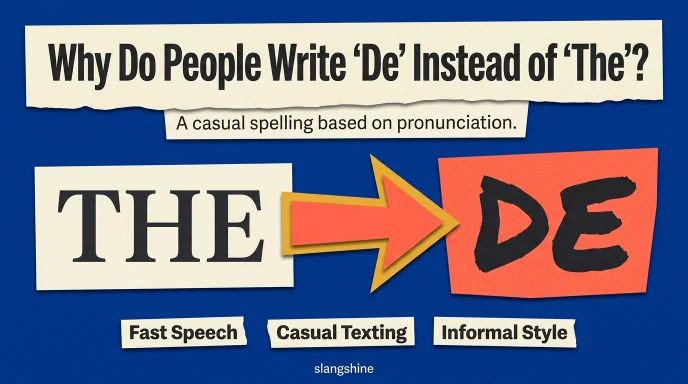
Why Do People Write “De” Instead of “The”?
Several reasons can explain this choice.
To Sound More Casual
Informal spelling can make a message feel relaxed rather than formal.
To Imitate Speech
Some writers use “de” to represent the way “the” sounds in a particular style of speech.
To Be Playful
Internet users often modify ordinary words for humor or personality.
To Match a Community Style
A particular online group may regularly use alternative spellings.
To Type Quickly
Although the difference is only one character, informal spellings can become habitual in fast paced chats.
DE vs. “The”
The two forms can communicate the same basic word while creating a different writing style.
| Form | Typical use | Tone |
| The | Standard English | Neutral |
| De | Informal or phonetic spelling | Casual or stylized |
| DE | Possible abbreviation | Context dependent |
This distinction is useful because capitalization can change how a reader interprets the letters.
For example:
“I’m going to de store.”
looks like informal spelling.
Meanwhile:
“What does DE stand for?”
makes it look more like an abbreviation.
Still, capitalization is only one clue. The surrounding words remain more important.
Is DE a Standard Texting Abbreviation?
Not in the same way as widely recognized abbreviations such as LOL, BRB, or IDK.
When “de” appears as a spelling of “the,” it is better described as an informal or phonetic spelling rather than a standard acronym.
If DE is being used as an abbreviation for a specific phrase, its meaning depends on that particular context.
This distinction helps prevent a common mistake: assuming every short form is automatically internet slang.
Can DE Have a Formal Meaning?
Yes.
DE can appear in formal, professional, educational, geographic, or technical contexts as an abbreviation or code.
The meaning in those situations may have nothing to do with texting slang.
For example, DE is used as the abbreviation for the U.S. state of Delaware in many contexts.
It can also represent other terms depending on the field.
Therefore, seeing “DE” in an email, document, address, or professional conversation should not automatically lead you to a slang definition.
DE in Casual vs. Formal Writing
The way you should interpret or use DE depends on the setting.
Casual Texting
Informal spelling and abbreviations are common. A friend may write “de” simply because it matches their usual texting style.
Social Media
Playful spellings are also common in comments, captions, and direct messages.
Professional Communication
Clear standard English is usually preferable. If “de” is being used to replace “the,” it may look like a spelling mistake in a formal message.
Academic Writing
Standard spelling should be used unless the term appears inside a direct quotation or has a specific technical purpose.
Common Mistakes: What does DE mean in text
A few mistakes can make a simple abbreviation harder to understand.
Assuming DE Always Means “The”
Although “de” can be an informal spelling of “the,” that is not the only possible use.
If DE is capitalized and appears in a specialized conversation, another interpretation may be more appropriate.
Treating DE as One Universal Acronym
There is no single definition that works for every online conversation.
The topic and surrounding words should guide your interpretation.
Ignoring Capitalization
Capitalization can provide a useful clue.
Lowercase “de” may suggest informal spelling, while “DE” may look more like an abbreviation. It is not a perfect rule, but it can help.
Looking at the Letters Without Context
Two letters alone often do not provide enough information.
Reading the entire sentence usually gives you a much better idea of what the sender intended.
Assuming Informal Spelling Is a Typo
Sometimes “de” is intentional.
The writer may be using it to imitate speech, create humor, or match a particular online style.
What Does DE Mean From a Friend?
If a friend writes de in a casual sentence, check if they are using it in place of “the.”
For example:
“I’ll meet you at de station.”
The intended word is probably “the.”
If your friend writes DE as a standalone abbreviation, the meaning may be something else.
In that situation, your previous conversation is the best clue.
What Does DE Mean on Social Media?
On social media, DE can have different interpretations.
Lowercase “de” may be used as a casual spelling of “the,” especially when someone is writing in a speech like or playful way.
Uppercase DE may function as an abbreviation, depending on the community or subject.
Because social media contains many different styles of communication, context is essential.
How to Know Which Meaning of DE Is Intended
Use these simple clues when you come across DE:
- Look at capitalization.
- Read the complete sentence.
- Check the surrounding messages.
- Identify the conversation topic.
- Consider the platform.
- Notice the sender’s usual writing style.
- Look for similar uses elsewhere in the conversation.
- Ask the sender when the meaning remains unclear.
This method works well for DE because the abbreviation does not have one fixed meaning in every situation.
Should You Use “De” in Your Own Messages?
You can use it in casual conversations if the people you are chatting with understand the style.
For example, a playful message between friends might say:
“Meet me at de usual spot.”
That can sound intentionally informal.
However, standard spelling is a better choice in professional or academic communication.
Instead of:
“I sent it to de manager.”
write:
“I sent it to the manager.”
Clear standard English avoids unnecessary confusion.
Frequently Asked Questions About What does DE mean in text
Q1. What does DE mean in text?
Answer: DE can have different meanings in text. In casual writing, lowercase “de” may be an informal spelling of “the,” while uppercase DE can work as a context specific abbreviation.
Q2. Does DE mean “the” in texting?
Answer: It can. Some people use “de” as a casual or phonetic spelling of “the,” especially when trying to imitate speech or create a playful tone.
Q3. Is DE a slang word?
Answer: “De” can appear as informal internet language, but it is not always slang. Sometimes it is simply a stylized spelling or part of an abbreviation.
Q4. Is DE rude?
Answer: DE is not inherently rude or offensive. Its tone depends on the sentence, the intended meaning, and the way the sender uses it.
Q5. What does DE mean on Snapchat?
Answer: On Snapchat, “de” may be an informal spelling of “the,” while DE can also have a different meaning within a particular conversation or group.
Q6. What does DE mean on TikTok?
Answer: TikTok users may write “de” as a playful or speech like spelling of “the.” An uppercase DE can have a separate community specific meaning.
Q7. Is “de” correct English?
Answer: “De” is not the standard spelling of “the” in English. It may be intentionally used in informal writing, dialogue, slang, or phonetic text.
Q8. Can DE have a formal meaning?
Answer: Yes. DE can be used as an abbreviation or code in formal contexts. For example, DE is commonly used for Delaware, so the subject of the conversation matters.
Key Takeaways: What does DE mean in text
- DE can have different meanings depending on context.
- Lowercase “de” may be an informal spelling of “the.”
- The spelling can be used to imitate speech or create a playful tone.
- Uppercase DE may function as a separate abbreviation.
- DE is not automatically rude or offensive.
- Social media communities may use DE in their own way.
- Formal contexts can give DE completely different meanings.
- Capitalization, surrounding words, and conversation topic can help identify the intended meaning.
- When you are unsure, asking the sender is the easiest solution.
Conclusion
The answer to what does de mean in text depends on how the letters are being used. In casual writing, de can be an informal or phonetic spelling of “the,” while DE may represent an abbreviation with a different meaning.
Context is the most reliable way to understand the term. Check the complete sentence, notice the capitalization, and consider the conversation before choosing a definition.
If the message still seems unclear, simply ask the sender what they mean. A quick clarification is better than assuming the wrong meaning.
Learn More About Slang:
- What Does DDM Mean in Text? Here’s What It Really Means
- What Does DDS Mean in Text? Meaning, Examples & Usage
- What Does DDY Mean in Text? What It Really Means in 2026

Hi, I’m Anna Whitmore. I have 7+ years of experience writing about English slang and vocabulary. At SlangShine, I create simple, easy-to-understand content for English learners.